Honda and Mitsubishi put it on sale in 1996, a decade before the phrase existed. A differential that thinks can turn a car, and it differs from a limited-slip diff in what it senses and decides.
Torque vectoring is a differential technology that uses an electronic system to vary the torque sent to each half-shaft, so a car can push harder on one wheel to help it turn or grip. Honda and Mitsubishi sold the first sporty examples in 1996.
The first road cars with torque vectoring went on sale in 1996, a decade before anyone used that name for the technology. Ricardo PLC is credited with first using the phrase, in 2006, to describe its driveline technologies.
What is torque vectoring?
Torque vectoring is technology in a car's differentials that can vary the torque going to each half-shaft, using an electronic system. In rail vehicles the same effect comes from individually motored wheels. It has become popular in all-wheel-drive cars, and some newer front-wheel-drive cars have a basic version.
The aim is simple to state and hard to do: send power to the wheels that can use it, in the amounts the moment demands. Torque vectoring builds on a standard differential, performing the basic differential job while also moving torque independently between wheels. The result is better grip for launching and better handling, in almost any driving situation. As the industry improves the technology, more vehicles are being fitted with it.
An open differential gives both wheels the same torque. Torque vectoring decides, wheel by wheel, who gets more.
What does an ordinary differential do?
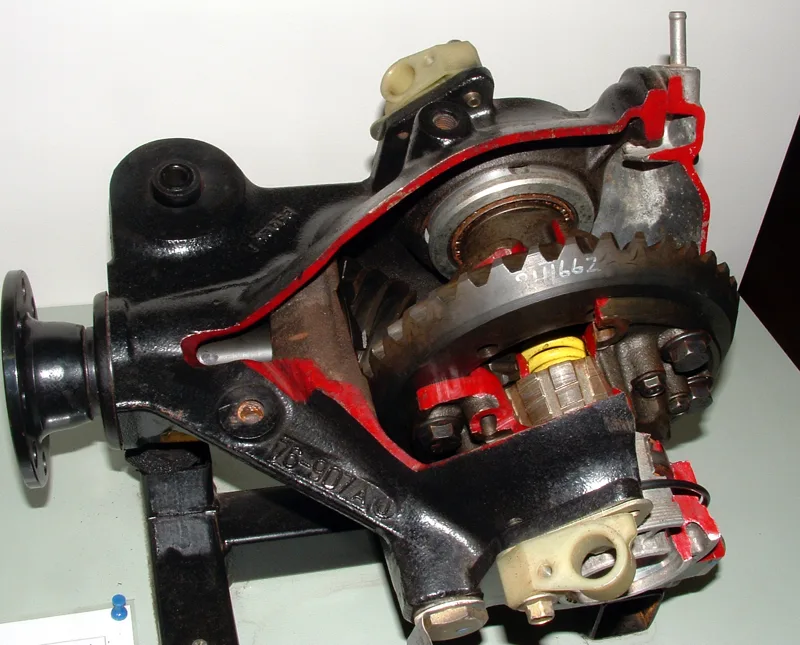
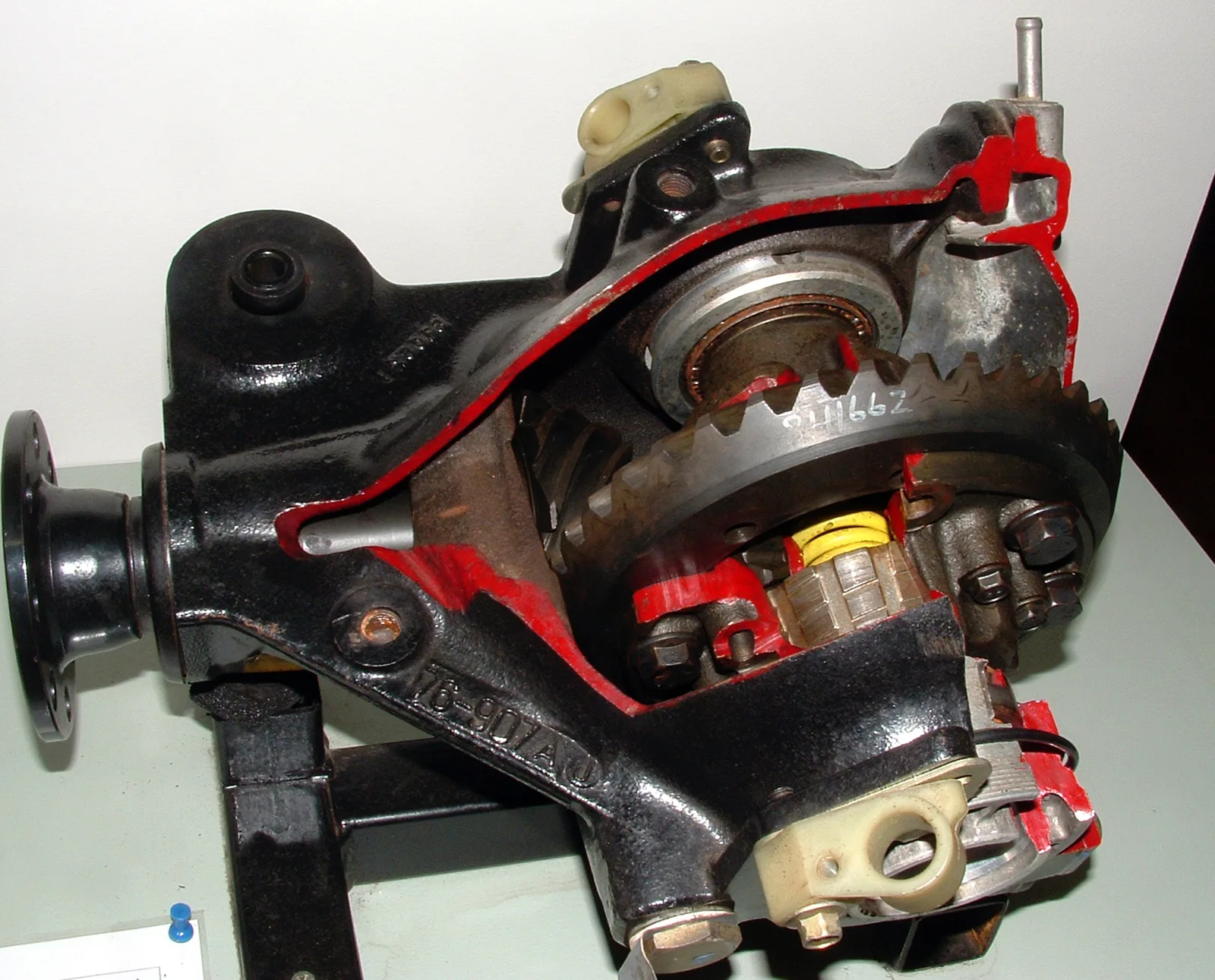
A differential is a set of gears linking three shafts, arranged so that one shaft always turns at the mean speed of the other two. In a car it lets the wheels at each end of an axle turn at different speeds while cornering. It can also provide a gear reduction between the driveshaft and the wheels.
The need is geometric. On a bend, the outer wheels travel farther than the inner ones because they follow a larger radius. If the wheels are free, that is easy. If both are driven by the same engine, one of them has to give. Go-karts and trams skip the differential and rely on wheel slip. Steam-powered road vehicles used to fit a clutch to each driven wheel, and often drove only one wheel.
The differential itself has a long history. The earliest verified example was a clock built by Joseph Williamson in 1720, though the Antikythera mechanism, with about 30 gear wheels, may have used one around 100 BC. In 1876 James Starley of Coventry patented a differential for a quadricycle, and in 1885 Carl Benz invented a very similar one inside the pulley of his belt-driven Patent-Motorwagen.
Why does an open differential run out of grip?
A standard open differential sends equal torque to both wheels. The problem comes when one of them is on a slippery surface. It may route the bulk of the power to whichever wheel has least grip, so that tyre spins while the other one, which could use the power, receives very little.
The numbers make the point. If the right tyre begins to spin at 70 newton metres (50 lb ft) because it is on ice, an open differential also limits the wheel with traction to 70 newton metres. That is far too little to move the car, while the slippery tyre simply spins and absorbs the engine's output.
Locking differentials fix the problem in the bluntest way, by forcing both wheels on an axle to turn together as if they shared one shaft. They are mostly used on off-road vehicles. For the road, the answer was the limited-slip differential.
How does a limited-slip differential help?
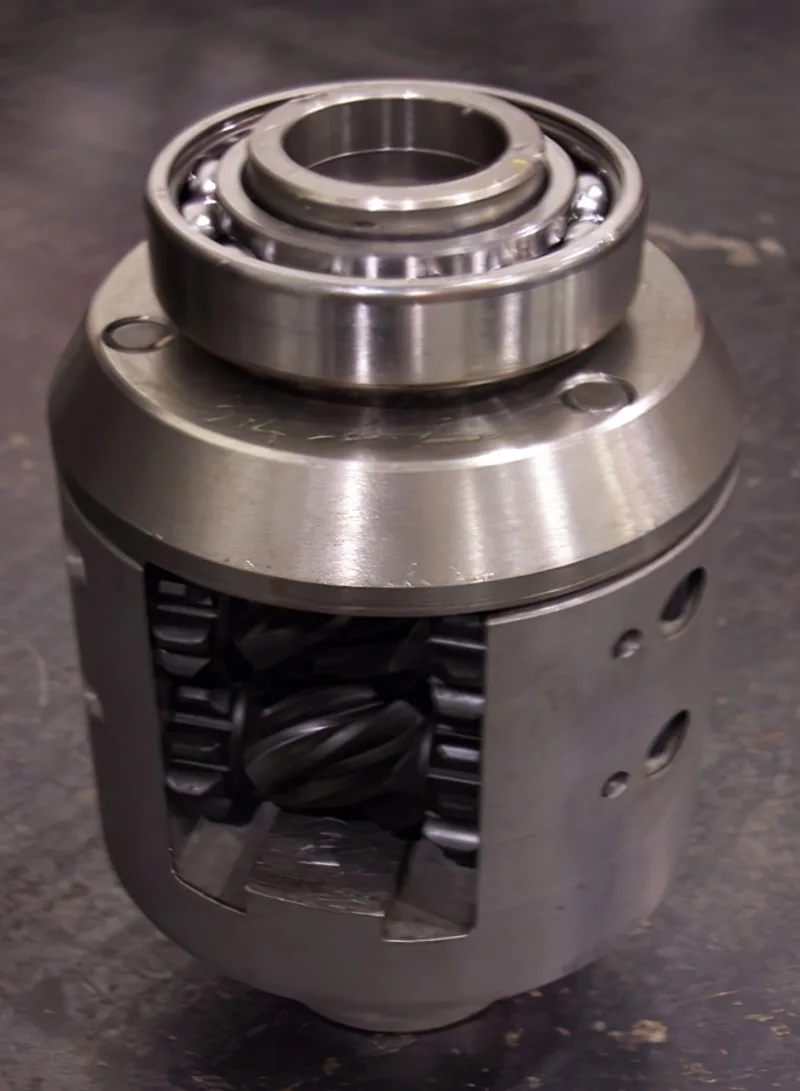
A limited-slip differential, or LSD, lets its two output shafts turn at different speeds but limits how far apart they can get. That enforces a minimum of traction, unlike an open differential, which allows one wheel to stand still while the other takes all the power, or a locking differential, which joins them completely.
The idea came from racing. Ferdinand Porsche drew up the P-Wagen Grand Prix car in 1932, and Auto Union later adopted the design for its racers. The power of its supercharged V16 made one rear wheel spin excessively at speeds as high as 160 km/h (100 mph), so in 1935 he asked the engineering firm ZF for a limited-slip differential.
American makers took the idea to the road. In early 1956 Packard introduced a clutch-type unit called Twin Traction, promoted as an aid in severe winter weather. In 1957 General Motors followed on Chevrolet vehicles with Positraction, a name that became a generic term for limited-slip differentials in the US. Pontiac, Oldsmobile, Ford, Lincoln and Chrysler all had their own brand names. In the muscle car era, with powerful rear-drive cars on live axles, an LSD gave a distinct advantage over cars that suffered the "one wheel peel", and mechanical limited-slip differentials are still considered essential to drift properly.
Inside, an LSD has some mechanism that applies a resisting torque against the difference in output speeds. The mechanism gives the type its name, and the main families are fixed value, torque sensitive, speed sensitive and electronically controlled. A torque-sensitive unit presses its clutches, cones or gears together harder as engine torque rises. Versions are named by the way they behave when the driver lifts off: a 2-way unit limits in both directions, a 1-way unit only under power, and a 1.5-way unit, common in racing cars, has different limits each way, which helps stability under engine braking.
The Torsen design is the best-known geared type, patented by Vernon Gleasman and marketed by the Gleason Works from 1982. Mario Andretti and Paul Newman used the original in racing, and later worm-gear designs descend from it. The T-1 became original equipment on the Audi Quattro and the Subaru Impreza WRX STI.
How is torque vectoring different from a limited-slip differential?
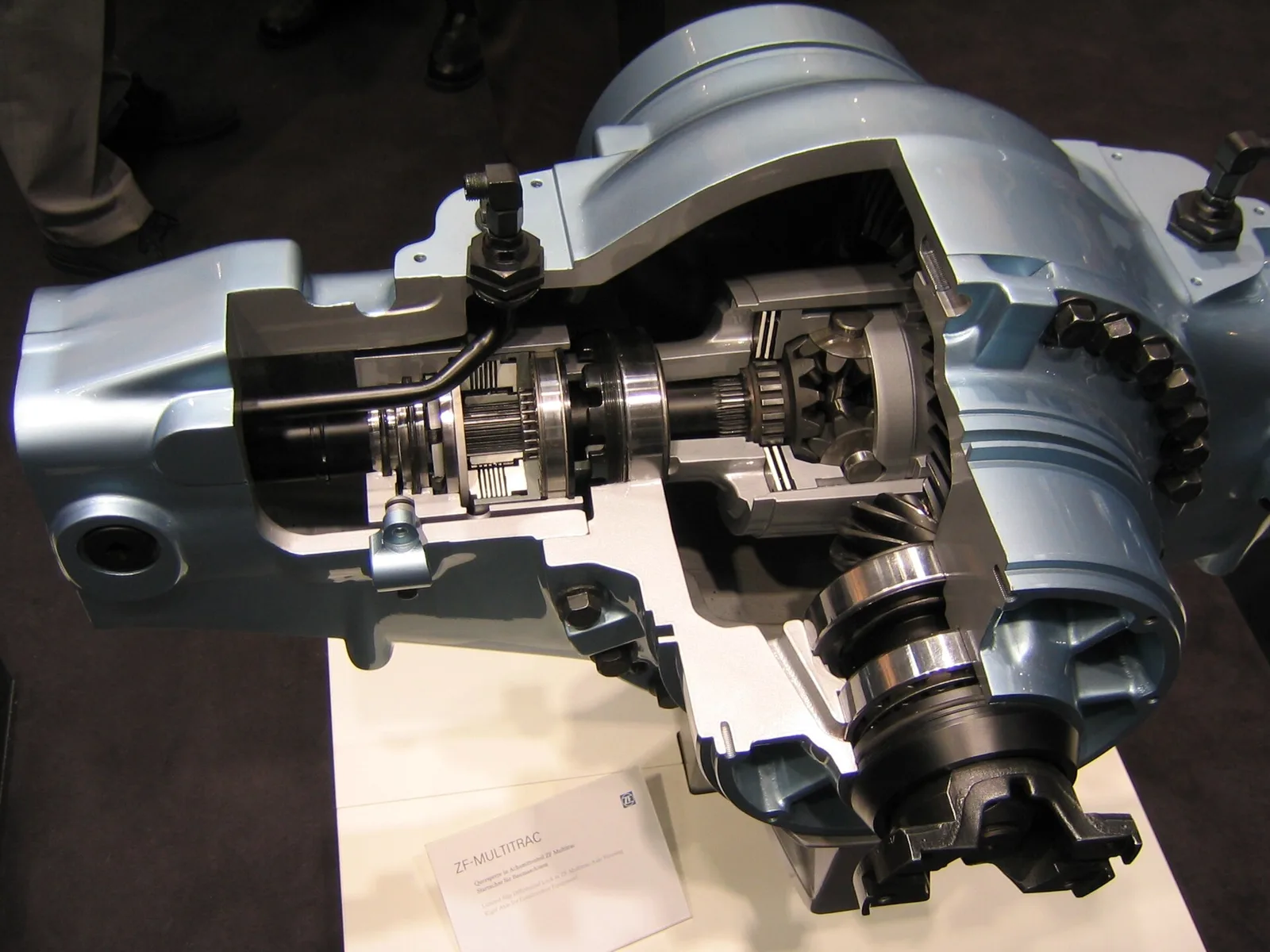
A limited-slip differential is a mechanism that resists a difference in wheel speed. Torque vectoring adds an electronic monitoring system that decides when and how to change the torque at each wheel. Ordinary differentials are generally all mechanical; a torque vectoring one is not.
| Type | What it does | Where it is used |
|---|---|---|
| Open differential | Lets wheels turn at different speeds; can send most power to the wheel with least grip | The regular road-car differential |
| Limited-slip differential | Limits the speed difference between the two outputs to keep a minimum of traction | Muscle cars, racing cars and many road cars |
| Locking differential | Locks both wheels on an axle together, regardless of grip at each | Mostly off-road vehicles |
| Torque vectoring differential | Varies torque to each half-shaft electronically to improve stability or cornering | All-wheel-drive cars above all, some front-wheel-drive cars, electric cars |
There is a handling difference too. In a turn, a limited-slip differential sends more torque to the slower inside wheel than to the outside one, a bias that can bring understeer. Torque vectoring can do the opposite on purpose, as Honda showed when its SH-AWD sharpened handling by sending extra torque to the wheels on the outside.
How does a car steer with its power?
A car turns when the forces at its wheels are unequal. Torque distribution creates a yaw moment, the twisting force that swings the nose, from the longitudinal forces at each tyre. Push harder through the outside wheel and the car rotates into the corner, much as pulling harder on one oar turns a rowing boat.
There is a price. Applying more longitudinal force to a tyre reduces the lateral resistance it can generate, so grip used for driving is grip taken from cornering. The best trade-off depends on the driving situation, and the system may need to damp or excite yaw acceleration. The final step is integration with brake stability functions, for fun as well as safety. The function does not depend on the hardware: driveline devices in a conventional powertrain can do it, and so can electric motors.
What did the first torque vectoring cars do?
The flagship fifth-generation Honda Prelude of 1996 carried an Active Torque Transfer System, or ATTS, driving the front wheels. It was sold as the Type S in Japan, the VTi-S in Europe and the Type SH in North America. ATTS amounted to a miniature automatic gearbox bolted onto the differential, where an electronic control unit operated clutches that shifted torque between the driven wheels.
Its job was to counter the front-wheel-drive Prelude's natural tendency to understeer. Honda later developed the idea into Super Handling All-Wheel-Drive, SH-AWD, by 2004.
At about the same time, the Mitsubishi Lancer Evolution IV GSR had a similar system, Active Yaw Control, or AYC, in 1996. It acted on the rear wheels, again through electronically controlled clutches, to counteract understeer. Mitsubishi rally cars were among the earliest users of the technology, which had originally been a racing tool.
How does torque vectoring work on front, rear and all-wheel-drive cars?
On a front or rear-wheel-drive car there are just two driven wheels to balance, so the electronic system has less to watch. A front-wheel-drive unit has to monitor the rotation and steering angle of the wheels, and since those change constantly it keeps adjusting the torque. If a wheel starts to slip, the differential can trim the torque it receives, effectively braking that wheel, and raise it at the opposite one. A rear-drive system works in much the same way. This is the ability that helps in poor weather.
All-wheel drive is more complex because more wheels receive power, and most torque vectoring differentials are found there. A basic one varies the split between front and rear. In ordinary driving the engine torque is divided in a fixed proportion, with the front wheels taking a set share and the rear wheels the remainder. A car might run at 90 per cent front and 10 per cent rear, then shift to 50/50 when needed, spreading the torque more evenly across four wheels to increase traction.
More advanced differentials add the ability to move torque between individual wheels. They watch each wheel independently and divide the available torque to suit current conditions, which is an even more effective way of improving handling.
What changes when the car is electric?
A great deal, because electric motors can be controlled electronically without clutches. Electric all-wheel drive is typically two independent motors, one per axle, so torque vectoring between front and rear is only a matter of controlling the power split between them, something achievable within milliseconds. With three or four motors the control is finer. A quad-motor car can have per-wheel torque control, while a tri-motor car has per-wheel control at two wheels plus per-axle control.
The effect is stronger again with two motors on the same axle, a layout that can shape the understeer characteristic and improve the car's transient response. The tri-motor Tesla Cybertruck puts two motors on a single axle, whereas the Rivian R1T carries two motors at the front axle and two at the rear. An experimental 2014 car, the MUTE from the Technical University of Munich, used a special transmission in which the bigger motor provided the driving power and the smaller one handled torque vectoring.
With four motors, an almost endless range of wheel-by-wheel torque splits can add up to one given total wheel torque and one yaw moment. That freedom lets engineers choose a criterion, and energy efficiency is one: the Rivian R1T truck, launched in 2021, takes that approach.
What does torque vectoring mean for someone buying or driving a car?
Where you find it depends on the drivetrain. It is most common on all-wheel-drive cars, with some newer front-wheel-drive cars carrying a basic version, and electric all-wheel-drive models do it with their motors. What you get in return is more traction in poor weather, better launches and handling that fights understeer.
The Prelude and the Evolution were both built to fight understeer, the tendency of a car to run wide at the front. A limited-slip differential still has its place, since the mechanical kind is considered essential for a proper drift, but it works without any electronic judgement about what the car is doing.
Where does torque vectoring go next?
On the road, the direction of travel is more of it. As automotive technology improves, more vehicles are being equipped with torque vectoring differentials, and electric cars with several motors can do the job without dedicated differential hardware at all.
Beyond cars, research is under way into using torque vectoring to steer railway wheelsets actively on the track. The claimed benefits are far less wear on the track and on the wheel, and a chance to simplify the bogie, or remove it entirely, since it is mechanically complex, heavy and bulky. Stored Energy Technology Limited built an Actiwheel system and demonstrated it successfully, using a wheel hub motor of its own design. At Innotrans 2022 the German Aerospace Centre showed a full-size mockup of torque vectoring running gear for its Next Generation Train.