How the old JGTC became a 650-horsepower championship, how GT500 and GT300 differ, where DTM fits in, and what Mugen has done on track.
Super GT is Japan's premier sports car championship, begun in 1993 as the JGTC and renamed in 2005. It runs GT500 cars with over 650 horsepower alongside GT300 cars, is managed by the GT Association, and counts tuner Mugen among its Honda-linked competitors.
The fastest production-based sports car racing in the world today is run in Japan. The cars in its top class use a two-litre, single-turbo four-cylinder engine to make over 650 horsepower, and they lap at close to the pace of the quickest Le Mans prototypes that have no hybrid system.
What is Super GT?
Super GT sits at the summit of Japanese sports car racing. Launched in 1993 as the All Japan Grand Touring Car Championship, or JGTC, it took its present name in 2005. The Japan Automobile Federation sanctions it, the GT Association manages it, and Autobacs has sponsored its title, and the JGTC's before it, since 1998.
Factory teams from Toyota, Nissan and Honda share the grid with independent entries, and through shared technical rules the series has a link to Germany's DTM, a connection that comes up again below.
Strict power limits and heavy weight penalties for winners were written in from day one to keep the racing close.
How did Super GT start?
The JGTC was set up in 1993 by the Japan Automobile Federation. It replaced two defunct championships, one for Group C sports prototypes and the other for Group A touring cars, the latter having moved to the supertouring formula. The organisers wanted to avoid the runaway budgets and one-team or one-make domination that had troubled both. To get there they held power down with strict limits and made winning cars carry heavy weight penalties, openly stating that the aim was close racing and happy fans.
The GT Association was founded in October 1993 and began managing the series in 1994. GT500 and GT300 became the two classes at that point, and the championship grew in popularity with Nissan, Toyota and Honda all running factory efforts in GT500. Around the turn of the millennium it started travelling, adding a Sepang round in Malaysia in 2000, then staging a non-championship race at California Speedway in the United States in 2004.
The 2005 name change had a regulatory cause. The series planned a second overseas round, at Shanghai, but holding events in more than two countries would have cost it the status of national championship under the FIA's International Sporting Code, and with it the right to carry the words All Japan Championship in its name. It would have become an international championship needing authorisation from the FIA itself, not the Japan Automobile Federation. The federation first proposed Super GT World Challenge, but the FIA objected because the suffix risked confusion with the higher World Championship status, and a dispute arose with the Sports Car Club of America, which had run its own Speed World Challenge since 1990. On 10 December 2004 the name Super GT was confirmed. Despite several attempts at a second overseas race, the series still holds just one a year, so in theory it could regain national status.
How do the GT500 and GT300 classes work?
There are two classes. The names come from the traditional power limits: early GT500 cars were held to no more than 500 horsepower and GT300 cars to roughly 300. Today the numbers have moved on, but the labels have stayed.
| Feature | GT500 | GT300 |
|---|---|---|
| Who enters | Manufacturer-supported teams only: Toyota, Honda, Nissan | Works-backed and independent teams |
| Power | Over 650 horsepower from a single-turbo 2.0-litre four | Around 400 to just over 550 horsepower |
| Downforce | Considerably higher | Far less than GT500 |
| Typical cars | Silhouette racers with carbon fibre monocoques | Mostly GT3 cars from European makers, plus JAF-GT entries including the Prius and BRZ |
| Headlight covers, decals and number panels | White | Yellow |
| Reserved race number | 1 for the defending champion | 0 for the reigning champion |
Each team chooses its own number, provided no one else uses it, and keeps it until the team leaves the series.
What are Super GT cars like?
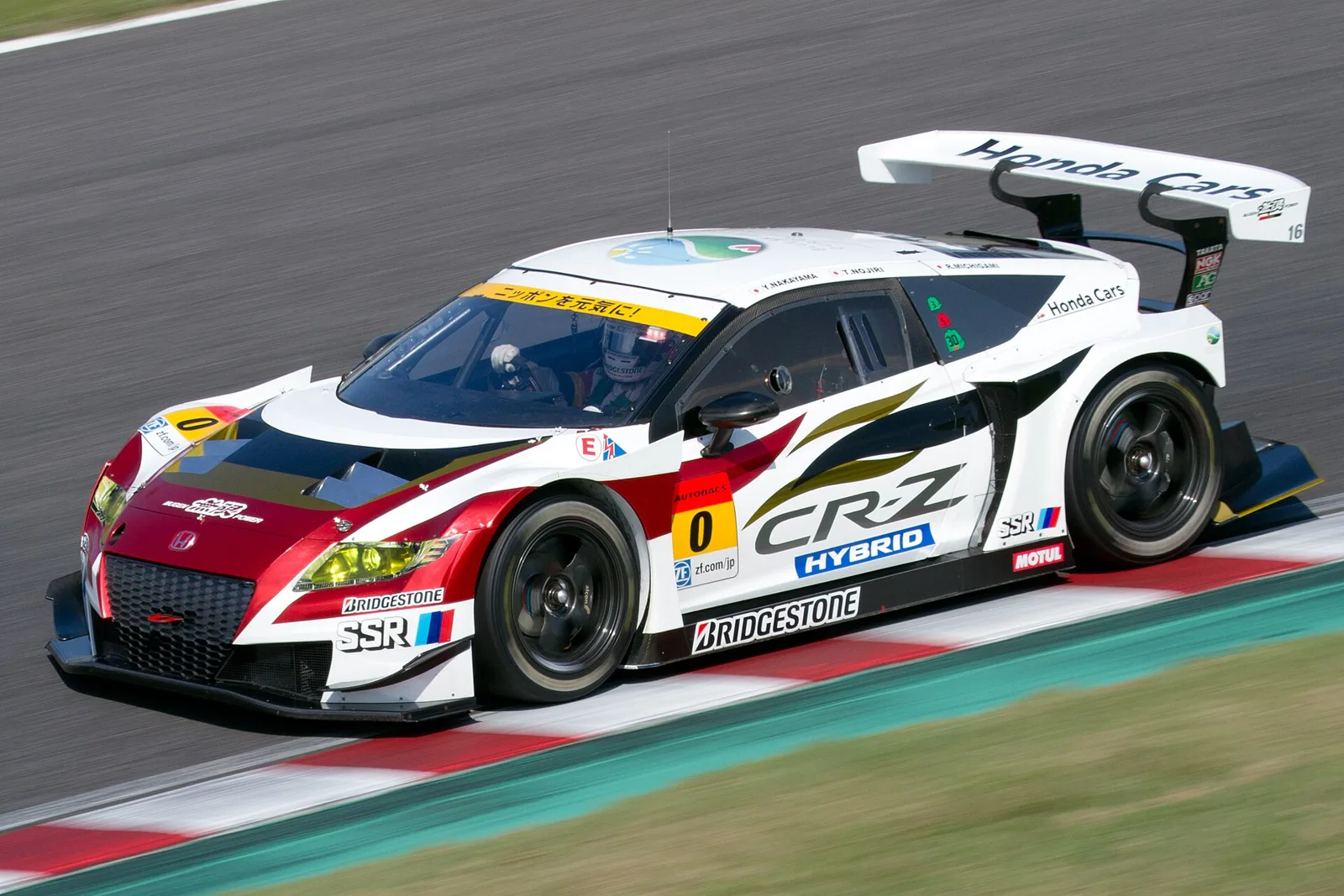
GT500 is the headline class. The Nissan Skyline GT-R, Toyota Supra (A80) and Honda NSX (NA1) stood for their makers over many seasons. Today's line-up is the Honda Prelude (BF1), the revived Toyota GR Supra and the Nissan Z (RZ34). Others have appeared in the past, including the Nissan Fairlady Z (Z33), Lexus SC 430, RC F and LC 500, the Nissan GT-R, the second-generation Honda NSX and the Honda Civic Type R (FL5), along with the Honda HSV-010 GT, a prototype built just for Super GT whose planned road version was cancelled.
Foreign cars did well early on. In the first season race wins went to the Porsche 962C, the Porsche 911 Turbo and the Ferrari F40. The Porsche 911 GT2 took the teams' title in 1995, and in 1996 the BMW-powered McLaren F1 GTR swept the drivers' and teams' titles; a longtail version won a race in 2001. The final overseas-built entrant was the Aston Martin DBR9 in 2009, which struggled, showing how far the newer GT500 cars had pulled ahead of the FIA GT1 machines that ruled Europe. Team Goh, which had entered the winning McLarens, planned a Maserati MC12 GT1 for 2006 but withdrew after pre-season testing.
The rules have been rewritten several times. From 2010 only front-engine, rear-wheel-drive layouts were allowed in GT500, so Honda swapped its first-generation NSX-GT for the purpose-built HSV-010 GT. In 2012 the rules made room for four-door cars, though the first to be announced was Honda's Civic Type R, due to take over from the NSX in 2024. A new generation of GT500 cars in 2014 raised downforce by 30% while cutting costs, restricted aerodynamic development above a design line around the fenders, bumpers and sills, and introduced over sixty common parts, including brakes, diffuser and rear wing. The Honda NSX Concept-GT was the class's first car with a KERS hybrid system. In 2017, as cornering speeds climbed, a further overhaul trimmed downforce by 25% and banned KERS, although Honda, the only user, had already dropped it in 2016. Honda had also been granted a waiver in 2014 to keep a mid-engine NSX, but the waiver ended after 2019, when Class 1 technical rules took full effect in 2020 with a standard ECU and suspension.
One shared part is the turbocharger. Every GT500 car has a single turbocharger with boost up to 3.5 bar (51 psi), supplied exclusively by Garrett Advancing Motion.
The GT300 field is more varied. Japanese makers build the Toyota Prius and Subaru BRZ to JAF-GT rules, but the class is dominated by GT3 cars from European manufacturers like Audi and Mercedes, and Audi and BMW back some entries directly. GT300 once hosted exotic specials from Vemac, Mosler, Mooncraft and ASL, and also detuned GT500 cars like the 2004 title-winning M-TEC NSX. From 2006 teams increasingly chose European GT cars, a trend that sped up in 2010. To revive local entries, the GT Association worked with Dome on the Mother Chassis, a low-cost platform with a standard Dome tub and a GTA-branded Nissan VK45DE engine, first racing in 2014. Mother Chassis cars are dressed to look like road cars, among them Toyota's 86 and Mark X and the Lotus Evora.
Super GT vs DTM, and what Class 1 meant
In 2014 Super GT and the German series DTM announced Class 1, which would join GT500's technical rules with DTM's so that a manufacturer could race in both with one specification of car. After some delays, the rules matched fully in 2020, with GT500 fully adopting Class 1. By 2021, however, DTM had switched to a GT3 series after a heavy exodus of manufacturers. Super GT kept the same technical regulations for GT500 but stopped using the Class 1 name. A joint Super GT x DTM Dream Race was run in November 2019, pairing GT500 and DTM cars in two sprints.
Where does Super GT race?
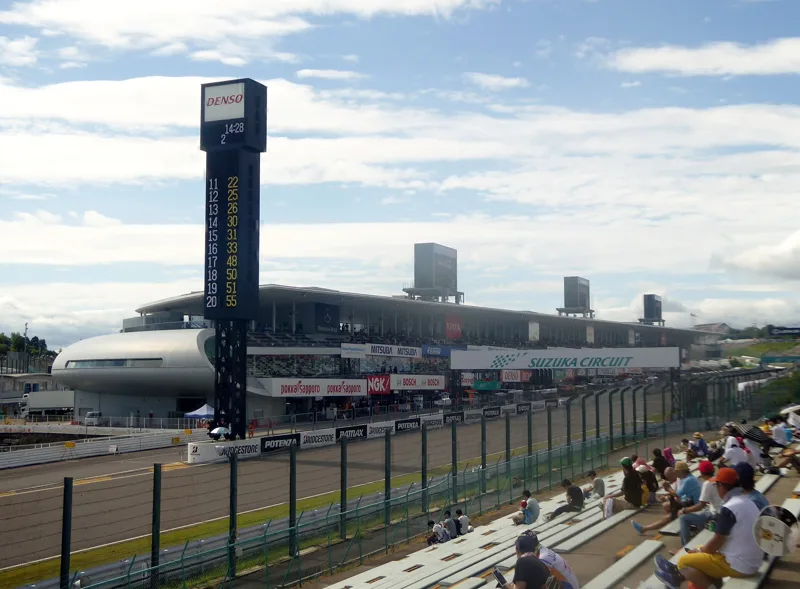
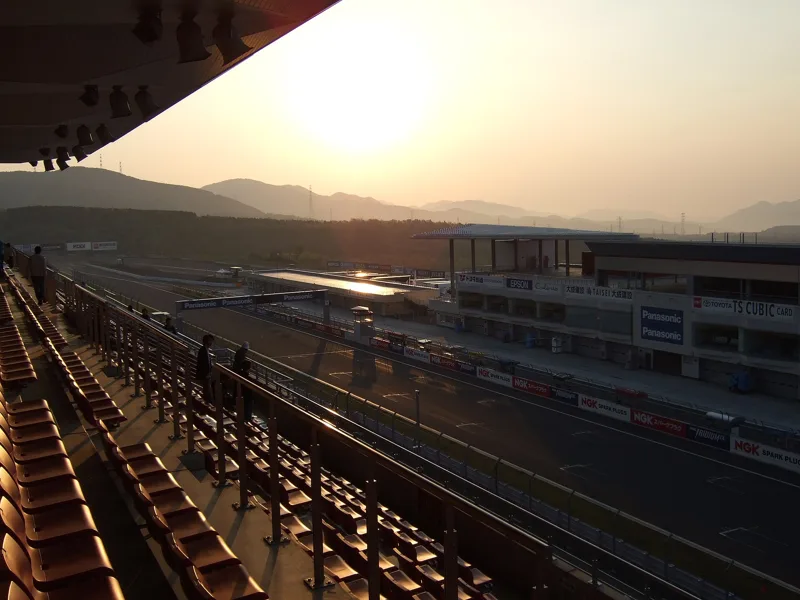
The home circuits include Suzuka Circuit, Mobility Resort Motegi and Fuji Speedway, with further rounds at Autopolis in Kyushu, Okayama International Circuit in the Chugoku region and Sportsland Sugo in Tohoku. Races are usually sprints of 250 to 300 kilometres with a single mandatory halfway stop to swap drivers and refuel. In 2022 select races switched to a longer 450-kilometre format with two stops, and in 2024 the series held its first timed races, adding three-hour events.
Overseas, A Sepang round in Malaysia appeared on the schedule each year up to 2014, after which Chang International Circuit in Buriram, Thailand took its place. Planned races at Shanghai in 2005 and Yeongam in 2013 were cancelled, and the 2020 rounds at Buriram and Sepang were lost to COVID-19. Sepang returned to the calendar in 2025.
Two events stand out. The International Suzuka 1000km was the longest and most prestigious race from 2006 to 2017, then gave way to the Intercontinental GT Challenge Suzuka 10 Hours in 2018. The Golden Week race at Fuji Speedway on 4 May draws the biggest crowds, with 91,000 spectators over two days in 2019. It was the opening event of the first official season in 1994 and has missed only 2004, when the circuit was closed for renovation, and 2020. Distances were cut after the 2009 energy crisis in Japan and again after the 2011 Tohoku earthquake and tsunami, then restored in 2012.
What is Mugen Motorsports?
Mugen, a word meaning without limit, began in 1973 as the venture of Masao Kimura and Hirotoshi Honda, whose father Soichiro founded Honda Motor Company. Its legal name is M-TEC Company, and it tunes engines and makes parts. It makes OEM parts for Honda such as body kits and sports exhausts, and also sells aftermarket parts to enthusiasts. Honda Motor Company has never owned the firm despite the family tie, though since 1991, when his father died, Hirotoshi Honda has held more Honda shares than anyone else.
Racing is in its blood. Not long before leaving Nihon University in 1965, Hirotoshi Honda had started building a racing car of his own in a workshop at the family home, and Kimura, a veteran racer, had won over 50 times in Honda sports cars and single-seaters. Mugen started with special parts for motocross bikes, moved into tuning Honda engines beginning with the 1200cc Civic unit, and made its first body kit for the Honda Ballade CR-X in 1984, leading up to the Mugen NSX prototype of 1992. Late in 2003 Hirotoshi Honda faced a tax evasion allegation, and in early 2004 the company was restructured as M-TEC, which kept the Mugen trademark and its base in Asaka, Saitama, under a former board member, Shin Nagaosa.
Mugen in single-seaters, Formula One and Super GT
When Formula 3000 arrived in Japan in 1986, Mugen and Honda built an engine for it, leased to 14 teams in 1987, and in 1989 Mugen won the European F3000 title with Jean Alesi. In Formula Three its tuned Honda engines took Mika Hakkinen to the British crown and Rubens Barrichello a year later, and the company has since won titles in Asia, Europe and Latin America.
Mugen reached Formula One with engines for Tyrrell in 1991, then supplied Footwork, Lotus, Ligier, Prost and finally Jordan. The high points came at Monaco in 1996, when Olivier Panis gave Mugen its first Grand Prix victory in a Ligier, and at Spa in 1998, when Jordan's Damon Hill and Ralf Schumacher scored a 1-2. In 1999 Heinz-Harald Frentzen won twice and Jordan finished third in the constructors' table with 61 points. Mugen left the sport after 2000.
In the JGTC, Mugen built four NSX racers in 1998. The Nakajima car won at Fuji, and Tom Coronel and Kouji Yamanishi finished second in the championship. The Mugen and Dome team took the title in 2000 with Ryo Michigami without winning a race, and in 2002 Mugen-prepared NSXs won five rounds and the team's championship. The company also developed a 4.0-litre V8, the MF408S, for Le Mans and the American Le Mans Series, rated at over 456 kW (612 hp; 620 PS) at 9,500 rpm. It first raced in a Panoz at the 2002 Sebring 12 Hours.
In 2004 M-TEC dropped to GT300 deliberately, to bring young drivers up to GT500 speeds. It simply detuned the car, and still won the class by one point over the ARTA Garaiya.
What Super GT means for fans and buyers
The links to the road are direct: the class runs Supra, Z, Prelude and Civic Type R models, and Mugen sells parts to amateur enthusiasts as well as racing Hondas. Its United States dealer for Mugen parts is King Motorsports, and team director Junichi Kumakura saw racing the NSX in America as a way to promote the brand in places it had not been. For a spectator, the Golden Week race at Fuji is the best-attended date on the calendar.
Where this goes next
Super GT's calendar keeps changing. Sepang returned in 2025, three-hour timed races joined the programme in 2024, and Honda's Civic Type R replaced the NSX that year in GT500, with the Prelude (BF1) listed as one of the three GT500 cars now racing.