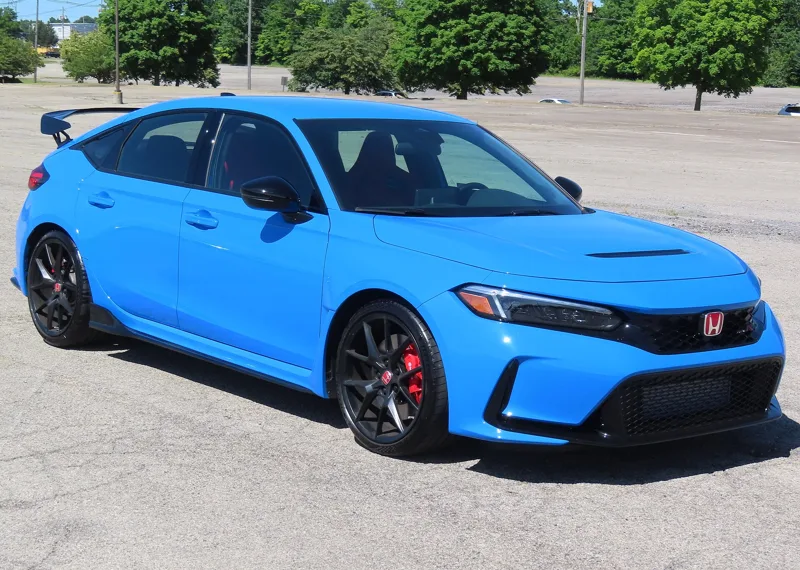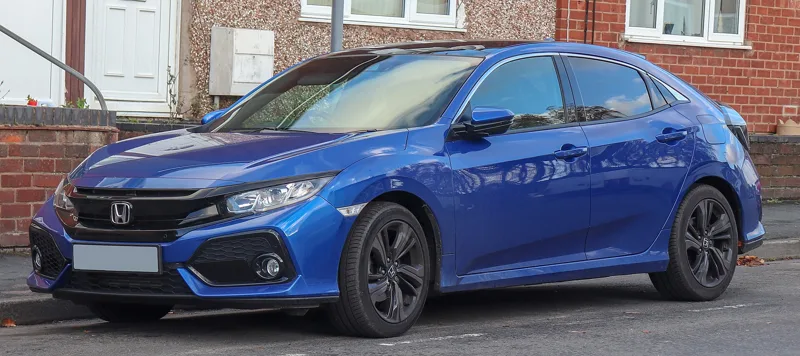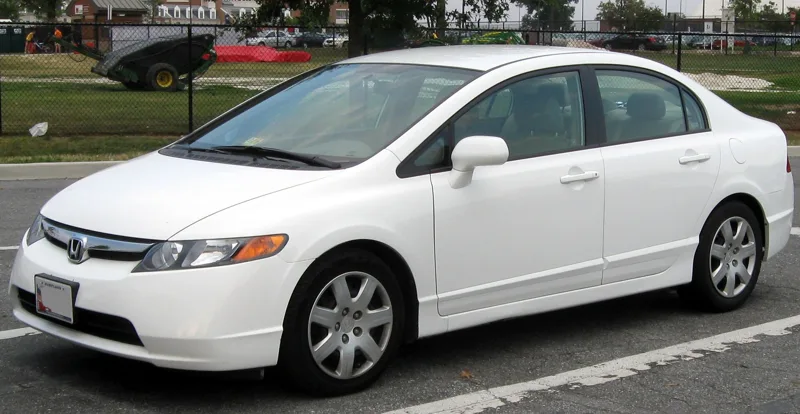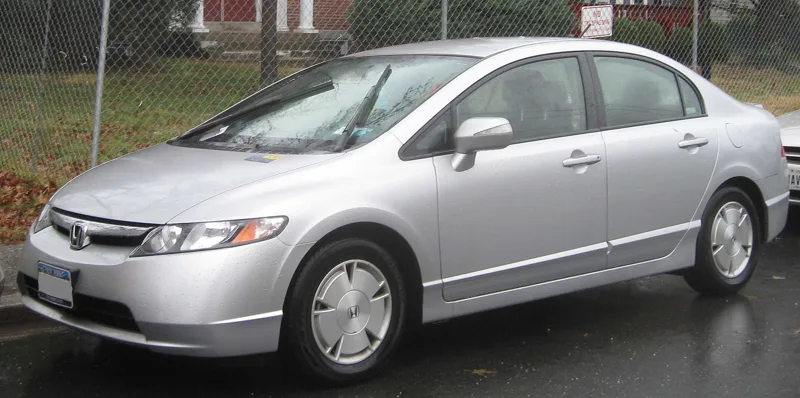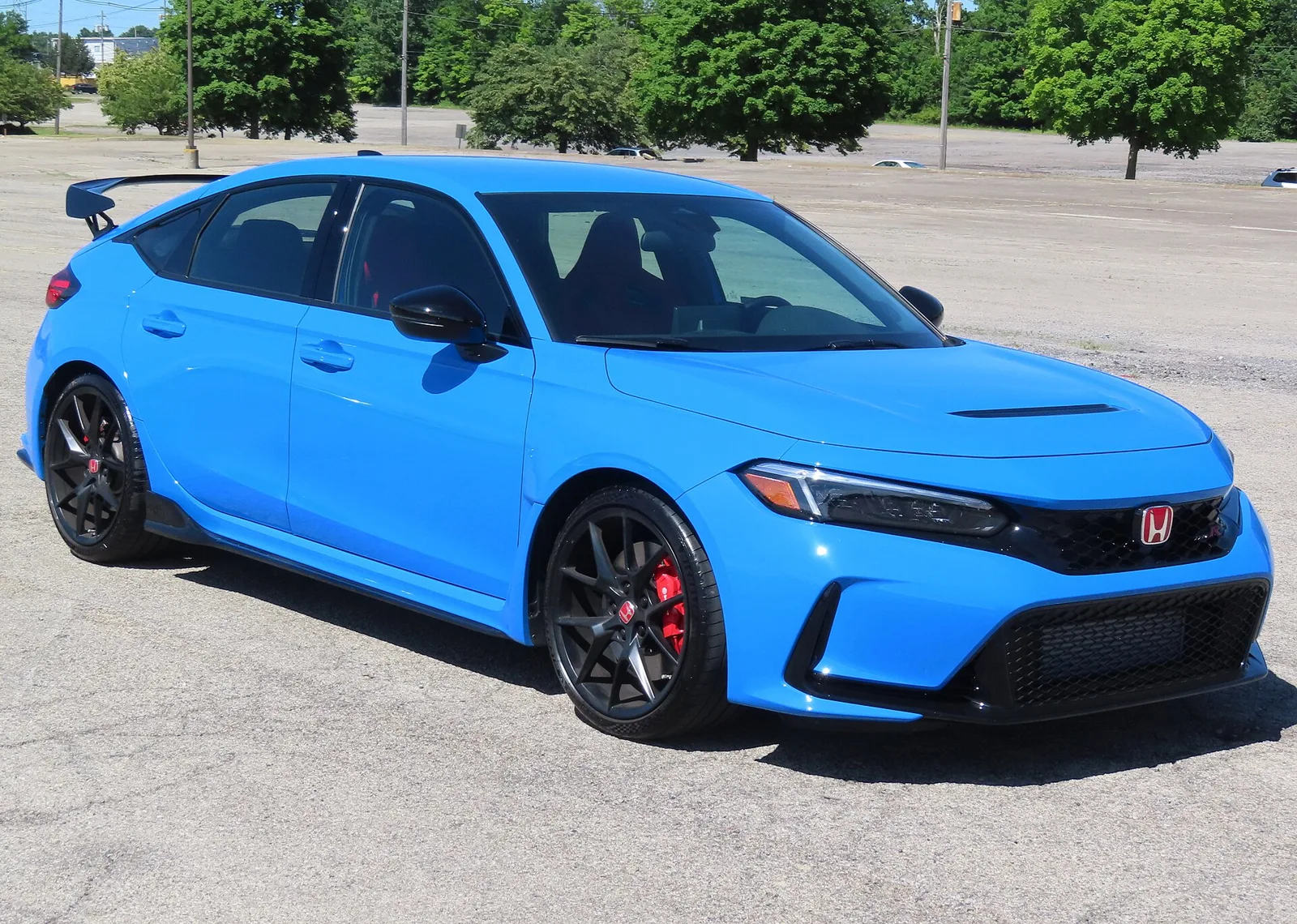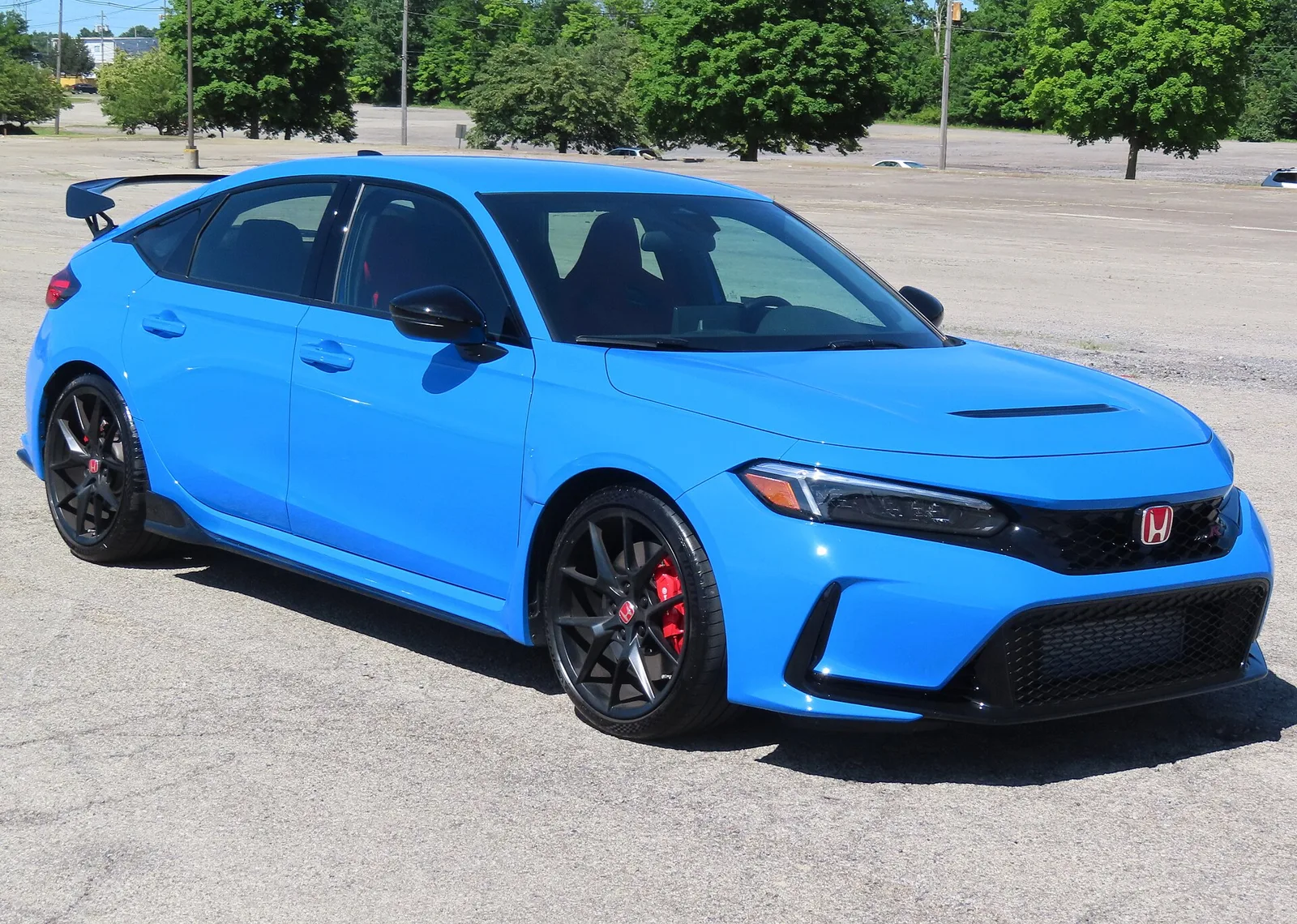
Five generations of Honda's front-wheel-drive performance hatch, from a 1997 naturally aspirated VTEC to a 2023 model with a turbocharged engine and Nurburgring records.
The Honda Civic Type R is a hot hatch series that began with the EK9 in August 1997. The FL5, the sixth generation, arrived for 2023 with a turbocharged 2.0-litre engine carried over from the FK8. Every Type R has been front-engine, front-wheel drive.
The Honda Civic Type R is a series of hot hatchbacks and sports saloons that Honda has built since September 1997. Every generation has kept the same core formula: a lighter, stiffer Civic with a tuned engine, upgraded brakes and chassis, and a manual gearbox.
Where did the Civic Type R begin?
The first Type R was built on the sixth-generation EK Civic, using the Japanese-market SiR three-door hatchback as its base. It was introduced on 19 August 1997 and was the third model to carry the Type R badge, after the NSX and the Integra.
Like its Integra sibling, the EK9 dropped sound deadening and other weight-saving measures in favour of performance. Its body used a strategically seam-welded monocoque for the first time, and the car was sold only in Japan.
Five generations of front-wheel-drive performance, from a 1997 naturally aspirated VTEC to a turbocharged record holder.
What made the EK9 engine special?
The B16B was a hand-ported 1.6-litre DOHC VTEC four-cylinder that produced 185 PS (136 kW; 182 hp) at 8,200 rpm and 160 Nm (118 lb-ft) at 7,500 rpm. From 1,595 cc it delivered one of the highest outputs per litre of any naturally aspirated engine.
Performance figures included 0 to 97 km/h (0 to 60 mph) in 6.7 seconds and a quarter-mile time of 15.3 seconds. The car could reach 225 km/h (140 mph).
Inside, the cabin was finished in red Recaro bucket seats, red door cards and red Type R floor mats, with a titanium shift knob and a Momo leather steering wheel.
How did the EK9 change in its later years?
A Motor Sports edition arrived in 1998 with steel wheels, the standard grey interior, manual windows and no air conditioning. It was the stripped-back version of the car for buyers who wanted nothing but the basics.
The Type Rx of 1999 added a CD player, power windows, auto air conditioning, keyless entry, aluminium sports pedals and a carbon-type centre panel. It was the final EK9 model, and production of the generation totalled 16,000 units.
Honda's tuning partner Spoon Sports built an N1 racing version in 1999 with the B16B redline raised from 8,400 rpm to 11,000 rpm.
What did the EP3 bring in 2001?
The EP3 arrived in 2001 as a three-door hatchback for the UK, built in Swindon, England. The European car used a 2.0-litre i-VTEC engine rated at 200 PS (147 kW; 197 hp), and it kept seam welding, a close-ratio six-speed gearbox and upgraded brakes.
It lacked two EK9 features: the helical limited-slip differential and the red Recaro race seats. Those features were standard on the Japanese-market EP3, which also used a 215 PS (158 kW; 212 hp) K20A engine built in Japan and shipped to Swindon for installation.
The Japanese car had more track-focused chassis settings, a fully balanced crankshaft and different intake and exhaust manifolds, along with high-lift camshafts and high-compression pistons. Its European counterpart had more relaxed gear ratios.
In 2003 the EP3 received quicker steering, revised suspension, projector headlamps and a lighter clutch. Honda aimed these changes at understeer at the limit, a numb steering response and a shortage of low-end torque.
Which EP3 special editions were built?
The 30th Anniversary Edition marked 30 years of the Civic name in 2003. Only 300 were built, 100 in each of three colours, with red Recaro seats, air conditioning and privacy glass.
The Premier Edition arrived in 2005, with Recaro Trendline seats in red and black and a MOMO steering wheel. Japan received a C Package in 2004 for 330,000 yen, which added HID lighting, rear privacy glass and an automatic air conditioner.
The last year of production brought 132 Vivid Blue Pearl EP3s, all left-hand drive. Many people mistake them for the Premier Edition, but they had the standard facelifted Type R interior.
How was the FD2 different in Japan?
The Japanese-market FD2 went on sale on 30 March 2007, and it was the first JDM Civic Type R sold as a four-door sedan rather than a three-door hatchback. Its wheelbase stretched from 2,570 mm (101.2 in) to 2,700 mm (106.3 in), which added stability at speed.
Its engine produced 225 PS (165 kW; 222 hp) at 8,000 rpm, with 215 Nm (159 lb-ft) of torque reached at 6,100 rpm, against 201 PS (148 kW; 198 hp) for the European FN2. Honda said mid-range power was up by 10 PS.
The front brakes were 320 mm discs with four-piston Brembo calipers, and the car wore Bridgestone Potenza RE070 tyres in 225/40 R18. Honda's back-to-back tests had the FD2 about one second quicker than the Integra Type R at Tsukuba and four seconds faster at Suzuka.
How did the FD2 sell, and what were the Mugen versions?
Production of the FD2 totalled 14,062 units until August 2010, when it ended because the car could not meet upcoming emissions requirements. Honda then imported European FN2 hatchbacks to Japan under the name Civic Type R EURO.
Mugen built a special Civic Mugen RR for Japan in 2007. Only 300 were made, all in Milano Red, and they weighed 1,255 kg (2,767 lb) thanks to carbon-fibre bumpers and an aluminium bonnet. The engine made 240 PS (177 kW; 237 hp) at 8,000 rpm.
A later Mugen RR Advanced concept, shown at the 2009 Tokyo Auto Salon, had a dry weight of 1,095 kg (2,414 lb) and 340 mm brake discs.
What was the European FN2?
The European and international FN2 was sold only as a three-door hatchback. Its fuel tank sat under the driver's seat, and a torsion beam axle replaced the double wishbone rear suspension used on the FD2.
It produced 201 PS (148 kW; 198 hp) at 7,800 rpm, and its torque of 193 Nm (142 lb-ft) peaked at 5,600 rpm, with 90 percent of its peak torque available from 2,500 rpm. Its curb weight was 1,320 kg (2,910 lb).
Honda built 29,039 FN2 Type Rs at Swindon, including 13,514 right-hand drive cars for the UK and 8,378 left-hand drive cars for Europe. Japan took 3,510 and Australia 2,285.
Top Gear named the European Civic Type R its Hot Hatch of 2007, though the programme later criticised the FN2 chassis for its different suspension and added weight.
What were the Mugen 200 and M20?
Honda offered two Mugen packages on the FN2 in selected markets. The Mugen 200 was a limited European model with revised engine management, a performance exhaust, upgraded suspension and Mugen aerodynamic bodywork.
The Mugen M20 was a similar package sold in very small numbers through select dealerships. Both focused on handling and track performance without changing the K20Z4 engine itself.
Did the FK2 bring a turbocharged engine?
The FK2 Civic Type R, launched in 2015, was the first factory turbocharged Civic Type R. Its K20C1 direct-injection 1,996 cc inline-four produced 310 PS (228 kW; 306 hp) at 6,500 rpm, while torque of 400 Nm (295 lb-ft) spreads from 2,500 to 4,500 rpm.
Honda said the car could reach 100 km/h in 5.7 seconds. The engines were built at the Anna Engine Plant in Ohio and shipped to the UK for assembly, and the single-scroll turbocharger was designed to reduce turbo lag.
The FK2 used 350 mm ventilated front discs with four-piston calipers, and 305 mm rear discs. Its 50-litre tank returned a combined 38.7 mpg (6 L/100 km), and the car emitted 170 g/km of CO2 on the combined cycle.
A development version of the FK2 set a Nurburgring lap of 7:50.63 in May 2014, the fastest front-wheel-drive production lap at the time.
What were the FK2 special editions?
A Special Edition with unique R numbering arrived in Europe in May 2016. It totalled 450 left-hand drive cars, with 300 finished in white and 150 in black, all based on the GT trim.
The right-hand drive Black Edition followed at the end of 2016 as a Final Edition, limited to 100 units for the UK. Across all special editions Honda built 550 cars.
How did the FK8 change the formula?
The FK8 was unveiled as a prototype at the Paris Motor Show in September 2016, and the production car followed at the 2017 Geneva Motor Show. It was built in Swindon, and it was the last Civic Type R made there before the plant stopped producing vehicles in 2021.
Its body brought a carbon-effect splitter, slatted ducts, enlarged wheel arches, 20-inch piano black wheels with red accents and 245/30 R20 tyres. Three tailpipes with directional strakes finished the rear, with a bright metallic red central pipe.
Engine output rose to 320 PS (235 kW; 316 hp) in Europe and Japan, while other markets kept 310 PS (228 kW; 306 hp). Both versions produced 400 Nm (295 lb-ft) and kept the close-ratio six-speed manual.
The FK8 reached 272 km/h (169 mph), the fastest Civic Type R to that point. Honda claimed 5.7 seconds to 100 km/h, while Car and Driver measured 4.9 seconds to 97 km/h.
Was the FK8 a better car than the FK2?
In back-to-back tests, reviewers praised the FK8 for a more compliant ride and better steering feedback. The older car's firmer ride and looser composure in +R mode drew the criticism.
Some reviewers still found the FK2 the more raw and visceral of the two, with a more analogue feel than the more refined FK8.
What was the FK8 interior like?
The cabin was based on the base-model Civic, with a low seating position and a high gear lever for quick shifts. Standard trim was red and black, with sports seats and faux carbon fibre trim.
A reversing camera came as standard, and parking sensors were fitted on the GT. The infotainment system, though, was often described as slow and hard to use, even if the fit and finish compared well with rivals.
The Type R earned a Euro NCAP five-star rating, and its safety kit included automatic emergency braking, traffic sign recognition and lane departure warning.
How did the Type R reach North America?
The FK8 went on sale in the United States and Canada on 14 June 2017, the first time the Type R had been officially sold there. Only the 306 hp turbocharged 2.0-litre engine was offered.
In 2021 Honda offered a Limited Edition Type R, with only 600 cars allocated to the US, all in Phoenix Yellow pearl. It was 38 pounds (17 kg) lighter than the standard car, with forged BBS wheels and recalibrated steering.
What is the FL5 Civic Type R?
The sixth-generation Civic Type R, codenamed FL5, was introduced on 20 July 2022 for the 2023 model year. It is built in Yorii, Saitama, Japan, where the Japanese Civic liftback is also produced.
The FL5 is less aggressive than its predecessor, with smaller vents and fewer decorative elements. It uses 19-inch wheels, which are smaller than the FK8's 20-inch units, but wears wider 265/30 Michelin Pilot Sport 4S tyres.
A fully reshaped rear door and quarter panel gave the FL5 a wider track, rather than the plastic add-ons used to widen the FK8's rear arches. The car kept red carpeting and semi-bucket seats, with a digital interface that integrates the Honda LogR data logger.
What records has the FL5 set?
A pre-production FL5 set a front-wheel-drive lap of 2:23.120 at Suzuka in March 2022. In April 2023 Honda confirmed that the lightweight Type R S had regained the front-wheel-drive production record at the Nurburgring, at 7 minutes 44.881 seconds.
That time looks slower than the FK8's 7:43.80, but the Nurburgring changed its measurement rules in 2019. The official lap grew from 20.600 km to 20.832 km, which explains the apparent gap.
Where is the Civic Type R sold now?
The FL5 reached European showrooms in late 2022, and customers took delivery from January 2023. Honda Europe made the Ultimate Edition public in June 2025, a run capped at 40 cars, which ended European sales because of tougher emissions standards.
The Ultimate Edition was finished in Championship White with red decals, a black roof and special Type R mirror projection lighting. The FL5 also arrived in the UAE on 1 February 2023, returning after 12 years, and in Vietnam on 26 October 2022.
Specifications across the generations
| Generation | Code | Years | Engine | Power |
|---|---|---|---|---|
| First | EK9 | 1997 | 1.6-litre B16B VTEC | 185 PS (136 kW; 182 hp) at 8,200 rpm |
| Second | EP3 | 2001 | 2.0-litre K20A2 i-VTEC | 200 PS (147 kW; 197 hp) |
| Third (JDM) | FD2 | 2007 | 2.0-litre K20A | 225 PS (165 kW; 222 hp) at 8,000 rpm |
| Third (Europe) | FN2 | 2007 | 2.0-litre K20Z4 | 201 PS (148 kW; 198 hp) at 7,800 rpm |
| Fourth | FK2 | 2015 | 2.0-litre K20C1 turbo | 310 PS (228 kW; 306 hp) at 6,500 rpm |
| Fifth | FK8 | 2017 | 2.0-litre K20C1 turbo | 320 PS (235 kW; 316 hp) in Europe and Japan |
| Sixth | FL5 | 2023 | 2.0-litre K20C1 turbo, carried over | Carried over from the FK8 |
Why did the Ultimate Edition matter?
The Ultimate Edition marked the end of European sales of the FL5, and it made the 40-unit run a farewell for the Type R in that market.