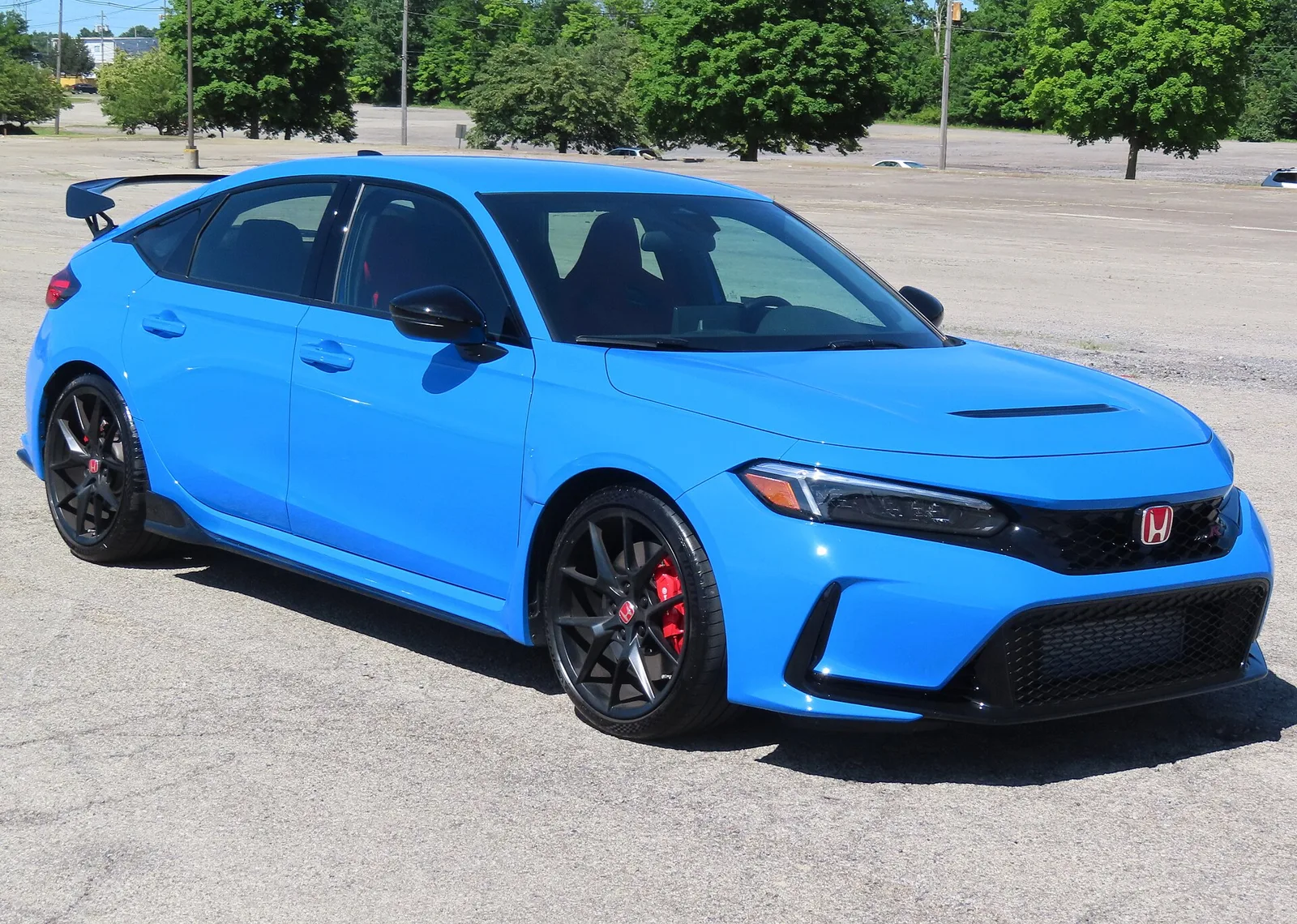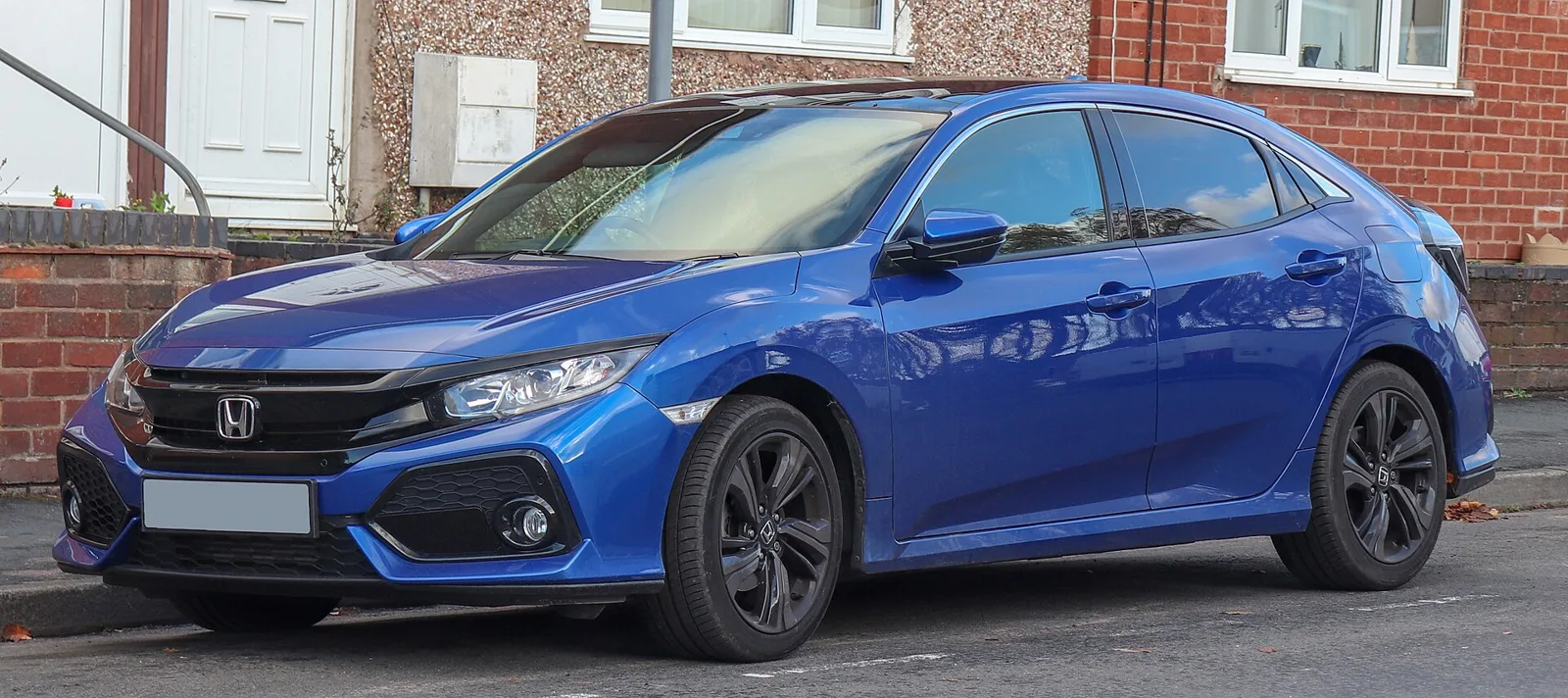
A single global Civic with a fastback look, sharper steering and a 306 hp Type R, built in plants from Ohio to Thailand before the line ended.
The tenth-generation Honda Civic, codes FC and FK, was a global compact built from 2015 to 2022. It came as a sedan, hatchback and coupe, and its performance range included the Si and a 306 hp Type R. The car was marketed worldwide as one model, with three body styles.
The tenth-generation Honda Civic (FC/FK) was a compact car built from 2015 to 2022 and sold as a sedan, hatchback and coupe. It was Honda's first Civic developed as a single global model, ending the dedicated European version that had been used since the sixth generation. A Type R hot hatch based on the hatchback followed, and the car was revived in Japan in 2017 after a seven-year gap.
What was the tenth-generation Civic?
The tenth-generation Civic was first released in November 2015 in North America, followed by Europe and Asia-Pacific in 2016 and Japan in 2017. It marked the unification of the Civic range. Honda ceased making a dedicated version for Europe and sold one global model with three body styles that shared a near-identical design: sedan, hatchback and coupe.
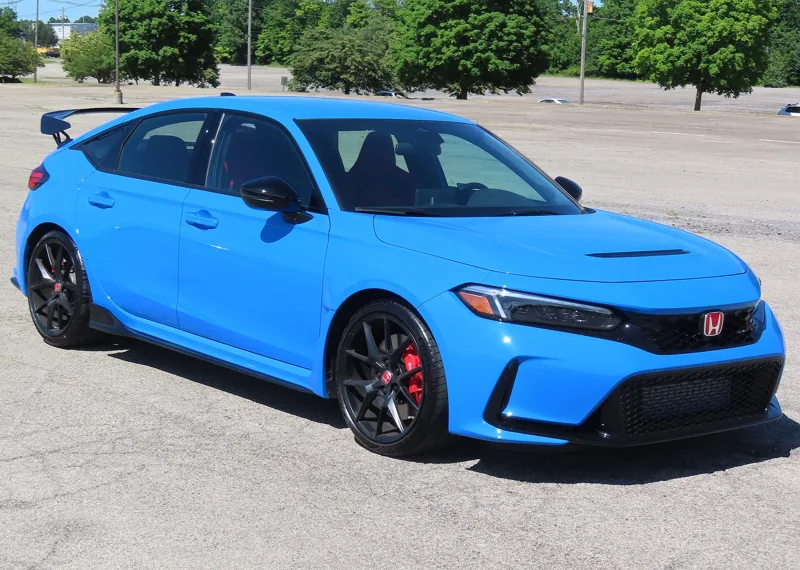
A Type R version based on the hatchback was shown as a prototype in September 2016, and it went on sale from 2017 in several markets, including North America, which received the Type R for the first time.
One global Civic, sold as a sedan, hatchback and coupe, that ended with a 306 hp Type R and a plant closure.
Why was the tenth-generation Civic a global model?
Honda designed the car as a global model, which improved development efficiency and produced cost savings. Honda then spent those savings on performance and quality. During development the company targeted its key US market, reviving its lead-country approach, which calls for developing a model specifically for its main market and selling it elsewhere.
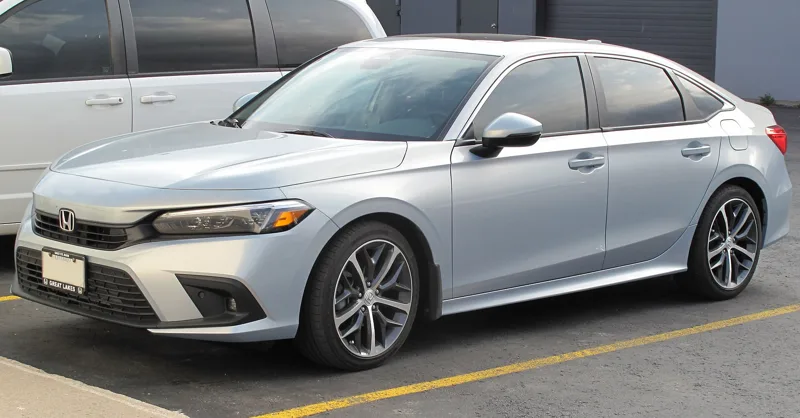
The result was a compact global platform with a sleeker, more sporty fastback design. Honda also said the unit body was 68 lb (31 kg) lighter than before, and body sealing cut cabin air leaks by 58 per cent.
What was new under the skin?
The tenth-generation Civic used higher-grade steel than its predecessor, and rear disc brakes were made standard. Fluid-filled suspension bushings reduced noise and vibration, and a dual-pinion steering system with a thicker steering column aimed to improve feel. The steering gear ratio became variable, with 2.2 turns lock-to-lock compared with 3.1 before, and a quicker 10.93:1 steering ratio.
The suspension was completely redesigned, with revamped MacPherson struts at the front and a new multi-link rear on an ultra-rigid rear subframe. The suspension and a lower floor and engine lowered the centre of gravity by 15 mm (0.6 in). A single-tier instrument cluster returned, replacing the two-tier design of the previous two generations.
How did the sedan, hatchback and coupe differ?
The production sedan debuted for the North American market on 16 September 2015, and it was 74 mm (2.9 in) longer, 46 mm (1.8 in) wider and 20 mm (0.8 in) lower than the outgoing car. It added 3.7 cu ft (105 L) of interior space with 2 in (51 mm) more second-row legroom.
The coupe was shown as a concept in April 2015 and went on sale in early 2016. It was offered only in North America, with two engine choices including a 1.5-litre turbo. It made up about 16 per cent of sales when it debuted in 2016, before dropping to 6 per cent in 2020. The coupe was discontinued in July 2020, and no coupe was offered for the eleventh generation.
What were the performance models?
The Civic Si was unveiled as a prototype in November 2016 at the Los Angeles show. It used a turbocharged 1.5-litre engine available only with a six-speed manual, and it had active shock absorbers, active steering and a limited-slip differential. Honda claimed 60 mph in 7.0 seconds, though Car and Driver recorded 6.3 seconds for a 2017 coupe.
The Type R was unveiled as a prototype at the 2016 Paris Motor Show and reached production the following year. It had a 2.0-litre turbocharged i-VTEC inline-four making 306 hp (310 PS; 228 kW) and 295 lb-ft (400 N-m) of torque. Its combined fuel economy was rated at 25 mpg-US (9.4 L/100 km).
How did the Civic change in its facelift?
A revised sedan and coupe were revealed in August 2018 for the 2019 model year, and they went on sale in the US in October 2018. Honda Sensing came as standard on the Sport trim, and the Sport variants offered a touchscreen display, unlike the basic display on the hatchback.
The front changed with a black housing around the projector headlamps on the non-turbo version, a restyled lower air splitter and a piano black grille. A new Sport trim sat above the LX, with a rectangular centre exhaust, rear decklid spoiler and 18-inch alloy wheels. The interior gained volume knobs for the 7-inch display and extra buttons for fan speed.
Where was the Civic built?
Sedan production began at Honda of Canada Manufacturing on 20 October 2015, and at Honda Manufacturing of Indiana on 27 October. Hatchbacks were built at Honda of the UK Manufacturing until 28 July 2021, when the last car, a US-market sedan, left the line. The plant closed on 30 July 2021.
Engines for the North American Civic were made in Anna, Ohio and Alliston, Ontario, while the CVT transmissions came from Russells Point, Ohio and Celaya, Mexico. Thailand and Indonesia built versions for their own markets, and Brazil built the car at Sumare until November 2021.
How did the Civic sell in other markets?
In Japan the Civic returned in 2017 after a seven-year hiatus. The sedan was built locally in Yorii, Saitama, and the hatchback was imported from the UK. The facelifted sedan and hatchback were revealed on 15 November 2019 and released on 23 January 2020. The sedan was discontinued in August 2020, while the hatchback continued until the eleventh generation.
In China the sedan launched on 14 April 2016 with 1.0-litre and 1.5-litre turbo engines paired with six-speed manual or CVT gearboxes, and a hatchback followed in 2020 above the sedan. Trims were 180TURBO and 220TURBO, each with CVT or manual. In Australia the sedan launched in June 2019, after which Honda's sales rose almost 50 per cent. The RS was the biggest seller there, with the turbocharged models making up 60 per cent of sales.
What were the Civic's Southeast Asian models?
Indonesia launched the sedan on 7 April 2016 with a 1.5-litre turbo, and a hatchback followed in 2017. Malaysia launched the sedan in June 2016 with 1.8 S, 1.5 Turbo and 1.5 Turbo Premium trims, and the 1.8 S was chosen as a police patrol vehicle.
The Philippines launched the car in April 2016 with 1.8 E and 1.5 RS Turbo trims, all imported from Thailand. Singapore and Thailand received local versions as well, with the Thai hatchback arriving in 2017 as a 1.5 turbo CVT car.
What engines did the tenth-generation Civic use?
North America offered a 2.0-litre naturally aspirated petrol engine and 1.5-litre turbo petrol engines, while the hatchback came only with the 1.5-litre direct-injection turbo. Europe launched with 1.0-litre and 1.5-litre turbos, a 1.6-litre diesel and a ZF 9-speed automatic on the diesel.
In North America the 2.0-litre sedan with the CVT had an EPA-estimated fuel economy of 31/40/34 mpg (city/highway/combined). A six-speed manual or CVT was offered on most models, but the Type R and Si came only with the manual, and the Touring models only with a CVT.
Higher-end trims of the 1.5-litre turbo and 2.0-litre engines came only with a CVT. The Sport Hatchback could be ordered with either transmission, and the Si was offered only as a sedan or coupe.
How did Europe receive the tenth Civic?
European models went on sale in spring 2017 with three engine choices: 1.0-litre and 1.5-litre turbo petrols and a 1.6-litre diesel. The petrols came with a six-speed manual or CVT, and the diesel with a ZF 9-speed automatic. The hatchback arrived first, and the saloon joined the range in 2018.
How did the Southeast Asian facelifts differ?
Facelifts followed in several markets. Singapore's sedan was revised in January 2019 with new wheels, LED foglamps for the 1.6-litre model and a volume knob for the touchscreen. Thailand's facelifted Civic debuted at the Thailand International Motor Expo in November 2018, with Honda Sensing on the Turbo RS.
In the Philippines the facelifted Civic launched in April 2019 in 1.8 S, 1.8 E and 1.5 RS Turbo trims, and the 1.8 S gained a rearview camera, electronic parking brake and a 7-inch touchscreen. Indonesia's facelifted hatchback replaced its S and E trims with the RS trim in February 2020.
Malaysia's facelifted Civic arrived on 26 February 2020 with the 1.8 S, 1.5 TC and 1.5 TC-P, and Honda Sensing was available on the top model only.
How did the Civic sell in India, Pakistan, Egypt and Brazil?
The tenth-generation Civic launched in India in March 2019 after a facelift, assembled at Honda India's Greater Noida plant with a 1.8-litre i-VTEC petrol and CVT, and a 1.6-litre i-DTEC turbo-diesel with a six-speed manual. Production there stopped in December 2020 when the plant closed.
Honda Atlas launched the car in Pakistan on 22 July 2016 as a locally assembled model. The 1.5-litre turbo was dropped in March 2017 because of engine knocking caused by poor-quality fuel, and a facelifted sedan returned in April 2019 with an RS VTEC Turbo.
In Egypt the car arrived in 2017, imported from Turkey, with Lxi and VTi trims using a 1.6-litre engine. Honda built the tenth Civic at Sumare in Brazil from 2016 until November 2021, the last generation of Civic built there.
What did the Civic earn in awards?
Car and Driver placed the tenth-generation Civic on its 10Best list in 2019, the year a Sport trim was added to the range. Honda Sensing became a key feature on the higher trims, and the Sport variants added a touchscreen display.
Civic tenth generation specifications at a glance
| Specification | Detail |
|---|---|
| Generation | Tenth (FC/FK), built 2015 to 2022 |
| Body styles | Sedan, hatchback, coupe (coupe North America only) |
| Platform | Compact global platform, fastback design |
| Type R engine | 2.0-litre turbo i-VTEC, 306 hp (310 PS; 228 kW) |
| Type R torque | 295 lb-ft (400 N-m) |
| Type R economy | 25 mpg-US (9.4 L/100 km) combined |
| Si engine | 1.5-litre turbo, six-speed manual only |
| Si 0-60 mph | 7.0 seconds (Honda claim) |