A piston that follows engine suction, a slide worked by the rider, a floatless fighter-engine regulator and a Detroit workhorse: four ways to mix fuel and air, and what pushed fuel injection ahead.
Carburettors mix fuel and air by using the suction of air passing through a venturi to pull fuel from a jet. The SU, Amal, Bendix-Stromberg and Holley each metered it differently, and fuel injection replaced them as accuracy, emission and racing demands grew.
Every team in NASCAR's top series ran an engine fed by a Holley-style carburettor, and so did every NHRA Pro Stock champion. Then both championships changed over to electronic fuel injection, and the device that had fed Henry Ford's Model T left the front line of American racing. The carburettor did not go quietly, though. It split into very different species, and four of them, the SU, the Amal, the Bendix-Stromberg and the Holley, between them mixed fuel and air in four quite different ways.
Each solved the same problem differently: an SU lets the engine's own suction move a piston, an Amal puts the rider's wrist in charge, a Bendix-Stromberg throws away the float to keep fighter engines running upside down, and a Holley became a mass-produced Detroit staple with a racing career. Their stories also explain why fuel injection took over.
How does a carburettor work?
Think of a perfume atomiser. Air rushes across the top of a thin tube, the pressure there drops, and liquid is pulled up the tube as a fine spray. A carburettor does the same job on a larger scale: air heading for the engine is forced through a narrowed passage called a venturi, the pressure falls, and fuel is drawn from a small hole called a jet.
The hard part is quantity. A petrol engine will only burn a mixture of roughly 4 to 7 kg (9 to 16 pounds) of air to 0.5 kg (1 pound) of fuel. Outside those limits the fuel will not burn. Inside that window there is a single ideal ratio for each moment, set by how far the driver has opened the throttle and what the engine is doing. The ideal carburettor delivers it every time.
Most carburettors keep the fuel supply steady with a float that opens and closes an inlet valve, much like the one in a lavatory cistern. That works nicely while the engine stays level and calm. The four designs below each get around the weaknesses of that arrangement in a different way.
The SU lets the engine's own suction move the piston that sets the fuel.
The SU carburettor: a piston that follows the engine
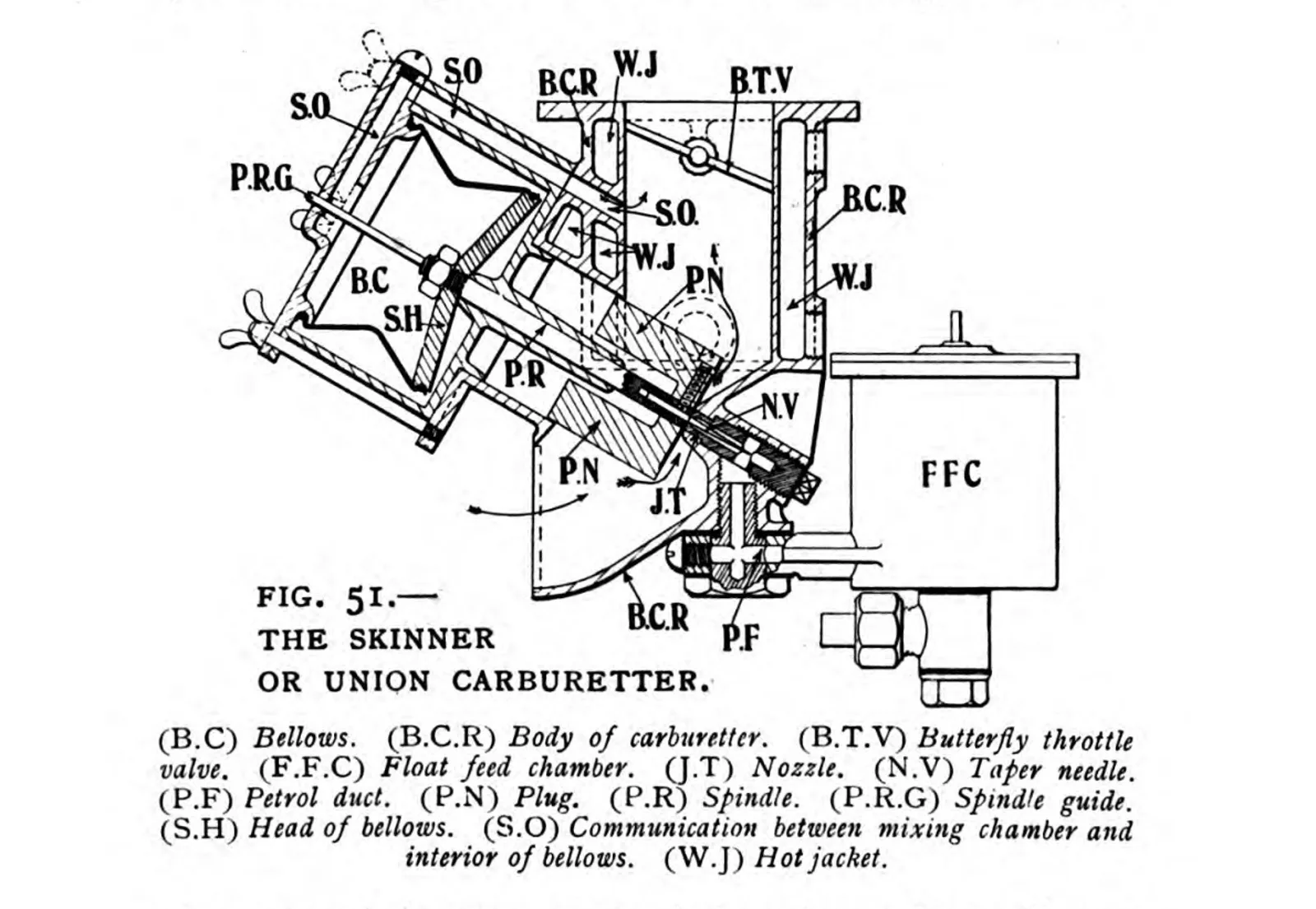
The SU begins with a family story. Herbert Skinner, a motoring pioneer, invented his Union carburettor in 1904 with help from his younger brother Carl. Herbert's son recalled his mother stitching the first leather bellows, and it went on loan to the Science Museum in South Kensington in 1934. The patent was applied for in 1905 and granted early in 1906. Herbert kept refining the idea into the 1920s, swapping the leather bellows for a brass piston along the way.
The business was a slow starter. S.U. Company Limited, the name taken from Skinner-Union, was incorporated in August 1910 and began making carburettors in Kentish Town, north London. Sales were poor. After the 1918 peace the firm still struggled. Carl Skinner went to a customer, W. R. Morris, who bought the business and moved production to the Wolseley factory at Adderley Park in Birmingham. Carl stayed on as managing director until he retired in 1948 at the age of 65.
The needle and the piston
The SU is a constant-depression design, and the idea is more elegant than it sounds. A sliding piston acts as an air valve, and a tapered metering needle fixed to the piston sits inside the jet. Suction in the venturi is passed to the top of the piston through a small passage, while the underside is open to the atmosphere. The pressure difference lifts the piston against its own weight and a light spring.
Open the throttle, let more air flow, and the suction rises. The piston is pushed upwards, enlarging the venturi, until the suction is back at its usual level. Close the throttle and the piston settles. So the suction at the jet never really changes, while the piston and needle rise and fall in step with the air. Because the needle is tapered, its position sets how much of the jet is open, and the shape of the taper, worked out during engine development, decides how much fuel arrives for each amount of air.
The result is that the SU matches fuel to demand far more closely than a fixed-venturi carburettor, a design that has to lean on a long list of compromises to meter fuel at all accurately. Atomisation stays good in all conditions, too.
Light 20W oil in a dashpot damps the piston, resisting upward movement so that a sudden throttle opening briefly enriches the mixture, much as an accelerator pump does elsewhere. Models made before roughly 1955 had no such damper. There is no conventional choke flap either. Pulling the choke drops the whole jet assembly, enriching the mixture just as a rising needle would, and the linkage usually props the throttle open slightly to stop the engine stalling. Tuning is done by moving the starting position of the jet against the needle on a fine screw, 26TPI on most pre-HIF versions.
The slide carburettor compared
At a glance an SU resembles the slide carburettors once common on motorcycles, since both use a piston and needle. The difference is who moves it. In a slide carburettor the throttle cable lifts the piston directly, so the rider decides the metering rather than the engine. Unless the machine is cruising at a steady speed and throttle, which rarely happens off a motorway, the mixture can go wrong, and makers set it a little rich to avoid damaging lean running. Japanese motorcycle manufacturers dropped slide carburettors for constant-depression types, which are essentially miniature SUs.
There is a trade-off. Because the SU enriches during acceleration by restricting airflow, throttle response in high-performance use lacks punch. A fixed-choke carburettor with an accelerator pump adds fuel more sharply.
Types, uses and imitators
SU variants are identified by a letter prefix describing the float arrangement: H from 1937, HD from 1954, HS from 1958 and HIF, the horizontal integral float design, from 1972, as fitted to the 1972-1974 MGB. The name also gives the throat size: HIF38 means 38 mm, and a one-digit code such as HS6 means 1-3/4 inch.
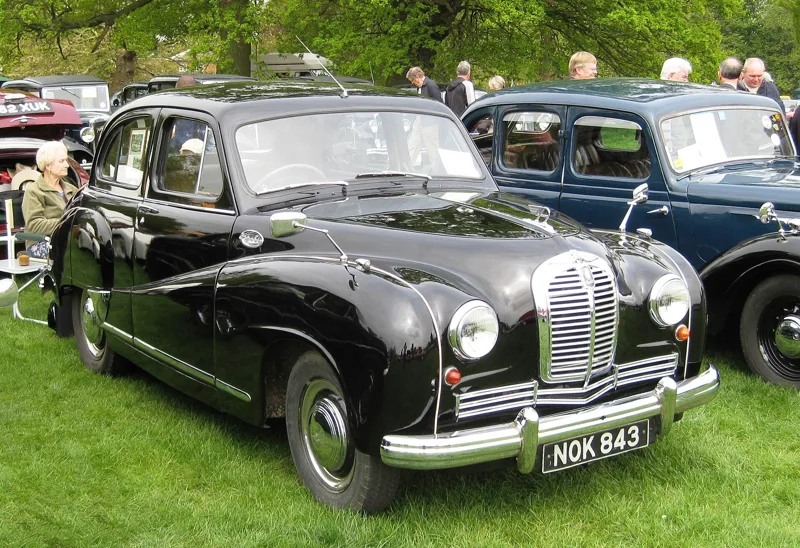
SUs sat under the bonnets of Morris, MG, Rolls-Royce, Bentley, Rover, Riley, Austin, Jaguar, Aston Martin, Triumph and, from Sweden, Volvo, and stayed on production cars until 1994, in the Mini and the Maestro. Hitachi built SU-licensed carburettors for the Datsun 240Z and 260Z. Rivals copied the principle with the Stromberg CD of the early 1960s, the Ford/Motorcraft VV, which came a couple of decades later, and the Keihin CV and Bing CV on motorcycles, yet none matched the SU's success. It might have spread further still had it not belonged to Morris and its successors, since rival car makers may not have wanted to depend on a competitor's component.
Amal: carburettors for the motorcycle industry
Amal supplied a large share of Britain's motorcycles. The firm took shape in the late 1920s, when Amac, Brown and Barlow, and Binks pooled their businesses, trading as Amalgamated Carburetters Ltd and becoming Amal Ltd in 1931. Its customers included Triumph, BSA and AMC. The IMI Group took full ownership by the mid 1960s, Grosvenor Works of north London bought the business after June 1973, and in 2003 it passed to Burlen Fuel Systems, which also makes SU, Solex and Zenith carburettors.
Standard, Monobloc and Concentric
Amal's road designs are slide carburettors in three generations. The Standard range of 1929 had a bronze body, brass internals and a float chamber on a separate arm. Sand-cast bodies were costly, so die-cast zinc alloy arrived in 1932. Dust still got in through the idle and air-bleed circuits and blocked jets, so from 1939 the 274, 275, 276 and 289 types took that air from the filtered intake.
The Monobloc, dated to 1954 in one telling and 1955 in another, folded the float chamber into the main casting to cut cost. Fitting two to a twin proved awkward because the float chamber stuck out on the left, so Amal made a chopped version without one, and Triumph twins ran two of them from a single remote float chamber. A mirror-image 689 followed in 1964 so each carburettor could have its own. Monobloc production stopped in 1967, but an aluminium-bodied 375 returned in 2014.
The Concentric came next, introduced for the 1967 or 1968 model year, depending on the telling. Its hemispherical float chamber sits directly below the main jet, which stops the fuel level shifting in corners. Pending emission controls called for more accurate fuel metering, which was one reason for the change. Bores ran from 12 to 32 mm across the 400, 600 and 900 series, and a 1000 series with 34 to 38 mm bores joined them in 1970. After 1975, with British motorcycle manufacturing in decline, production was limited to replacement and aftermarket sales.
Later variants followed: a Spanish-licensed Mark 1.5 in 1973 with its own cold-start circuit, and an aluminium Mark 2 in 1974.
Racing Amals
Competition carburettors followed their own path. The Type 27 took its lead from a 1924 AMAC design and used two float chambers, one on each side, to cut fuel surge in corners. The TT arrived in 1932, the RN in 1937 and the GP in 1954, and the GP and TT were found on machines such as the BSA Gold Star and the Velocette Thruxton.
Bendix-Stromberg: the pressure carburettor
A float carburettor has a fatal flaw in a fighter. In a steep dive the float, momentarily weightless, rises and shuts the fuel valve, so the mixture goes leaner than 16:1 and the engine dies. Fly inverted and the opposite happens: the float opens the valve, the pump overfills the bowl, the mixture goes richer than 9:1 and the engine stops again. There was another enemy as well. When fuel vaporises it cools the air around it, sometimes below freezing, and ice builds on the throttle plate and inside the carburettor.
No float, no problem
Bendix-Stromberg engineers moved the fuel nozzle below the throttle plates, or to the eye of the supercharger, and removed the float entirely. A servo-operated poppet valve took over from the float-operated inlet valve. Fuel is held under pressure from the pump, and the venturi is used only to measure how much air is arriving rather than to suck fuel out. The first Bendix-Stromberg pressure carburettor, a model PD12-B, flew on an Allison V-1710-7 in 1936.
Inside, the regulator is a stack of diaphragms forming four chambers, labelled A to D. Chambers A and B compare air pressures from the venturi and from impact tubes, which together describe the quantity and density of the incoming air. Chambers C and D compare the fuel pressure before and after the jets. The balance of those two forces moves a rod that opens or closes the metering valve. The pilot's fuel control has idle-cutoff, auto lean and auto rich positions, and on some carburettors a military setting for maximum if life-shortening power.
The significance goes beyond aircraft. The floatless pressure carburettor is regarded as the forerunner of single-port fuel injection. Late in the Second World War, engines with a specific horsepower above 1.0 were fitted first with distributed fuel injection, which measured air in the same way but fed each cylinder through its own line, and then with direct injection, which became the preferred system. Descendants of those systems still sit on high-performance light-aircraft engines in the 21st century.
The pressure carburettor was one of three types used on large American aircraft engines in the war. The other two, from Chandler Groves (later Holley) and Chandler Evans, had many internal parts, and the Holley's variable-venturi design brought complications of its own.
Holley: Detroit's carburettor and the drag strip
George and Earl Holley were teenagers when they built a one-cylinder three-wheeled Runabout in Bradford, Pennsylvania, in 1896, with a top speed of 30 mph. By 1902 their Motorette sold for $550, and more than 600 were built. The company dates its official start to 1903, when it began mass-producing carburettors for Henry Ford, and its first original design, nicknamed the iron pot, went onto the curved-dash Oldsmobile in 1904. The carburettor made for Ford's Model T was an immediate success, and Holley became one of Ford's biggest suppliers.
The firm's later fame came from performance. The Double Pumper and the Dominator became its signature carburettors, and until electronic fuel injection took over, Holley-style units drove the whole NASCAR Sprint Cup field and every NHRA Pro Stock champion. In 1952 it produced the Visi-flo, with a glass bowl that let an owner watch the float at work.
Colt Industries bought Holley in 1968, when it employed about 3,000 people at four facilities. A management-led team paid $100 million for Holley Performance in 1998, and after bankruptcy filings in 2008 and 2009 the company emerged on 22 June 2010.
Why fuel injection replaced the carburettor
| Design | How it meters fuel | Where it was used |
|---|---|---|
| SU | Piston and tapered needle move with engine suction | British cars including Mini and Maestro until 1994; Datsun under licence |
| Amal | Slide moved by the rider's throttle cable | Triumph, BSA and AMC motorcycles; racing machines |
| Bendix-Stromberg | Floatless; air measurement drives a fuel metering valve under pressure | High-performance wartime aircraft engines |
| Holley | Mass-produced designs, later tuned for racing | Detroit cars, NASCAR and NHRA Pro Stock |
Several threads run through the four stories. Accuracy comes first. The SU's strength was matching fuel to air demand, and the Bendix-Stromberg went further by measuring airflow and metering fuel directly, a design regarded as the progenitor of single-port injection. When aircraft engines grew more powerful, fuel injection became the system of choice. Emissions entered the picture too: Amal's Concentric was designed partly because pending emission controls demanded more accurate metering.
Holley's own record shows the handover in cars and racing. The company entered fuel injection in the 1980s with OEM electronic components and Pro-Jection retrofit systems for carburettor cars, later developing digital versions called Pro-Jection 4D and 4Di. In 2011 NASCAR decided to switch from carburettors to fuel injection for the 2012 Sprint Cup season, and Holley billet aluminium throttle bodies were selected alongside McLaren Electronic Systems and Freescale Semiconductor. Holley's HP EFI engine control unit became standard in all NHRA Pro Stock cars in 2016 and on the optional NT1 engine in NASCAR's Truck Series in 2018.
What it means if you own or drive one
A car with SU carburettors asks for small rituals: topping up the dashpot with light oil, and setting the mixture by moving the jet on its fine-threaded screw. The reward is simplicity, with no multiple jets to juggle. A motorcyclist can fit an SU to a bike that came with a slide carburettor and expect better economy and gentler low-speed manners.
Parts have not disappeared. Burlen Fuel Systems of Salisbury builds SU carburettors, pumps and parts, aimed mostly at classic cars, and Amal spares are still made for the same audience. An owner who wants injection can look to retrofit kits of the kind Holley has sold since the 1980s.
Who still makes SU, Amal and Holley carburettors
The carburettor's future is largely in classic and specialist hands. The new SU company that Burlen formed in 1996 continues to build carburettors for classic cars. Amal launched the Premier in 2012, with an aluminium body and a float resistant to the ethanol in modern fuel, and brought back the Monobloc in aluminium alloy in 2014, while Talleres Arreche in Spain still builds a descendant of the 400 series with 16, 18 and 20 mm bores.
Holley, meanwhile, announced in March 2021 a merger agreement with the special purpose acquisition company Empower Ltd that would put it on the New York Stock Exchange under the ticker HLLY.