A Korean nameplate that began as a Jeep licence, a Mercedes-engined SUV and pickup, an Italian-styled flagship and an MPV that Top Gear loved to mock.
The SsangYong Korando, Musso, Rexton and Rodius form the SUV and people-carrier core of the South Korean brand, now badged KGM. The Korando began as a Jeep licence, the Musso and Rexton used Mercedes-Benz engines, and the Rodius MPV ran from 2004 to 2019.
SsangYong's oldest nameplate began life as a licensed American Jeep. Korando is short for Korea Can Do, and the Guinness Book of Records lists it as Korea's longest surviving name on a car. The Musso, the Rexton and the oddball Rodius all came later.
Between them, the four names cover much of the company's SUV and people-carrier business. They also show how a smaller Korean manufacturer survived by borrowing: Jeep licences first, then Mercedes-Benz engines and gearboxes, then Italian styling, and eventually a parent company in India, Mahindra & Mahindra.
SsangYong Korando history, from licensed Jeep to electric crossover
The story starts in 1964, when Ha Dong-hwan Motor Company began assembling Jeeps, trucks and buses for the US armed forces and the United Nations Command. In November 1969 the CJ-5 entered production there with a 75 hp (56 kW) Willys Hurricane four-cylinder engine, and in 1971 a ten-seater and a pickup joined it. American Motors and Shinjin Motors formed a joint venture in April 1974 to build local Jeeps, first with a locally built AMC 258 ci six-cylinder of 110 hp (82 kW). After the oil crises, an Isuzu 2.8-litre diesel with 85 hp (63 kW) arrived in July 1979.
Ownership kept shifting. AMC pulled out of South Korea in August 1978, and Shinjin sold a shipment of Jeeps to Libya in 1979 despite an embargo, which invalidated the licence. Keohwa took over production in March 1981 and rotated the bars in the grille so the car looked less like a Jeep. A nine-seater, the Family Deluxe, followed in November 1982, and in March 1983 the range took the Korando name.
Keohwa was absorbed by Dong-A in December 1984. The March 1985 facelift swapped the large diesel for a 2238 cc Isuzu C223, dropped the pickup and added a 2-litre Isuzu petrol in June. Exports began to Japan in 1986 and to Europe in 1988. Dong-A joined the SsangYong Group in November 1986, and the company took the SsangYong Motor Company name in March 1988. The Jeep-based Korando finally ended in 1996, although a separate Korando Family built on an Isuzu Trooper chassis had appeared in late 1988 with no link to the Jeep beyond its name.
The second-generation Korando of 1996 was a different animal. Designed by Professor Ken Greenley, it was a 1.8 tonne three-door mini SUV on a shortened Musso chassis. It reached Asia in 1996, Europe in 1997 and Australia in 1998, with petrol and diesel engines built under Mercedes-Benz licence and a five-speed Borg-Warner manual gearbox. Its dashboard had a steering-wheel arch on both sides, so that converting it to right-hand drive was easy and cheap. Daewoo sold it as the Daewoo Korando from 1999 to 2001, after buying a majority stake in SsangYong that it was later forced to sell. Production ended in 2006, though stock kept sales going in many markets through 2007, and TagAZ in Russia built it as the Tager from 2008.
Korando means Korea Can Do, and Guinness lists it as Korea's longest surviving name on a car.
The Korando from the C200 to the E-Motion
The third-generation Korando, codenamed C200, went into production in late 2010 as the first car in a revised line-up. It had a slightly longer wheelbase than the Hyundai ix35 and Kia Sportage, and in Russia it was sold as the New Actyon. Reviewers liked the design, the interior space and the monocoque body. It became SUV of the year in Macedonia for 2012.
Its concept cars were busy. The C200 itself debuted at the 2008 Paris Motor Show, and many people hoped it would repair the brand's reputation for questionable styling. A C200 Aero followed at Seoul in 2009 and reached production a year later as the Korando C with almost no change. The C200 Eco was a diesel-electric hybrid with stop-start. At Busan in 2010 came a Korando C concept with a 2.0-litre turbo diesel of 135 kW (184 PS; 181 hp) and 360 Nm, and a Korando EV concept with a 180 km range.
The production car arrived with a 2.0-litre turbodiesel of 175 horsepower, front-wheel or four-wheel drive, six airbags and a boot of 480 litres, expanding to 1300 litres with the seats folded. Combined fuel consumption was 5.5 L/100 km and the 0-100 km/h time was under 10 seconds. Petrol power arrived in 2012. A 2013 facelift added LED daytime running lamps, a 2.2-litre Euro 6 diesel replaced the 2.0 in 2016, and a second facelift followed in 2017.
The fourth generation, the C300, was teased on 28 January 2019, launched in South Korea on 26 February and shown at Geneva. Buyers chose a 163 horsepower 1.5-litre turbo petrol or a 136 horsepower 1.6-litre diesel. The Korando E-Motion is the electric version and the first fully electric SsangYong, from the 2022 model year. Its 61.5 kWh battery gives a WLTP range of 339 km and feeds a 140 kW (190 hp), 360 Nm motor driving the front wheels.
SsangYong Musso: Mercedes engines, then a pickup
The SsangYong Musso was produced from 1993 as a collaboration with Daimler-Benz and styled by the Briton Ken Greenley. The SUV came with Mercedes-Benz engines throughout: 2.8-litre and 3.2-litre inline-six petrols, a 2.3-litre four-cylinder petrol, and 2.3-litre four-cylinder and 2.9-litre five-cylinder diesels. A turbo intercooler option arrived for the diesels in 1997. It took the Auto Design Award at the Birmingham show in 1994 and 1996, and won the 4WD class of the Rallye des Pharaons in October 1994. The SUV seated five, or seven in rare models with a folding boot seat.
It travelled widely. Morattab Khodro has built it in Iran since 2003, Mekong Auto sold it in Vietnam from 1997 to 2005, and TagAZ in Russia produced it as the Road Partner from 2008 to 2011. From 1995 to 1999 SsangYong built it for the UK market, and then Daewoo took over and relabelled it the Daewoo Musso with a new grille. Germany got it too. Production of the Daewoo Musso ended in the latter half of 2002, two years before General Motors rebadged Daewoo.
The dual-cab Musso Sports, the P100 series, arrived in 2002 with a Mercedes-designed engine and gearbox and five seats. Its production is dated to 2005 in some places and 2006 in others, while the SUV itself ended in 2005.
SsangYong Musso pickup, the Q200 and the Q300
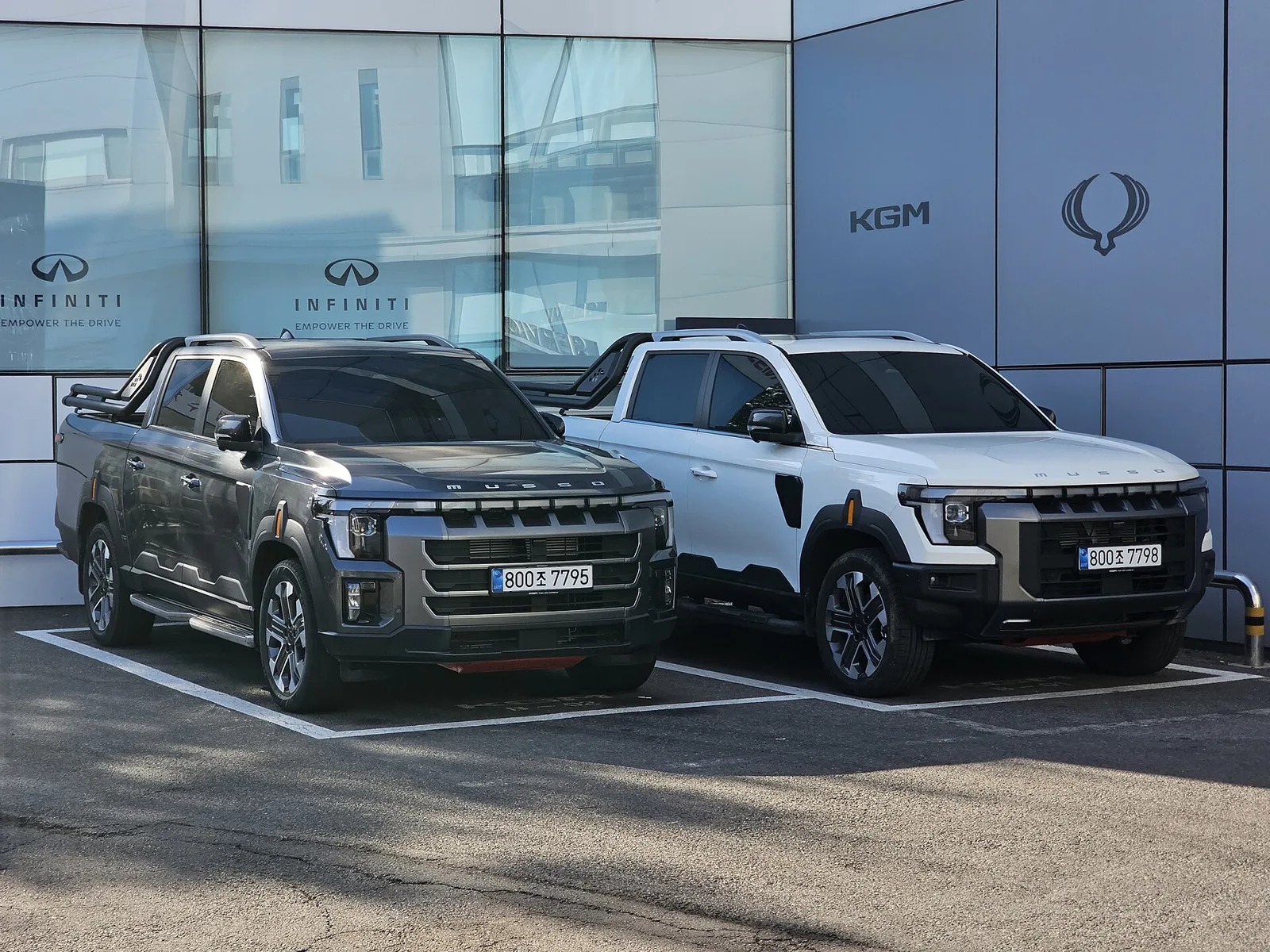
The name returned in March 2018 at the Geneva Motor Show on an all-new pickup, the Q200. In Italy, South Korea and Taiwan it is sold as the Rexton Sports, where Musso means donkey in Venetian. It sits on SsangYong's body-on-frame platform, built from advanced high-strength steel and shared with the second-generation Rexton.
Buyers could pick a 2.0-litre turbo petrol with 225 hp (168 kW) or a 2.2-litre diesel with 181 hp (135 kW), both shared with the Rexton, with two-wheel drive or part-time four-wheel drive and a six-speed manual or an AISIN six-speed automatic. The suspension is five-link with an optional locking differential. In Australia, the long-wheelbase XLV uses rear leaf springs as standard on the base ELX and as an option on the Ultimate. In the United Kingdom, the long-wheelbase truck is called the Musso Rhino, borrowing the New Zealand name for a top-spec trim. Six airbags, autonomous emergency braking, blind-spot detection and rear cross-traffic alert are fitted.
The Rexton Sports Culmen concept of May 2023 previewed an upcoming Musso facelift. The second-generation Q300 KGM Musso debuted in the Korean market in December 2025.
SsangYong Rexton: Giugiaro styling and a flagship role
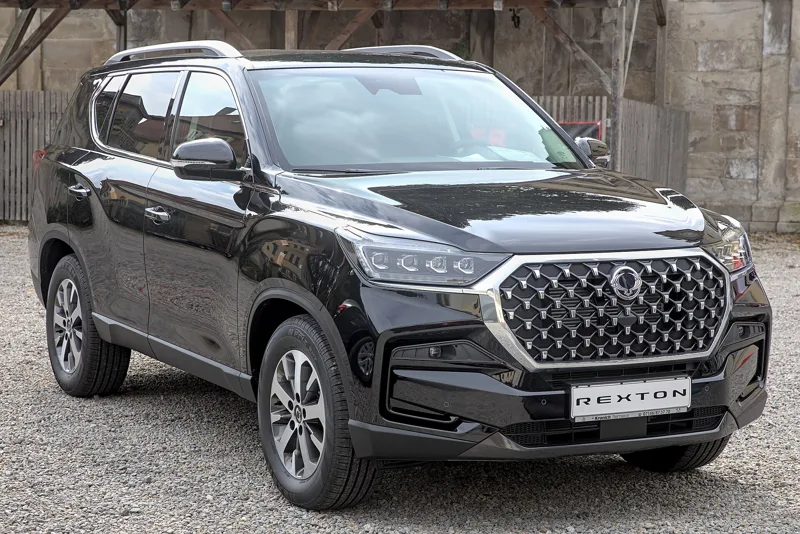
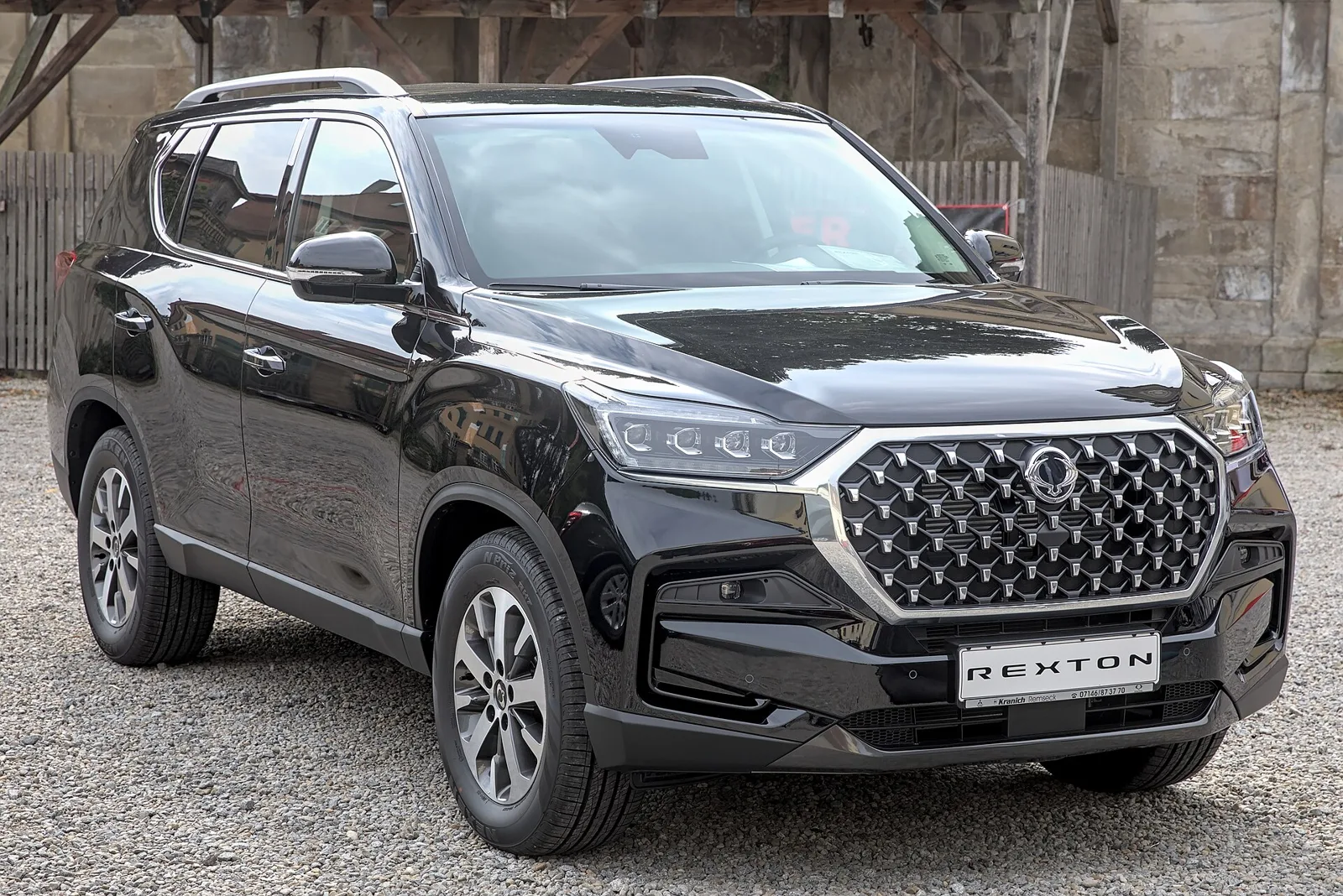
Rexton comes from the Latin word rex and the English word tone, meant to suggest the ruler's tone, and it has been the company's mid-size SUV since late 2001. The Y200 generation ran to 2006. Giorgetto Giugiaro's Italdesign studio styled it, and it came only with four-wheel drive and a choice of four engines: a 2.3-litre petrol of 112 kW (150 hp), a 2.7-litre common-rail diesel of 121 kW (162 hp) and 342 Nm (252 lb ft), a 2.9-litre diesel, and a 3.2-litre petrol of 162 kW (217 hp) and 310 Nm (229 lb ft). The 2.7 was based on a Mercedes OM612 engine but heavily re-engineered by SsangYong.
In France and other European markets it wore a Daewoo badge, without technical changes, until early 2003. In June 2003 it reached Europe as a SsangYong on a slightly extended Musso chassis, at first with only a 2.9-litre five-cylinder diesel and a 3.2-litre six-cylinder petrol, both borrowed from the Musso. Diesel buyers had a five-speed Tremec manual or a four-speed automatic from BTR Automotive, and the petrol came only as an automatic. From 2004 the 2.7-litre diesel could be paired with a five-speed Mercedes automatic.
The early-2006 upgrade added a catalysed particulate filter and a variable-geometry turbocharger. South Korea classed the 2008 Rexton as low-emission, so owners were exempt from a quasi tax for five years. New features included a tyre-pressure monitor, electronic toll collection and a forward collision warning system. In 2008, the tuning firm Project Kahn showed a Rexton 270 SPR at the British International Motor Show, and in 2009 it joined the British range. Its uprated diesel made 186 PS (137 kW) and 402 Nm (296 lb ft) at 2400 rpm.
The Rexton W unveiled at Busan in 2012 was the first facelift under Mahindra & Mahindra, with a new grille and lamps, a Euro 5 2.0-litre diesel from the Korando and a retuned 3.2 petrol. At the end of 2015 Europe received a Euro 6 2.2-litre diesel with a Mercedes 7G-Tronic automatic.
There was also a copy. In 2005, SG Automotive released the Huanghai Aurora, which looked much like the Rexton. SsangYong chose not to sue, citing the Chinese lawsuit system, and only told SAIC, its largest shareholder then.
Second-generation Rexton and the Mahindra link
The Y400 Rexton traces back to the LIV-1 concept and the LIV-2 shown at the 2016 Paris Motor Show. It debuted at Seoul in 2017 and in Germany that year, and SsangYong says the Parthenon inspired its design. It uses the new body-on-frame platform with advanced high-strength steel, and its towing capacity rose to as much as 3,500 kg. It has an electric parking brake with auto hold. Engines mirror the Musso pickup's: a 2.0-litre petrol turbo of 225 horsepower (168 kW; 228 PS) and a 2.2-litre diesel of 181 horsepower, with Mercedes 7G-Tronic, AISIN or manual gearboxes.
Awards stacked up. The Ergonomics Society of Korea gave it a Best Ergonomic Design prize, and it won the Prime Minister's award at the 2017 Korean Good Design awards. 4x4 Magazine named it Best Value 4x4 for six years running through 2023. Safety kit includes nine airbags and a suite of driver aids, and in Korea's KNCAP test it earned five stars and 88.5 points.
Mahindra sold a rebadged version in India as the Alturas G4, shown at the 2018 Auto Expo and placed above the XUV500. Assembled at Chakan from kits supplied by SsangYong's Pyeongtaek plant, it was Mahindra's flagship until it was discontinued in late 2022 because of poor sales and marketing. A facelift of the Rexton itself, the Y450, was unveiled in September 2019 as a 2020 model.
SsangYong Rodius: the MPV people loved to hate
The Rodius went on sale in late 2004. The name is an inaccurate blend of road and Zeus, meant to mean Lord of the Road, and in Australia, New Zealand, South America, Southeast Asia and Africa it is sold as the Stavic. It was offered in 7, 9 and 11 seat layouts, with a five-seater in Hong Kong. Its seats could fold into tables, fold double to add cargo space, turn round to face each other and slide forward and back.
Mercedes licences supplied the engines: a 3.2-litre six-cylinder petrol that made 309 Nm (228 lb ft) alongside 162 kW (217 hp), and a 2.7-litre five-cylinder diesel with 342 Nm. Reviewers called the diesel dated but liked its Mercedes underpinnings. Greenley, formerly of the Royal College of Art, aimed to evoke a luxury yacht.
Reviewers were less kind about almost everything else at launch, from build quality and handling to refinement, safety and interior finish. They did praise the space, practicality, price, seat count, after-sales service, available four-wheel drive and generous warranty. Many became airport taxis. In 2015 the first-generation Rodius became a favourite of Banger racing because of its high centre of gravity and strength in a crash, and was banned from the sport in 2017, the second vehicle after the Chrysler Imperial in 2016.
The looks drew most of the fire. Top Gear Magazine gave it a 2009 WTF award, Jeremy Clarkson called it an unholy merger of a coupe and a removal van, Richard Hammond called it rather ugly, and journalists settled on the nickname Odious Rodius. Readers of the Daily Telegraph voted it the ugliest car on the road, with 29 percent of the vote. SsangYong denied it was ugly and said the car had a strong emotional component. In 2017, Top Gear joined a pre-facelift Rodius to a boat chassis to build a luxury yacht, the SsangYacht, which Eddie Jordan tested in Monaco harbour for Boat International.
A facelift in August 2008 eased the complaints without ending them. Europe dropped the car on 31 December 2011 without a successor, but it returned on 2 July 2012 as the Rodius Euro, with a 155PS e-XDi200 diesel and a six-speed manual or Mercedes 5G-Tronic automatic.
The second generation, shown at Geneva in 2013 after a reveal on 5 February, was called the Korando Turismo in South Korea and the Turismo in the UK because the predecessor had been so poorly received there. It offered five, seven, nine, ten or eleven seats and up to 3,240 litres of cargo volume, with a 2.0-litre turbo diesel, a six-speed manual and a Mercedes automatic. From 2016 it had a seven-speed e-Tronic gearbox and met Euro VI. The Stavic won Best MPV Design in Thailand's Grand Prix magazine awards at the 35th Bangkok International Motor Show in March 2014. A final facelift came in July 2018, with a new grille, bumper, bonnet, wings, steering wheel and infotainment screen.
SsangYong models side by side
| Nameplate | Name means | Type | Years |
|---|---|---|---|
| Korando | Korea Can Do | Mini or compact SUV | 1983 to 2006, then 2010 onward |
| Musso | Donkey in Venetian | SUV, then pickup | SUV 1993 to 2005, pickup from 2018 |
| Rexton | The ruler's tone | Mid-size SUV | Late 2001 onward |
| Rodius | Lord of the Road | MPV | Late 2004 to 2019 |
What these SsangYong models mean for buyers
Much of the tale is about engines. Mercedes-Benz units sit inside the Musso, the early Korando, the Rexton and the Rodius, which is why reviewers often praised the mechanicals when they disliked the rest. Four-wheel drive is the common thread: the first Rexton had nothing else, and a Rodius could be ordered with it. The newer cars share a platform, so a Musso pickup and a second-generation Rexton are close relatives under the skin.
Badges matter too. Daewoo sold the Musso, Korando and Rexton at different times, so older cars can carry either name.
KGM badges and the end of the Rodius
The nameplates now carry the KGM badge, as SsangYong Motor has become KG Mobility. The Q300 Musso debuted in Korea in December 2025, and the Rexton Sports Culmen concept of May 2023 pointed to a pickup facelift. For the Rodius, the plan ended in 2019. SsangYong cited poor sales and the Euro 6D-Temp rules, which its 2.0-litre and 2.2-litre diesels could not be modified to meet, and said it would focus on crossovers, SUVs and pickup trucks.