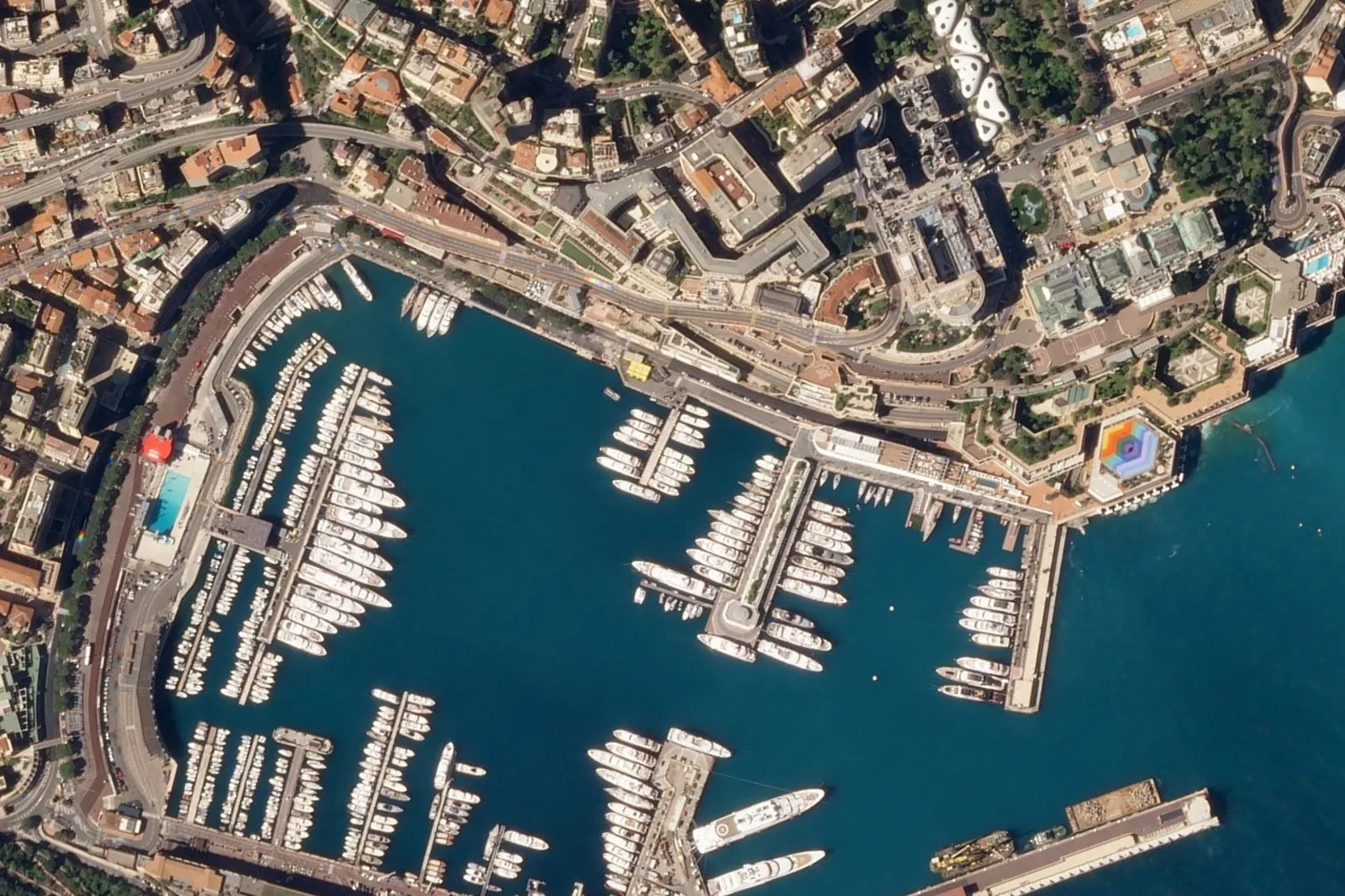
A refused club application began it in 1929. Nearly a century on, a race with almost no overtaking is still on the Formula One calendar.
The Monaco Grand Prix began in 1929 after the local motor club was refused national status for lacking a major home event. It survives because of its prestige as part of the Triple Crown, even though the narrow streets make overtaking rare and the circuit is judged less safe than modern tracks.
In 2021 the Monaco Grand Prix ran for 78 laps and produced exactly one overtake, made on the opening lap by Mick Schumacher on his own teammate Nikita Mazepin. That single statistic captures Formula One's most famous race: a track so tight that passing is close to fantasy, on a weekend that stays on the calendar year after year.
Monaco Grand Prix history: the application that started it
The race exists because a motor club was turned down. The Automobile Club de Monaco, led by its president Antony Noghes, already organised the Rallye Automobile Monte Carlo. In 1928 it asked the international governing body of the day, the AIACR, to elevate it from a regional French club into a full national one. The answer was no. A rally that mostly ran on the roads of other countries could not count as a major event held wholly inside the principality.
Noghes proposed a Grand Prix through the streets of Monte Carlo instead. He secured the blessing of Prince Louis II, plus the backing of Louis Chiron, a Monegasque racing driver who thought the local topography would make a fine track.
The first race took place on 14 April 1929. It was by invitation only, and it set very different cars against one another in the Formula Libre manner. The leading Maserati and Alfa Romeo drivers stayed at home, but Bugatti arrived in force. William Grover-Williams won in a works Bugatti Type 35B, entered under the pseudonym "Williams".
Mercedes had no 2-litre Grand Prix car, so it sent its best driver, Rudolf Caracciola, in a big, heavy 7-litre SSK sports car. He started fifteenth, charged into the lead, then lost four and a half minutes to refuelling and a tyre change and had to settle for second. Baron Philippe de Rothschild also raced under a false name, "Georges Philippe". Chiron was absent because he had already committed to the Indianapolis 500.
Caracciola's SSK was refused entry the following year. Chiron did start, in a works Bugatti Type 35C, but privateer Rene Dreyfus beat him in a Type 35B. Chiron finally won in 1931 at the wheel of a Bugatti, and until 2024 he stayed the sole Monaco-born winner.
Riding a bicycle around your living room: Nelson Piquet's verdict on racing at Monaco.
From Grande Epreuve to the world championship
Within a few years the race was a fixture. The AIACR formally recognised the most important event of each national club as an International Grand Prix, or Grande Epreuve, and in 1933 Monaco was ranked as one alongside the French, Belgian, Italian and Spanish races. That year's event was also the first Grand Prix to decide the grid by practice times rather than by balloting. Achille Varzi and Tazio Nuvolari swapped the lead many times before Varzi prevailed on the last lap, after Nuvolari's car went up in flames.
In 1936 Monaco joined the new European Championship as a round, and the weather turned savage. A storm and a broken oil line triggered a chain of crashes that removed the Mercedes-Benz cars of Chiron, Fagioli and von Brauchitsch, plus the Auto Union of the newcomer Bernd Rosemeyer. Caracciola, nicknamed Regenmeister (Rainmaster), won. In 1937 von Brauchitsch beat him in a straight duel. It was the last race before the war: in 1938 the organisers could not make a profit and the AIACR balked at demands for nearly 500 pounds in appearance money per top entrant, so the event was cancelled.
Racing resumed after the war without Monaco, which sat out 1945 to 1947 for financial reasons. It came back in 1948, under the new Grand Prix formula, and Nino Farina won in a Maserati 4CLT. A motorbike race shared the programme that year. The death of Prince Louis II cancelled the 1949 event, and the principality joined the new Formula One World Drivers' Championship in 1950, when Juan Manuel Fangio took the first of his World Championship wins there and the 51-year-old Chiron finished third.
The calendar was far from stable. There was no race in 1951 because of budget worries and a lack of regulations. In 1952 it ran to sports car rules and did not count towards the championship, and neither 1953 nor 1954 saw a race at all because the car regulations had not been settled. The Grand Prix returned in 1955 and began a streak of 64 consecutive years on the calendar. Maurice Trintignant won that year, and Chiron, at 56, became the oldest driver ever to line up for a Formula One Grand Prix.
Stirling Moss produced a giant-killing drive in 1961, fending off a trio of works Ferrari 156s with a year-old Lotus 18 run by the privateer Rob Walker team, for his third Monaco win.
Monaco GP most wins: Hill, Senna and the winners list
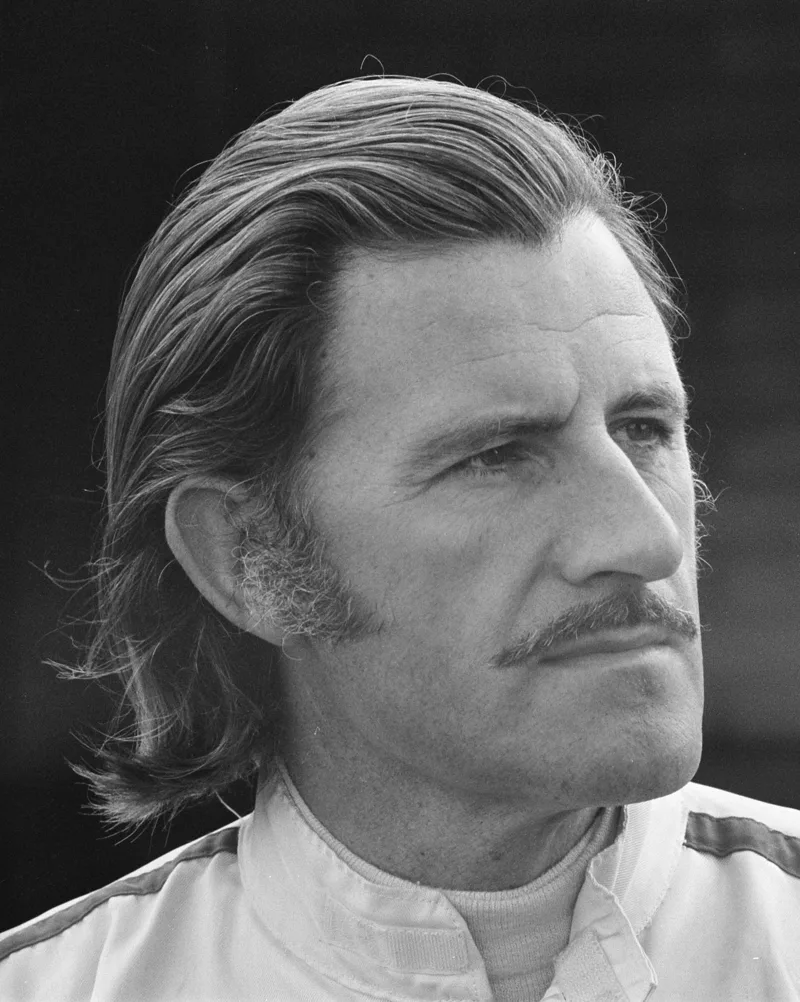
Ayrton Senna holds the record with six victories, including five in a row between 1989 and 1993. Before him the town belonged to Graham Hill, whose five wins in the 1960s earned him the names "King of Monaco" and "Mr. Monaco". He took his first in 1963 and the next two straight after it, and won twice more, the second time in 1969. That win was his last in a Formula One championship race, by which time he was a double world champion.
His 1965 victory is the one people remember. Hill took pole, led from the start, then took to an escape road on lap 25 to avoid a slow backmarker. He rejoined in fifth place, set several lap records and won anyway. Jim Clark skipped that race to compete at the Indianapolis 500, and Paul Hawkins put his Lotus into the harbour. Jackie Stewart won in 1966 and Denny Hulme in 1967, which filled the gap in Hill's run.
The decade from 1984 to 1993 belonged to two men only. Alain Prost and Senna shared every win. Prost had already won the Formula Three support race in 1979, and his first Grand Prix victory in 1984 came in odd circumstances. Heavy rain delayed the start by 45 minutes. Nigel Mansell passed Prost on lap 11 and crashed five laps later. By lap 27 Prost led from Senna's Toleman and Stefan Bellof's Tyrrell, with both closing fast, Bellof in the one car with a naturally aspirated engine. On lap 31 the race was stopped, controversially, because conditions were judged undriveable.
The 1982 race shows how the circuit can throw up a winner nobody planned. Rene Arnoux led for 15 laps before retiring. Prost took over and stayed in front until four laps remained, then spun on the damp surface, struck the barriers and shed a wheel. Riccardo Patrese inherited the lead and spun himself with a lap and a half left, which handed the front to Didier Pironi, with Andrea de Cesaris behind. On the final lap Pironi's tank ran dry in the tunnel, and De Cesaris ran dry too before he could pass. Patrese, meanwhile, had bump-started his car and rolled on to a first Grand Prix victory.
Local success is rarer. In 83 editions only two Monegasque drivers have won the Grand Prix: Chiron in 1931 and Charles Leclerc in 2024, the first to do it as a round of the Formula One World Championship. Counting feeder races, four locals have won at the circuit: Stefano Coletti in a 2013 GP2 sprint race, Stephane Richelmi in a 2014 GP2 sprint race, plus Chiron and Leclerc. A year after Leclerc's win, Lando Norris set the first lap below 1:10 at Monaco and went on to win the race.
How has the Monaco circuit changed?
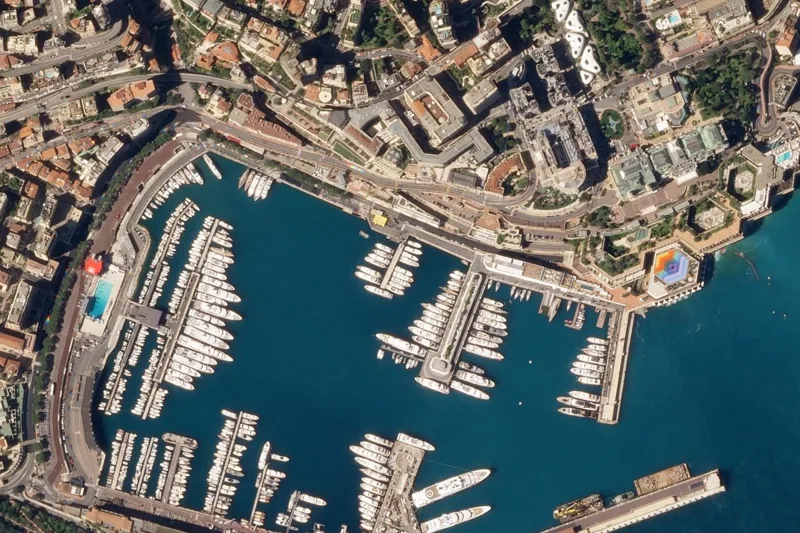
Surprisingly little, given that the layout follows ordinary town roads. The current lap is 3.337 km (2.074 mi) around the harbour, through Monte Carlo and La Condamine, and the track is commonly and even officially known as "Monte Carlo". Almost every alteration has been forced by the redesign of the streets themselves.
| Year | Change |
|---|---|
| 1929 | Start and finish on Boulevard Albert 1er, leading to Sainte Devote |
| 1955 | Start line switched to the other straight, beside the promenade |
| 1963 | Start line moved back to Boulevard Albert 1er |
| 1969 | First Armco barriers installed, at selected points |
| 1972 | Pits moved to the harbour area; circuit almost completely Armco-lined |
| 1973 | New swimming pool section adds 0.133 km, taking the lap to 3.278 km (2.037 mi) |
| 1976 | Sainte Devote and Antony Noghes corners slowed with kerbs and protections |
| 1986 | Port chicane widened and slowed, renamed Nouvelle Chicane |
| 2003 | Port lane widened; Piscine to Rascasse section made faster; new pit buildings |
| 2004 | Pits reversed, so they separate the track from the pit lane |
| 2015 | Tabac re-profiled; lap shortened by three metres, from 3.340 km to 3.337 km |
Early photographs show how raw the place once was. Until the 1969 Armco, conditions were virtually identical to everyday road use. A driver who slid off had a chance to meet buildings, trees, lamp posts, shop windows and even a railway station, and in the cases of Alberto Ascari and Paul Hawkins, the Mediterranean. The pits now give Monaco another oddity: it is the only Formula One circuit where the pits lie between the track and the pit lane rather than facing the track.
What is a lap of the Monaco circuit like?
The lap begins with a short sprint up Boulevard Albert 1er to Sainte Devote, a right-hander of nearly 90 degrees normally taken in first or second gear. Many first-lap accidents have happened here, though fewer since the mini roundabout on the apex went before the 2003 event. The cars then climb Avenue d'Ostende, where the gradient peaks at around 12%, and change down for the long left at Massenet.
Past the famous casino the cars reach Casino Square, 44 m (144 ft) above the lowest part of the lap, then snake down Avenue des Beaux Arts and avoid an enormous bump on the left. Mirabeau is tight, and the Fairmont Hairpin beyond it is tighter. It is the slowest corner in Formula One, taken at just 48 km/h (30 mph), and two modern cars could scarcely get round it side by side because drivers need full steering lock. Many teams redesign their steering and suspension specifically for it.
Portier, a double right-hander named after the region of Monaco, feeds into the tunnel. Light turns to dark and back to light at one of the fastest places on the lap, where the flat-out kink is taken at 260 km/h (160 mph). A car can lose 20 to 30% of its downforce in there. When it rains the tunnel tends to stay dry apart from the water the cars drag in on their tyres. Before the very wet 1984 race, Bernie Ecclestone had local fire crews wet the road in the tunnel so it matched the grip of the rest of the track, because Niki Lauda of McLaren had asked for it.
Braking out of the tunnel leads to the left-right-left Nouvelle Chicane, the scene of heavy accidents involving Karl Wendlinger (1994), Jenson Button (2003) and Sergio Perez (2011). It is usually the one spot on the lap where a move can be attempted. A short straight follows, down to Tabac, which takes its name from a tobacconist that used to stand on the outside of the corner.
Why is overtaking at Monaco nearly impossible?
Width, mostly. The circuit is narrow, full of elevation changes and tight corners, so it rewards driver skill over engine power. Nelson Piquet compared a lap there with "riding a bicycle around your living room". Results tend to be settled by grid position and pit strategy, while gearboxes and brakes suffer badly over the race distance.
Before 1987 the number of cars starting the race at Monaco was limited to 20, compared with 26 at other circuits. The tunnel adds its own difficulty: drivers are said to find the quick switch from light to dark and back again hard to cope with at one of the fastest points on the lap.
Why is Monaco GP so famous?
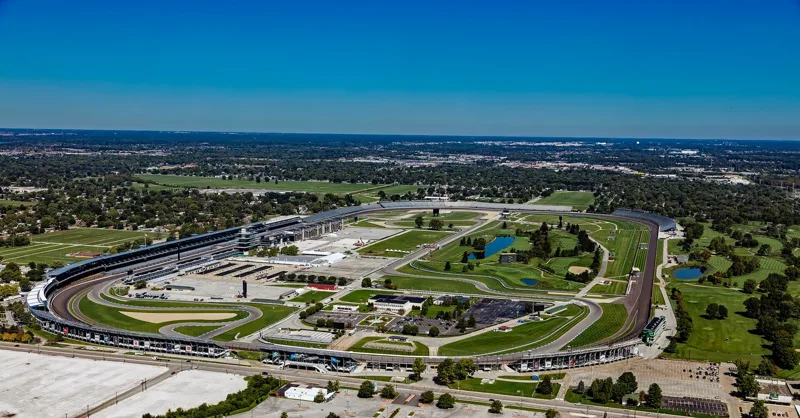
Part of the answer is the setting, a harbour town whose circuit is described as "an exceptional location of glamour and prestige". Part is the sporting weight. The race is widely considered one of the most important and prestigious in the world, and victory counts towards the Triple Crown of Motorsport, together with the 24 Hours of Le Mans and the Indianapolis 500. In January 2009 a poll of 3,500 British sports fans ranked the circuit first for the "Seven Sporting Wonders of the World".
It is also a one-off. Every other Grand Prix is held to the FIA's mandated minimum race distance of 305 km (190 miles); Monaco alone falls outside it. The circuit hosts three weekends of racing in April and May: the Formula One Grand Prix, the Formula E Monaco ePrix and the Historic Grand Prix of Monaco. Feeder series such as Formula 2, FIA Formula 3 and the Porsche Supercup run alongside Formula One.
Putting the track together takes six weeks, and dismantling it after the race takes another three.
Why does Monaco survive on the F1 calendar?
Safety is the obvious objection. The circuit is generally recognised as less safe than other Formula One venues, and Michael Schumacher said before the 2012 race that the extra risk was "justifiable once a year". Were it not already a Grand Prix, it would not be permitted onto the schedule for safety reasons. In 2011, after several accidents including a serious one for Sergio Perez, drivers called for changes between the tunnel exit and the Nouvelle Chicane, complaining about the road surface and the guard rail in the escape road. Those requests were not followed up.
Yet the race has repeatedly proved too valuable, and too stubborn, to lose. In the early 1970s Bernie Ecclestone began using the combined negotiating strength of the Formula One Constructors Association (FOCA) to challenge organisers. The Automobile Club de Monaco had always set the number of cars permitted at a low figure of around 16. In 1972 Ecclestone started negotiating deals that relied on a guarantee of at least 18 entrants at every race, and a stand-off put that year's race in jeopardy until the club agreed that 26 cars could take part. Two years later, in 1974, it got the number of cars permitted back down to 18.
In 1983 the club struck its own television deal with ABC in the United States, breaking a rule that all rights should be negotiated centrally. Jean-Marie Balestre, president of the sport's governing body FISA, announced that Monaco would not be part of the 1985 world championship. The club fought the case in the French courts, won, and the race was reinstated.
Where this goes next
The Formula One date has long been a source of friction with American racing. Until 2026 the Monaco date, frequently placed around Ascension Thursday, clashed with big American events at the end of May, on Memorial Day weekend: the Indianapolis 500 and NASCAR's Coca-Cola 600.