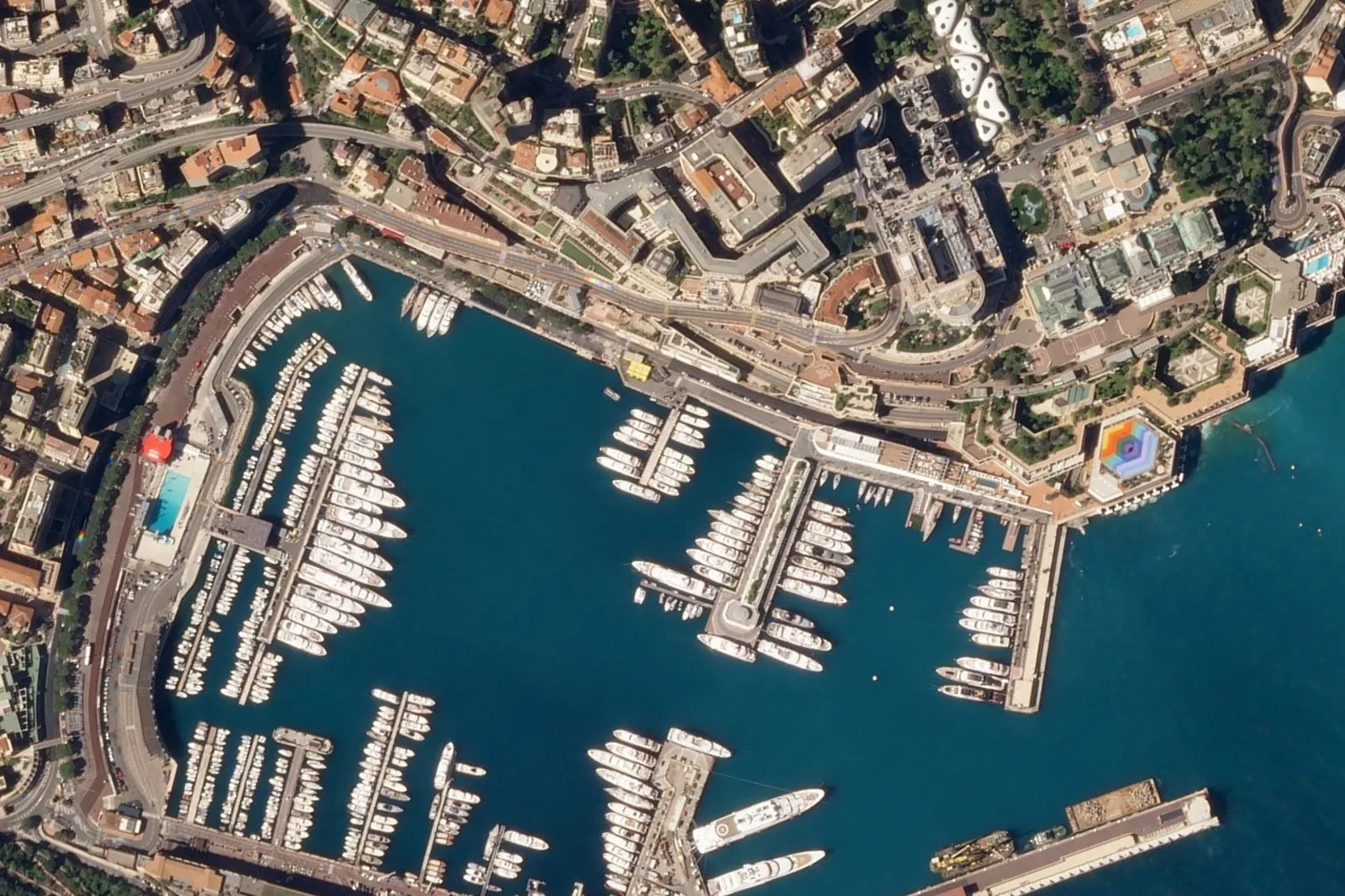
A 3.337 km harbour loop through the streets of Monte Carlo, where a single tunnel, a slow hairpin and very few overtakes shape every race.
The Monaco circuit is a 3.337 km (2.074 mi) street course on the roads of Monte Carlo, first used for a Grand Prix in 1929. Its tunnel, the slow Fairmont Hairpin and narrow streets make overtaking rare. Charles Leclerc was the first Monegasque driver to win the Monaco Grand Prix as a Formula One World Championship event.
The Circuit de Monaco measures 3.337 km (2.074 mi) and winds through the Monte Carlo and La Condamine streets around the harbour of the Principality of Monaco. It hosts Formula One, Formula E and historic racing, and it is the only Formula One circuit where the pit garages sit apart from the racing line. Its narrow streets, tunnel and tight corners make it one of motor sport's most demanding tests.
The circuit is often called Monte Carlo, because most of it lies inside that neighbourhood. The Monaco Grand Prix is also one of three events that complete the Triple Crown of Motorsport.
How did the Monaco Grand Prix begin?
The first Monaco Grand Prix was held in 1929, and William Grover-Williams took the opener in a Bugatti. The idea came from Antony Noghes, president of the Automobile Club de Monaco and a close friend of the ruling Grimaldi family. The race became a long-running fixture on the calendar from that point onwards.
The Monaco circuit has produced a small group of local winners. Louis Chiron won the non-championship 1931 Monaco Grand Prix. Stefano Coletti won a GP2 sprint race in 2013, Stephane Richelmi did the same in 2014, and Charles Leclerc won the 2024 Monaco Grand Prix as the first Monegasque to win it as a Formula One World Championship event.
Lando Norris set the fastest time at Monaco the year after Leclerc's win, the first lap below the 1:10 mark, and went on to win the race.
A narrow harbour street circuit where one tunnel and one slow hairpin decide far more than raw power.
How has the circuit changed over time?
The track has barely changed since 1929, because its shape follows the principality's road system. The main alterations have been small, including start and finish moves in 1955 and 1963, a harbour section added in 1973 and a series of safety and pit changes in the decades that followed.
In 1973 a new harbour section added 0.133 km (0.083 mi) and brought the total length to 3.278 km (2.037 mi). The tunnel was extended toward the Portier curve during the same work, because a new hotel was being built above it.
Later changes were mostly about safety and space. The harbour chicane became a double 90-degree turn in 1986, the traffic divider at Sainte Devote was removed in 2003, and the pit garages were reversed in 2004 so that they sit apart from the racing line. Land reclaimed from the harbour in 2002 gave the paddock more room, and the Tabac curve was re-profiled in 2015, cutting the lap to 3.337 km (2.074 mi).
What are the main sections of the lap?
The lap begins with a short climb and the tight Sainte Devote corner, then runs past the casino, the Fairmont Hairpin and the tunnel before reaching the Nouvelle Chicane, Tabac, Piscine, La Rascasse and Antony Noghes. The slowest corner in Formula One and one of the quickest tunnel kinks both sit within this sequence.
| Corner | Character | Speed or detail |
|---|---|---|
| Sainte Devote | Nearly 90-degree right-hander | Usually taken in first or second gear |
| Fairmont Hairpin | Slowest corner in Formula One | 48 km/h (30 mph) |
| Tunnel kink | Flat out, with a sudden change of light | 260 km/h (160 mph) |
| Tabac | Tight fourth-gear corner | About 195 km/h (121 mph) |
| Piscine | Fast left-right, then a slower right-left | Cars accelerate to 225 km/h (140 mph) |
| La Rascasse | 135-degree right-hander | Demands full steering lock |
The climb along Avenue d'Ostende is steep, with a maximum gradient of around 12 percent. Casino Square sits 44 m (144 ft) above the lowest part of the circuit,.
The tunnel is one of a kind on the Formula One calendar. Until 2009 only Detroit had one, and cars can lose 20 to 30 percent of their downforce inside it. The rest of the track often stays wet while the tunnel stays dry, which led Bernie Ecclestone to have local fire crews wet the road before the 1984 race at Niki Lauda's request.
Why is overtaking so rare at Monaco?
Overtaking is rare because the track is narrow, the corners are slow and the best chance for a move comes at the chicane after the tunnel. In the 2021 race only one pass was made, on the opening lap, when Mick Schumacher overtook his team-mate Nikita Mazepin.
Nelson Piquet likened the experience to riding a bicycle around your living room. Qualifying often decides the outcome, because a grid position is hard to recover from, and race results are frequently settled by pit strategy rather than wheel-to-wheel racing.
Criticism has grown since the start of the 21st century. Commentators and drivers say the design produces dull races, pointing to few overtaking moves and how often the pole-sitter wins. Fernando Alonso called one race the most boring ever, and Lewis Hamilton said the 2018 Grand Prix was not really racing.
Ideas to help include extending the track along the east side of Hercules harbour and adding a second DRS zone. Monaco has only one DRS zone, along the pit straight, which covers 510 m (560 yd). Suzuka and Imola are the only other circuits with one zone.
How do the cars need to be set up for Monaco?
Monaco needs high downforce, but not mainly for cornering speed. Most corners are taken so slowly that the aerodynamic effect is small, so the downforce is used to shorten braking distances and keep the car stable under acceleration. Teams use special wing assemblies and closer ratio gears, which were allowed until 2014.
Brakes are not a wear problem at Monaco, because the speeds are low. The difficulty is keeping them at working temperature, since cold carbon discs can become glazed and lose bite. Juan Pablo Montoya adopted radially grooved discs in 2006 to improve bite and raise the average brake temperature.
Cooling is a major concern because Formula One cars have no forced cooling and rely on airflow alone. Teams once opened the radiator intakes to create the so-called Monaco nose, and a special steering rack with a larger pinion gear was fitted so the cars could be driven around the tightest corners.
Experiments also fail. In 2001 Jordan and Arrows tried new mid-wings to add downforce, but the FIA banned both after they were tested during Thursday practice.
Is the Monaco circuit considered safe?
The circuit is generally recognised as less safe than other Formula One venues, mainly because of its narrow margins and the tunnel. Michael Schumacher said that the extra risk was justifiable once a year.
The Nouvelle Chicane has seen several large accidents, and those involving Wendlinger in 1994, Button in 2003 and Perez in 2011 are among the notable ones.
Four drivers have died in crashes at the circuit. Norman Linnecar died in 1948, Luigi Fagioli in 1952, Dennis Taylor in 1962 and Lorenzo Bandini in 1967.
Where else does the circuit host racing?
The circuit hosts the Historic Grand Prix of Monaco each April, the Formula E Monaco ePrix and the Formula One Monaco Grand Prix, with feeder series such as the FIA Formula 2 and FIA Formula 3 championships and the Porsche Supercup running alongside.
Formula E used a shorter 1.760 km (1.094 mi) layout in 2014-15, 2016-17 and 2018-19, and a 3.318 km (2.062 mi) layout from 2021. The full Formula One layout was used from 2022.
Rallies and cycling have used the streets too. The 2008 Monte Carlo Rally included a super special stage on a shorter layout, and the 2026 WRC edition ran with its start-finish at La Rascasse. The 2009 Tour de France opened with an individual time trial partly on the circuit, which Fabian Cancellara won.
What is the weather like at the Monaco Grand Prix?
Race day falls on the final Sunday of May, and the weather is usually mild, with ambient temperatures of about 20 degrees Celsius (68 Fahrenheit). Rain is the real danger, because the painted surfaces and the tunnel make wet racing extremely difficult.
Wet conditions have caused trouble in 1984, 1996, 1997, 2008, 2016, 2022 and 2023. The 1984 race was red-flagged and never restarted. In 1996 mixed conditions brought Olivier Panis a shock win in a Ligier, and in 1997 the race ended after only 62 of the planned 78 laps.
How did the paddock and pit lane change?
The pit lane and paddock have been reworked several times in recent decades. The first Piscine corner was modified in 1997 to improve visibility, and in 1998 the paddock was surrounded by shatterproof fences to control access. Widening the harbour lane in 2003 made room for new grandstands and a larger pit lane.
The 2003 changes also brought semi-permanent two-storey buildings to replace the tiny prefabricated structures the teams had used before. When the pit garages were reversed in 2004, Monaco became the only Formula One circuit where the pits are not facing the track but are physically separate from the pit lane.
How much does skill matter more than power at Monaco?
Monaco favours driver skill over the power of the cars, because the track is tight and twisty and the short straights leave little room to use a big engine. Before 1987 the field was limited to 20 starters, compared with 26 at other circuits, which made qualifying even more decisive than it already was.
Race outcomes tend to be decided by grid positions and pit strategy, so the team's decisions can matter as much as a driver's pace. The race is also very hard on gearboxes and brakes, which means reliability is a constant concern over a full race distance.
What did the 2011 complaints involve?
After several accidents during the 2011 race weekend, drivers pressed for changes to the section between the exit of the tunnel and the Nouvelle Chicane. Their complaints focused on a disconnected road surface and the guard rail positioned on the escape route opposite the tunnel.
Those requests were not followed up, and the chicane has remained one of the most discussed sectors on the lap. Sergio Perez suffered a rather serious accident there during that weekend.