An argument over engine size started it. Six decades later McLaren has 205 Formula One wins, a Triple Crown and a supercar built with Mercedes-Benz.
McLaren began in 1963 when Bruce McLaren left Cooper to race in the Tasman Series. It has won 205 Formula One races and 10 Constructors' titles, is owned through the McLaren Group by Mumtalakat Holding Company, and built the Mercedes-Benz SLR McLaren, sold from 2003 to 2010.
McLaren exists because of an argument about engine size. In the early 1960s Bruce McLaren, a works driver for Cooper, wanted to race in the Australasian Tasman Series, where the rules allowed 2.5-litre engines. Cooper's owner, Charles Cooper, insisted on the 1.5-litre Formula One units. So Bruce built his own team, and what began as a way to go racing in the southern summer grew into the second most successful team in Formula One, with 205 race wins to its name.
McLaren history: how Bruce McLaren started the team
The New Zealander Bruce McLaren set up Bruce McLaren Motor Racing in 1963. Bruce had won three Grands Prix for Cooper and finished second in the 1960 World Championship. When Charles Cooper would not budge on engines, Bruce set up a team to run himself and his prospective F1 team-mate Timmy Mayer in custom-built Cooper cars.
He won the 1964 Tasman series, but Mayer died in practice for the last race, at Longford in Tasmania. Bruce then asked Teddy Mayer to help him buy a Zerex sports car from Roger Penske. Talk turned to partnership, and Teddy Mayer bought into the company and ended up its largest shareholder.
The team ran under a British racing licence, and its base moved from Feltham in 1963 and 1964 to Colnbrook from 1965 until 1981, then to Woking, where it has been ever since. Yet Bruce never used British racing green. His first Formula One car, the M2B that raced at the 1966 Monaco Grand Prix, was white with a green stripe, painted to stand in for a fictional team in the film Grand Prix.
Mercedes did the styling; McLaren took responsibility for everything else.
How McLaren grew in Formula One
The debut at Monaco in 1966 lasted nine laps before a terminal oil leak ended it. The M2B, designed by Robin Herd, was let down by its engines, first a 3.0-litre development of Ford's Indy 500 unit and then a Serenissima V8. Neither had enough power or reliability. For 1967 Bruce planned to use a BRM V12, but delays forced him to start with a modified Formula Two car, the M4B, and then a larger car, the M5A. The best result of the season was fourth at Monaco.
Cosworth power and a first win
The upturn came in 1968. Denny Hulme, the 1967 champion and a fellow New Zealander already racing for McLaren in Can-Am, joined Bruce. The new M7A, Herd's last design for the team, carried the new Cosworth DFV engine, which McLaren would use until 1983. Bruce won the non-championship Race of Champions at Brands Hatch and then took the team's first championship victory at the Belgian Grand Prix. Hulme added wins in Italy and Canada, and McLaren finished second in the Constructors' Championship.
In 1969 McLaren tried four-wheel drive in the M9A, which ran only once, at the British Grand Prix with Derek Bell. Bruce likened driving it to trying to write your signature while somebody jogs your elbow. The fifth win arrived in the final race of that season, when Hulme won in Mexico.
Bruce died in June 1970, in a testing crash at Goodwood in the new M8D Can-Am car, and Teddy Mayer took effective control of the team. Hulme carried on, partnered at times by Dan Gurney and Peter Gethin, and in 1972 he won in South Africa, the team's first Grand Prix victory in two and a half years. McLaren finished that year third in the Constructors' Championship, and Jody Scheckter made his Formula One debut for it at Watkins Glen.
The first titles
The M23, designed by Gordon Coppuck, arrived in 1973 and remained the team's mainstay for four years. In 1974 the Lotus world champion of two years earlier, Emerson Fittipaldi, joined. He won in Brazil, Belgium and Canada and clinched the Drivers' Championship with fourth place in the final race, in the United States, three points clear of Ferrari's Clay Regazzoni. With Hulme and Mike Hailwood alongside him, he also delivered McLaren's first Constructors' Championship. That year also began the long Marlboro sponsorship.
When Fittipaldi left for his brother's team at the end of 1975, Mayer turned to James Hunt, a driver his biographer said had a dubious reputation. In 1976 Niki Lauda in his Ferrari led Hunt 56 points to 26 at midseason. Then Lauda crashed heavily at the German Grand Prix, nearly died, and missed two races. Hunt won four more times and went to the finale in Japan three points behind. It rained torrentially, Lauda retired over safety concerns, and Hunt finished third to take the Drivers' title. McLaren lost the Constructors' Championship to Ferrari.
Then came a lean spell. The M26 replaced the M23 in 1977, and Hunt won three times, but Ferrari and Lauda were too strong. Lotus took the 1978 titles with ground-effect cars, which the M26 lacked. Coppuck's M28 for 1979 fared no better, and McLaren ended that year eighth, with John Watson scoring only 15 points.
Ron Dennis, Honda and the dominant years
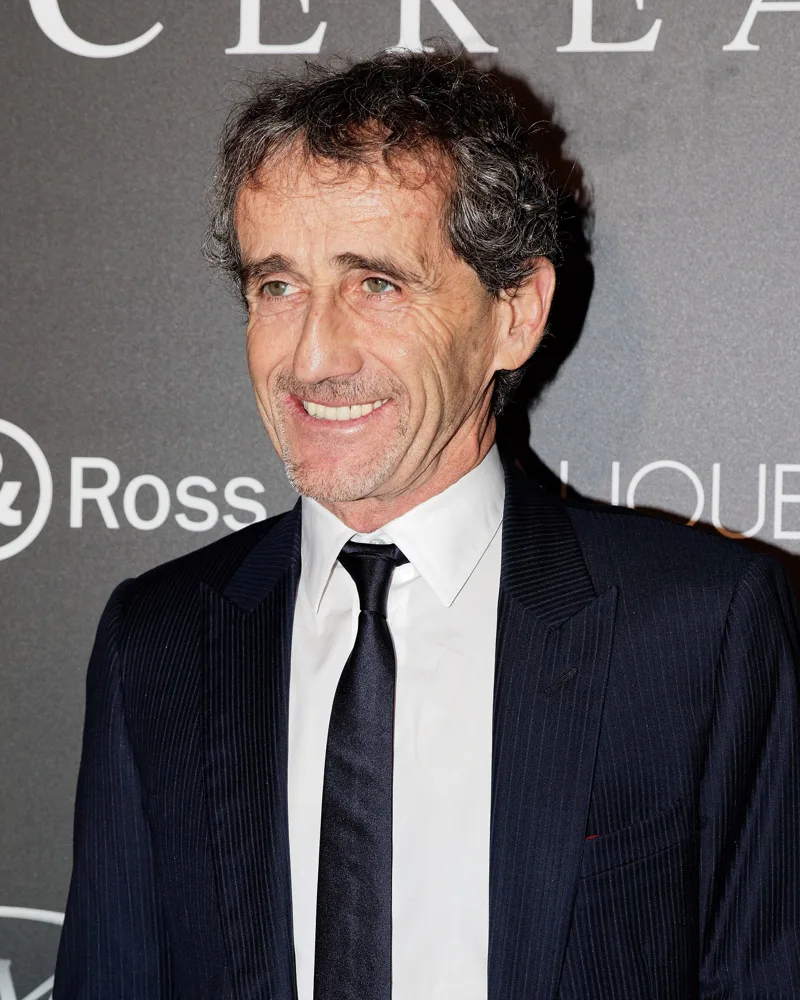
Ron Dennis' Project Four Racing merged with McLaren in 1981. Dennis became team principal and shortly afterwards bought out the original shareholders. The most successful era followed: on Porsche and Honda power, Niki Lauda, Alain Prost and Ayrton Senna collected seven Drivers' Championships, and the team six Constructors' titles.
The Prost and Senna pairing was especially dominant in 1988, taking all but one race, although the rivalry later turned sour and Prost moved to Ferrari. The partnership with Honda between 1988 and 1991 produced four consecutive Constructors' Championships, and in 1988 the team won 15 of the 16 races. Williams offered the most consistent challenge of the period, the two teams between them taking every constructors' title from 1984 to 1994.
By the mid-1990s Honda had pulled out and Senna had joined Williams, and McLaren endured three seasons without a victory. Recovery came with Mercedes-Benz engines, West sponsorship and the designer Adrian Newey, previously of Williams. Mika Hakkinen won the Drivers' Championship in 1998 and 1999, and the team was a regular front-runner through the 2000s. Lewis Hamilton took the 2008 drivers' title.
Setbacks and the climb back
Dennis retired as team principal in 2009 and handed over to the long-serving Martin Whitmarsh, who was ousted at the end of 2013 following the worst year since 2004. McLaren said it would take Honda engines from 2015 in place of Mercedes-Benz, and the McLaren Honda name returned at the 2015 Australian Grand Prix, for the first time since 1992. The second Honda spell brought poor results. In September 2017 McLaren agreed a supply deal with Renault from 2018 to 2020, and from 2021 returned to Mercedes-Benz engines, under a deal that runs to at least 2030.
After a spell in the midfield, McLaren started 2023 poorly yet climbed to fourth in the Constructors' standings. In 2024 it won its ninth Constructors' title, the first since 1998. The following year Lando Norris won the Drivers' Championship, the team's first since 2008, and McLaren took a tenth Constructors' title and a second in a row, the first back-to-back since 1991. That made it the second most successful team in history by Constructors' Championships.
What has McLaren won beyond Formula One?
McLaren is the only team, and one of just three constructors, to complete the Triple Crown of Motorsport, with wins at the Indianapolis 500, the 24 Hours of Le Mans and the Monaco Grand Prix. It won Le Mans in 1995 with a modified McLaren F1 road car. It has also won the Can-Am sports car championship, and in American open-wheel racing it has been both an entrant and a chassis constructor.
Arrow McLaren, its IndyCar entry, has taken 10 wins since absorbing Sam Schmidt Motorsports in 2020. McLaren has also tried Formula E and Extreme E, with less success than elsewhere, and withdrew from both.
Endurance racing is on its list again: the team intends to re-enter the FIA World Endurance Championship in 2027 with the McLaren MCL-HY, an LMDh car. Its 1000th Grand Prix entry came at the 2026 Chinese Grand Prix, making it the second constructor after Ferrari to reach that mark.
Who owns McLaren?
McLaren Racing Limited, which competes as the McLaren Mastercard F1 Team, works from the McLaren Technology Centre in Woking, Surrey. It belongs to the McLaren Group, and Mumtalakat Holding Company owns that group outright.
That has not always been the arrangement. When the SLR was in development, Mercedes-Benz held 40 percent of the McLaren Group, and the two companies built the car together.
Where does the Mercedes-Benz SLR McLaren fit?
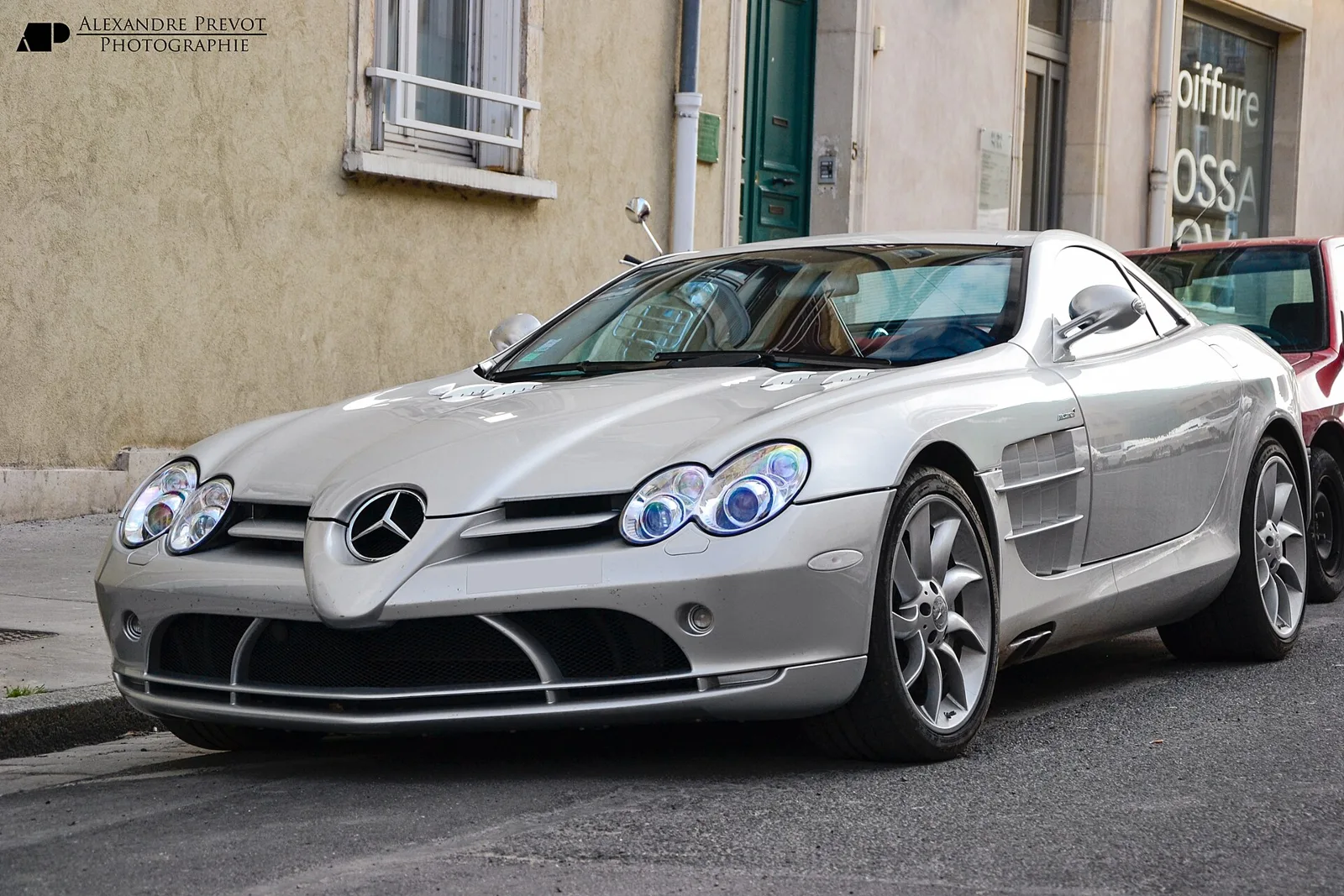
The Mercedes-Benz SLR McLaren is a grand tourer developed jointly by Mercedes-Benz and McLaren Automotive and sold from 2003 to 2010. Its name abbreviates Sport Leicht Rennsport, or Sport Light Racing, and honours the Mercedes-Benz 300 SLR. It came as a coupe and a roadster, plus a limited-edition speedster.
The story starts with a show car. Mercedes-Benz showed the Vision SLR concept at the 1999 North American International Auto Show, inspired by the 1955 300 SLR Uhlenhaut Coupe and by closed-wheel Formula One cars. It was presented as the Tomorrow Silver Arrow, a reference to the Silver Arrows of the 1950s, and was powered by a 5.0-litre supercharged AMG V8 making 565 PS (416 kW; 557 hp). Reception was positive, so Mercedes joined forces with its Formula One partner, McLaren.
The split of work was clear. Mercedes did the styling, while McLaren took responsibility for everything else, from design and engineering to manufacture and the testing of every car on the production line. During development two TVR Cerberas were modified as test mules for the engine. The production car was unveiled on 17 November 2003, with major design changes from the concept. To give it the performance Mercedes wanted, McLaren radically changed the concept for better weight distribution. It moved the engine almost a metre back, to about 50 centimetres behind the front axle, and lowered the fuel tank.
Engineering and performance
The SLR uses a hand-built 5.4-litre (5,439 cc) supercharged all-aluminium V8 weighing 232 kg (511 lb). A Lysholm-type twin-screw supercharger spins at up to 23,000 rpm, producing 0.9 bar (13 psi) of boost, and two intercoolers cool the compressed air. It makes 626 PS (460 kW; 617 hp) at 6,500 rpm, with 780 N m (575 lbf ft) available from 3,250 to 5,000 rpm. Power passes through a five-speed AMG SPEEDSHIFT R automatic with three manual modes. Mercedes preferred it to its seven-speed gearbox for durability, since that unit was more complex.
Carbon-fibre reinforced plastic keeps weight down, though the kerb weight is still 1,750 kg (3,858 lb). Top speed is 207 mph (333 km/h). Car and Driver recorded 0-60 mph in 3.4 seconds and a quarter mile in 11.2 seconds at 130 mph (209 km/h), and its 30-50 mph and 50-70 mph top-gear times of 1.7 and 2.4 seconds were the fastest the magazine had measured in any production car. Motor Trend managed 3.3 seconds to 60 mph in April 2006, and Road & Track 3.5 seconds in July 2005.
The brakes were Sensotronic brake-by-wire units with carbon-ceramic discs, which Mercedes claims resist fade up to 1,200 degrees C (2,200 degrees F). Eight-piston callipers grip 370 mm (14.6 in) front discs, and in the wet they skim the surface to keep it dry. The rear spoiler doubles as an air brake and rises automatically at a set speed to 10 degrees, going as high as 30 degrees when the driver asks for more downforce. Because of the flat underbody and rear diffuser, the exhausts exit at the sides of the car.
The SLR family compared
| Version | Power | Top speed | Acceleration | Production |
|---|---|---|---|---|
| SLR McLaren coupe | 626 PS (460 kW; 617 hp) | 333 km/h (207 mph) | 0-60 mph in 3.4 s (Car and Driver) | 2003 to 2010 |
| 722 Edition (2006) | 650 PS (478 kW; 641 hp) | 337 km/h (209 mph) | 0-100 km/h in 3.6 s | 150 units |
| Roadster (2007) | 626 PS (460 kW; 617 hp) | 334 km/h (208 mph) | 0-100 km/h in 3.6 s | Dropped early 2009 |
| Roadster 722 S | Same engine as the 722 Edition | 334 km/h (208 mph) | 0-100 km/h in 3.1 s | 150 units |
| 722 GT (2007) | 680 PS (500 kW; 671 hp) | 315 km/h (196 mph) | 0-97 km/h in 3.3 s | 12 built, 21 planned |
| Stirling Moss (2009) | 650 PS (478 kW; 641 hp) | 350 km/h (217 mph) | 0-100 km/h in 3 s | 75 units |
The special editions
The 722 Edition of 2006 takes its name from the Mille Miglia win of Stirling Moss and Denis Jenkinson in 1955 in a 300 SLR wearing number 722, which indicated a 7:22 a.m. start. The car has a stiffer damper set-up, a ride height 10 mm (0.39 in) lower, 19-inch alloy wheels and larger 390 mm (15.4 in) front brakes. It reaches 200 km/h in 10.2 seconds and 300 km/h in 27.6 seconds.
The roadster went on sale in September 2007. The roof uses a newly developed material rather than folding metal, and once unlatched by hand it retracts electrically in ten seconds. An official Mercedes document says driver and passenger can still hold a conversation at up to 200 km/h (124 mph) with it down. It was aimed at rivals such as the Pagani Zonda F Roadster, though the extra weight of a convertible affected its performance and handling.
The 722 GT was a racing version for a one-make series called the SLR Trophy, built by Ray Mallock Ltd at the request of enthusiasts and with Mercedes-Benz approval. It shed 398 kg (877 lb) to reach a dry weight of 1,390 kg (3,064 lb), gained wider bodywork and a fixed racing wing, and produced 830 N m of torque at 1.75 bar of boost. Inside it had Recaro bucket seats, a roll cage and a digital display. In North America it was sold through Renntech.
The 2008 Crown Edition came from the King of Bahrain, who ordered ten cars with 722-specification parts to give to fellow Arab royals. The last special was the Stirling Moss of 2009, a speedster with no roof or windscreen, designed by Yoon Il-hun with an interior by Sarkis Benliyan. About 200 kg (441 lb) lighter than the regular model, it began production in June 2009. All 75 planned cars were finished by December 2009, available only to existing SLR owners, each costing in excess of US$1 million.
Where this goes next
Mercedes announced on 4 April 2008 that it would discontinue the SLR. The roadster was dropped in early 2009, and the last coupes left the line at the end of 2010. The Stirling Moss was due to be the last series under the Mercedes-Benz partnership, but McLaren announced a final edition of its own in late 2010.
On the track, McLaren's Formula One engine deal with Mercedes is in place until at least 2030.
What this means for fans and buyers
For anyone who follows McLaren, the pattern is long runs of success separated by lean spells, with engine partners such as Ford-Cosworth, Honda, Mercedes-Benz and Renault shaping each period. For anyone considering a McLaren-built road car from the SLR years, the choice runs from the standard coupe to the 150-unit 722 Edition and the roadster, and up to the 75-car Stirling Moss, which cost more than US$1 million.