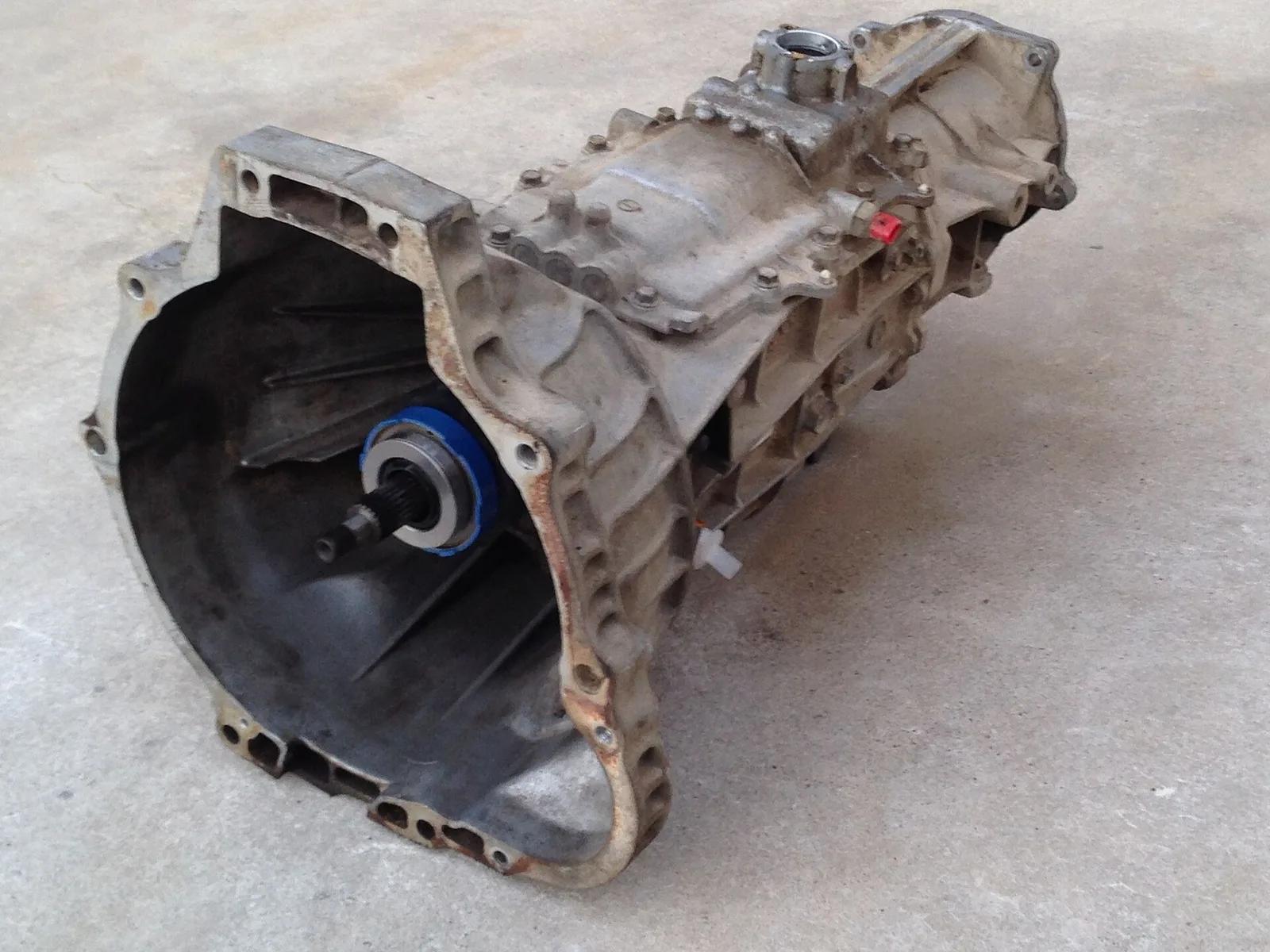
From 75.2% of Western Europe's output in 2008 to a rarity in the United States, the stick shift is losing ground to automatics and dual-clutch boxes.
Manual gearboxes are fading because automatics suit the rising number of electric and hybrid cars, work more easily with safety systems, and have closed the old gaps in cost and efficiency. Mercedes and Volvo no longer sell manuals, UK new cars have been mostly automatic since 2020, and the United States was at 2.4% manual in 2020.
In 2008, 75.2% of the vehicles built in Western Europe had a manual gearbox. Since 2020, most new cars sold in the United Kingdom have been automatics, and in the United States only 2.4% of new cars still carry a clutch pedal.
How does a manual gearbox work?
The driver presses the clutch pedal to disconnect the engine from the gearbox, moves the lever to choose a ratio, then lets the pedal up to reconnect. Inside the box, gear pairs are permanently in contact, and picking a gear simply locks one pair to the output shaft. Every other pair spins freely.
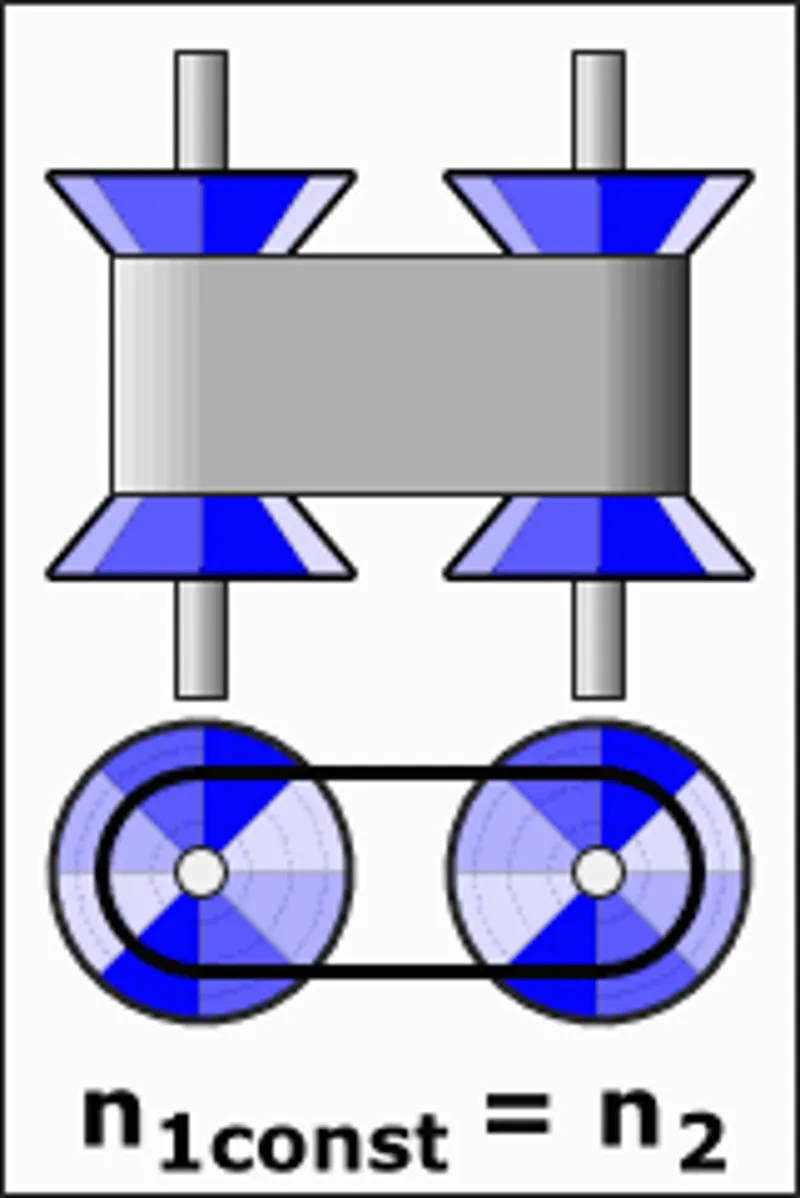
Begin with the clutch. A flywheel is fixed to the end of the engine's crankshaft, so it turns at engine speed whenever the engine runs. A friction disc sits against it, pressed in place by springs, and that disc drives the gearbox input shaft. Press the pedal and the pressure is released, so engine and gearbox can turn at different speeds. Think of it as a grip you can tighten or loosen: firm and everything passes through, loose and the surfaces slide against each other. Sliding is needed to pull away from rest, but it wears the disc, so it should be kept brief. Most manual cars use a dry clutch, worked by linkage, hydraulics or a cable.
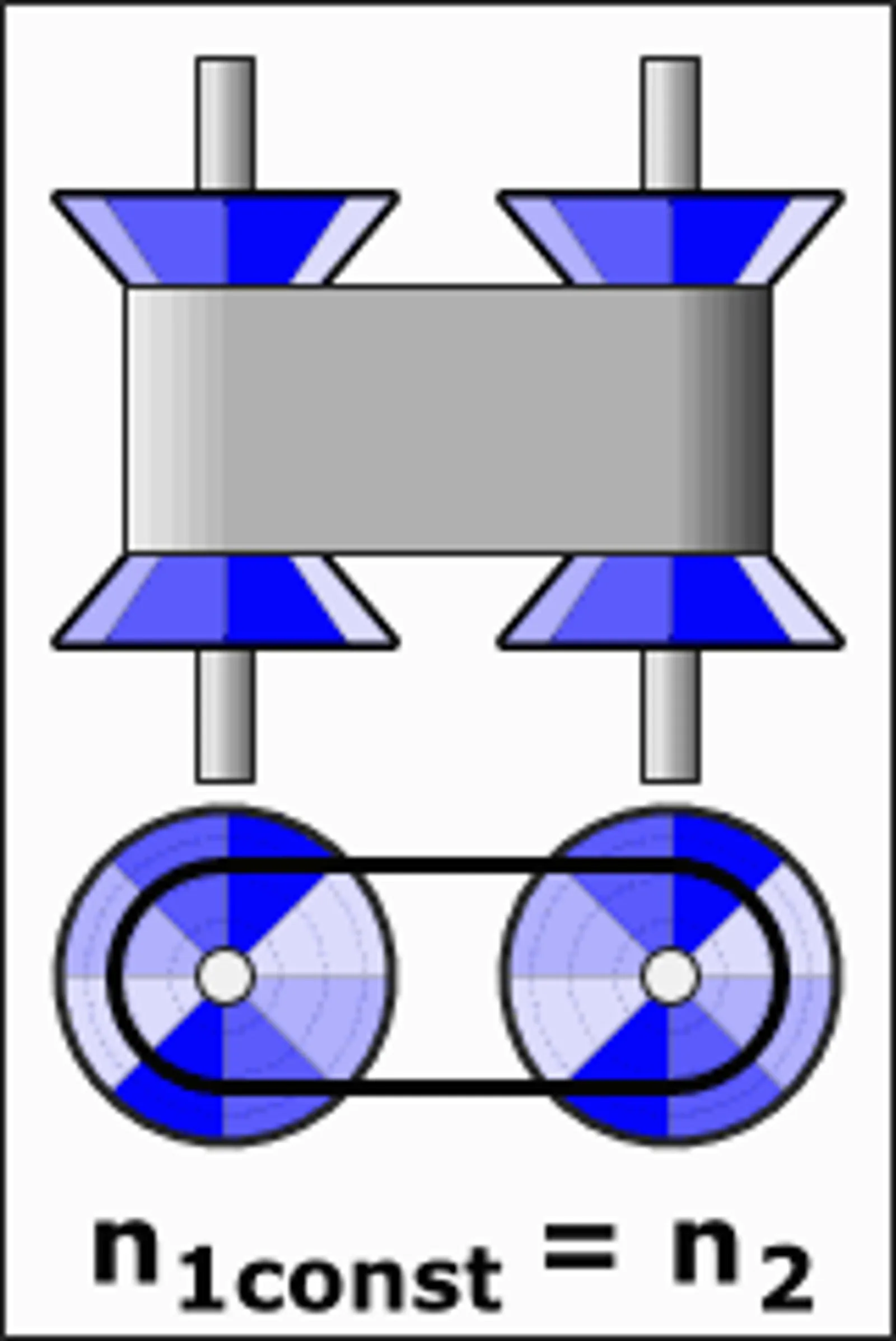
Beyond the clutch, most modern car gearboxes are of the constant-mesh type and are built around three shafts. One takes the drive from the engine and spins with it whenever the clutch is engaged. A second, the layshaft, carries gears of different sizes, each permanently meshed with a partner on the third, which carries the drive out. Those partners sit on bearings, free to rotate independently of the shaft itself, until the driver chooses a gear.
Choosing is the job of a dog clutch, a sliding collar with teeth that travels along the output shaft when a selector fork linked to the gear lever pushes it. The collar locks the chosen gear to the shaft, which then turns at the speed that gear pair dictates. That speed is the ratio. In neutral nothing is locked, so the input and output shafts turn independently. Reverse adds an idler gear, which flips the direction of rotation. In many boxes the input and output can also be locked straight together, giving direct drive.
A combustion engine needs a gearbox to keep it in a narrow band of revs, and that is the one thing a battery car never has to do.
What does synchromesh do?
Synchromesh is a set of cone-shaped friction rings that brings a spinning gear and its shaft up to matching speed before the teeth lock together. It spared drivers the job of matching engine revs by hand, a skill that earlier gearboxes demanded and punished with grinding noises.
The early cars had no such help. The 1891 Panhard et Levassor, with its three-speed box, was a significant advance, but its gears slid along their shafts to mesh, and a driver who mistimed the throttle heard the teeth refuse to engage. The crunching earned these gearboxes the nickname crash boxes. Heavy trucks, motorcycles and racing cars kept the layout long after passenger cars moved on, because it withstood the forces involved or allowed a faster change.
Synchromesh was invented in 1919 by Earl Avery Thompson. Cadillac was first to use it on production cars, in the late 1920s. Porsche patented a split ring system in 1947, and the 1952 Porsche 356 was the first car with synchromesh on every forward gear. Even in the early 1950s most cars had it only between third and second, which is why drivers' handbooks of the period advised stopping before dropping into first.
The working principle is friction. Dog teeth cannot engage while the two sides spin at different speeds, so a brass ring on each gear presses against a conical sleeve on the collar and drags the speeds together. A second part, the blocker ring (also known as a baulk ring), twists slightly while the speeds differ and keeps the collar from sliding home. When the speeds match it twists back and lets the teeth drop into place.
The price is wear. The rings and sleeves must overcome the momentum of the input shaft and clutch disc at every change, and the bigger the difference in speed, the harder the friction has to work. Over time that can leave the synchromesh ineffective.
How many gears did the manual end up with?
Until the late 1970s most gearboxes had three or four forward ratios. Five became widespread in the 1980s, six appeared in high-performance cars in the early 1990s, and the first seven-speed manual arrived in the 2012 Porsche 911 (991). Contemporary manual cars typically carry five or six.
There were earlier outliers. Five speeds turned up occasionally in sports cars, among them the Ferrari 166 Inter of 1948 and the Alfa Romeo 1900 Super Sprint of 1953, and the first six-speed manual was in fact the 1967 Alfa Romeo 33 Stradale, well before the 1990 BMW 850i and the 1992 Ferrari 456 made six ratios a feature of high-performance cars.
Why are automatics taking over?
The growing share of automatics is attributed to two things. Electric and hybrid cars make up more of the market, and an automatic fits more readily with driver aids like Autonomous Emergency Braking. A third factor is that the old penalties of cost and efficiency have narrowed.
The United States moved first. In 1957 over 80% of its new cars had automatic transmissions, and from 1974 at the latest, large cars came with them as standard. Cheaper fuel there made the efficiency gap matter less than it did in Europe, where the change came much later: in 1997 only 10 to 12% of European cars were automatics. A combustion engine needs a gearbox to hold it inside a narrow band of revs, whereas a battery car has no such constraint.
- Western Europe, 2008: manual 75.2% of vehicles produced, automatic 16.1%, other 8.7%.
- Worldwide: 43% of new cars produced in 2015 were manuals, falling to 37% by 2020.
- United Kingdom: since 2020, automatics have been in the majority among new cars.
- United States, 2020: 2.4% of new cars had a manual.
Some makers have gone all the way. Neither Mercedes nor Volvo sells a manual any more, which closes the question for buyers of those brands.
Is a manual still more efficient?
Conventional automatics run at 86 to 94% efficiency, while a manual typically loses about 4% to parasitic drag. Real-world tests reported in 2022 found manuals delivering 2 to 5% better fuel economy in typical driving, rising to 20% in the hands of an expert driver. That lead comes with several caveats.
Laboratory tests can flatter the automatic, because they prescribe a shifting pattern for the manual that is not always tuned for economy. On a long motorway run the manual only pays off if the driver holds one particular cruising speed, which is why an automatic can be the better choice there. The manual's advantage also holds against all but the newest automatics. It remains cheaper to make, lighter and mechanically simpler.
Volkswagen puts a figure on how far dual-clutch design has come. According to the company, its seven-speed DQ200 improves fuel economy by 6% over a six-speed manual and by 20% over a traditional hydraulic automatic.
How does a traditional automatic differ?
A hydraulic automatic swaps the friction clutch for a torque converter and replaces the manual's shaft-mounted gear pairs with planetary gearsets. Internal clutches and bands lock different elements to choose a ratio, pressurised transmission fluid operates them, and a computer now decides when to change gear.
The torque converter does the work of the clutch pedal. Before the 1960s a simpler fluid coupling filled the role. Picture one household fan blowing on a second fan: the second spins without ever touching the first. A fluid coupling does the same with oil, linking engine and gearbox with no pedal for the driver to manage, and a converter goes further by multiplying torque at low speeds.
The fluid does more than carry power. Automatic transmission fluid lubricates, prevents corrosion and carries the hydraulic pressure that operates the clutches and bands, and it is one of the few parts that needs routine service as the car ages. A pump driven from the torque converter housing pressurises it, so there is no pressure when the engine is stopped. That is why an automatic generally cannot be push-started. A valve body directs the pressure. In older boxes the valves responded to pump pressure and a governor on the output side. In recent ones, computer-controlled solenoids obey a dedicated transmission control unit.
All those parts once made automatics dearer and slower to build and repair than a manual. Mass production and decades of development have reduced that cost gap, which is one reason cost no longer shields the stick shift.
The idea is older than most people assume. The 1904 Sturtevant gearbox is often called the first true automatic, shifting back to low as the car slowed, though it was prone to sudden failure under the shock of abrupt changes. Two Brazilian engineers built the first automatic to use hydraulic fluid in 1932.
The breakthrough in numbers came from General Motors. Its Hydra-Matic, introduced in 1939 for the 1940 model year, teamed a fluid coupling with a trio of hydraulically operated planetary gearsets to give four forward speeds, and it shifted according to throttle position and road speed. From 1948 it spread to Hudson, Lincoln, Kaiser, Nash and Holden in Australia, while Rolls-Royce and Bentley licensed production in Britain. The Buick Dynaflow of the 1948 model year was the first to use a torque converter, followed by the Packard Ultramatic in 1949 and the Chevrolet Powerglide in 1950. Chrysler's three-speed TorqueFlite came in 1956 and General Motors' Turbo Hydramatic in 1964.
What does a dual-clutch gearbox add?
A dual-clutch gearbox has two clutches, one for the odd-numbered gears and one for the even. While the car runs in one gear, the next is already selected on the other clutch, so a shift is a hand-over between clutches. That lets it change gear several times faster than a manual, with no break in torque to the wheels.
It works like a stage crew who set up the next scene behind the curtain while the current one is still playing. The clutches are either dry or wet. Wet clutches run in oil, which carries away heat, so they suit high torque: the Bugatti Veyron's engine, with 1,250 Nm (922 lb ft), uses them. Most car designs stack two clutch packs on the flywheel axis, one inside the other, while the Volkswagen DQ200 sets two identical dry clutches side by side.
The concept dates to 1939, when French engineer Adolphe Kegresse devised it for the Citroen Traction Avant but ran out of money before building a working model. The first version to reach production was the Easidrive on the 1961 Hillman Minx, from Smiths Industries and Rootes, which used two electro-magnetic clutches, analogue electronics and solenoids. It was not reliable, and many were replaced by conventional manuals.
Racing revived it. From the late 1970s Porsche developed a dual-clutch gearbox, the PDK, partly because it could stop boost falling away during shifts on a turbocharged engine. A prototype ran in a Porsche 956 in 1983, and the 1985 Porsche 962 C that used it won the World Sportscar Championship in 1986. The first mass-production passenger car with the technology was the 2003 Volkswagen Golf R32, fitted with a BorgWarner unit.
High-performance cars followed quickly: the Bugatti Veyron in 2005, the Nissan GT-R in 2007, the Ferrari California and Mitsubishi Lancer Evolution X in 2008, and the Porsche 911 (997) in 2009. Getrag's 7DCL750, rated at 750 Nm (553 lb ft), went into mid-engined cars such as the Ford GT of 2017, the Mercedes-AMG GT of 2014 and the Ferrari 458 of 2009. Tremec supplied the eight-speed in the 2020 Chevrolet Corvette C8 and a seven-speed in the 2020 Ford Mustang Shelby GT500. Since the late 2000s dual-clutch boxes have spread widely and replaced hydraulic automatics in various models.
The design has a known weakness at crawling speeds, where some dual-clutch boxes jolt and shudder. Acura's answer on its 2015 TLX was to pair an eight-speed dual-clutch unit with a torque converter, borrowing from the traditional automatic.
How do the three designs compare?
| Feature | Manual | Hydraulic automatic | Dual-clutch |
|---|---|---|---|
| Link to the engine | Friction clutch worked by a pedal | Torque converter (fluid coupling before the 1960s) | Two clutch packs, wet or dry |
| How a ratio is chosen | Dog clutch locks one gear pair to the output shaft | Planetary gearsets, with clutches and bands worked by pressurised fluid | Odd and even gears on separate clutches, next gear pre-selected |
| Driver input | Pedal and lever | None | None in cars and trucks |
| Efficiency figures | Parasitic losses of about 4% | 86 to 94% efficient | Volkswagen claims 6% better economy than a six-speed manual (DQ200) |
| Early landmark | 1891 Panhard et Levassor three-speed | 1904 Sturtevant; Hydra-Matic, 1940 model year | 1961 Hillman Minx Easidrive; 2003 Golf R32 |
| Known weak point | Clutch and synchromesh wear | Fluid needs routine service | Jolting at low speed in some designs |
Where does that leave the manual?
Mercedes and Volvo have stopped selling manuals, and in the United States the stick survives in 2.4% of new cars. A battery-electric car has no need to hold an engine inside a narrow band of revs, so the manual gearbox belongs to combustion cars by definition.
Performance cars show the squeeze most clearly. They were where the manual climbed highest, from the 1990 BMW 850i and 1992 Ferrari 456 to the seven-speed 911 (991) of 2012, and where its replacement arrived first. The Porsche 911 (997) was already offered with a dual-clutch box in 2009, three years before the 991 introduced the seven-speed manual.
What should a buyer weigh up?
- Manual: cheaper to make, lighter and simpler, with the best real-world economy for a skilled driver. Clutch and synchromesh are the wear items, and the clutch wears fastest when it is allowed to slip.
- Traditional automatic: the choice on a long motorway run, and the cost gap with manuals has narrowed. Fluid needs routine service as the car ages.
- Dual-clutch: the fastest shifts and a growing presence in performance cars. Some designs shudder at low speed, and wet clutches are the answer where torque is high.
Where this goes next
The plans show where the engineering effort sits. Stellantis was building an electrified dual-clutch gearbox, the eDCT, at its Mirafiori site in Italy as of 2024. Hyundai Transys was making a dry seven-speed and a wet eight-speed dual-clutch unit that year, used in some Hyundai and Kia models including the Ceed. And the growth of automatics is linked to a rising number of electric and hybrid cars.