A staircase, a relay team and a pool of oil: three very different machines share the name automatic. How each works, where each came from and where each falls short.
A torque-converter automatic links engine and gearbox through fluid and picks fixed ratios with planetary gearsets, a dual-clutch gearbox swaps between two clutches for odd and even gears, and a CVT slides a belt or chain between pulleys for a continuous ratio. Belt CVTs run at about 88% efficiency; conventional automatics at 86 to 94%.
A belt-driven CVT is only about 88% efficient, less than a manual gearbox, and it can still save fuel. The reason is that it lets the engine run at its most efficient speed whatever the car is doing. That is one of three very different ideas hiding behind the word automatic.
How do the three main automatic gearboxes work?
A torque-converter automatic uses fluid to link engine and gearbox and planetary gearsets to pick fixed ratios. A dual-clutch gearbox is two manual-style gearsets with a clutch each, one for odd gears and one for even. A continuously variable transmission has no fixed gears at all, only a ratio that glides.
Picture a staircase and a ramp. The torque-converter automatic and the dual-clutch both climb in steps: each ratio is fixed, and the job is to move between them without a lurch. The CVT is the ramp. Because its ratio changes through a continuous range, it can in principle hold the engine at one steady speed while the car accelerates, instead of letting the revs rise and fall with each gear.
The CVT is the ramp, while the other two automatics climb in steps.
How does a torque-converter automatic work?
The torque converter replaces the clutch pedal. It passes the engine's rotation to the gearbox through a fluid, which an input impeller flings through the fixed vanes of a stator and into an output turbine. When the output turns slower than the input, the converter multiplies torque, which a plain fluid coupling cannot do.
Most converters add a lock-up function that rigidly couples input and output when conditions permit, so the car stops paying the efficiency penalty of pushing torque through moving oil. Their behaviour depends heavily on size: the governing equation includes the fifth power of the radius.
Behind the converter sit planetary gearsets, a different arrangement from the manual's rows of gears on parallel shafts. Internal clutches, friction bands and brake packs lock certain parts of these sets to choose the ratio, and automatic transmission fluid, pressurised by a pump, supplies the force. A valve body directs the pressure. In recent boxes, computer-controlled solenoids obey a transmission control unit that picks the gear. The fluid is among the few parts that need routine service as the car ages.
Efficiency runs from 86 to 94% for conventional automatics. The complexity once made them dearer and slower to build and repair than a manual, but mass production and development have narrowed the gap. They are especially common in vehicles with intense acceleration and frequent idling, such as buses and waste collection trucks.
The history explains the design. The 1904 Sturtevant gearbox is often called the first automatic, though it failed suddenly under abrupt gear changes, and two Brazilian engineers built the first one to use hydraulic fluid in 1932. General Motors introduced the Hydra-Matic in 1939 for the 1940 model year: a fluid coupling and three hydraulically controlled planetary gearsets giving four speeds. The Buick Dynaflow of 1948 was the first with a torque converter, followed by the Packard Ultramatic in 1949 and the Chevrolet Powerglide in 1950. GM's Turbo Hydramatic arrived in 1964.
Others took different routes. Chrysler's Fluid Drive of 1939 simply added a fluid coupling to a manual gearbox so the driver no longer needed a clutch pedal. Its PowerFlite followed in 1953 with two speeds and a converter, and the three-speed TorqueFlite of 1956 was the first to use the Simpson compound planetary gearset. Before mass-produced automatics arrived, several European and British makers fitted preselector gearboxes, a form of manual that removed the need for skilled timing by the driver, and Rolls-Royce and Bentley licensed the Hydra-Matic for production in Britain.
How does a CVT work, and why is it efficient?
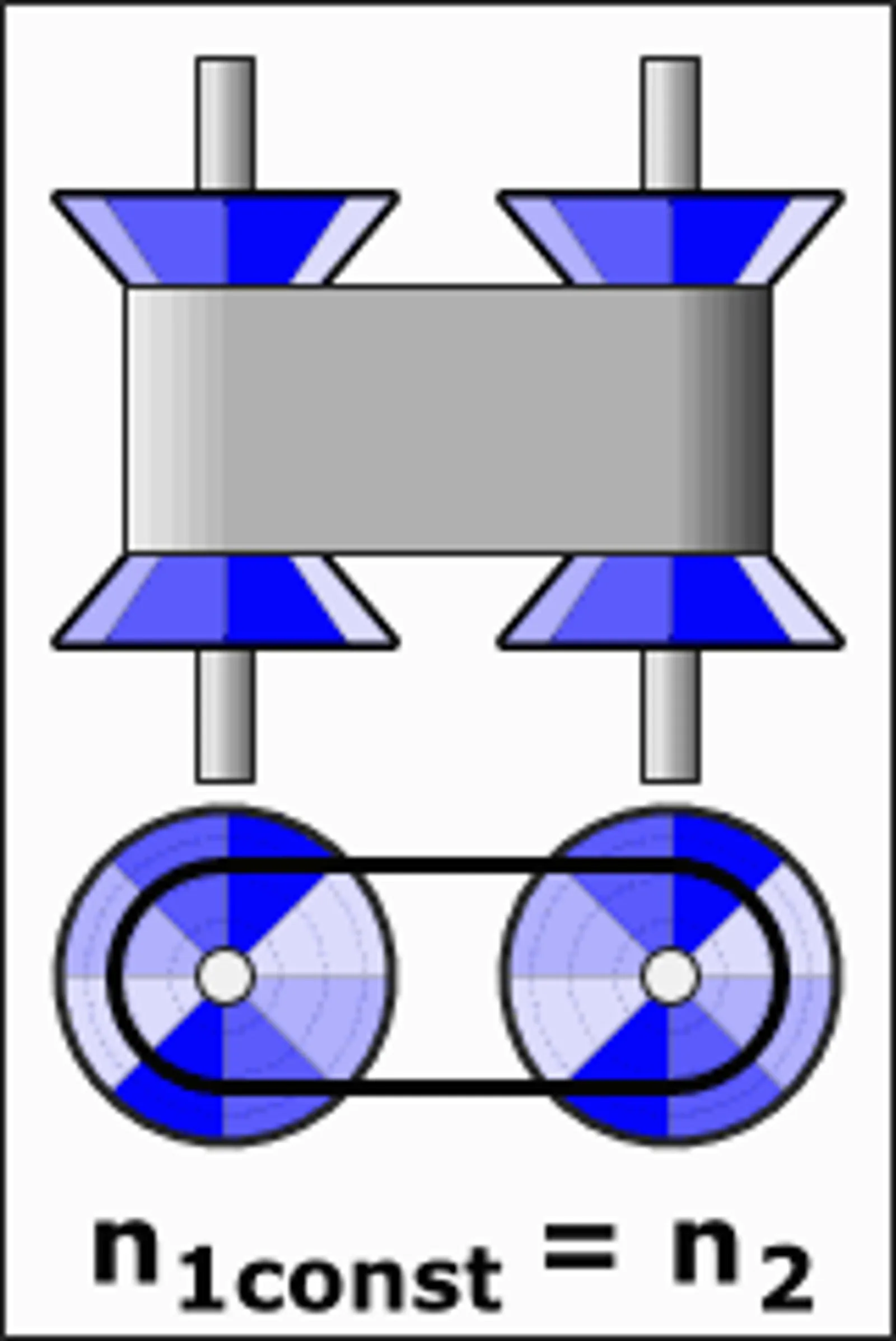
The common CVT runs a belt or chain between two pulleys, each made of two cone-shaped halves that slide together and apart. Pushing one pulley's halves together makes the belt ride higher on it, while the other pulley opens and the belt sinks lower. That change in effective diameters sets the ratio, with no steps in between.
Both pulleys have to move together, one growing as the other shrinks, because the distance between them and the belt's length are fixed and tension must be kept. Material matters. A steel-reinforced V-belt is enough for light, low-torque work such as utility vehicles and snowmobiles, but cars need a chain built from many tiny elements with conical sides, since the contact area depends on their number. In the chain version, steel bands slide over each other and need generous lubrication, and the pulleys carry a film of oil thick enough to prevent metal contact but thin enough not to waste power.
The 88% figure for a belt-driven design sounds poor next to a manual gearbox, but the CVT recovers the loss by keeping the engine at the speed where it is most efficient, however fast the car travels. When power matters more than economy, the ratio can be changed so the engine turns at the speed where it makes the most power. Typically that gives better fuel economy in petrol cars, and lower consumption than a standard automatic.
Where the drive force comes from varies. Some CVTs pull, carrying power to the output pulley through belt tension, while others push and rely on compression of the chain elements, with the input pulley pushing the chain and the chain pushing the output pulley.
The less common CVTs
Several other designs exist. A toroidal CVT, used on the Nissan Cedric (Y34), has discs and rollers and can generally take higher torque than a pulley type. A hydrostatic CVT uses an engine-driven pump to feed oil to hydraulic motors. It is smooth and flexible, but few such systems exceed about 65 percent efficiency, against as much as 90 percent for gears, so it turns up in harvesters, small loaders and road rollers instead of cars. Ratcheting designs suffer vibration. Positively infinitely variable chain drives interlock with grooved pulleys using stacks of thin plates, a millimetre thick or so, and carry significant torque but run at a much lower maximum speed.
Hybrids use a related idea. An electric variable transmission, sometimes written eCVT, balances electric and combustion power in the Toyota Prius, the Ford Fusion and Lincoln MKZ Hybrid, the Mitsubishi Outlander PHEV and the Ford Escape Hybrid.
How does a dual-clutch gearbox differ?
One clutch drives the even-numbered gears and the other the odd. While the car runs in one gear, the next is already selected, so a shift is a hand-over from one clutch to the other. That lets it shift several times faster than a manual, with no break in the torque reaching the wheels.
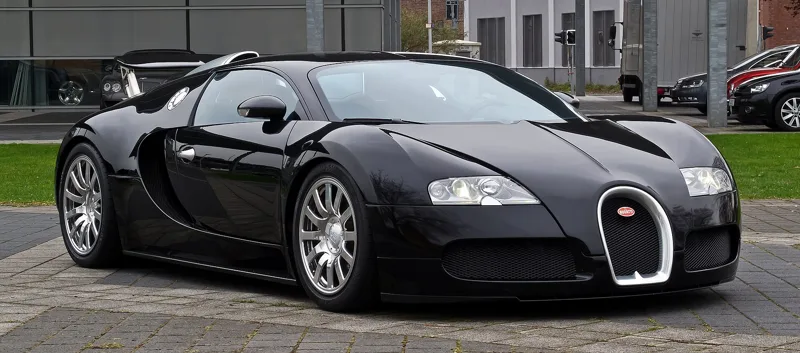
The clutches are wet or dry. Wet clutches run in oil for cooling, so they suit high torque: the Bugatti Veyron's engine, with 1,250 Nm (922 lb ft), uses them. Most car designs stack two clutch packs on one axis behind the flywheel, one inside the other, while the Volkswagen DQ200 uses two identical dry clutches side by side. In a car or truck the driver does nothing; it behaves as an automatic.
The idea is old and its first outing was rough. Adolphe Kegresse conceived it in 1939 but ran out of money. The Easidrive on the 1961 Hillman Minx was the first to reach production, with electro-magnetic clutches and analogue electronics, and it was not reliable; many were replaced with ordinary manuals. Porsche picked up the idea in the late 1970s for racing, partly to stop boost from dropping during shifts on a turbocharged engine. A prototype ran in a Porsche 956 in 1983, and the Porsche 962 C won the World Sportscar Championship in 1986. The 2003 Volkswagen Golf R32, with a BorgWarner unit, was the first volume-built passenger car fitted with one. A truck followed in 2010, the Mitsubishi Fuso with its six-speed Duonic.
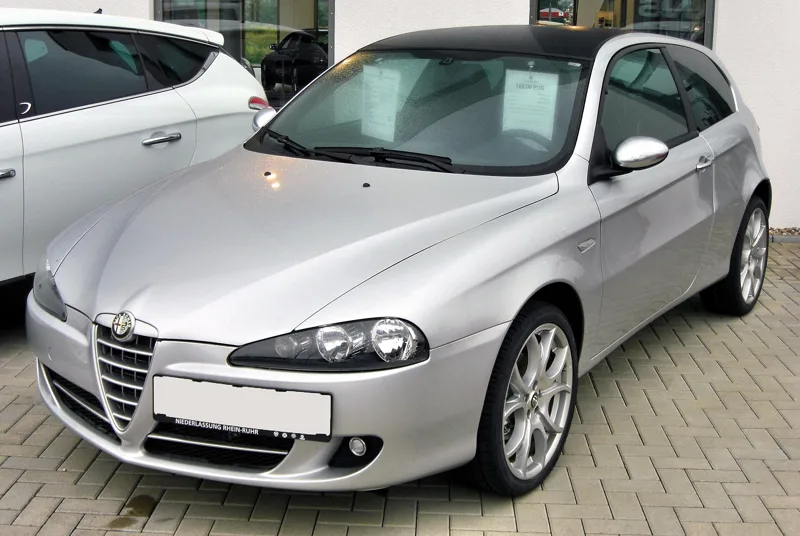
Marketing names vary. Volkswagen calls its units DSG, Audi has used S-Tronic, Alfa Romeo says TCT and Tata Motors says DCA. Volkswagen claims its seven-speed dry DQ200 improves fuel economy by 6% over a six-speed manual and by 20% over a traditional hydraulic automatic.
Performance cars adopted the design quickly: the Bugatti Veyron in 2005, the Nissan GT-R in 2007, the Ferrari California and Mitsubishi Lancer Evolution X in 2008, and the Porsche 911 (997) in 2009. Getrag's 7DCL750, rated at 750 Nm (553 lb ft), suits high-performance engines, and Tremec supplied the eight-speed in the 2020 Chevrolet Corvette C8. Since the late 2000s dual-clutch boxes have become more widespread and have replaced hydraulic automatics in various models.
Are CVTs reliable, and which gearbox lasts longest?
A CVT has a simpler structure and, in theory, longer-lived internal parts and potentially greater durability. Each design has its own weak points, and they differ in kind.
The dual-clutch record is mixed. The first production unit was unreliable, and some dual-clutch boxes jolt and shudder at low speed. Acura answered on its 2015 TLX by pairing an eight-speed dual-clutch unit with a torque converter to smooth low-speed driving. The torque-converter automatic needs routine fluid service as the car ages. In the CVT, chain elements and sliding plates wear: the plates in an interlocking chain drive wear slowly over years, so makers cut them longer than needed to allow for it.
How do the three compare?
| Feature | CVT | Dual-clutch | Torque-converter automatic |
|---|---|---|---|
| Ratios | Continuous range | Fixed steps on odd and even gearsets | Fixed steps from planetary gearsets |
| Link to the engine | Pulleys with a belt or chain | Two clutch packs, wet or dry | Fluid in a torque converter |
| Efficiency figures | About 88% for a belt-driven design | Volkswagen claims 6% better than a six-speed manual | 86 to 94% |
| Shift behaviour | No steps; engine can hold a steady speed | Several times faster than a manual; no torque break | Smooth shifts chosen by solenoids and a control unit |
| Known weak points | Belt is a compromise between ratio and torque; chain needs lubrication | Low-speed jolting in some; first production unit unreliable | Fluid needs routine service |
| Early landmark | 1903 cone-CVT patent; 1920s Evans countershaft | 1961 Hillman Minx; 2003 Golf R32 | 1904 Sturtevant; 1940 Hydra-Matic; 1948 Dynaflow |
Which gearbox suits how you drive?
- CVT: built around fuel economy and smoothness, with no gear steps to feel. It uses a belt or chain whose material limits how much torque it can take, so look at how a model uses it.
- Dual-clutch: the quickest shifts and the choice in many performance cars. Check how it behaves at crawling speeds.
- Torque-converter automatic: the established design, common in vehicles that accelerate hard and idle often. Efficiency has improved and the cost gap with manuals has narrowed.
- Hybrids: many use an electric variable transmission and so sit outside this choice entirely.
Where this goes next
The gearbox is changing with the engine. Combustion engines need a gearbox because they can only work in a narrow range of speeds, and electric cars do not, so the growth of electric and hybrid cars is cited as one reason automatics are spreading. As of 2024, Stellantis was building an electrified dual-clutch gearbox, the eDCT, at its Mirafiori site in Italy, and Hyundai Transys was making a dry seven-speed and a wet eight-speed dual-clutch unit used in some Hyundai and Kia cars.