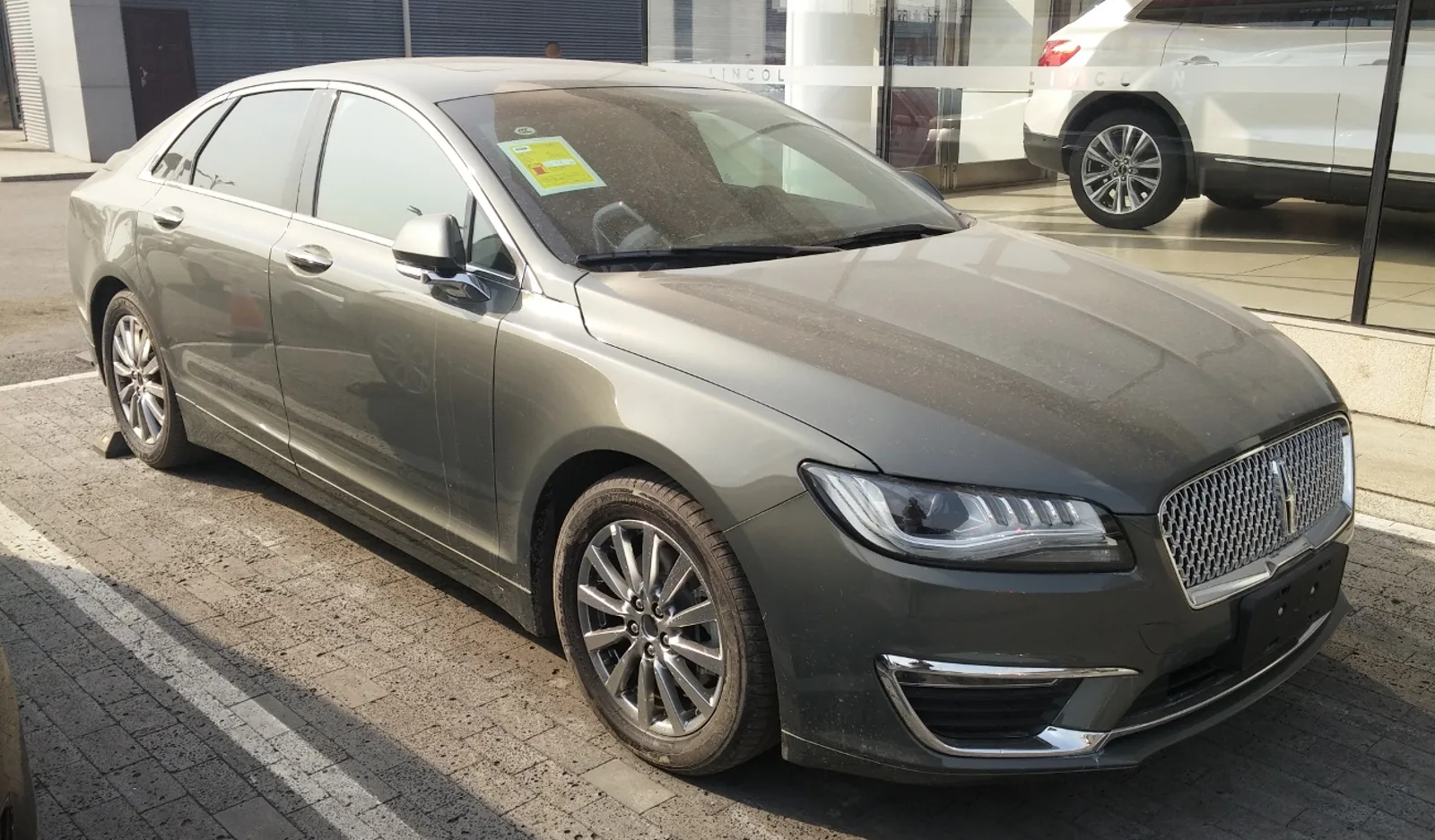
A mid-size luxury sedan that started as the Zephyr in 2006, added a hybrid in 2011 and ended in 2020.
The Lincoln MKZ was a mid-size luxury sedan that Lincoln sold across two generations. Built in Hermosillo, Mexico, it launched as the Zephyr, was renamed MKZ for 2007 and came with gasoline or hybrid power until production ended in 2020.
Lincoln's MKZ debuted as the Zephyr in 2006 and was sold until 2020 over two generations. It was a mid-size, four-door, five-passenger luxury sedan, offered with gasoline power or a gasoline-electric hybrid system. Ford co-developed it with the Fusion and the Milan, so the three cars were closely related from the start.
Where did the Lincoln MKZ come from?
The MKZ was built only at Ford's Hermosillo Stamping and Assembly plant in Mexico. Production began in August 2005 and ended in 2020, so the car was made in one factory for its entire life.
The name Zephyr comes from Zephyrus, the Greek personification of the west wind. Ford used the name in the late 1930s for a range of cars in the mid-size class, and it returned on the Mercury Zephyr during the late 1970s and early 1980s.
The car also went to China. In 2015 the MKZ was exported there to increase overall sales.
A Zephyr that became the MKZ, took a hybrid in 2011 and left the range after a 2017 facelift and a final year of two trims.
What did the first-generation Zephyr look like?
The Zephyr had a split-wing, waterfall-style grille and quad projector beam headlights, which Lincoln had first shown as a concept at the 2004 New York International Auto Show. Chrome trim ran along the beltline, and LED taillights sat above dual chrome exhaust tips.
Chief Designer Darrell Behmer styled the first generation, and the production car arrived in the fall of 2005 for the 2006 model year. It rode on Ford's CD3 platform, which was derived from the front-wheel drive Mazda 6 and shared with the Fusion and the Milan.
Inside, the Zephyr used an instrument panel that was distinct from the Fusion and Milan. Genuine ebony or maple wood inserts sat alongside chrome-bezelled gauges, and white LED backlighting lit the controls and instrumentation. Leather seating surfaces were standard in every model.
What features did the Zephyr offer as standard?
The Zephyr's standard equipment included global power windows, which lowered together at the push of a button. Buyers also got a six-disc, MP3-compatible CD changer as part of the standard audio system.
The audio was a point of pride. Lincoln fitted an industry-first THX II-Certified audio system with ten speakers. Later, for 2008, the MKZ gained heated and cooled front seats as standard equipment, and Lincoln SYNC arrived with late availability.
How did the Zephyr become the MKZ?
The Zephyr was renamed MKZ for the 2007 model year. Sales of the renamed car began in September 2006.
The Zephyr replaced the rear-wheel drive Lincoln LS as the brand's entry-level sedan. It was smaller than the LS and front-wheel drive, but it took over the LS market.
Pricing started at US$28,995 for the 2006 Zephyr and rose to US$35,340 for the top versions.
What powered the first Lincoln MKZ?
The first-generation Zephyr used a 3.0 L DOHC Duratec V6 that delivered 165 kW (221 hp) at 6250 rpm, with 278 N m (205 lb ft) of torque arriving at 4800 rpm. It was mated to an Aisin 6-speed automatic transmission, with a final drive ratio of 3.46:1.
The front-wheel drive Zephyr reached 60 mph (97 km/h) from a standstill in 7.5 seconds. The same V6 powertrain was used in the Fusion and Milan from 2006 to 2009, so the engine was not unique to Lincoln.
The Zephyr's chassis used a coil-over damper with a short- and long-arm front suspension. Four-wheel anti-lock disc brakes with traction control were standard.
What did the 2007 all-wheel drive MKZ add?
For 2007 the MKZ offered optional all-wheel drive and a larger engine. Ford's all-aluminum 3.5-L DOHC Duratec 35 V6 was tuned for 265 hp (196 kW), with 249 lb ft (337 N m) of torque peaking at 4500 rpm.
In a road test, an all-wheel drive MKZ reached 60 mph (97 km/h) in 6.8 seconds. It covered the quarter mile in 15.2 seconds, crossing the line at 93.4 mph (150.3 km/h), which the magazine credited to the more powerful engine and extra traction.
For 2008 the MKZ gained standard Sirius satellite radio, perforated leather seats and a reverse sensing system. The stability control package called AdvanceTrac became standard for 2009, and a special Midnight Black package added black leather with real maple and satin nickel inserts.
What did the 2010 facelift change?
The 2010 MKZ was a substantial update, with underbody work and a new look at the front. The most visible change was a more pronounced split-wing grille, which the company called the Bow Wave, paired with larger LED taillights and restyled 17-inch wheels.
Inside, the facelift brought a new instrument cluster, a new centre stack and updated door trim. The materials changed too, with genuine wood accents in ash or swirled walnut and standard Bridge of Weir leather.
The 2010 car also gained a reverse camera, rain-sensing wipers, adaptive HID headlights and a capless fuel filler. A radar-controlled blind spot monitor, marketed as BLIS, added a cross-traffic alert for backing out of a parking space.
A new SelectShift six-speed automatic arrived in this update. The engine output was unchanged, but the revised transmission cut shift times and improved acceleration.
What made the 2010 MKZ quieter?
From the 2010 model year the MKZ used acoustic glass for its windscreen and backlight, marketed as Carlite SoundScreen. The glass laminated an acoustic layer between two sheets, cutting noise by up to 6 dB at some frequencies and 2 to 3 dB overall.
Lincoln paired that glass with thicker window glass, better door seals, absorption padding in the fenders and pillars, and an acoustic headliner. The package was marketed as the Quietcraft interior, and it made conversations inside the car easier to follow.
How did the MKZ Hybrid work?
The MKZ Hybrid was shown at the 2010 New York International Auto Show and launched as a 2011 model. It was Lincoln's first hybrid and its first four-cylinder engine. The car was co-developed with the Fusion and Milan hybrids, and the three models shared identical engineering.
The powertrain combined a 2.5-L Atkinson-cycle Duratec inline-four producing 156 horsepower with an electric motor rated at 106 horsepower. Together they made a total of 191 hp (142 kW), with an electronically controlled continuously variable transmission connecting the two.
The transmission used a power-split planetary gearset to blend power from the engine and two motor-generators. The hybrid battery was a Sanyo-supplied nickel-metal hydride unit, and the Fusion, which used the same system, was Ford's second generation hybrid engineering.
Regenerative braking recovered nearly 94 percent of the kinetic energy that would otherwise have been lost as heat. The electronic throttle was adjusted to reduce airflow on shutdown, which cut fuel use on restarts.
How efficient was the MKZ Hybrid?
The 2011 car was credited with 36 mpg-US (6.5 L/100 km; 43 mpg-imp) on the highway and 41 mpg-US (5.7 L/100 km; 49 mpg-imp) in town. It could run on electricity alone at speeds up to 47 mph (76 km/h).
The car was the most fuel-efficient luxury sedan sold in the US until the 2011 Lexus CT 200h arrived in March 2011. Ford also took the unusual step of pricing the hybrid at the same MSRP as the gasoline version.
The second-generation MKZ Hybrid moved to a compact lithium-ion battery pack, which raised its highway fuel economy to as much as 48 mpg-US (4.9 to 5.0 L/100 km; 56 to 58 mpg-imp). The EPA figure for the 2013 car stood at 45 mpg-US (5.2 L/100 km; 54 mpg-imp).
How well did the hybrid sell?
Sales began in September 2010. Roughly 136,600 first-generation cars were built, and about 13,000 of them were hybrids. Hybrids made up about 20% of 2011 MKZ sales until June 2011.
Demand was strongest in the Los Angeles region, where hybrids took 44% of sales. In the San Francisco area the hybrid reached a 66% market share. A study by Vincentric found that the MKZ delivered the lowest five-year ownership costs of 25 hybrids tested from the 2012 model year, saving $6,168 against its gasoline variant.
How did reviewers rate the MKZ Hybrid?
The first-generation Fusion, which shared the hybrid system, was named North American Car of the Year at the 2010 Detroit Auto Show and was Motor Trend's Car of the Year. Car and Driver included it among its 10 Best Cars for 2010, and the hybrid siblings collected many more prizes afterwards.
The MKZ Hybrid was one of five finalists for the 2011 Green Car of the Year, which the Chevrolet Volt won. The Union of Concerned Scientists ranked it, with the Lexus CT200h, as the top luxury hybrid in its environmental improvement category.
How safe was the MKZ?
The MKZ initially received mediocre crash test ratings, so Ford made changes. From 2007 models built after January 2007, structural reinforcements improved occupant protection in frontal overlap crashes. From 2010, door trim changes improved side impact protection.
After retesting by the federal regulator and the insurance industry's safety institute, the car earned higher ratings. It became an Insurance Institute Top Safety Pick from 2010 onwards, and the 2013 model earned the Top Safety Pick+ award.
Standard safety equipment included dual front-side airbags, front seat-mounted side airbags and curtain airbags running from the front to the rear seats. The rollover rating was 9.2% for the all-wheel drive car and 10.5% for the front-wheel drive model.
What changed with the 2013 redesign?
The second-generation MKZ arrived for the 2013 model year on Ford's CD4 platform, which it shared with the Fusion and Mondeo. Three powertrains were offered: a 240-horsepower EcoBoost 2-liter four-cylinder, a 300-horsepower 3.7-liter V6 and a hybrid system based on the 2-liter engine.
Release was held back to resolve quality issues. Early production cars were shipped from Hermosillo to Ford's Flat Rock plant for inspection before going to dealers, an unusual step for a product of this size. Production reached dealerships in sufficient numbers by mid-March 2013.
For 2015 automatic headlights, rear parking sensors and a rear view camera became standard. The Black Label trim package added Alcantara on the headliner and visors, embossed Lincoln logos on the headrests and a leather-wrapped instrument panel with a discreet airbag.
What did the 2017 facelift bring?
The MKZ received a facelift for 2017, shown at the Los Angeles show, with a redesigned front grille and headlights. The 3.7-liter V6 was dropped in favour of a 3.0 L twin-turbo V6 that only Lincoln used, rated from 350 to 400 horsepower according to drivetrain.
Trim levels included the standard model, Premiere, Select, Reserve and the top Black Label. The transmission was controlled by buttons to the left of the MyLincoln Touch screen rather than a console lever. The Sport mode changed the damping, steering and shift points together.
How did the MKZ end its run?
The MKZ received no more major changes after the 2017 facelift. Later model years brought new colours and a gradual shrinking of the line-up. For 2020, the final year, only the Base and Reserve trims remained, with Hybrid, Turbo or V6 powertrains.
The car had been built in the same Mexican plant since 2005. Throughout its run, the hybrid was offered at the same price as the non-hybrid model.
What are the Lincoln MKZ specifications?
The table lists the main figures across the model's life. Where a figure applies to one generation or powertrain, the table says so, so that the 2006 Zephyr is not confused with the 2017 twin-turbo car.
| Specification | Detail |
|---|---|
| Type | Mid-size, four-door, five-passenger luxury sedan |
| Production | Hermosillo, Mexico, from August 2005 to 2020 |
| First-generation engine | 3.0 L DOHC Duratec V6, 221 hp (165 kW) at 6250 rpm |
| First-generation transmission | Aisin 6-speed automatic; final drive 3.46:1 |
| 0-60 mph, front-wheel drive Zephyr | 7.5 seconds (97 km/h) |
| 2007 all-wheel drive engine | 3.5-L DOHC Duratec 35 V6, 265 hp (196 kW) |
| Hybrid system | 2.5-L four with electric motor, 191 hp (142 kW) |
| Second-generation engines | 2-liter EcoBoost four at 240 hp; 3.7-liter V6 at 300 hp |
| 2017 twin-turbo V6 | 350 to 400 horsepower |
| 2013 hybrid EPA rating | 45 mpg-US (5.2 L/100 km; 54 mpg-imp) |
| Rollover rating | 9.2% (AWD); 10.5% (FWD) |
Frequently asked questions
Was the MKZ ever called the Zephyr?
Yes. It launched under that name and was renamed MKZ for 2007. The Zephyr name had its own history, going back to the Greek west wind and earlier Ford use.
Which MKZ was the first hybrid?
The 2011 MKZ Hybrid was Lincoln's first hybrid. It paired a 2.5-L Atkinson-cycle four with an electric motor for a total of 191 hp (142 kW).
How much power did the second generation offer?
The 2013 redesign offered a 240-horsepower EcoBoost 2-liter four and a 300-horsepower 3.7-liter V6. The 2017 facelift replaced the V6 with a 3.0 L twin-turbo rated at 350 to 400 horsepower.
When did the MKZ go out of production?
Production ended in 2020, the car's final year on sale. The line-up had been cut to two trims by then, offered with hybrid, turbo or V6 power.