A Piedmontese joke, a sideways-to-lengthways engine and a doorway that lifts upwards, from the 1971 prototype to the 2021 hybrid revival.
The Lamborghini Countach is a rear mid-engine V12 sports car made from 1974 to 1990, designed by Marcello Gandini of Bertone as the successor to the Miura. The LP500 prototype appeared at Geneva in 1971. Its name comes from a Piedmontese exclamation of astonishment.
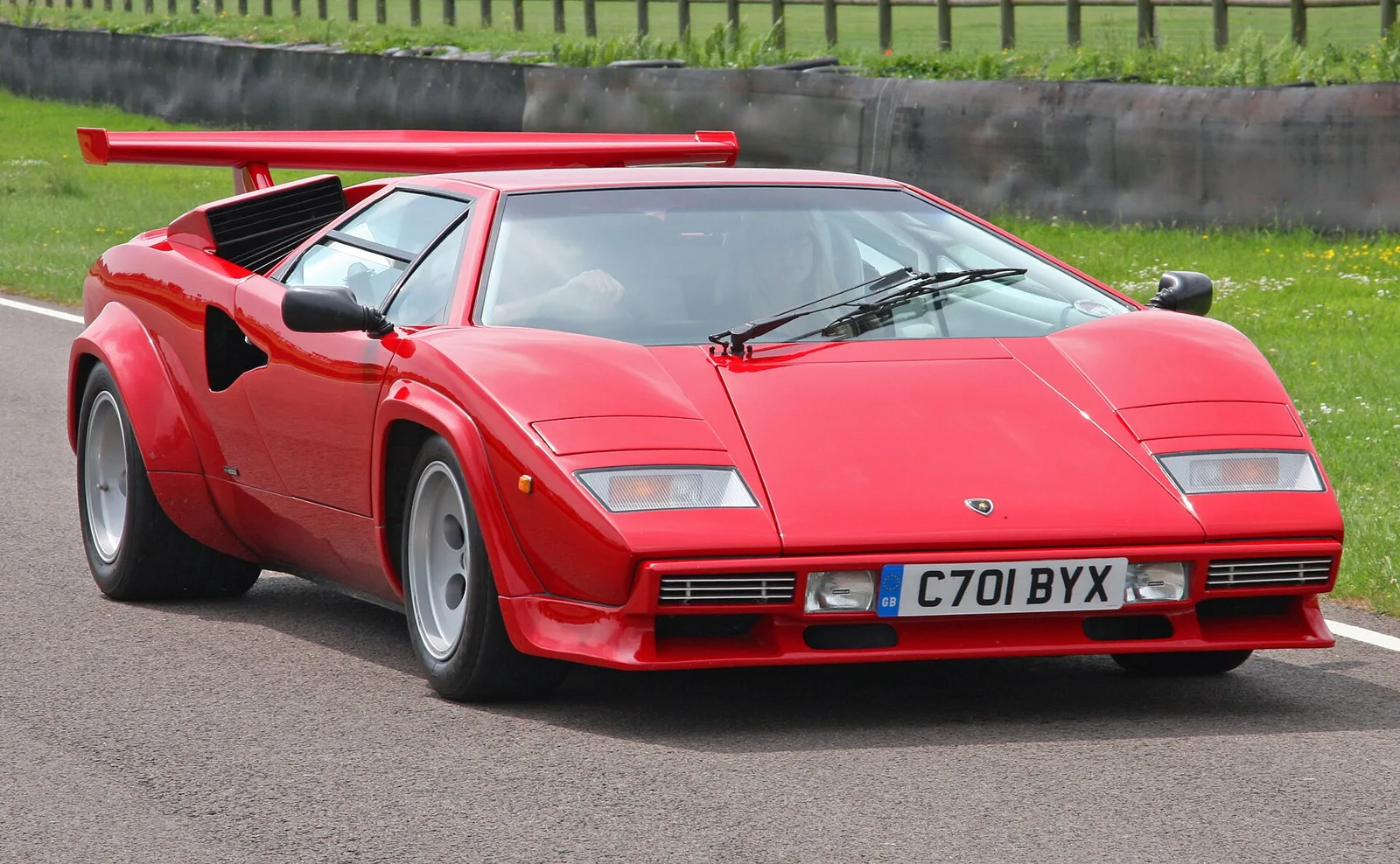
The Lamborghini Countach is named after a joke. Late one night, while Marcello Gandini's team was working on a show car, the group borrowed a Piedmontese exclamation of astonishment for the name, and it stuck. The car itself was a low, sharp wedge with scissor doors.
How did the Lamborghini Countach follow the Miura?
Ferruccio Lamborghini started the project himself, aiming to replace the Miura. The Miura had been widely acclaimed since its introduction in 1966, but by 1970 rivals such as the Ferrari Daytona had arrived, and it was showing its age. Chief engineer Paolo Stanzani and his staff started in 1970 on a project coded LP112.
Around Stanzani were test driver Bob Wallace, assistant engineer Massimo Parenti and Gandini, the designer from Bertone. Stanzani and Lamborghini agreed that the successor needed a mechanical design for the greatest possible performance and bodywork that slipped through the air well and looked daring. Lamborghini himself preferred comfortable grand tourers, but he saw the commercial value of an uncompromising sports car like the Miura, and he let the team push boundaries.
The Countach kept the Miura's basic layout, with the engine in the middle and the power going to the rear, and added new engineering and styling ideas. The engineers also went after the Miura's flaws: high-speed stability, lift-off oversteer, limited access for maintenance, uneven weight distribution, and cooling problems that came with its transverse engine.
The car behind the car
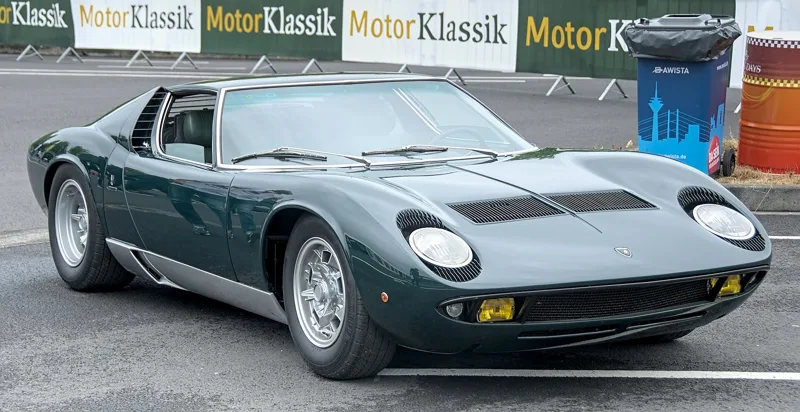
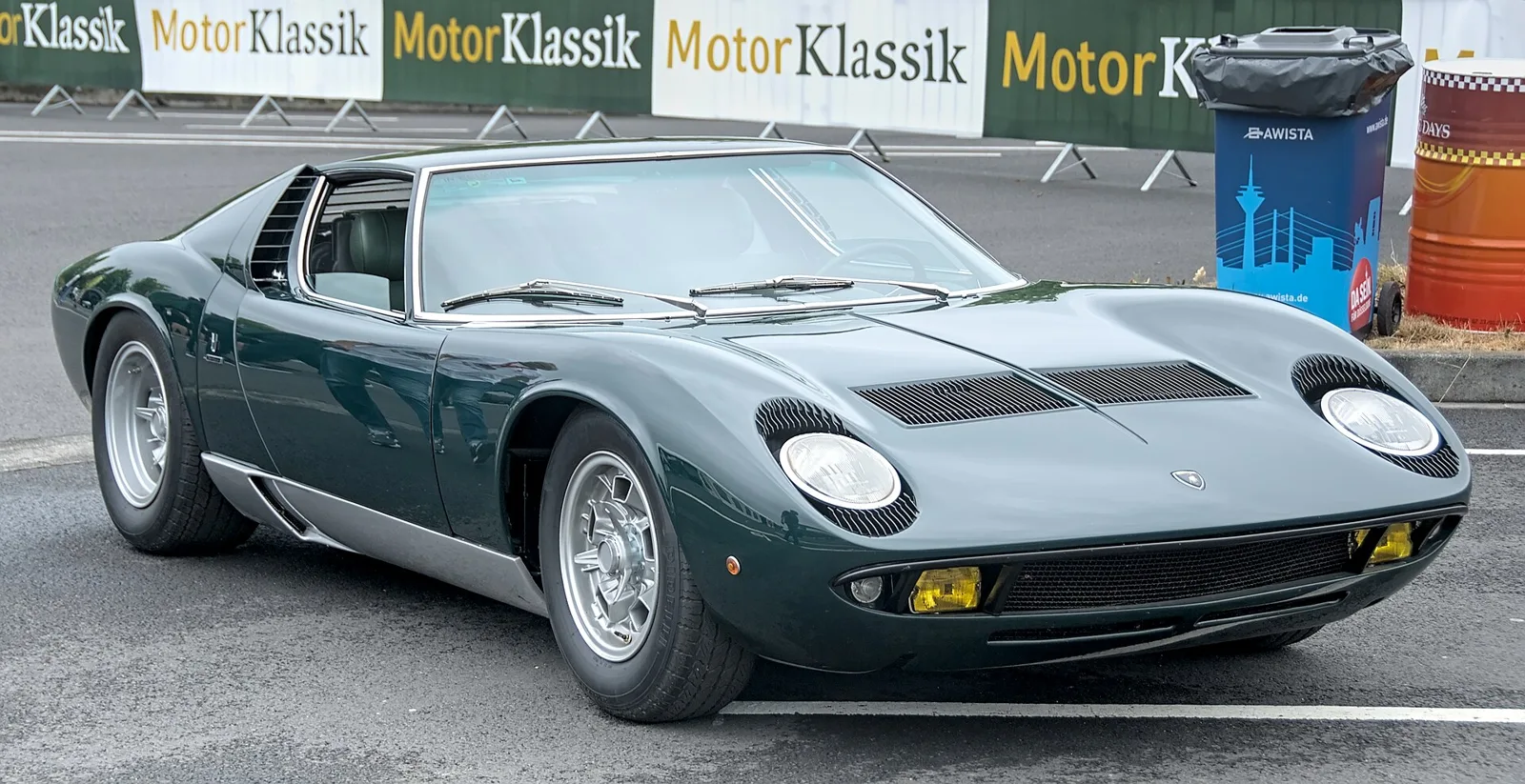
The Miura had begun life as a rebellion. Giampaolo Dallara, Stanzani and Wallace developed it in their own time in 1965, against the wishes of Ferruccio Lamborghini, who preferred sedate grand tourers to the race-derived machines of his Ferrari rival. When he saw the development mule, he approved it.
The Miura was the first high-performance production road car to put the engine behind the driver and drive the rear wheels, an arrangement that has since become the norm for performance sports cars. At its release no production car was faster. Its rolling chassis appeared at the 1965 Turin Auto Show and the prototype at Geneva in 1966, and production ran from 1966 to 1973. The first version, the P400, used a transverse 3,929 cc V12 with 350 PS (257 kW; 345 hp), and exactly 275 were built between 1966 and 1969 at a then-steep US$20,000. As on the Mini, engine and gearbox shared one casting. A year after the Miura ended, the Countach joined the range, during a difficult financial period for the company.
The name began as a joke among tired designers working through the night.
Why is it called the Countach?
The word comes from "contacc", an exclamation of astonishment in the Piedmontese language. Most Lamborghini names allude to famous bulls and bullfighting, and the Countach broke the tradition. The name dates from late 1970 or 1971, near the start of the LP112 project.
Gandini told the story himself. The team worked at night on show cars and joked to keep their spirits up. A profiler who made the locks, a tall man with enormous hands who spoke almost only Piedmontese, kept using the word "countach", which literally means plague or contagion but is used to express amazement or even admiration, something like "goodness". Gandini proposed it as a joke, then asked Wallace how it sounded to an English-speaking ear. Wallace pronounced it in his own odd way, and it worked. They made the lettering and fixed it to the car. Gandini added that the real suggestion might have come from a young colleague, calling his account the only true story behind the word.
Who was Marcello Gandini?
Marcello Gandini, born in Turin on 26 August 1938 and died on 13 March 2024, was the Italian designer behind the Miura and the Countach. His father was an orchestral conductor who wanted him to be a pianist, but Gandini developed an early, intense interest in cars and mechanical engineering and left school at 18.
In 1964 he approached Nuccio Bertone, head of the Gruppo Bertone company, who liked his zeal and meant to apprentice him to the chief designer, Giorgetto Giugiaro. Giugiaro left to start his own studio the following year, and Gandini, then 27, took his place. He took three months to take the Miura from first sketch to finished prototype and stayed with Bertone for fourteen years. He left in July 1979 to found his own design house, Clama.
His other work ranged from the Lancia Stratos, Alfa Romeo Montreal, Maserati Khamsin, Ferrari GT4 and Fiat X1/9 to practical cars such as the first-generation Volkswagen Polo, the first BMW 5 Series, the Citroen BX and the Renault 5 "Supercinq". Car Design News gave him its first Lifetime Achievement Award in 2012. Flavio Manzoni, Ferrari's chief design officer, called him "probably the greatest car designer ever". Gandini himself said his interests lay more in architecture, construction and mechanisms than in styling.
How was the Countach designed?
The Countach grew from earlier Gandini concept cars. After the Miura's debut he began experimenting with a more angular, geometric look for Lamborghini, Alfa Romeo and Lancia. The 1968 Alfa Romeo Carabo and the 1970 Lancia Stratos Zero were its direct styling forerunners. Each was a pure wedge with the engine amidships, a low flat nose, a cut-off tail and sharp-edged details. The Stratos Zero had a hinged windscreen for entry, and the Carabo had scissor doors.
When the LP112 project began in 1970, Lamborghini commissioned Gandini and his Bertone team to design a body for the still-nameless prototype. Stanzani supplied chassis information so the body could proceed while the mechanical details were settled. Shortly before the 1971 Geneva show, the finished chassis was shipped to Bertone for the bodywork and interior. The LP500 prototype made its debut there, to great public interest and wide press coverage.
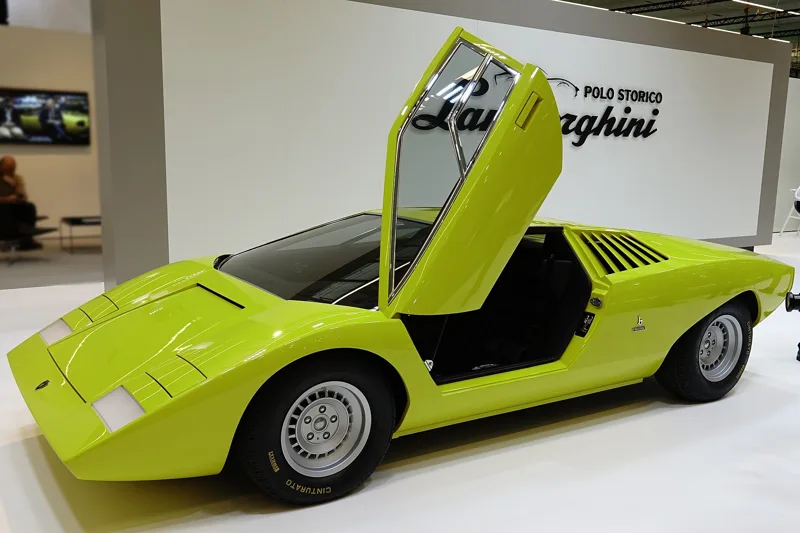
The LP500 was shorter than the Miura but wide and very low. It measured 185 cm (73 in) across, 103 cm (41 in) high and 401 cm (158 in) from nose to tail. The nose tapered sharply to a thin grille, and retractable headlights flipped down inside the body when not in use. There were no bumpers, spoilers or side mirrors to disturb the lines, and trapezoids repeated in the windscreen, side windows, door openings, bonnet, engine covers and tail lamps. Louvred vents behind the side windows fed air to the engine and the side radiators, though road testing soon showed they could not keep temperatures down.
A cockpit from the future
Inside, Gandini sketched an all-digital dashboard, which was not ready in time, so the prototype had a conventional speedometer and rev counter. It did have aircraft-style warning lights in the arc of the steering wheel, one of which lit when a set speed was exceeded, and an on-board diagnostic display showing the status of each subsystem on a schematic of the car. Because rear visibility was poor, a periscope in the roof replaced the usual mirror, and Donnelly Mirrors supplied it. A steering wheel with one spoke and bucket seats set deep into the floor completed a cabin that felt like a race car's.
Why does the Countach have scissor doors?
For style and for getting in. The doors were hinged horizontally at the front and lifted up and tilted forward, helped by gas struts that carried their weight. The idea first appeared on Gandini's Carabo of 1968. The Countach's wide chassis and high, wide sills made conventional doors awkward in narrow spaces, but the scissor doors need care under low ceilings.
Living with them had quirks. Many drivers deal with poor rear visibility and wide sills by parking in an unusual way: door open, perched on the sill, reversing while peering back over the bodywork. The doors also made it hard to climb out after a rollover. Lamborghini's engineers studied a removable "kick-out" windscreen and explosive bolts to remove the doors after a crash, but neither reached production.
How did the LP500 prototype become the Countach LP400?
After the 1971 show, Lamborghini's team spent three years refining the radical prototype into the production LP400, which debuted in 1974. The body was altered during pre-production testing to improve aerodynamics, high-speed stability and cooling, and to meet safety rules.
The most visible change was extra vents: NACA ducts across the doors and rear wings, and protruding air intake boxes that replaced the louvres behind the side windows. The nose slope was made shallower to cut excessive front downforce that had destabilised the prototype under braking. The side windows became two-piece units with a retractable lower half. The futuristic dashboard gave way to a conventional one with Stewart-Warner analogue gauges, and the single-spoke wheel became a three-spoke design like those on other Lamborghinis. The periscope stayed for the LP400 but was dropped for later cars in favour of conventional mirrors. The production LP400 grew slightly, to 189 cm (74 in) wide, 107 cm (42 in) high and 414 cm (163 in) long.
The styling kept changing as new models arrived, with flared arches, spoilers, carburettor covers and bumpers added for performance, safety and looks. Even so, the basic shape of the 1971 prototype stayed virtually unchanged through the car's 19-year lifespan.
How is the Countach engine laid out?
Lengthways, where the Miura's had sat sideways. The Countach was designed around the existing Lamborghini V12. Unlike the Miura's transverse engine, it was mounted longitudinally. That was a first for a road-going V12, which had previously been seen only in Ferrari's P-series racing cars.
Stanzani wanted even better weight distribution, so he devised a layout that kept the heavy transmission away from the rear. The output shaft was at the front of the engine, linked through the clutch to the gearbox, a 5-speed manual with Porsche-type synchromesh, mounted mid-car between the two seats. A driveshaft then ran through the engine's oil sump to the differential at the back. The engine was in effect sandwiched between the mid-mounted gearbox and the rear differential.
| Feature | Miura | Countach |
|---|---|---|
| Production | 1966 to 1973 | 1974 to 1990 |
| Engine layout | Transverse V12, mid-mounted | Longitudinal V12, mid-mounted |
| Designer | Marcello Gandini of Bertone | Marcello Gandini of Bertone |
| Prototype shown | 1966 Geneva Motor Show (P400) | 1971 Geneva Motor Show (LP500) |
| First engine | 3,929 cc, 350 PS (257 kW; 345 hp) | 3.9-litre in the LP400 |
| Door design | Not scissor doors | Scissor doors |
What do LP400, LP500 and 5000QV mean?
Lamborghini used alphanumeric codes. "LP" stands for the Italian longitudinale posteriore, meaning "longitudinal rear", which describes the engine position shared by every Countach. For the prototype and early production cars, a three-digit number gave nominal engine size: 400 for the 3.9-litre engines and 500 for the 4.8-litre and 5-litre ones. The first production car was therefore the Countach LP400. As on the Miura, an S for Sport marked later high-performance versions.
The 1985 LP5000 Quattrovalvole, with a 5.2-litre engine and also called the 5000QV, disrupted the scheme. The LP code was dropped altogether for the 1988 25th Anniversary Edition.
Has the Countach name come back?
The Countach name came back in 2021 on the Countach LPI 800-4, a limited-production hybrid-electric model based on the Sian.
Gandini, who had drawn the original design proposal for the Diablo, returned to Lamborghini in the 1990s to work on that car.