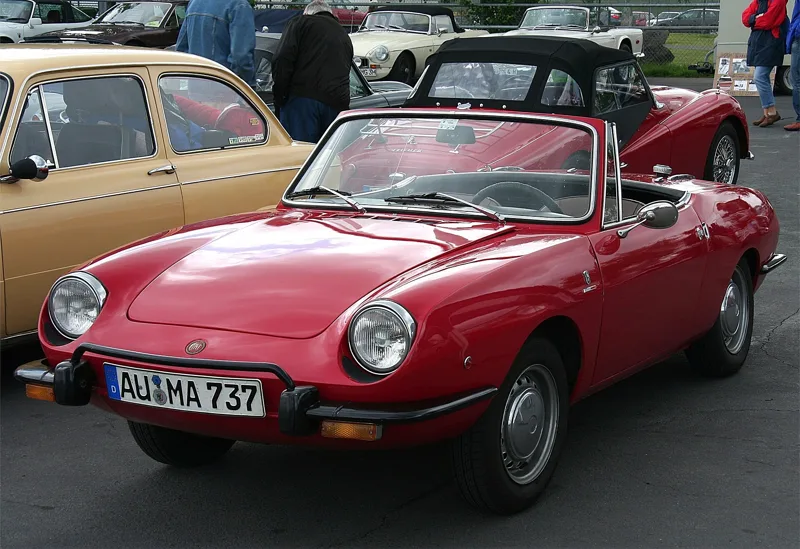
Bertone styling, a mid-mounted Fiat 128-derived engine, a removable targa top and a production run from 1972 to 1989.
The Fiat X1/9 was a mid-engined two-seater styled by Bertone, built by Fiat from 1972 and by Bertone from 1982 to 1989. It used a 1,290 cc Fiat 128-derived engine, a removable targa top and a design that sold strongly in the United States.
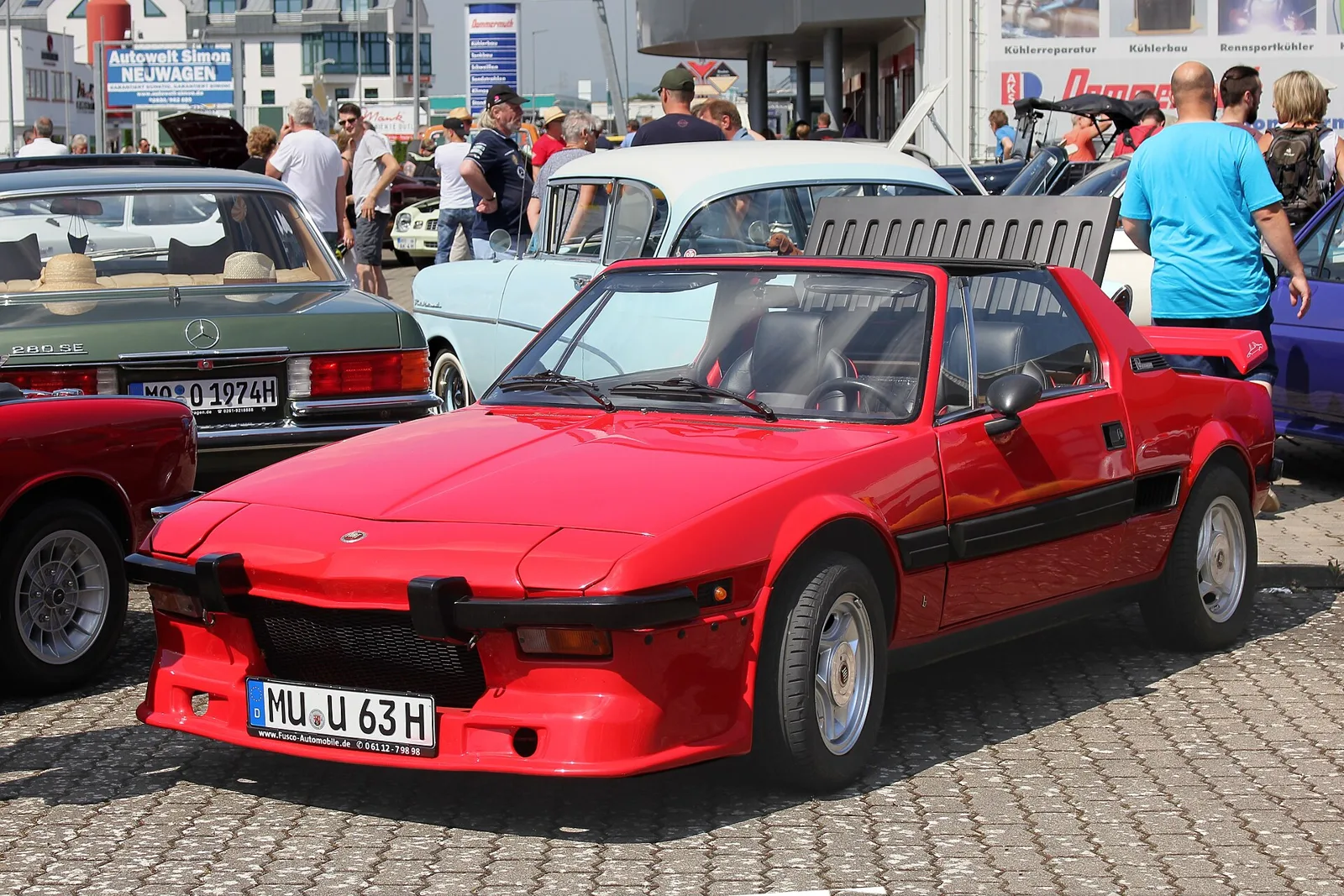
The Fiat X1/9 was a two-seater, mid-engined sports car that Bertone styled and Fiat sold from 1972, with Bertone taking over production in 1982. Its transverse four-cylinder engine sat behind the seats, and a removable targa roof could be stored in the front boot. It was also the first Fiat designed from the outset to meet US safety rules.
Where did the Fiat X1/9 come from?
The X1/9 grew out of the 1969 Autobianchi A112 Runabout concept, which Bertone styled under chief designer Marcello Gandini. The Runabout took many cues from power-boat design, and its engine was a version of the new Fiat 128 unit. Many of its features carried over to the production car.
The Runabout had a distinctive wedge shape, with headlights mounted in the C-pillars and a small wind-deflector windscreen. The production car dropped the most extreme of these ideas, but the flat bonnet with its dip in the middle, the generous nose overhang and the waterline running the length of the car all carried over.
Bertone supplied the styling, while the mechanical package came from Fiat. The car was built to replace an earlier Bertone design, and the engineering team reworked the Fiat 128 parts into a mid-engined layout that suited a two-seater.
A mid-engined two-seater that Bertone styled, with a removable hardtop and an active UK owners club.
Why is the car called the X1/9?
Fiat's marketing names at the time were numbers such as 127, 128, 124 and 131, which showed a car's place in the range. The X1/9 kept its prototype code instead. Fiat's prototype coding used X0 for engines, X1 for passenger cars and X2 for commercial vehicles.
In Italian the name is read as Icsunonove, with the x as ics, one as uno and nine as nove. English speakers usually say x-one-nine. The car was the ninth passenger car developed under this system, which explains the name.
How was the mid-engined layout arranged?
The X1/9 took the transverse engine and drivetrain from the front-wheel-drive Fiat 128 and relocated them behind the passenger cabin, directly ahead of the rear axle. The result was a mid-engined, rear-wheel-drive two-seater with more balanced handling than its donor car.
Aurelio Lampredi, a well-known Ferrari engine designer who had moved to Fiat, designed the engine. The fuel tank sat behind the driver's seat and the spare wheel behind the passenger seat, which helped spread the weight and freed up cargo space at the front and rear.
Moving front-drive parts to the back left some unusual solutions behind. The rear suspension used adjustable auxiliary control arms, the speedometer was driven by a long cable that ran forward and turned through 180 degrees, and the front radiator fed the rear engine through long coolant tubes.
What engine and gearbox did the first X1/9 use?
The first X1/9 used a 1,290 cc type 128 AS single overhead cam straight-four with a twin-choke Weber 32 DMTR carburettor and 8.9:1 compression. It produced 75 DIN hp (55 kW; 74 hp) at 6,000 rpm and came with an all-synchronised four-speed gearbox.
Torque measured 97 Nm (72 lb ft) at 3,400 rpm. The gearbox was carried over from the 128, but with a taller fourth gear to suit the sports car's better aerodynamics. The engine had a cast aluminium oil sump to match its aluminium cylinder head.
The X1/9 had a top speed of over 170 km/h (106 mph), which was 10 km/h faster than the similarly engined 128 Coupe 1300. That Coupe was 65 kg lighter, so the sports car's lower weight was not the reason for its extra speed.
How did the X1/9 ride and stop?
The X1/9 used fully independent suspension with MacPherson struts at both ends, rack and pinion steering and split circuit brakes. The brakes used equally sized 227 mm (8.9 in) solid discs all round.
Standard wheels were 4.5J x 13-inch stamped steel, fitted with 145 HR 13 tyres. Cast alloy wheels were available as an extra-cost option.
The cabin was simple. A four-spoke steering wheel resembled the one fitted to the Lamborghini Marzal, and the upholstery was leatherette. Lockable interior latches on the driver's door jamb opened the engine cover and the rear trunk.
When did production begin and where were cars built?
Fiat had planned to show the X1/9 at the November 1972 Turin Motor Show, but it delayed the launch until after the show so the new Fiat 126 city car would not be upstaged. Press drives followed at the end of November 1972 on the Sicilian Madonie roads.
The monocoque body was built at Bertone's factory in Grugliasco, Turin, and then taken to Fiat's Lingotto factory for final assembly. The car was intended to replace the 850 Spider, another Bertone design, while the larger 124 Sport Spider continued in production for much of the X1/9's life.
Estimates of total output vary, but roughly 160,000 cars were built over the model's life, and the largest share of them went to the United States.
Did the X1/9 come in right-hand drive?
Yes, but not at first. Fiat began marketing a right-hand drive version in 1976, and before that the British firm Radbourne Racing converted left-hand drive cars for the UK market. None of those early conversions are believed to survive, so early UK buyers relied on work done outside the factory.
What changed with the 1979 Series II?
For 1979 Fiat introduced the only major revision of the X1/9, usually called the Series II. The 1,290 cc four-speed drivetrain gave way to an adapted 1498 cc five-speed unit from the Fiat Ritmo, and the car gained a taller engine lid to suit the larger engine.
The original split bumpers of the Series I were replaced by an aluminium box channel bumper with corner trim. The taller lid was needed to accommodate the bigger engine.
US cars received their own changes for 1979, which are covered in the American section below.
How did Bertone take over production?
In 1982, shortly after the 1500 model arrived, complete production passed to Bertone and the car was badged as the Bertone X1/9. Bertone redesigned the footwells to improve legroom, which made the car more comfortable for taller drivers than the original design had been.
The last production models were the Gran Finale, sold over the 1989/1990 period. Dealers built them by modifying the 1988/1989 SE special edition, adding a rear spoiler and Gran Finale badges.
The Gran Finale closed a run that had begun in 1972.
How did the X1/9 fare in the United States?
The US took roughly two thirds of the approximately 160,000 X1/9s built, making it by far the car's biggest market. Three generations were sold there: the 1974 cars, the 1975 to 1978 cars and the 1979 to 1989 cars, each with different engines and bumpers.
The 1974 US cars were close to the worldwide model. They had small US-specific bumpers, 1290 cc engines rated at 63 hp (47 kW) and four-speed gearboxes. The 1975 to 1978 cars had ladder-style impact bumpers, exhaust gas recirculation valves, air pumps and activated charcoal systems, and were rated at 61 hp (45 kW).
In 1979 the US cars gained a 1498 cc engine and a five-speed gearbox from the Ritmo, sold in America as the Strada, with up to 67 hp (50 kW). Model years 1980 and 1981 moved to Bosch L-Jetronic fuel injection, with a catalytic converter and unleaded fuel, lifting output to 75 hp (56 kW).
The 1979 US cars also received integrated front and rear bumpers, new grilles and air dams, and a rearranged dashboard. Fiat ended its presence in the US during 1982, when International Automobile Importers, headed by Malcolm Bricklin, took over marketing and support.
How did Bertone sell the X1/9 in America after 1982?
After 1982 the car was sold as the Bertone X1/9 from 1983, and International Automobile Importers and Bertone worked together on rust protection, seating and the electrical system for the 1984 models. Sales fell in the final years, and 1987 was the last year that International Automobile Importers imported the car.
From mid-1987 until production ended in 1989, M.I.K. Automotive of North Hollywood, California, imported the Bertone cars. Its owner, Miro Kefurt, was then the number one Bertone dealer in the US and was one of very few dealers who sold only X1/9s.
The last four X1/9s arrived in the US in April 1990. They were 1989 model year cars, built in December 1989, and they closed the American chapter of the car's life.
Was the X1/9 sold in Australia and New Zealand?
Yes. The X1/9 went on sale in Australia and New Zealand in 1978, first with the 1,290 cc engine and four-speed gearbox, before the larger 1498 cc engine and five-speed gearbox arrived. It was withdrawn from Australia in 1983 and continued to be sold in New Zealand until 1985.
When the car became a Bertone model it needed to pass new Australian Design Rules before it could be sold there. Bertone also had to find new showrooms, and the combination of those demands meant the car was withdrawn from sale in Australia in 1983.
The Bertone X1/9 returned to the Australian market in 1988 and was sold until 1991, marking a second stint for the model in that country.
What concept cars did Bertone build from the X1/9?
Bertone built at least three design and engineering studies based on the X1/9. Examples of all three are displayed at the Volandia Museum beside Milan Malpensa airport, which now houses most of the Bertone collection. The studies were the Superlight, the Passo Lungo and a full convertible Spider.
The Superlight programme used an all-aluminium body shell developed with ALCAN. Five cars were built to the same strength and stiffness as the steel production cars, and they were tested for vibration, noise, high load input and corrosion. Weight savings were about a third compared with the steel body.
One Superlight was entered in the 1987 Longest Day of Nelson Ledges, a 24-hour Showroom Stock endurance race, but a slip during test and tune practice kept it out of the event. The programme also tested adhesives and assembly techniques, not just the metal.
The Passo Lungo of 1981 was a 2+1 study with a stretched wheelbase of 2,450 mm (96 in), a third seat behind the passenger and a DOHC Fiat engine. It was 2 inches (5 cm) wider and more than 7 inches (18 cm) longer, which meant the targa roof could no longer be stored in the front boot.
The Spider study deleted the fixed rear window and sail panels. Its roof was a flexible cover on a new roll bar, fixed with the original targa clips at the windscreen and twist-clips at the rear.
Did the X1/9 compete in motorsport?
Yes. Scuderia Filipinetti presented the first X1/9 race car at the Geneva Motor Show in March 1973, Abarth built a rally prototype that same year, and Dallara entered a version in the 1975 World Championship for Makes.
The Filipinetti car was built with Fiat's cooperation by the racer Mike Parkes, who later developed the Lancia Stratos. It ran a 1290 cc unit with Lucas mechanical injection, paired with a Colotti five-speed box. Its output was roughly 160 PS (118 kW) at 8600 rpm, with a top speed of 210 km/h (130 mph).
Abarth developed the X1/9 Prototipo in 1973 to replace the 124 Spider Abarth as Fiat's main rally car. It used an 1840 cc engine with a 16-valve head and twin 44 mm Weber IDF carburettors, but the parallel 131 Abarth project was chosen instead. About five genuine Prototipo cars are believed to have been built.
Dallara built the Icsunonove for the Group 5 Special Production class in 1975. It had a modified engine, a custom 16-valve head, massively flared wheel arches and an oversized rear wing.
Which kits changed the X1/9's looks?
Several aftermarket kits gave the X1/9 a wider, more aggressive shape. The best known were the Faran Eliminator, Eurosport's full and bolt-on kits and a German Schult kit, and at least one of them is still available. Each changed the wings, bumpers or sills in different ways.
The Faran Car Co Ltd sold its Eliminator kit in DIY and assembled forms. It used replacement fibreglass front and rear wings and integrated bumpers, with side sill skirts and a rear boot spoiler. Faran also offered Lancia or Fiat Twin Cam engine conversions, although some owners kept the original single overhead cam set-up. Production ended following a factory fire.
Eurosport (UK) Ltd, an X1/9 parts specialist, produced a full kit with wide wings, integrated bumpers and side skirts, plus side air intakes ahead of the rear wheels. Its bolt-on version swapped in bumper sections that blended with the standard wings, and both kits are still available today.
The Schult kit from Germany took some inspiration from the Testarossa style, but its lines were more angular and less curved.
Are X1/9s still on the road today?
Yes, in limited numbers. As of December 2025, 355 X1/9s were road legal in the UK, and more than 900 were registered as off the road under SORN. An active owners club runs events and gives maintenance advice.
In the US, 1,034 X1/9s were legally plated for road operation and 115 in Canada, according to the latest available figures from the third quarter of 2018. Those figures are a snapshot rather than a current count.
The UK owners club produces a quarterly magazine and attends or organises events. Its advice covers routine car maintenance for owners of these older two-seaters.
What are the core X1/9 specifications?
| Specification | Detail |
|---|---|
| Layout | Two-seat, mid-engined, rear-wheel drive |
| Engine | 1,290 cc type 128 AS single overhead cam straight-four |
| Power | 75 DIN hp (55 kW; 74 hp) at 6,000 rpm |
| Torque | 97 Nm (72 lb ft) at 3,400 rpm |
| Gearbox | 4-speed all-synchronised; five-speed on Series II |
| Top speed | Over 170 km/h (106 mph) |
| Suspension | MacPherson struts front and rear |
| Brakes | Split circuit, 227 mm (8.9 in) solid discs |
| Wheels and tyres | 4.5J x 13-inch steel; 145 HR 13 tyres |
| Series II engine | 1498 cc from the Fiat Ritmo, five-speed |
| US 1979 cars | 1498 cc, up to 67 hp (50 kW) |
| US 1980 to 1981 fuel-injected cars | 75 hp (56 kW) |
| Production | Roughly 160,000 built |