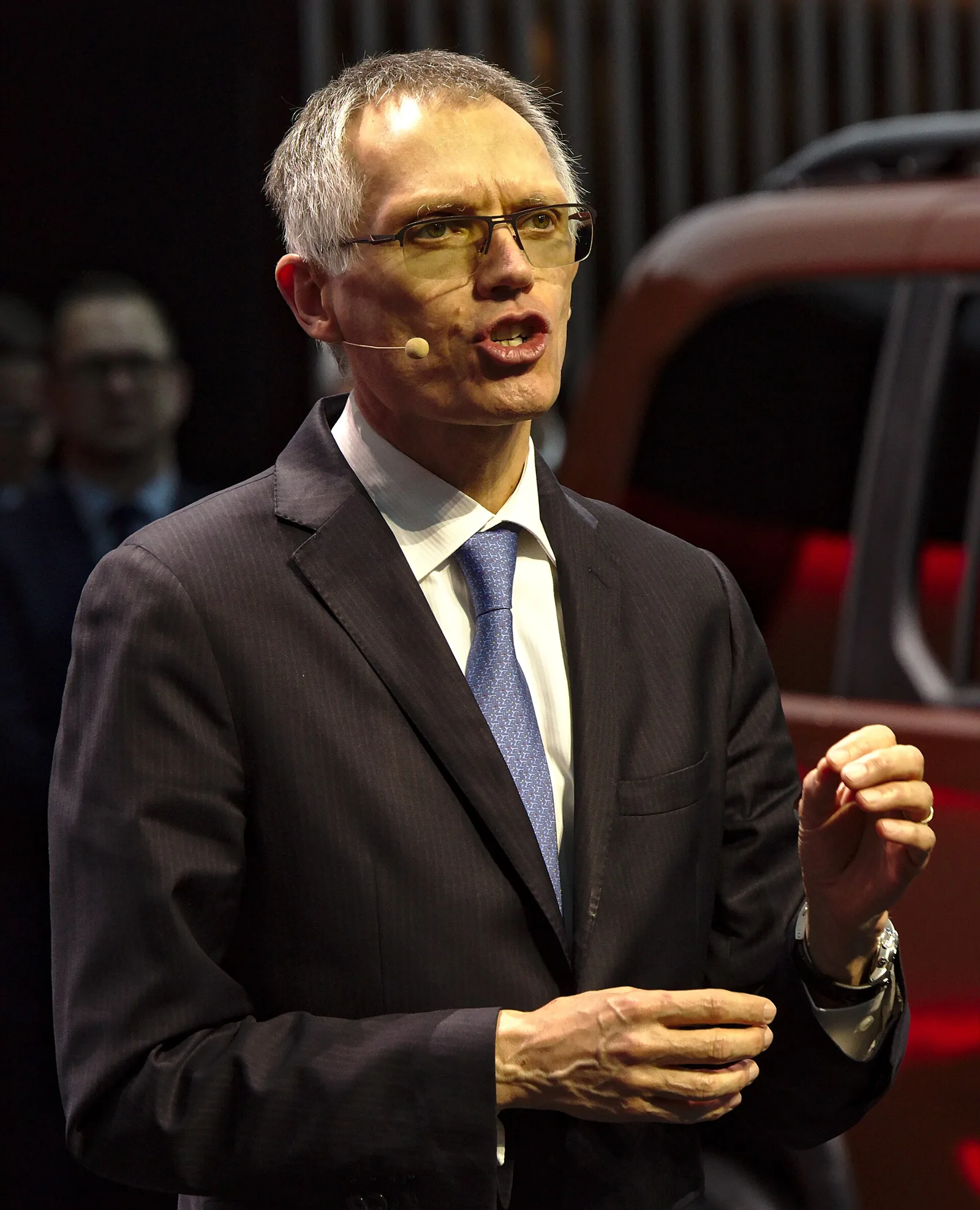
A Daimler turnaround, a Volkswagen scandal, a Stellantis merger and a Renault recovery: four chief executives, four endings.
Dieter Zetsche ran Daimler and Mercedes-Benz from 2006 to 2019, Martin Winterkorn led Volkswagen from 2007 until the 2015 emissions scandal, Carlos Tavares headed PSA and then Stellantis until December 2024, and Luca de Meo ran Renault from 2020 to 2025 before joining Kering.
Martin Winterkorn took over Volkswagen in 2007 with a target of overtaking General Motors and Toyota to become the world's largest automaker by 2018. In September 2015 he resigned over the diesel emissions scandal. Dieter Zetsche at Daimler, Carlos Tavares at PSA and Stellantis, and Luca de Meo at Renault also ran major European car groups, each with a very different outcome.
Who are Dieter Zetsche, Martin Winterkorn, Carlos Tavares and Luca de Meo?
They are four executives who led big European car companies in the last two decades. Zetsche, a German engineer, headed Daimler and Mercedes-Benz. Winterkorn, also German, ran Volkswagen. Tavares, a Portuguese executive, ran PSA and then Stellantis. De Meo, from Milan, ran Fiat's car arm, SEAT and then Renault.
Four chief executives ran four European car groups in the same era, and no two left the same way: a handover, a resignation under scandal, an abrupt exit and a move to luxury.
How do the four car bosses compare at a glance?
| Executive | Born | Main group led | Time at the top | How it ended |
|---|---|---|---|---|
| Dieter Zetsche | 5 May 1953 | Daimler and Mercedes-Benz | 1 January 2006 to 22 May 2019 | Stepped down in May 2019, as announced in September 2018 |
| Martin Winterkorn | 24 May 1947 | Volkswagen AG | 1 January 2007 to 23 September 2015 | Resigned after the emissions scandal came to light |
| Carlos Tavares | 14 August 1958 | Groupe PSA, then Stellantis | PSA from 2014; Stellantis from January 2021 to December 2024 | Resigned abruptly on 1 December 2024 |
| Luca de Meo | 13 June 1967 | Renault Group | July 2020 to June 2025 | Left to become chief executive of Kering |
What did Dieter Zetsche do at Daimler and Mercedes-Benz?
Dieter Zetsche was born in Turkey, where his father, a civil engineer, was working on a dam. The family moved back to Germany in 1956. He studied electrical engineering at Karlsruhe from 1971 to 1976 and took a doctorate in engineering at Paderborn in 1982. His career started in Daimler-Benz's research department in 1976, and by 1981 he was assistant development manager in the Vehicles unit.
A seat on the DaimlerChrysler board came in 1998. From mid-2000 to the end of 2005 he was president and chief executive of Chrysler Group, where he was credited with turning around the American operations. On 1 January 2006 he succeeded Juergen Schrempp as chairman, with Thomas W. LaSorda taking over Chrysler. The 2007 split of Daimler from Chrysler, which gave birth to Daimler AG, owed most to Zetsche.
His standing wobbled in the 2010s. Two profit warnings, in 2012 and 2013, along with sluggish China sales and friction with the company's strong labour side, meant a renewal of only three years, not the five many expected. His pay and bonuses in 2014 came to 14.4 million euros, second only to one other employee of a listed German company. A record 2015 for sales and revenue then led to an extension to 2019.
He is credited with making core changes at Mercedes-Benz to end a decade-long slide in product quality and customer satisfaction. Time magazine put him on its 2006 list of the 100 most influential people.
What was the Ask Dr. Z campaign?
Chrysler Group announced its Employee Pricing Plus programme on 30 June 2006, with Zetsche appearing as Dr. Z in television commercials across the United States and Canada. A website of the same name went live on 1 July. He answered customers' questions and signed off with "Auf Wiedersehen".
Media spend covered television, radio, print, online, dealership displays, mobile billboards, aerial banners and street teams, with an eye on NASCAR fans. One advert had him crossing a pile of logs in a Jeep Liberty, another had him heading a soccer ball from the back of a Dodge Caravan, and a third put him behind the wheel of a Chrysler Pacifica in a crash test, from which he stepped out unharmed.
It did not land. Critics said the company had the wrong man for funny ads, and a poll found that most viewers thought Dr. Z was a fictional character. Many missed the employee-discount offer, and radio listeners struggled with his German accent. DaimlerChrysler pulled the campaign after three months because of a significant loss in market share, extended the pricing offer to the end of August and added three new adverts that did not feature him.
Where did Dieter Zetsche go after Mercedes-Benz?
Zetsche was elected to the supervisory board of the tourism company TUI AG in February 2018, before his departure from Daimler was announced, and became its chairman in May. In September 2018 it was announced that he would step down as Daimler's chief executive in May 2019, in line with a two-year cooling-off rule, with a plan announced then for him to chair the supervisory board in 2021.
His other roles include Deutsche Bank's European advisory board since 2006. In the autumn of 2011 he was investigated over the death of a 27-year-old engineer in a test-track accident caused by an intern, although it was generally agreed that prosecutors had overreached in holding him responsible.
How did Martin Winterkorn rise to run Volkswagen?
At the University of Stuttgart, from 1966 to 1973, Winterkorn read metallurgy and metal physics; a doctorate followed in 1977 at the Max-Planck-Institute. He played football as a goalkeeper. His career began at Bosch, where from 1978 to 1981 he led a development group working on refrigerant compressors.
Inside Volkswagen he became head of Group Quality Assurance in 1993 and general manager in March 1994, then took on group product management in 1995. From January 1996 he ran technical development for the Volkswagen brand, and from July 2000 for the whole group. He was instrumental in persuading chief executive Ferdinand Piech to approve production of the New Beetle.
He took charge of Audi AG on 1 March 2002, heading a brand group that also included SEAT and Lamborghini, and added technical development there in 2003. He then succeeded Bernd Pischetsrieder as Volkswagen's chief executive on 1 January 2007. By 2014 he was the best-paid chief executive among the companies in Germany's blue-chip DAX index.
What was Volkswagen's Strategie 2018?
It was Winterkorn's plan to pass General Motors and Toyota and make Volkswagen the largest automaker in the world by 2018. A central tool was the pair of MQB and MLB platforms. They standardise the part of the car between the accelerator pedal and the front wheels, engines included, where 60% of development cost sits. That cut costs while leaving more design freedom for the rest of the car.
Inside the group he was seen as product-focused, methodical and precise, and also demanding. He sat on the supervisory board of the football club Bayern Munich from 22 February 2003 to 18 December 2018 and is credited with building the club's partnership with Audi.
What happened to Martin Winterkorn after the emissions scandal?
In September 2015 Winterkorn apologised for software that let Volkswagen's diesel cars cut emissions when they detected a test and otherwise pollute far beyond legal limits. He said the company could face fines of up to $18bn, and no recall had been issued when he left. He blamed mistakes by a few people and resigned as chief executive on 23 September 2015, saying he knew of no wrongdoing on his part.
On 11 November 2015 he also resigned as Audi chairman, a week after further revelations about emissions test rigging, this time in petrol cars numbering close to one million.
A United States indictment of 3 May 2018 charged him with fraud and conspiracy. It alleges that he was briefed at a 2015 conference in Wolfsburg on the defeat device software and approved its continued concealment from US regulators. Oliver Schmidt, then Volkswagen's compliance liaison, pleaded guilty in 2017 and received a seven-year jail term. Winterkorn is wanted by the US Environmental Protection Agency on charges that include conspiracy to defraud the United States and conspiracy to violate the Clean Air Act.
In Germany, prosecutors in Braunschweig charged him on 15 April 2019 with fraud, unfair competition offences and defalcation. A court there ruled in September 2020 that he would face trial on fraud and market manipulation. In testimony in February 2024 he denied wrongdoing, saying he had neither requested nor encouraged the functionality nor condoned its use. He has since denied all charges.
The German trial opened in September 2024 and was suspended on 1 July 2025 over Winterkorn's health. In June 2026 it was suspended indefinitely for the same reason. Bundestag committee chairman Herbert Behrens had earlier reacted with disbelief to his claim never to have heard the term defeat device before 2015. In June 2021 it was reported that Winterkorn and other former managers should pay Volkswagen around 10 million euros in compensation.
How did Carlos Tavares become head of PSA?
Carlos Tavares was born in Lisbon, the son of a French teacher and a chartered accountant. His passion for cars is traced to an open day at the Estoril circuit when he was 14, where he volunteered as a track marshal. At 17 he left for Toulouse to study maths, and he graduated as an engineer from the Ecole Centrale Paris in 1981.
He started at Renault in 1981 as a test-driving engineer, aged 23, and later directed the Megane II project. Between 2004 and 2011 he worked at Nissan, rising to executive vice-president in 2005 and overseeing its business in North and South America by 2009. In 2011 he returned to Renault as chief operating officer under Carlos Ghosn.
The partnership ended on 29 August 2013, two weeks after Tavares said publicly that he wanted to be the chief executive of a car company. He reportedly refused Ghosn's demand for an apology to staff and resigned.
In 2014 he became chief executive and chairman of Groupe PSA, replacing Philippe Varin. He cut costs, lifted market share in China and brought the group back to profit after several years of losses. DS Automobiles became a stand-alone brand that year. He won praise for buying Opel and Vauxhall from General Motors and for returning them to profit, although PSA sales in China slipped.
What happened to Carlos Tavares at Stellantis?
PSA merged with Fiat Chrysler Automobiles in January 2021 to form Stellantis, with Tavares as its first chief executive. At the first press conference he promised annual savings of 5 billion euros from investment, shared engines and platforms, and joint development. He also said he would relaunch the most fragile brands.
Pay became a flashpoint. During the 2022 French presidential election, both Emmanuel Macron and Marine Le Pen called his 2021 package of around 19 million euros ($20.5 million) shocking, and it came with stock worth some 32 million euros and long-term pay of about 25 million euros. In 2023 the board approved nearly $40 million in compensation, and he drew criticism for remarks suggesting consumers should expect to pay more, including for "more expensive burgers".
He also warned of an "invasion" by Chinese electric-car makers. Between 2021 and 2022 their share of the European market doubled to almost 9%.
The board started a succession process at the end of September 2024 even though his mandate ran until 2026, and on 1 December 2024 Tavares resigned abruptly. John Elkann chaired a new interim executive committee tasked with finding a successor. Under his leadership Stellantis's net profit fell 70% in 2024, its share price dropped more than 50% from its early-2024 peak, and market share in North America and Europe contracted by 5%.
What else does Carlos Tavares do?
Tavares has raced since he was 22. In 1983 he began rallies and endurance races with friends and entered the Monte-Carlo Rally. In 2014 a Peugeot RCZ Cup carried him to victory in the A2 class at the Barcelona 24 Hours, and he runs his own team, Clementeam Racing, named after his daughter. He sat on the boards of Faurecia, Airbus and Total in various years between 2014 and 2022.
He was named World Car Person of the Year in 2020. His collection includes a 1966 Porsche 912, a 1976 Alpine A110 and a 1979 Peugeot 504 V6 Coupe. After leaving Stellantis he is reportedly living on a farm in Santarem, Portugal, making port wine at a vineyard he owns in the Douro valley.
What did Luca de Meo do at Fiat, SEAT and Renault?
Luca de Meo was born in Milan, and his family lived abroad at various times, in Ivory Coast, Tanzania, Nigeria and Brazil. He graduated from Bocconi University in 1991. After Renault sales in Italy in 1992 and Paris marketing in 1994, he joined Toyota Europe in 1998 and became its chief of product strategy in 2000.
At Fiat, he was appointed chief executive of Fiat Automobiles in 2004 and drove the launch of the new Fiat 500 in 2007. In the same year he became the group's chief marketing officer and took charge of Alfa Romeo and Abarth. He resigned in January 2009 and joined Volkswagen in August as marketing and sales director for passenger cars.
In the midst of 2015's Dieselgate, Volkswagen made him chief executive of SEAT. He launched SEAT's first B-segment model, the Ateca, created its premium brand Cupra and introduced its first electric cars, and a 2019 deal with JAC Motors was meant to grow SEAT in China.
How did Luca de Meo turn Renault around?
He resigned from SEAT in January 2020 and was named Renault's chief executive that month, effective July 2020. When he arrived, the company was losing 8 billion euros. His stated aim was to change Renault from a car company that uses technology into a technology company that makes cars, which meant brand building, a full move to electric technology and a pivot to new mobility habits.
The Renault 5 was his pick as the symbol of the revival, and he consolidated Renault's electric vehicle business as Ampere, which he has led as chief executive since June 2023. He merged Renault Sport and its Formula One team into the Alpine brand, launched the microcar-sharing brand Mobilize, which was discontinued in 2025, and sealed a partnership with Geely to develop low-emission combustion technology under the name Horse Powertrain. In 2023 he became president of the European Automobile Manufacturers Association.
Results followed. Renault's 2021 results showed revenues up 6% and a net profit of 967 million euros, and he is said to have turned the company around in 18 months, with the first phase of his transformation programme done by January 2023. By 2023 the operating margin stood at 5.6%, against 2.8% in 2021, and Alpine grew 33% in 2022. He left Renault in June 2025, and from September 2025 he has been chief executive of the luxury group Kering, owner of Gucci, Yves Saint Laurent, Balenciaga and Bottega Veneta.
What are the four doing now?
At Kering, de Meo is auditing the retail network with a view to downsizing, cutting its financial dependence on Gucci and reducing debt. He postponed full ownership of Valentino, sold the beauty division, Creed fragrances among it, to L'Oreal for 4 billion euros and named Francesca Bellettini as chief executive of Gucci.
Winterkorn's German case remains unresolved while the proceedings are suspended on grounds of his health. Zetsche chairs TUI's supervisory board, and Tavares is reportedly out of the industry and making wine in Portugal.