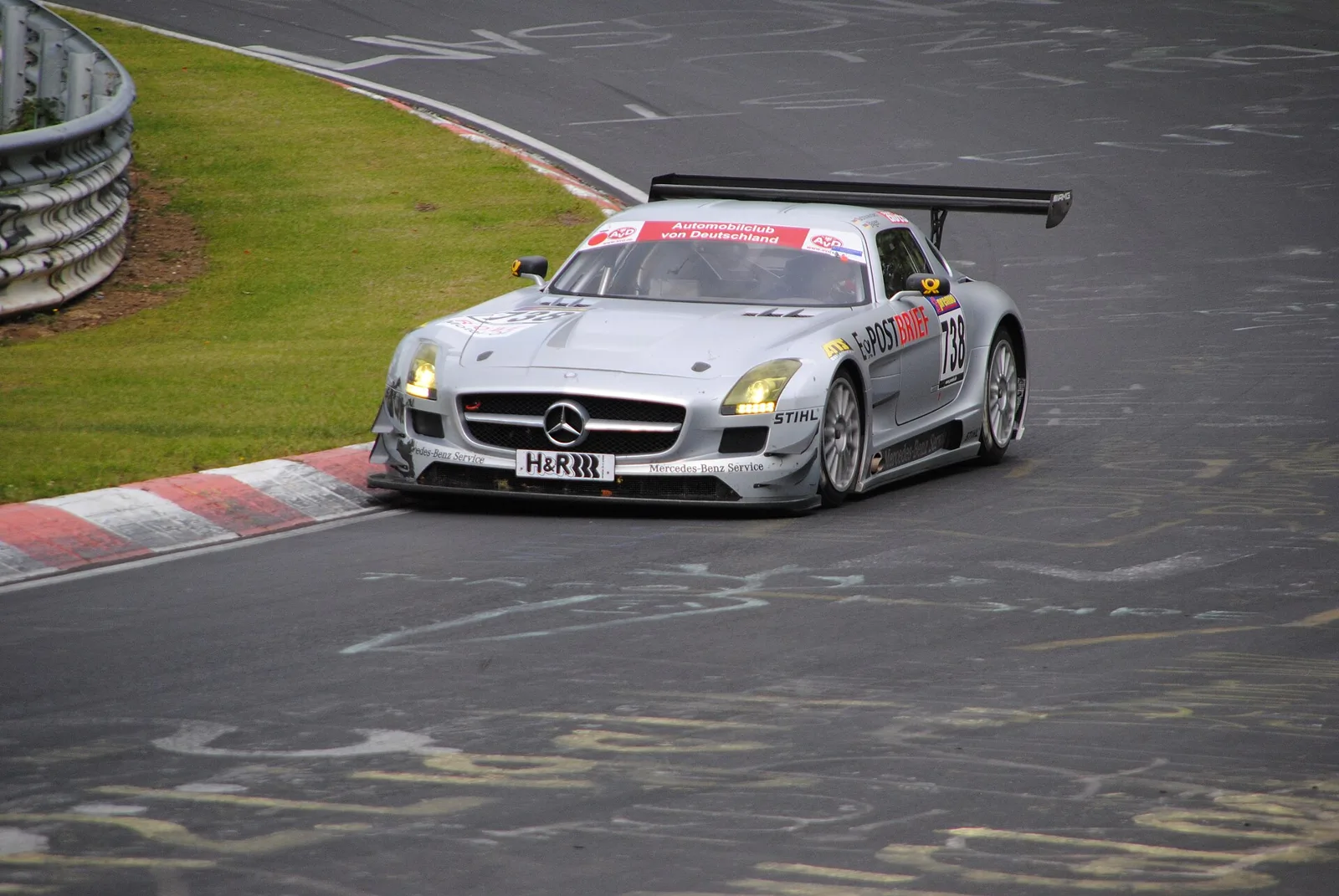
A hatchback can win the Nurburgring title, a Japanese series burns hydrogen and synthetic fuel, and Creventic only races for 12 or 24 hours. How four endurance series work.
Super Taikyu is Japan's pro-am endurance series, the NLS is a Nordschleife endurance championship with mixed classes, the 24H Series is Creventic's 12-hour and 24-hour calendar, and the Michelin Pilot Challenge is IMSA's GT4 and TCR series of two-hour races.
A Renault Clio can win the Nurburgring Endurance title. The NLS gives its drivers' championship by group position rather than overall position, so entry-level hatchbacks such as the Clio, Opel Corsa and Suzuki Swift have all taken it, while GT3 factory cars chase a separate prize. That quirk is one of several that set the NLS apart from three other endurance series with very different ideas.
What is the Nurburgring Langstrecken-Serie?
The Nurburgring Langstrecken-Serie, or NLS, is a series of endurance races on the Nordschleife, each hosted by an ADAC club. Until 2020 it was called the VLN Series. Entries mix hobbyists in compact road-legal cars fitted with rollcages and harnesses with professional factory squads running Group GT3 cars.
It is closely tied to the Nurburgring 24 Hours. The rules are largely the same, and most of the entrants are too. The calendar leaves several weeks free around the 24 Hours in May or June so teams can prepare and then repair, but that race is no longer part of the championship. The grid is famously big and varied, with an average of 113 cars starting each race in 2023.
A Renault Clio can win the Nurburgring Endurance title.
Why has the NLS had so many names?
The series was founded in 1977 by motorsport clubs belonging to ADAC or the Deutscher Motorsport Verband, who wanted to pool their efforts. Beforehand, each club ran its own touring car event at the Nurburgring, lasting 3.5 to 6 hours with about 150 cars and 400 drivers. The rules were unified and the events became a series.
Sponsors shaped the title. It began as the Valvoline Langstreckenpokal Nurburgring and ran under that name until the end of 1980. From 1981 to the end of 2000 it was the Veedol Langstreckenpokal, and people simply called it the Veedol-Cup. The German body DMSB recognised it as the national endurance championship in 2001, and it became the BFGoodrich Langstreckenmeisterschaft until 2009, then the VLN until the 2020 rebrand to NLS, although the VLN organisation kept its name.
Late 2023 brought a legal fight between the series' rightholders and the Nurburgring operator over dates for 2024, and the AvD planned a rival series based at the circuit. The 2024 season went ahead with eight races over six weekends, including the qualifying races for the 24 Hours. The 2025 season ran ten races over eight weekends, including those qualifiers and a new NLS Light race.
What does an NLS race day look like?
Every race is a one-day event on a Saturday, to keep costs down. The drivers' briefing is at 07:30 and qualifying runs from 08:30 to 10:00. The field first completes a warm-up lap following safety cars. One of three groups then leaves at 12:00 and the other two follow a few minutes behind, so all three are away before the fastest cars finish a first lap, which takes them just over 8 minutes. Once parc ferme opens and the winners are honoured, teams can drive home the same day. Some weekends also fit in sprint races for classic cars and youngtimers.
The Nurburgring 6 Hours is the season highlight. Sir Jack Brabham took part in 1998 at the age of 72. Two to four drivers share each car in that race, whereas in the others a single driver can go four hours alone, or up to three can team up.
Two other rounds are famous for rituals. At the NLS-6 Barbarossapreis, which honours Michael Schumacher's success with Ferrari in Formula One, everyone on the podium receives a red wig. At the NLS-9 Munsterlandpokal, also called the ham race, class winners are handed large pieces of ham from the Munsterland region.
Most fans watch from the Nordschleife itself, and getting to the favourite spots often means a walk. The spots at Adenauer Forst, Karussell and Wippermann can lie as much as a kilometre from the nearest main road, while Breidscheid, Brunnchen and Pflanzgarten are easy to reach and always busy. Around most of the circuit there is no entrance fee. A 20 euro ticket buys access to the paddock, the grid walk, two spectator areas at the Nordschleife and the grandstands of the Grand Prix circuit.
How does the NLS crown a champion?
The drivers' title is decided on positions within each group, not on overall positions. Contenders very often are not in the hunt for overall wins or podiums, and they often are not racing each other directly. As of 2023, four titles in a row had gone to entries from the slower production cars group.
Overall results still count in one place. The NLS Speed-Trophy, a teams' championship, uses overall results only, so it goes to the quicker GT3 cars in SP9 or Porsche 992 GT3 machinery in Cup 2. The Junior and Ladies awards work like the drivers' title, and every class also has its own drivers' and teams' championships.
How many classes does the NLS have?
In 2023 cars from 22 classes ran in at least one race. The VLN production cars group is meant to allow relatively cheap racing with near-standard cars, with normally aspirated classes V3 to V6, turbocharged classes VT1 to VT3, a hybrid class and an electric class. The 24h-Special group is for pure race cars that may also compete elsewhere, from SP1 to SP8 by engine displacement to SP9 for FIA GT3 cars and SP10 for SRO GT4 cars.
Further classes cover prototypes above 3000cc (SP-Pro), special vehicles (SP-X) and alternative-fuel cars (AT). A historic group, H, covers cars made in 2008 and before, with H2 up to 1999cc and H4 from 2000 to 6250cc. A large part of the field is TCR and Cup cars such as the Porsche 911 GT3 Cup, Porsche Cayman GT4 Clubsport, BMW M2 CS and BMW M240i.
How does the NLS deal with safety on the Nordschleife?
The length of the track and the championship's format call for unusual procedures. There are no safety cars. Double yellow flags impose a 120 km/h limit locally, and code 60 flags, which on shorter tracks would justify a safety car, hold drivers to 60 km/h. Course cars and recovery trucks regularly circulate beneath local double yellows. Closing speeds between the fastest and slowest classes are a perennial worry, with blind crests and corners everywhere.
Five drivers have died in racing accidents in the NLS, the most recent in 2026. Two others died of heart attacks at the wheel, and a marshal and a spectator were killed after being hit by cars in 1977 and 2015.
What is Super Taikyu?
Super Taikyu, meaning Super Endurance, is a Japanese endurance series that began in 1991. It was the N1 Endurance Series until 1995 and the Super N1 Taikyu Series until 2005. Its sponsored name today is the Eneos Super Taikyu Series Empowered by Bridgestone.
Unlike Super GT, it is a pro-am series for commercially available racing vehicles, namely GT3, GT4 and TCR cars, and lightly modified production vehicles, mostly from the Japanese domestic market. Races take place at all of Japan's major circuits as either a single five-hour race or a double-header of two three-hour races.
The headline event is the Fuji Super TEC 24 Hours, run every year at Fuji Speedway since its 2018 revival. Before that, the Tokachi 24 Hours held the title of biggest event, from 1994 until 2008. From 2026 the organisers created a new series for national amateur drivers called the Super Taikyu Challenge and announced a long-term plan for a third tier for entry-level drivers, My First Super Taikyu.
The class structure has five domestic classes originally based on FIA Group N rules and four international ones, two based on SRO Motorsports Group, one on WSC Group rules and one on ADAC rules. ST-1 to ST-4 were the original four, separated by displacement and drivetrain layout, and ST-5, a production class, was launched in 2010. SRO's GT3 cars joined in 2011, now labelled ST-X. In 2017 came ST-Z for GT4 cars and ST-TCR. The ADAC-based ST-Q arrived in 2021. For November 2025 the series planned ST-USA at Fuji, working with the Automobile Competition Committee for the United States, for GM and Ford GT cars, the Chevrolet Corvette GT3 and Ford Mustang Dark Horse R among them.
Which alternative fuels has Super Taikyu tested?
ST-Q is for manufacturer-developed special racing vehicles that are not homologated, with rules that follow the SP-X class in the NLS. Toyota and ROOKIE Racing entered a modified GR Corolla hatchback with a hydrogen-powered combustion engine from 2021. Mazda ran a modified Demio, also known as the Mazda2, on biofuel in the 2021 finale.
In 2022 Toyota and Subaru entered versions of the GR86 and BRZ adapted for carbon-neutral synthetic fuel. Nissan brought a Racing Concept version of the new Fairlady Z (RZ34), which was the prototype for the Nissan Z GT4, and Mazda introduced the Mazda3 Bio Concept, a biodiesel car, at the end of the year. The hydrogen GR Corolla was to switch to liquid hydrogen in 2023, which would make it a world first among race cars. Honda unveiled a Civic Type R compatible with carbon-neutral fuel that year.
Who supplies Super Taikyu's tyres?
Tyre supply has shifted several times. Yokohama supplied the series until the end of 2017, Pirelli took over in 2018 on a three-year contract, and Hankook followed in 2021. A fire at Hankook's plant in Daejeon on 12 March 2023 led Bridgestone to step in, announced on 24 April with immediate effect, before the second round of the 2023 season, and then to sign for three years from 2024.
Where does the 24H Series race?
Creventic's 24H Series mixes sports cars and touring cars under FIA approval. Entries include GT3 and GT4 cars built to class spec, sports cars, touring cars and 24H-Specials, silhouette cars for example. Nothing on its calendar is shorter than 12 hours. In 2015 drivers began fighting for championship points and titles for the first time, and the series gained official FIA International Series status.
Creventic is a Dutch agency that organises and promotes the series. Its stated goals are cheap racing, a friendly atmosphere with crews from around the world and fair competition. Working alongside the Dutch National Racing Team, it staged the first Dubai 24 Hour in 2006. A second race, the 12H Hungary, followed in 2008, making that the first campaign with multiple races. Creventic also organises the 24H TCE Series.
The circuit list is long. Dubai Autodrome hosted from 2006 to 2022, while Barcelona-Catalunya has been used since 2011 with some gaps, and Spa-Francorchamps, Mugello and Paul Ricard are on the current calendar. Other venues include the Hungaroring, Mount Panorama in 2013, the Circuit of the Americas from 2017 to 2019 and Sebring in 2021. The Nurburgring is listed for 2026 and Kyalami for 2027. The official FIA seasons were called the 24H Series in 2015 to 2017, the 24H GT Series from 2018 to 2023, and the 24H Series again in 2024 and 2025.
What is the Michelin Pilot Challenge?
Run by the International Motor Sports Association, the Michelin Pilot Challenge mixes grand touring and touring cars. It started as the Canadian Motorola Cup. Grand-Am took it over in 2001 and renamed it the Grand-Am Cup, after the demise of IMSA's rival Firehawk series, which had similar rules.
KONI became sponsor in 2007, and it was the KONI Challenge Series, then from 2009 the KONI Sports Car Challenge, and from 2010 the Continental Tire Sports Car Challenge. In 2019 Michelin became the official tyre supplier and the series dropped the words Sports Car from its name. It was the support series for Grand-Am's Rolex Sports Car Series, and from 2014, after the Rolex Series merged with the American Le Mans Series, it supported what is now the IMSA SportsCar Championship.
Today races are two hours long with a required driver change. GT4 (Grand Sport) and TCR cars usually share the track in a combined race, though sometimes classes are split into separate races, which is especially common at short venues such as Lime Rock Park. Originally the two classes were Grand Sport, for large-displacement six, eight, ten or twelve cylinder cars as well as small turbocharged four-cylinders, and Street Tuner, for smaller sedans, hatchbacks, coupes and convertibles. From 2017 IMSA allowed SRO GT4 cars from mainstream manufacturers and phased out the original Grand Sport class a year later. TCR arrived as a third class in 2018 and replaced Street Tuner in 2019.
The format echoed the original Trans-Am Series, which also mixed sports and touring cars but usually had one driver per car, while the Continental Challenge uses two. Some cars have been wrapped to look like Trans-Am originals, among them Boss 302 Mustangs raced by George Follmer and Parnelli Jones and the original Sunoco Camaro. The cars are also eligible for the one-hour GT4 and TCR classes of the Pirelli World Challenge.
How do the four endurance series compare?
| Series | Region | Race lengths | Distinguishing feature |
|---|---|---|---|
| Super Taikyu | Japan | Five hours, or two three-hour races; 24 hours at Fuji | Pro-am, with an ST-Q class for new fuels |
| Nurburgring Langstrecken-Serie | Germany | Up to 6 hours at the Nurburgring 6 Hours | Titles decided by group position; 22 classes in 2023 |
| 24H Series | Europe, the Middle East and beyond | 12 and 24 hours | FIA International Series status since 2015 |
| Michelin Pilot Challenge | United States | Two hours | GT4 and TCR cars with a required driver change |