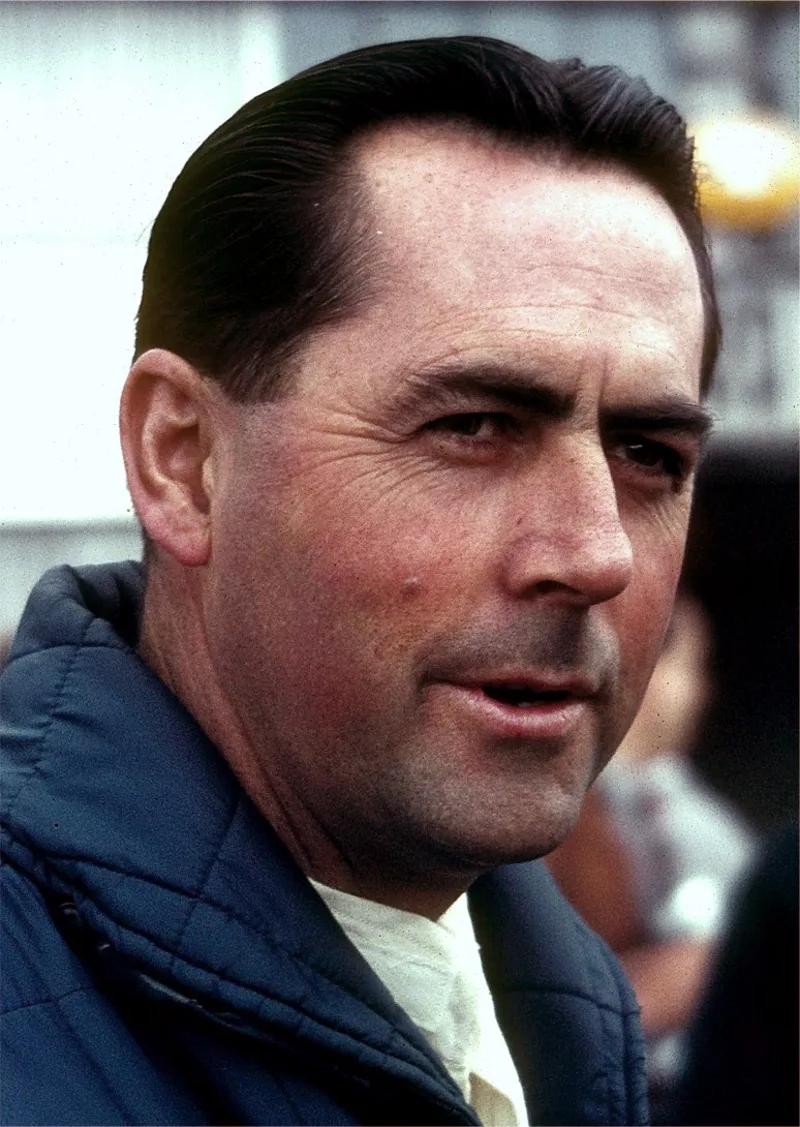
Jack Brabham pushed his Cooper home in 1959 to become the first champion with the engine behind him, and the Lotus 18 soon took the idea further.
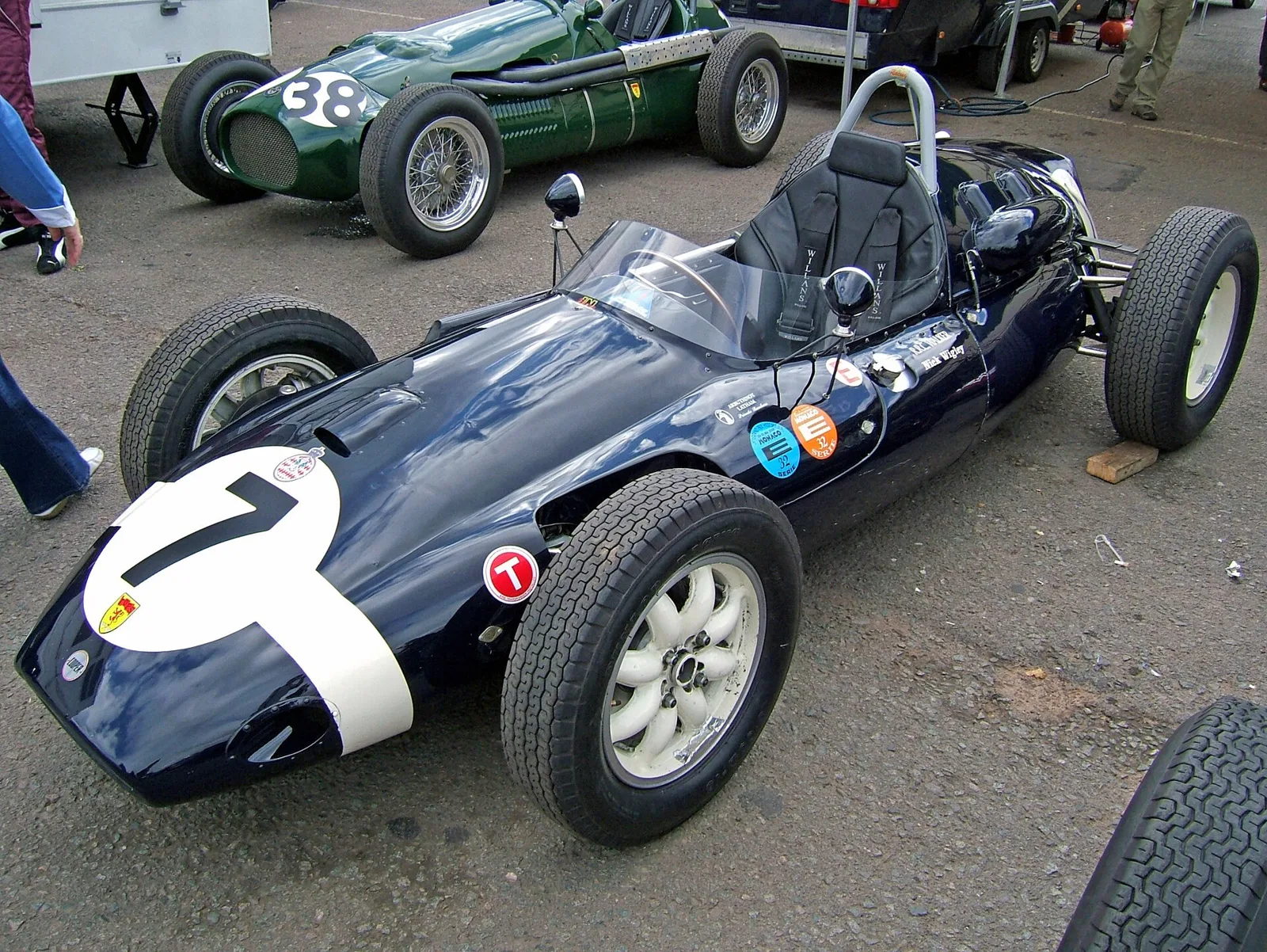
The Cooper T51 won the 1959 championship for Jack Brabham, the first title for a car with its engine behind the driver. Lotus followed with the mid-engined Lotus 18 in 1960, which won Monaco that year and the next and soon eclipsed the Cooper.
At Sebring in 1959, Jack Brabham led until the final lap, ran out of fuel, and pushed his Cooper across the line in fourth place. It was enough. He was World Champion, the first driver ever to win the title in a car with its engine behind him.
Within a year, Cooper's title-winning T51 was being outrun by the new Lotus 18, drawn by a designer whose own front-engined Formula One cars had struggled. The change from one layout to the other took barely a season.
What was the rear-engine revolution in Formula One?
It was the move of the engine from in front of the driver to behind him. The Cooper T51 won the 1959 Drivers' Championship that way, and Lotus responded with the Lotus 18 for 1960, its first mid-engined car, which soon overtook the Cooper. By 1960 the T51's last major win was behind it.
| Car | Designer | Engine position | Engine | Best known for |
|---|---|---|---|---|
| Lotus 16 | Colin Chapman | Offset, then central, ahead of the driver | Climax FPF 2.0 to 2.5 litres | Five championship points in three seasons |
| Cooper T51 | Owen Maddock | Behind the driver | 2.5-litre Climax four-cylinder | 1959 Drivers' Championship for Jack Brabham |
| Lotus 18 | Colin Chapman | Behind the driver | 2,497 cc Climax FPF, 178 kW (239 hp) | Wins at Monaco in 1960 and 1961 |
Brabham pushed his out-of-fuel Cooper across the line at Sebring and became champion.
Why does putting the engine behind the driver work?
A front-engined Grand Prix car had to find space for a propshaft running back to the rear wheels, with a separate gearbox and a differential housing at the far end. A mid-engined layout puts all of that in one compact bundle behind the driver. The Cooper's mid-engine layout saved weight and gave aerodynamic benefits for that reason.
There was a handling benefit too. Cooper placed the fuel tanks on either side of the cockpit rather than behind the driver, so the car behaved more consistently as the fuel burned off during races that could last up to three hours. Think of carrying a heavy shopping bag close to your body rather than at arm's length: the closer the mass sits to the middle, the less it throws you around as it changes.
The Cooper T51: a first for a rear-engined champion
Owen Maddock designed the T51 for the Cooper Car Company for 1959, as a Formula One and Formula Two car. It grew out of the T43 and T45, which had given Cooper its first two wins. Like them, it had a spaceframe chassis with curved links that ignored orthodox design thinking. The rear suspension was a throwback, a transverse leaf spring, while the front used a more modern coil spring and wishbone arrangement.
Cooper built it to sell. It was designed from the outset to be produced in large numbers for privateers, with Rob Walker receiving full-works cars and the rest getting slightly more workmanlike versions. At the 1958 International Trophy, 19 Coopers of various types had made up more than half the grid.
The Cooper-Climax engine and the gearbox problem
The standard F1 T51 was the first Cooper to use the 2.5-litre four-cylinder Coventry Climax engine that Cooper and Lotus had jointly commissioned for their rear-engined cars. The new layout caused a new difficulty: there were so few rear-engined production cars that nobody had a ready gearbox to borrow. The shortage opened a gap in the market that later helped Hewland become prominent.
Meanwhile teams improvised. The works Coopers used modified Citroen gearboxes, while Rob Walker's team ran specially made units from the Italian specialist Valerio Colotti, which proved much more fragile. In championship races, eight different engines sat behind T51 drivers, including 2.2-litre and 1.5-litre Climax units, Maserati, Borgward and Ferrari-derived engines, and a Ferrari 2-litre taken from a 625LM.
How the Cooper T51 won in 1959
The T51 won the Glover Trophy at Goodwood and the Silverstone International Trophy before its first World Championship appearance at the 1959 Monaco Grand Prix, where eight were entered. Only the five 2.5-litre cars qualified. Stirling Moss took pole position, Cooper's first, with Brabham third on the grid.
Jean Behra's Ferrari led from the start, but it developed engine problems after 21 laps, and the Coopers took over. Moss and Brabham ran first and second until Moss's transmission failed 19 laps from the end, leaving Brabham to win his first championship race, with Maurice Trintignant third and Bruce McLaren fifth.
From there the season went from strength to strength. Brabham led the championship from start to finish, won again in the British Grand Prix, and Moss won in Portugal and Italy and dominated the non-championship Gold Cup.
Sebring: Brabham pushes home
By the last race at Sebring, Cooper had the Constructors' Championship in hand, but the Drivers' title was open. Moss needed to beat Brabham and finish second or better, while Tony Brooks of Ferrari had a mathematical chance if he won and set the fastest lap. Moss took the lead from pole, ten seconds clear after five laps, before his gearbox failed again.
Brabham led until the last lap, when a poor decision meant he ran out of fuel. He pushed the car over the line in fourth. Cooper still won the race, because Bruce McLaren took the victory and became the youngest winner in Formula One history, a record he held until Fernando Alonso took it in 2003. Brabham was champion.
Why the Lotus 18 overtook the Cooper
Cooper arrived in Argentina in 1960 seemingly at the peak of its powers, and Trintignant won the non-championship Buenos Aires event before the main race. It turned out to be the last major win for a T51. The speed of the new Lotus 18 began to dominate, and on the journey home John Cooper decided he needed a new car. The low-line T53 debuted at the next championship race, Monaco.
Rob Walker had already bought a Lotus 18 for Moss, though Moss still took the Walker T51 to second in the Glover Trophy and pole at the International Trophy before a wishbone failed. He then missed a large part of the season, injured when his fragile Lotus shed a wheel at speed in Belgium. Cooper itself entered the T51 only three more times, with Chuck Daigh and Ron Flockhart both retiring.
Lotus 16: when Chapman put the engine in the wrong place
The Lotus 18 followed an awkward first attempt. The Lotus 16 was Colin Chapman's second single-seater and Lotus's first car built for Formula One, with ideas from his work on the Vanwall that made the press call it the mini Vanwall. Frank Costin sculpted the bodywork of both cars. Chapman had by then moved from Austin 7 specials to the Lotus 6 of 1952, then to Le Mans class wins in 1956 and 1957, and he joined Vanwall to help with its Formula One cars in 1956. The first single-seat Lotus, the Formula Two 12, followed in 1957.
The 16's engine sat offset in the chassis, so the driveshaft could pass to the left of the driver rather than beneath him, lowering the seat. It did not work. The shaft used Hooke joints, which at the steep angles involved produced a vibration at twice engine speed that cracked chassis welds and transaxle mounts. The unequal weight distribution also hurt handling, and the 16 had to be reworked with the engine in a more conventional, though oblique, central position.
It appeared three Grands Prix after Lotus's debut at Monaco, at the 1958 French Grand Prix on 6 July with Graham Hill, who qualified second slowest and overheated on lap 19. Later races brought more overheating and mechanical failures. In 1959 the works cars gained full 2.5-litre engines, yet Hill failed to finish a single race, and Innes Ireland scored the 16's only points with fourth in the Dutch Grand Prix and fifth in the United States. Eight were built, and they scored five championship points over three seasons. For the 1960 opener Lotus entered two 16s and gave Ireland the new 18, then abandoned the 16.
Lotus 18: the first mid-engined Lotus
The Lotus 18 was designed by Colin Chapman for Formula One, Formula Two and Formula Junior and raced in F1 from 1960 until 1966. It was the first mid-engined Lotus and a marked improvement on the front-engined 12 and 16. About 27 Formula One and Formula Two cars were built, and 110 for Formula Junior. Some 18 chassis were later rebodied as hybrid 18/21 cars as a stop-gap, before the Lotus 21 replaced the 18 in Formula One for 1961.
It was a classic Chapman design, light and simple, with panels bolted to a heavily triangulated tube spaceframe. Chapman kept the 16's forward weight distribution even though the engine had moved behind the driver. The car stood only 71 cm (28 in) high and weighed 440 kg (980 lb). To make it so low, the driver reclined in a semi-supine position, an idea pioneered about a decade earlier by Gustav Baumm of NSU.
Engine, gearbox and suspension
The first engine was the 2,467 cc Coventry Climax FPF four-cylinder from the 16, enlarged in 1960 to 2,497 cc. That engine produced 178 kW (239 hp) at 6,750 rpm and weighed only 132 kg (290 lb). When the rules changed in 1961, a 1.5-litre Climax FPF Mk II replaced it. Formula Junior cars used a 998 cc Cosworth unit or a 948cc BMC A-Series.
The sequential transaxle combined a motorcycle-style gearbox with a ZF limited-slip differential in a magnesium housing. Its predecessor on the Lotus 12 had earned the nickname "Queerbox" for poor reliability, and Keith Duckworth, hired as a gearbox engineer, improved it. Mike Costin then adapted it for mounting directly behind the engine on the 18, with dedicated oil pumps, which improved reliability further.
The front suspension used double wishbones with an outboard coil and damper and, unlike earlier Chapman cars, a separate anti-roll bar. At the back, radius arms and a reversed lower wishbone used the fixed-length half-shaft as the upper link. The suspension reduced weight transfer and body roll in corners, and its design was widely copied afterwards.
Lotus 18 race wins and the end of the T51
Innes Ireland gave Lotus its first Formula One victory in the non-championship Glover Trophy on 8 April 1960. The first World Championship win came six weeks later, on 29 May, but by Rob Walker, who leased the car from Chapman, with Stirling Moss driving at Monaco. Moss also won the 1960 United States Grand Prix, and Lotus finished second in the constructors' championship.
In 1961 Moss repeated his Monaco win in a memorable race against the more powerful sharknose Ferraris, then won at the Nurburgring in changeable weather, and Ireland took a third win in the United States. Lotus again finished second among constructors. Jim Clark made his first Grand Prix start in an 18 in 1960. At Spa that year Moss crashed in practice, and Alan Stacey died after leaving the track in his 18, apparently after a bird strike.
The T51 lives on with privateers
Cooper's customer cars kept the T51 racing. Ten other entrants ran T51s in Formula One in 1959, and at least 38 drivers were entered in Grands Prix across the car's life. Scuderia Centro Sud, run by Maserati distributor Guglielmo Dei, entered it in 14 World Championship races, more than any other team. The British Racing Partnership, founded by Ken Gregory and Alfred Moss, ran Borgward-engined and later Climax-engined cars in mint green and red livery, but lost three drivers to fatal accidents by the end of 1960 and switched to Lotus for 1961.
Scuderia Castellotti fitted its own Ferrari-derived 2.5-litre engines, with exhausts on the left, unlike all other T51 engines. Giulio Cabianca scored its first points with fourth place at the 1960 Italian Grand Prix. The last World Championship appearance came when Trevor Blokdyk finished twelfth in the 1963 South African Grand Prix in a Scuderia Lupini T51-Maserati, and the car turned up on minor entry lists as late as the 1967 Rhodesian Grand Prix.
What the results show
The Cooper proved a mid-engined car could win the title, with the Constructors' Championship secured before Sebring. The Lotus 18 then took the same layout into a lower, lighter car, and won at Monaco in both 1960 and 1961 while Lotus took second in the constructors' standings both years.
Chapman's own front-engined 16 had struggled with vibration and weight distribution before the mid-engined 18 followed. The 16 first raced in 1958 and the 18 arrived for 1960.
Where this goes next
Both cars were soon replaced. For 1961 the Lotus 21 took over from the 18 in Formula One and the Lotus 20 in Formula Junior, under new engine rules that brought in the 1.5-litre Climax. Cooper's own successor to the T51, the T53, debuted at Monaco in 1960.