How a vehicle frame carries the car, why unibody construction took over passenger cars, and where separate frames still dominate trucks and buses.
A vehicle frame is the main structure that carries a car's weight and loads, and to which all other parts attach. Early cars used separate body-on-frame designs, but unibody construction, where the body and frame form one shell, became standard on most passenger cars. Trucks and buses still use separate frames.
A vehicle frame, once also called the chassis, is the main supporting structure of a motor vehicle. Every other component attaches to it, so it works much like a skeleton does for an animal. Frames have changed shape a great deal over the past century, from heavy steel ladders to the integrated unibody that now dominates passenger cars.
What does a vehicle frame have to do?
The frame supports the vehicle's mechanical components and body without bending or distorting under load. It carries the weight of the body, passengers and cargo, along with the twisting that comes from going over uneven ground. It also takes lateral forces from side winds and steering, along with the torque from the engine and transmission.
The frame must also cope with longitudinal forces. Starting and accelerating pull it one way, and braking pushes it the other, while sudden impacts from collisions can load it in every direction at once. A good frame keeps those loads under control, so that the car stays predictable and the occupants remain protected.
Carbon steel is the usual choice for strength, while aluminium alloys are used when lighter construction matters more. In a separate chassis, the frame is made from structural rails or beams. These are normally steel channel sections formed by folding, rolling or pressing steel plate.
A frame does little glamour, yet every other part of the car depends on it to stay where it belongs.
How did body-on-frame construction work?
Until the 1930s, almost every car had a structural frame that was separate from its body. Body-on-frame construction could be used by a manufacturer building complete vehicles in volume, a method epitomised by the Ford Model T, and by suppliers of rolling chassis.
Fisher Body in the United States supplied rolling chassis for mass production, while Hooper served smaller firms that made bespoke bodies and interiors.
Separate frames stayed common for decades because one chassis could carry several body styles. Perimeter frames later made annual model changes practical, since a body could be restyled without costly structural changes. The same logic still applies to heavy trucks and buses.
How do the rail designs differ?
There are three main designs for frame rails. If a steel plate is folded twice, it forms an open cross-section, either C-shaped or hat-shaped. Boxed frames contain closed rails, which are made either by welding or by using ready-made metal tubing. The choice between them affects stiffness, cost and weight.
C-channel is the most widespread rail. Makers form it by folding both edges of a flat steel strip into a C-shaped beam that runs the vehicle's length, and nearly every type of vehicle has used it at some stage. Thicknesses usually range from 1/8 inch to 3/16 inch, and heavy-duty trucks may use plate of 1/2 inch or more. C-channel is generally more flexible than a fully boxed rail of the same gauge.
| Rail type | Shape | Strengths and weaknesses |
|---|---|---|
| C-channel | Open C-shaped beam | Most common; more flexible than boxed rails of the same gauge |
| Hat | U-shaped, upright or inverted | Weak and prone to rust; later welded to unibody floors |
| Boxed | Closed rectangular tube | Stiffer; welded from two C-rails or bent and welded from one sheet |
Hat frames are not widely used because they are weak and tend to rust, although they appeared on 1936 to 1954 Chevrolet cars and on some Studebakers. The hat shape was later revived when manufacturers welded it to the underside of unibody cars, which effectively created a boxed frame. Boxed frames were originally made by welding two matching C-rails together, while modern methods bend a single piece of steel into four sides and weld the seam.
Why does frame height matter?
Beam height is the first design issue that engineers address. The taller the vertical side of a frame, the better it resists vertical flex when force is applied to the top of the rail. This is why semi-trucks have taller frame rails than other vehicles, rather than simply thicker ones.
As ride quality and handling became more important to buyers, designers added shapes to frames. Arched frames sit low, roughly level with the axles, and curve up over them before dropping again for bumper placement. Kick-ups do the same job without the curve down on the far side, and they are more common at the front. Tapered rails narrow in front of the cabin, which saves weight and makes room for the engine.
What types of full under-body frame exist?
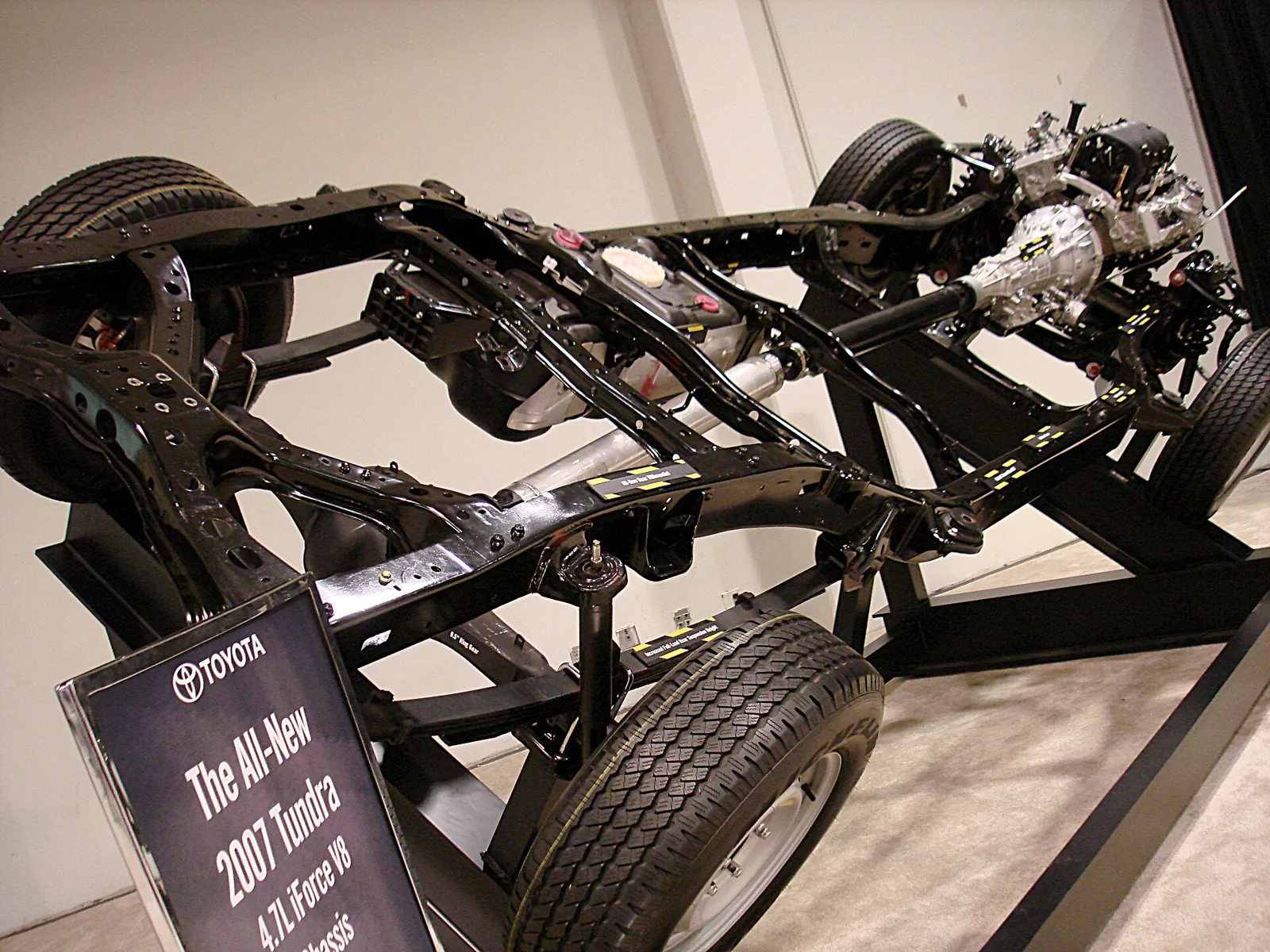
The ladder frame is among the oldest and simplest designs. It consists of two beams running the length of the vehicle, joined by several cross-members. It was once seen on almost every vehicle, but it was gradually replaced on cars by perimeter frames and unitized bodies, and today it is found mainly on large trucks.
It resists side impacts well because its rails are continuous, but simple cross-members offer poor resistance to torsion.
The backbone chassis uses a central, strong tube, usually rectangular in cross-section, which carries the powertrain and links the front and rear suspension mounts. The body is placed over or around this structure. The X-frame is shaped like the letter X, which let the floor sit lower than it could on a full ladder frame. Its centre humps, however, intruded into the cabin, and it was weak against side impacts.
The perimeter frame addressed that problem by routing the middle of the rails outside the front and rear rails, around the footwells and inside the sill panels. This lowered the floor, reduced the roof line and centre of gravity, and improved handling. Perimeter frames became the prevalent design for body-on-frame cars in the United States, although the Ford Panther platform, discontinued in 2011, was one of the last examples.
How do platform frames and space frames differ?
A platform frame modifies the perimeter or backbone design by making the passenger floor, and sometimes the luggage floor, a load-bearing part of the frame. Several well-known European cars used platform chassis. The Volkswagen Beetle is the best known example, and its construction was termed body-on-pan.
Renault's 4 used a platform frame as well, and more than eight million of them were built.
A space frame uses tubular steel, alloy or carbon fibre to form a load-bearing three-dimensional skeleton, to which the suspension, engine and body panels attach. Because the panels carry little structural load, the geometry is arranged to maximise rigidity, often using triangles so that each strut carries only tension or compression. The first true space frames were designed in the 1930s by Buckminster Fuller and William Bushnell Stout.
Space frames were adapted to racing after the Second World War. The 1951 Jaguar C-Type used a multi-tubular, triangulated frame with an aluminium body. The 1954 Mercedes-Benz 300 SL Gullwing made the approach a mass-production reality, and its high sills are why it needed gullwing doors. In 1994, the Audi A8 became the first mass-market car with an aluminium chassis, built around an aluminium space frame integrated into the bodywork.
What is unibody construction?
Unibody, or unitised body, construction combines the body, floor pan and chassis into a single structure. Such a design is generally lighter and more rigid than a body and separate frame. Integral construction is more than welding an unstressed body onto a frame.
In a fully integrated structure, the entire car carries the driving and cargo loads, and ribs, bulkheads and box sections reinforce the shell.
The first attempt at this technique came on the 1922 Lancia Lambda, which used a torpedo body for structural stiffness and a lower height. The Lambda's roof was unstressed, so it was closer to a bowl than a true monocoque, and about one thousand were built. The American Budd Company later supplied pressed-steel bodies that were fitted to separate frames for several automakers, and its engineer Joseph Ledwinka designed a fully unitary prototype in 1930.
Citroen bought that design for the Traction Avant, a front-wheel drive car introduced in 1934 that sold 760,000 units over the next 23 years of production. It used spot-welded, deeply stamped steel sheets to form a structural cage, which made it the first iteration of modern body and chassis integration. Opel produced the first German unibody car, the Olympia, in 1935. Chrysler's Airflow, built from 1934 to 1937 with three body sections welded into a bridge-truss, suffered from poor panel fits. The Soviet GAZ-M20 Pobeda of 1946 later copied the Opel Kapitan's unibody structure.
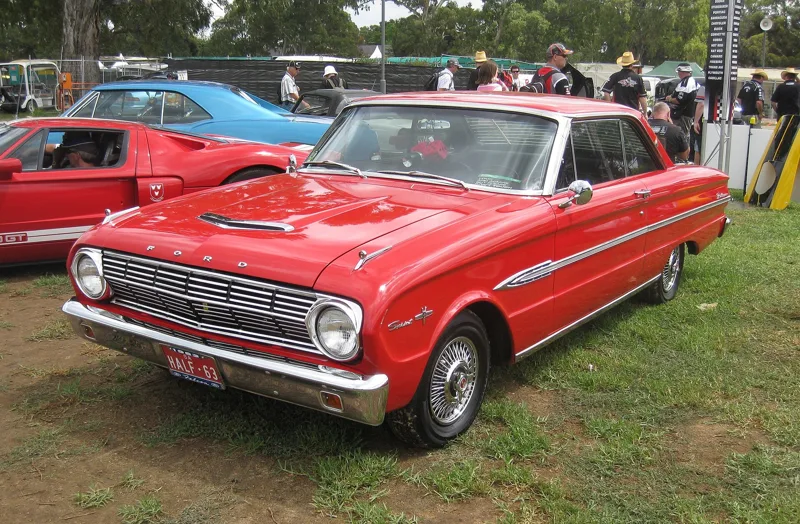
Unibody construction spread through the 1940s and 1950s. By 1960, the unitized body was used by Detroit's Big Three on their compact cars, including the Ford Falcon, Plymouth Valiant and Chevrolet Corvair. The development of finite element analysis in the 1970s let engineers optimise unibody structures for strength, crash protection and minimal material. Today the unibody is the preferred construction for mass-market cars because it saves weight, improves space and eases manufacture. Many American unibody cars used torque boxes to reduce vibration and chassis flex, although the Chevy II relied on a bolt-on front apron instead.
Where are separate frames still used?
Separate frames remain common on trucks and buses, and most pickups still use one. Trucks and buses are the clearest examples of this approach, because the frame remains their chassis. The American Motors Jeep Cherokee of the late 1970s used a uniframe, which combined a stamped steel frame with a unit-body structure.
The same approach appears in the Jeep Grand Cherokee, the Land Rover Defender and large vans such as the Ford Transit, the VW Crafter and the Mercedes Sprinter.
Frame shapes can also be mixed within one rail. Some pickups have a boxed section in front of the cab, shorter and narrower rails beneath the cab, and ordinary C-rails under the load bed.
What is a subframe?
A subframe is a distinct structural component that reinforces or complements one section of a vehicle, usually the front or rear. It can carry the engine, transmission and suspension loads, and spread them across a wide area of thin sheet metal in a unitized body. Subframes often have pressed or box steel construction, although they can be tubular.