From the egg-shell idea to unibody, ladder frame and carbon-fibre tub: how cars stopped using a separate chassis, and why trucks never did.
A monocoque is a structure whose outer skin carries the load, like an egg shell. Most road cars are unibodies, not true monocoques: body, floor and chassis form one structure. Trucks and many off-roaders keep a separate frame, which suits heavy loads and different bodies.
Almost no ordinary car is a monocoque. The word is thrown at unibody road cars all the time, yet the bodies of commercial cars are very rarely true monocoques, and the strict meaning is far narrower than the way the word is used. A true monocoque is a shell whose skin carries the load, the way an egg does.
What is a monocoque?
The word is French for single shell. In a monocoque, loads are carried by the object's external skin, like the shell of an egg. The idea began with boats, and a true monocoque asks the skin to take both tension and compression, which means you can spot one by the absence of an internal frame carrying the load.
Pure examples are rare. Aircraft show the problem: apart from those with milled skins, few metal aircraft qualify as pure monocoques, because the metal shell is stiffened by frames riveted to it. The label for that compromise is a semi-monocoque, a hybrid that combines a skin working in tension with a compressive structure of longerons and ribs or frames.
The first great success came from aviation. Early aircraft were built from wooden or steel-tube frames covered in fabric, and the fabric contributed a little in tension and nothing in compression. Treating the whole structure as one unit, instead of a frame plus a cover, brought significant gains in strength and weight. The Deperdussin Monocoque racer of 1912 had a fuselage laminated from three layers of glued poplar veneer, which formed both the skin and the main structure. It was smoother and lower in drag, and it won most of the races it entered.
Metal came later. The Dornier-Zeppelin D.I of 1918 was the first all-metal monocoque aircraft to go into production, the work of Claudius Dornier, who first had to contend with aluminium alloys that frequently formed layers and not a uniform material. Even so, aluminium alloy monocoques did not become common until the mid 1930s.
Commercial car bodies are almost never true monocoques; the word is frequently misapplied to unibody cars.
Unibody vs monocoque: what is the difference?
A unibody, which goes by several names including unitary construction, merges body, floor pan and chassis into one structure. As a rule it is lighter and stiffer than a car built from a separate body and frame. But the skin of a unibody car adds relatively little strength or stiffness, so it is not a monocoque.
In the fully integrated version, the whole car carries every load, from driving and from cargo. Makers weld preformed metal panels together, form or cast whole sections in one piece, or combine the two. Since the outer skin is load-bearing, people sometimes say monocoque, but ribs, bulkheads and box sections still reinforce the body, which makes semi-monocoque the better name.
The first attempt at this technique was the 1922 Lancia Lambda, which wanted structural stiffness and a lower body for its torpedo-style shape. With an open layout and an unstressed roof, the Lambda was less a shell than a bowl, and one thousand were produced.
Body on frame vs unibody: how cars changed
For the first decades of motoring, the car was a frame with a body on top. Through the 1920s and into the 1930s, a structural frame sat apart from the body on practically every car. The Ford Model T epitomised the method in mass production, and rolling chassis were also supplied to coachbuilders, such as Fisher Body in the United States and Hooper for smaller bespoke work.
A separate frame has practical virtues. Steel ladder and X-frame chassis let many vehicles share a chassis and drivetrain while the bodywork and interiors changed, which kept costs down and cut design time. In the late 19th century frames still followed carriage practice and could be made of wood, commonly ash, with steel flitch plates. Early in the 20th century steel ladder frames quickly became the standard. The Budd Company and the Dodge Brothers started mass-producing all-metal bodies, which were common in the 1920s, with Europe following almost a decade later.
The alternative came from Europe in the late 1920s, when manufacturers developed designs in which the panels of the body itself held the car up on its suspension, drawing on the technical know-how of Budd USA. The costs were high: designing these structures was expensive, and so was the machinery to make the large pressings. Low-volume manufacturers therefore avoided the method, and might weld steel tube into a space frame as an equivalent.
By the end of the 1930s a handful of small passenger cars had made the switch, among them the Citroen Traction Avant of 1934 and the Opel Olympia of 1935. Trucks, buses, large low-volume cars and those made in the United States kept using separate bodies on conventional frames. Come the 1960s, passenger cars built as unibodies were common, and the shift carried on through the decades after.
Computer-aided design helped make unibody construction economically feasible. Another push came from weight. Modern comforts, luxury and power-assisted features, plus extensive safety reinforcement, have all added mass, and the ability to offset it with a unibody has proved advantageous.
Why do trucks and off-roaders still use a frame?
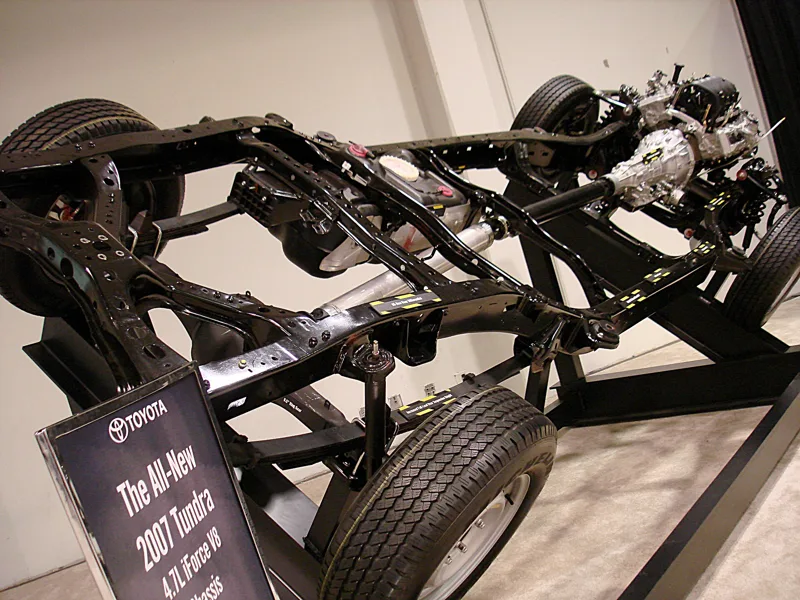
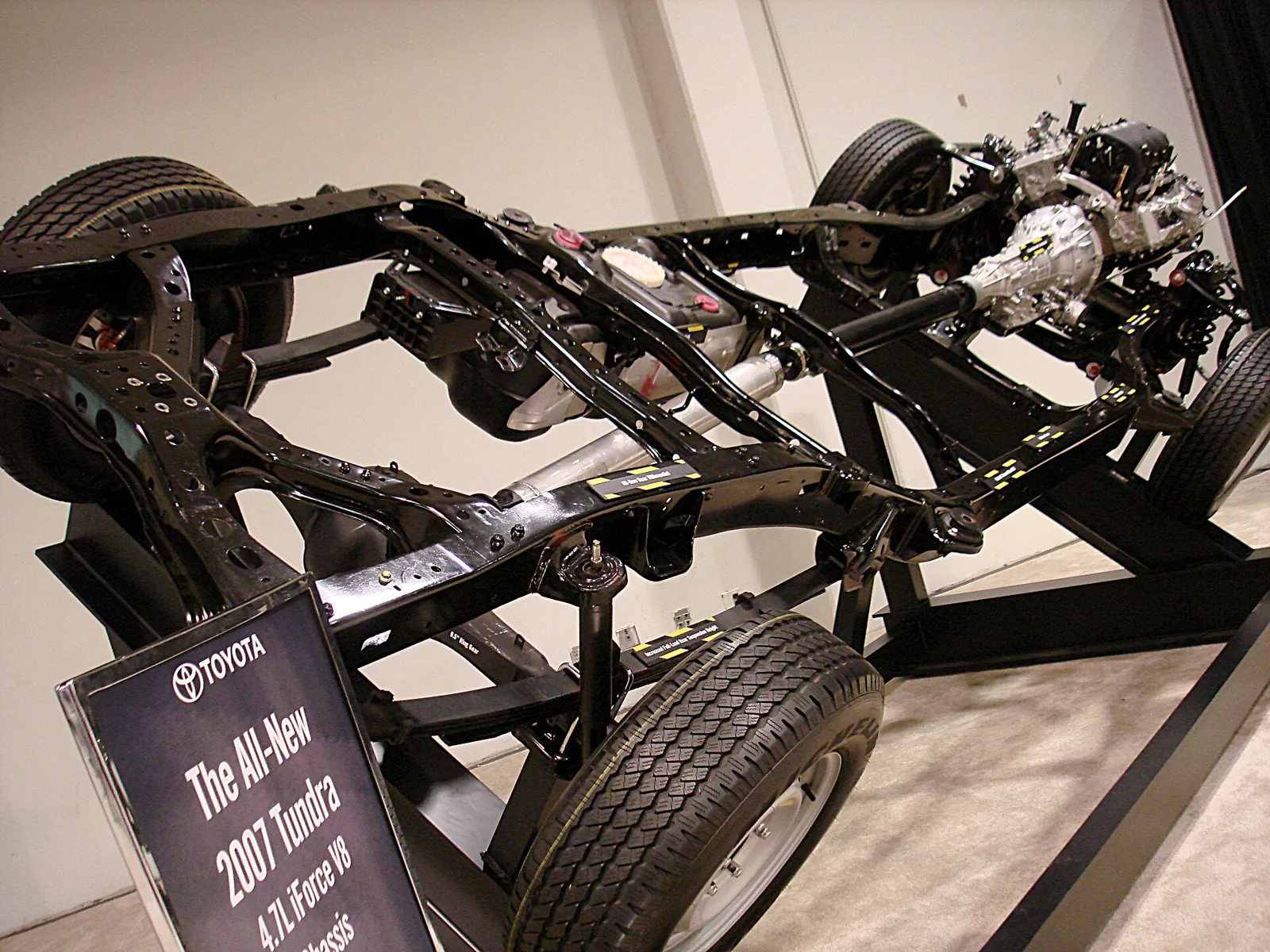
A separate frame as the chassis is still the choice for nearly all trucks and buses and most pickups. Today body-on-frame serves chiefly pickups, large SUVs and heavy trucks, and it stays the favoured method for heavy-duty commercial work, especially vehicles meant to carry or tow heavy loads.
The frame is, in effect, the skeleton, and it has to deal with everything the vehicle meets: the weight of body, passengers and cargo, twisting from uneven surfaces, lateral forces from side wind and steering, torque from the engine and transmission, forces from acceleration and braking, and sudden impacts from collisions. A tall rail resists vertical flex better, which is why semi-trucks use taller frame rails and not merely thicker ones.
A separate body on a frame also suits a business that sells the same chassis in many forms. Commercial vehicle makers sell chassis only, cowl and chassis, and chassis cab versions that can be fitted with specialised bodies such as motor homes, fire engines, ambulances and box trucks.
Even among SUVs the balance is shifting. With rising production volumes, a growing number of SUVs and crossovers are moving to unibody frames, and Ford, General Motors and Chrysler have been dropping true body-on-frame SUVs. Toyota builds the most of them, and Nissan comes next with the Patrol, Armada and Infiniti QX56/80. On the Toyota side the list covers the 4Runner, Sequoia, Land Cruiser, Land Cruiser Prado, Lexus GX and Lexus LX. Other body-on-frame vehicles include the Suzuki Jimny, the Jeep Wrangler, the Ford Bronco, the Mercedes-Benz G-Class and the INEOS Grenadier, along with pickups such as the Toyota Hilux, Ford Ranger and Chevrolet Silverado.
Ladder frame chassis and other frame types compared
| Type | How it works | Known for |
|---|---|---|
| Ladder frame | Two rails joined by cross-members | Good side-impact resistance, poor torsion resistance, taller vehicle; now mainly large trucks |
| Backbone tube | Central tubular spine carrying the powertrain, body placed on top | Connects front and rear suspension structures |
| X-frame | Rails cross in the middle to allow a lower floor | Weak in side impact; fitted to Mercedes-Benz 300 limousines and some full-size GM cars around 1960 |
| Perimeter frame | Middle rails outboard, routed around the footwells | Lower floor, roof and centre of gravity; lacks stiffness, so uses torque boxes |
| Platform frame | Passenger floor built into the frame as a structural part | Volkswagen Beetle, Mercedes-Benz Ponton, Renault 4, Citroen 2CV |
| Space frame | Three-dimensional skeleton of tubes, panels carry little load | Jaguar C-Type, Mercedes-Benz 300 SL, Audi A8 |
| Unibody | Body, floor pan and chassis form a single structure | Lighter and more rigid than separate body and frame |
The ladder frame gets its name from its looks, and it is among the oldest and simplest designs. Two symmetrical rails run the length of the vehicle, joined by several transverse cross-members. Its continuous rails give good side-impact resistance, but if the cross-members are simple and perpendicular it resists twisting poorly, and the floor pan sits above the frame instead of inside it, making the vehicle taller. It was once seen on almost every vehicle and is now mostly found on large trucks.
The X-frame tried to lower the floor, and the perimeter frame solved its flaws. The X-frame's centreline humps intruded on the cabin and it was weak in side impact, so side rails were added, which spurred the perimeter frame. By routing the middle section of the rails around the passenger footwells, inside the sill panels, a perimeter frame lowers the floor, and with it the seating, the roofline and the centre of gravity. In the United States it became the usual layout for body-on-frame cars, and Hudson brought it in on its 1948 Commodore. One of the last perimeter-frame passenger cars in the country was built on the Ford Panther platform, which ended in 2011.
Space frames work differently. A true space frame is a load-bearing three-dimensional skeleton of tubular steel, alloy or carbon fibre that carries the suspension, engine and body panels. Because the panels carry little or no load, geometry maximises rigidity and minimises weight, often with triangles in which every strut is in tension or compression and none bends. The first true space frame chassis came in the 1930s from Buckminster Fuller and William Bushnell Stout, and racing took up the idea after the war: the 1951 Jaguar C-Type used a lightweight triangulated tubular frame under an aluminium body. The 1954 Mercedes-Benz 300 SL Gullwing brought it into production, and its high sills made conventional doors impractical, which gave the car its gullwing doors. The Audi A8 of 1994 was the first mass-market car to have an aluminium chassis, made possible by an aluminium space frame worked out with Alcoa.
Carbon fibre monocoque: racing and supercars
The true monocoque found its natural home in motor racing, although few cars have used one despite the weight saving, since the driver's safety rests on the body and the regulations are strict. Lotus brought the design to Formula racing in the 1962 Lotus 25 Formula One car, which had an aluminium alloy monocoque body-chassis, and it is now the standard there. McLaren was the first to build a monocoque from carbon-fibre-reinforced polymers, in the 1981 McLaren MP4/1.
On the road, the first production car with a carbon-fibre monocoque was the Jaguar XJR-15, in 1990.
Two wheels have their own history. Spanish maker Ossa raced a monocoque motorcycle in the 1967 Grand Prix season: the single-cylinder bike gave away 20 horsepower (15 kW) to its rivals, yet it was 45 pounds (20 kg) lighter and far stiffer than a conventional frame, and it won four Grands Prix. In 2000 Kawasaki's ZX-12R became the first mass-produced motorcycle with an aluminium monocoque frame. On the bicycle side, the Lotus Type 108 carbon-fibre bike took Chris Boardman to gold at the 1992 Barcelona Olympics, and its design was so innovative that new regulations later restricted it.
Boats are the easy case. Most glassfibre boats are monocoque, because glassfibre is easy to form, easy to make in moulds and relatively easy to repair.