Carbon fibre is stiff, light and brittle, aluminium is a third the density of steel, and tubular steel built the first space frames. How the three materials behave and why they dislike touching.
Carbon fibre is extremely strong for its weight but brittle and expensive to produce. Aluminium has about one-third the density of steel but is less strong and stiff. Steel behaves the same in every direction and has a known fatigue limit. All three can form a space frame or monocoque.
Strength is a slippery word when you are building a car. Carbon fibre can be very stiff for its weight, yet an epoxy-based part stretches less than 0.5 per cent before it gives way, and it gives way all at once. Set beside aluminium and steel, it shows how differently each material behaves once it is turned into a car structure.
What makes carbon fibre different from metal?
Carbon fibre reinforced polymer, or CFRP, is a composite: carbon fibres for strength, bound in a plastic matrix, most often an epoxy. Unlike steel and aluminium, which behave the same way whichever way you load them, its strength has a direction, set by how the fibres are laid.
A useful picture is plywood or a rope. Pull along the grain and either one is immensely strong; pull across it and the story changes. The same is true here. The properties of a CFRP part depend on the layout of its fibres and on the proportion of fibre to polymer, and the choice of resin, and of additives such as silica, rubber or carbon nanotubes, shifts the result again. Engineers can therefore put strength where a part needs it, but they must also work out where it will be needed.
CFRP can be expensive to produce. It still turns up wherever a high strength-to-weight ratio and stiffness matter, in aerospace, the superstructures of ships, cars, civil engineering and sports equipment. Aircraft show how far the share can go: the Airbus A350 XWB is 53 per cent CFRP, including wing spars and fuselage components, ahead of the Boeing 787 Dreamliner at 50 per cent.
Carbon fibre can be very stiff and very light, yet an epoxy-based part gives almost no warning before it fails.
How is a carbon fibre car part made?
Each part begins as a filament made from a precursor polymer such as polyacrylonitrile, rayon or petroleum pitch. The yarns are spun, then heated to drive off every atom that is not carbon, and what remains is carbon fibre. It is then wound on bobbins and woven into fabric or laid out as unidirectional sheets that can be stacked at angles such as 0, +60 and -60 degrees to one another.
One method is moulding. Cloth is laid into a mould shaped like the finished piece, with the weave and alignment chosen to optimise stiffness and strength, and the mould is filled with epoxy and heated or left to cure in the air. Less critical pieces can be draped over a mould with the epoxy already in the fibres, the material known as pre-preg, or painted on.
High-performance parts are normally vacuum-bagged and often cured in an autoclave, a pressurised oven, because even small air bubbles in the material reduce its strength. An alternative to the autoclave uses internal pressure from inflatable air bladders or foam inside the uncured layup.
Vacuum bagging and the pace of production
Vacuum bagging suits simple pieces of which only one or two are needed per day. The mould, which may be fibreglass, carbon fibre or aluminium, is polished, waxed and treated with a release agent before the fabric and resin go on, and a vacuum is pulled while the piece cures. Resin can be applied three ways: a wet layup by hand, infusion, in which the vacuum draws resin through tubes into dry fabric, or a dry layup using pre-preg, which wastes the least resin, can give lighter constructions, and generally leaves fewer pinholes.
Carbon fibre forging
Speed is the attraction of compression moulding, also called carbon fibre forging. The fabric and resin go into a two-piece or multi-piece mould, usually of aluminium or steel and more recently of 3D printed plastic, and the halves are pressed together. Some car makers, BMW among them, claimed they could produce a new part every 80 seconds. The price is control: the direction of the fibres cannot be managed as it can with the other methods, so such parts have limited or variable strength.
Where does carbon fibre struggle?
It is brittle. A typical epoxy CFRP has less than 0.5 per cent strain to failure, so it shows virtually no plasticity and fails catastrophically, which makes failure hard to spot in advance. Aluminium, by comparison, is ductile and can stretch by 50-70 per cent.
Fatigue is a second weakness. CFRPs have no definable fatigue limit, so in theory failure after repeated stress cycles cannot be ruled out. Steel and many other structural metals do have estimable endurance limits. Because the failure modes of composites are complex, which include debonding between fibre and matrix, fibre pull-out and delamination between sheets, fatigue behaviour is difficult to predict, and low-velocity impacts can damage the material. Engineers using it for critical parts under repeated loading may therefore need considerable strength margins.
The environment matters too. CFRP resists corrosion well, but moisture across a wide range of temperatures can degrade the bond between fibre and matrix, because the fibres themselves are untouched while the plastic around them softens. Paint is applied to shield composite parts from ultraviolet light.
The corrosion problem between materials
The awkward fact for anyone mixing materials is galvanic corrosion. Carbon fibres can cause it when a CFRP part is attached to aluminium or mild steel. Stainless steel and titanium do not suffer it. CFRP is also very hard to machine and wears out cutting tools, so makers use coated tools, and cutting methods range from CNC systems and rotating knives to ultrasonic and waterjet cutting.
Why is aluminium so widely used for light structures?
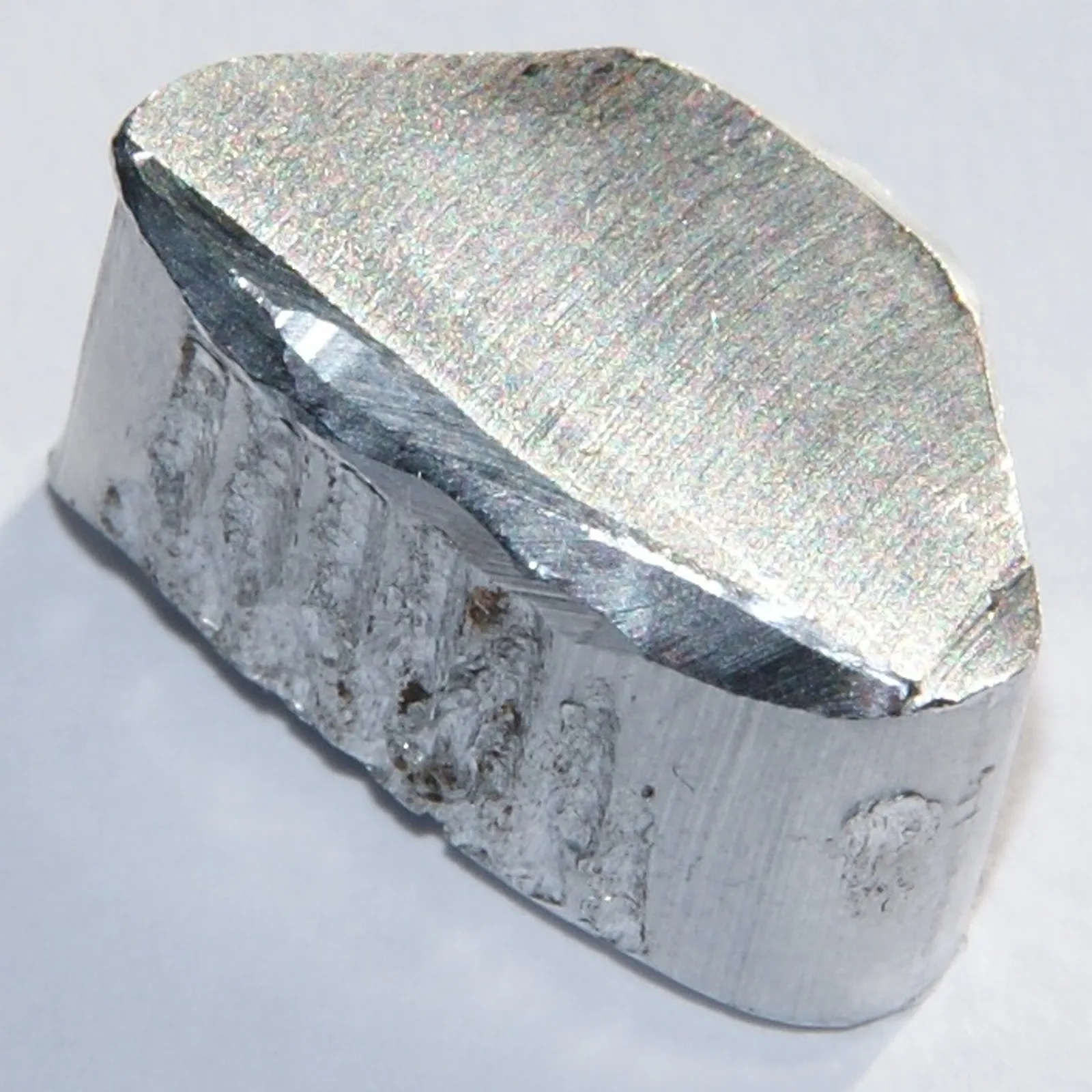
Weight, mainly. Aluminium has a density of 2.70 g/cm3, about one-third that of steel and much lower than other commonly encountered metals. It is not as strong or stiff as steel, but its lightness makes up for that wherever low weight and relatively high strength both count, as in aerospace.
Pure aluminium is soft. Its yield strength is only 7-11 MPa, so nearly all practical uses rely on alloys, which have yield strengths from 200 MPa to 600 MPa. The metal is ductile, with 50-70 per cent elongation, and it can be drawn, extruded, machined and cast with ease, which suits the drawn tubes and extruded sections a frame is built from.
Aluminium protects itself in a way steel does not. In air it grows a thin oxide layer, about 5 nm thick at room temperature, that shields it from further attack by oxygen, water or dilute acid. Anodizing adds a protective oxide layer of its own. The protection has limits, though. Dissolved chlorides such as common salt attack it, and the strongest alloys are less corrosion-resistant because of galvanic reactions with alloyed copper. Aqueous salts, especially where dissimilar metals touch, greatly reduce its resistance.
It has also become cheap enough to be everywhere. The Hall-Heroult process of 1886 made aluminium far more available, and from 1954 it was the most produced non-ferrous metal, ahead of copper. Transportation is one of the largest uses.
How do the three materials compare?
| Material | Weight and strength | Failure and fatigue | Corrosion |
|---|---|---|---|
| Carbon fibre (CFRP) | Very strong and stiff for its weight; strength follows fibre direction | Less than 0.5% strain to failure; no definable fatigue limit | Excellent resistance; moisture can degrade the matrix; galvanic with aluminium and mild steel |
| Aluminium | 2.70 g/cm3, about one-third the density of steel; alloys 200-600 MPa yield | Ductile, 50-70% elongation | Protective oxide layer; salts and dissimilar metals reduce it |
| Steel | About three times as dense as aluminium; stronger and stiffer | Estimable fatigue or endurance limits | Mild steel suffers galvanic corrosion beside CFRP; stainless does not |
What is a space frame, and how did it reach cars?
A space frame is a rigid, lightweight structure of interlocking struts, strong because of the rigidity of the triangle: bending loads become tension and compression along each strut. Its simplest form is a slab of pyramids and tetrahedra built from aluminium or tubular steel. Alexander Graham Bell developed tetrahedral frames from 1898 to 1908, and Buckminster Fuller patented his octet truss in 1961.
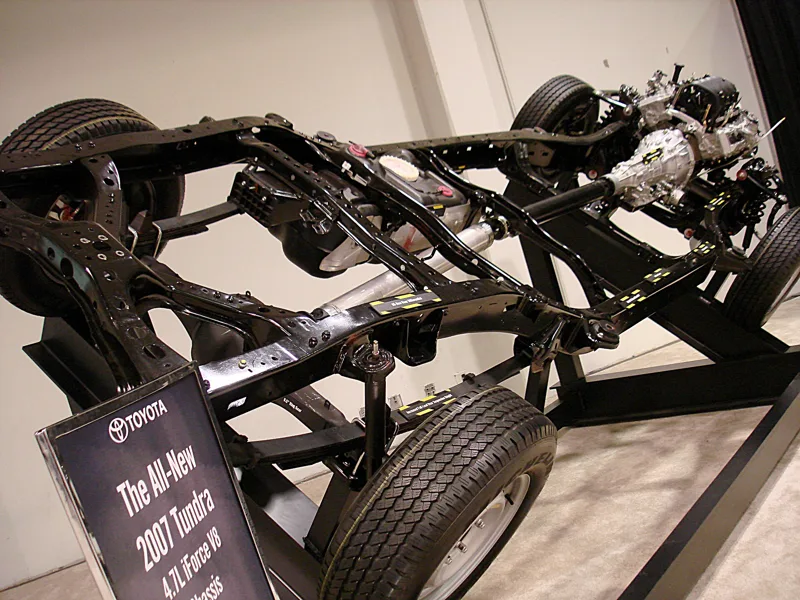
In a car, the idea is a skeleton of tubes. The suspension, engine and body panels bolt to it, and the panels do little or no structural work. A unibody or monocoque works the opposite way: the body is part of the structure.
Tube-frame chassis came first and grew out of the ladder chassis. Tubes resist twisting better than the open channels they replaced. Many tubular chassis picked up extra tubes and were called space frames, but they were rarely stressed as one. In a true space frame, every force in every strut is tension or compression and never bending, which requires diagonal bracing.
The cars that proved it
An early contender for the first true car space frame was a single Chamberlain 8 racing special, put together in 1929 in Melbourne by the brothers Bob and Bill Chamberlain. In the 1930s Buckminster Fuller and William Bushnell Stout, with the Dymaxion and the Stout Scarab, are credited by some with vehicles built on the true theory, which they knew from architecture or aircraft design. Cisitalia's D46 of 1946 used tubes that were not diagonalised, but Porsche's Type 360, designed for Cisitalia a year later, added diagonal tubes and so counts as a true space frame, and arguably as the first mid-rear engined design.
Then came the results. Robert Eberan von Eberhorst designed the Jowett Jupiter in 1949, and it took a class win at Le Mans in 1950. Also in 1949, the small British maker TVR built a two-seater with an alloy body on a chassis of many tubes. The Jaguar C-Type racing car, with a space frame, was built from 1951 through 1953. In 1954 Mercedes-Benz launched the space-frame 300 SL, the fastest production car of its day.
What does a space frame cost the driver?
Room. The frame encloses much of the car's working volume, which can make it hard to get into and hard to reach the engine. The 300 SL received its upward-opening doors because its tubular frame ruled out the regular kind.
There are compensations. Some frames are designed with sections that can be removed, joined by bolted pin joints, as around the engine of the Lotus Mark III. Since the tubes of a space frame see no bending forces, taking out a section need not weaken the frame once it is bolted back together. The method also suits small producers: kit cars use space frames because making them in small numbers needs only simple, inexpensive jigs, and an amateur designer can fairly easily reach good stiffness. The principle crossed over to two wheels as well, with tubular frames common on motorcycles from the 1970s, the Honda CBX of 1978 among them, and Ducati using them extensively.
Where does this go next?
The materials are moving toward fixing their weak points. Recent efforts to toughen CFRP include modifying the existing epoxy and looking for alternative matrices. One with high promise is PEEK, which shows an order of magnitude more toughness with a similar elastic modulus and tensile strength, but it is much harder to process and costs more. Research has begun to shed light on how low-velocity impacts affect composites, and moulds for compression moulding can now be 3D printed in plastic.