Molten silicon, a carbon fibre skeleton and a lot of heat produce a disc that behaves nothing like glass.
Carbon-ceramic brake discs are a ceramic matrix composite: carbon fibres in silicon carbide, made by soaking a porous preform in molten silicon above 1,414 C. The material has extreme thermal shock resistance and about 3% porosity, and it is used in high-performance cars.
A carbon-ceramic brake disc starts out as a carbon-fibre skeleton, and the process that turns it into ceramic involves soaking it in molten silicon at a temperature above 1,414 degrees Celsius, the point at which silicon melts. What comes out is a ceramic that, unlike a lump of plain ceramic, resists cracking in the way glass does not. That unusual material is why carbon ceramic brakes sit on high-performance cars and why people ask whether they are worth it.
How does a disc brake slow a car?
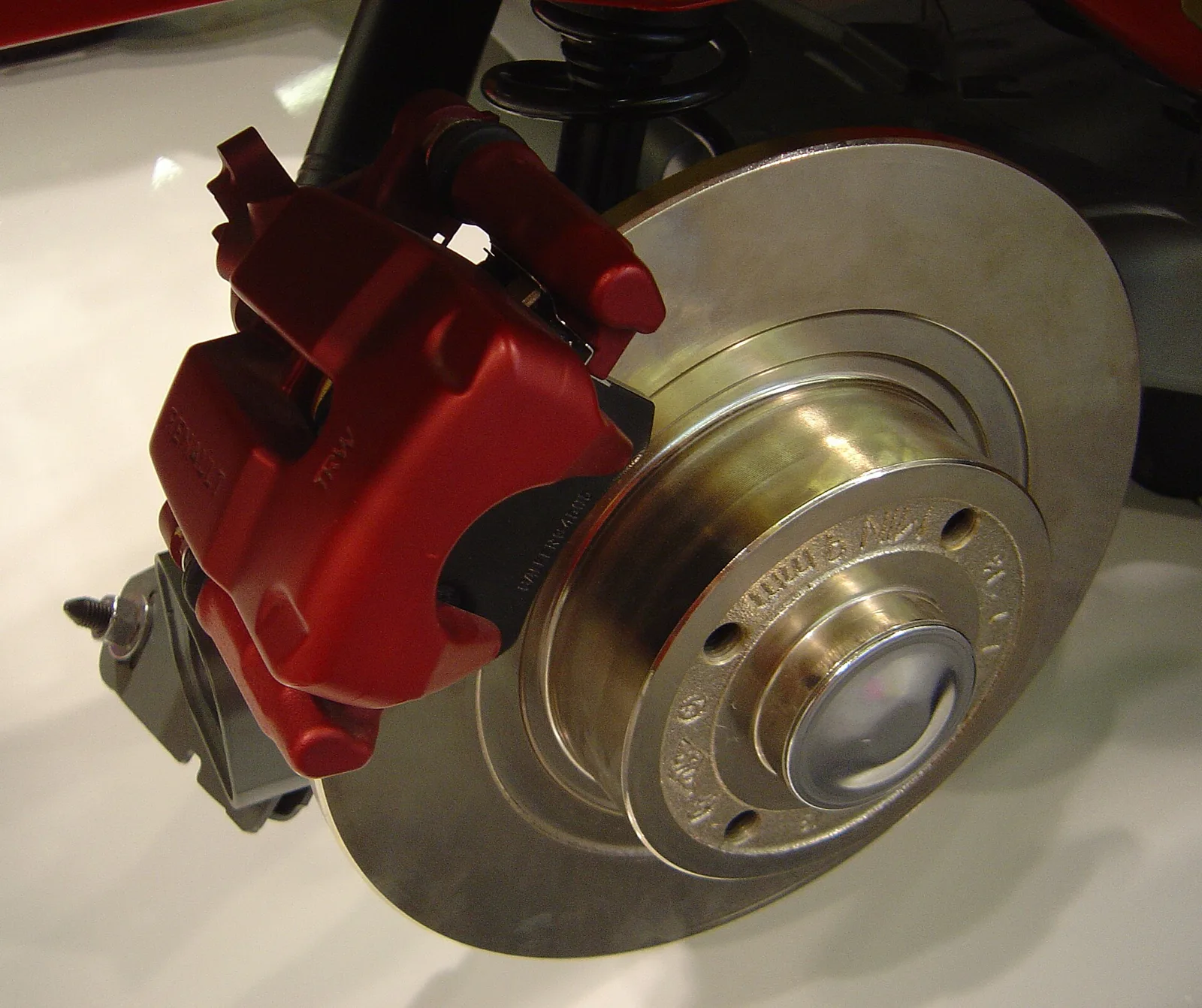
A caliper squeezes a pair of pads against a rotating disc, also called a rotor, and friction does the rest. The car's energy of motion becomes heat, and that heat has to go somewhere. In most cars the hydraulic version of this system is standard: a master cylinder sends fluid pressure to calipers, each holding at least one piston and a pad on each side of the disc.
The disc itself is usually grey iron, a form of cast iron. Some are solid. Others are hollowed out and joined by fins or vanes, a ventilated design that sheds heat and is common on the heavily loaded front axle. Discs on some cars are drilled or slotted. Slots help remove gas and water and deglaze the pads, and are preferred in most racing environments.
Two-piece discs split the job in two: a central bell, or hat, usually made of an alloy, carries a separate friction ring that is generally grey iron. For particular applications the ring can be steel or carbon ceramic. Those materials began in motorsport and can be found in high-performance cars and aftermarket upgrades. The advantages of the two-piece layout are lower unsprung mass and extra heat dissipation through the alloy hat. Floating versions let the ring and hat expand at different rates, which reduces the risk of warping, but they are prone to rattle and debris and are best suited to motorsport. Fixed versions are the better choice for the road.
A ceramic brake disc starts as carbon fibre and is made with molten silicon, which is why it does not shatter like glass.
Why did discs replace drums?
Discs cool more effectively than drums, so they resist the brake fade caused by overheating and recover faster after a soaking. They also lack the self-servo action of drum brakes, which means braking force follows pedal pressure directly. That improves driver feel and helps prevent wheel lock.
The idea is old. Development began in England in the 1890s, and in 1902 Frederick William Lanchester patented a caliper-type disc brake. The limited metals of the time forced him to use copper as the braking medium, and on the rough, dusty roads of the day it wore out too fast. The technology only proved itself decades later. At Le Mans in 1953, a Jaguar C-Type was the only car in the race with disc brakes, which Dunlop had developed in Britain. It won, and it was the first car at Le Mans to average more than 100 mph (161 km/h). Rival drum brakes could match discs for ultimate stopping power, but not for staying power.
Before that, the military showed the way. Disc brakes were applied successfully on streamlined passenger trains, aircraft and tanks before and during the Second World War. The Budd Company fitted them to the General Pershing Zephyr in 1938, and Hermann Klaue patented a design at Argus Motoren in 1940. The German Tiger I heavy tank arrived in 1942 carrying a 55 cm (22 in) disc on each drive shaft. Back on the road, America's Crosley Hot Shot wore four-wheel discs in 1949 and 1950, but they stuck and corroded, especially where roads were salted in winter, and were quickly removed. Chrysler offered a very different design from 1949 until 1953, with twin expanding discs rubbing the inside of a drum. In 1953, fifty Austin-Healey 100S cars became the first European production cars offered to buyers with discs at all four corners.
Mass production followed. The Citroen DS in 1955 was the first sustained use of modern discs and went on to sell 1.5 million cars across 20 years with its brakes unchanged. By 1965 the Chevrolet Corvette Stingray had four-wheel discs.
What is a ceramic matrix composite?
A ceramic matrix composite (CMC) is a ceramic reinforced with ceramic fibres. Both the fibres and the surrounding matrix can be any ceramic, including carbon. The reason for inventing them was a weakness of conventional technical ceramics such as alumina or silicon carbide: they fracture easily under mechanical or thermal loads, because cracks start from small defects or scratches, and their resistance to crack growth is as low as glass.
Early attempts to fix that by embedding tiny particles gave only limited improvement. Long multi-strand fibres did far more. They bridge cracks as they form, so the material avoids the abrupt brittle failure of plain ceramics. The result has much higher fracture toughness, greater elongation and extreme thermal shock resistance. In tests, every CMC tested demanded energy up to several orders of magnitude higher to drive a crack through it than a conventional silicon carbide ceramic does.
For the bridging to work, the bond between fibre and matrix has to be weak, so the fibres can slide and pull out. A thin pyrolytic carbon or boron nitride coat on the fibres does the job. The material names list fibre first and matrix second. C/C is carbon fibre in carbon, and C/SiC is carbon fibre in silicon carbide. Commercially, four families dominate: C/C, C/SiC, SiC/SiC, plus alumina fibre in alumina.
How are carbon-ceramic brake discs made?
Manufacturing a CMC follows three steps. First, fibres are laid up and fixed into the shape of the final part, using techniques borrowed from fibre-reinforced plastics such as weaving fabrics and winding filament. The result is called a preform. Second, ceramic matrix material is infiltrated between the fibres. Third, the part is machined and, if needed, coated or impregnated to seal the pores.
Step two can be done in five ways. The one introduced for ceramic brake discs is liquid silicon infiltration. A porous C/C preform reacts with silicon at a temperature above silicon's melting point of 1,414 degrees Celsius (2,577 Fahrenheit). Engineers control the conditions so the carbon fibres keep almost all of their mechanical properties. The material that forms is sometimes written C/C-SiC, after its starting point.
| Matrix method | Conditions | Porosity left |
|---|---|---|
| Chemical vapour infiltration | Gas of argon and a hydrocarbon above 1000 C | About 10 to 15% |
| Liquid polymer infiltration | Five to eight cycles of infiltration and pyrolysis | About 15% |
| Liquid silicon infiltration | Molten silicon into a C/C preform above 1,414 C | About 3% |
| Sintering (oxide CMCs) | 1,000 to 1,200 C | About 20% |
Chemical vapour infiltration bathes the preform in argon mixed with a hydrocarbon gas such as methane or propane, at or below about 100 kPa and above 1000 degrees Celsius, and carbon builds up on and between the fibres. Liquid polymer infiltration fills the preform with a polymer, cures it and bakes it, then repeats the cycle, usually five to eight times, because the polymer shrinks and leaves the matrix full of voids after each pass.
Every route yields a porous material, and the silicon route leaves by far the least void space, about 3%. Machining is demanding: grinding, drilling, lapping or milling must be done with diamond tools, though water jets, lasers and ultrasonic machining can also be used. Only fibres stable above 1,000 degrees Celsius can be used at all, which rules out organic, metal or glass fibres.
How does a ceramic composite cope with heat?
Every disc brake turns motion into heat, and the temperature it reaches limits how hard and how often a car can stop. Discs already handle that better than drums, which is why discs are less prone to fade. A ceramic matrix composite adds extreme thermal shock resistance, a high tolerance for sudden swings in temperature, and its fibres are chosen to stay stable above 1,000 degrees Celsius. Matrix cracks form at only about 0.05% elongation, as in any ceramic, but the fibres hold the material together and allow elongation to rupture of up to 1%.
The properties also depend on direction. A CMC is anisotropic, meaning its strength follows the orientation of the fibres, which is why the preform layout matters as much as the ceramic around it.
Are carbon ceramic brakes worth it? What the material changes
The ceramic addresses heat in the disc. It does not change the rest of the system. A disc still needs pads, and pads wear. They are a steel backing plate with friction material, and on a hot stop they transfer a thin film of themselves onto the disc, leaving a dull grey film; the pad and the coated disc then grip each other. Racing calipers can use up to six pads of differing grades in a staggered pattern.
Pad choice has trade-offs that apply to any disc. Modern pads typically have a friction coefficient between 0.3 and 0.5, low enough to avoid wheel lock yet high enough to stop the car. Non-metallic pads are gentle on rotors but dusty and short-lived. Semi-metallic pads are harder and more fade-resistant but wear rotors faster. Fully metallic pads, made of sintered steel, are for racing only, last a long time, and are loud. Ceramic pads combine clay and porcelain with copper flakes. Despite the name they are a different thing from a ceramic disc, and their main drawback is that they do not dissipate heat well. Care is needed with non-standard pads, because performance pads may not brake efficiently when cold and standard pads can fade under hard driving.
For ordinary iron discs, the guidance is to inspect the pads at least every 5,000 miles. Pads are generally replaced about every 50,000 miles and discs about every 70,000 miles, although wear is unique to each vehicle. Pads include warning features, such as a central groove that wears away, a soft metal strip that squeals, or a tab that lights a dashboard warning.
Brake wear also matters beyond the garage. Wear particles can account for up to 55 percent of non-exhaust fine particle emissions in cities, and regulation in Washington and California is restricting copper in friction materials, which must drop under 5% by weight in 2021 and to 0.5% in 2025.
What it means if you buy or drive one
Iron discs remain the standard in most cars, with drum brakes still used at the rear of many lightweight vehicles to save cost and weight, since the front brakes do most of the work.