Malcolm Sayer, a wartime aircraft engineer who disliked the word stylist, turned a Le Mans winner into the road car Enzo Ferrari is said to have praised.
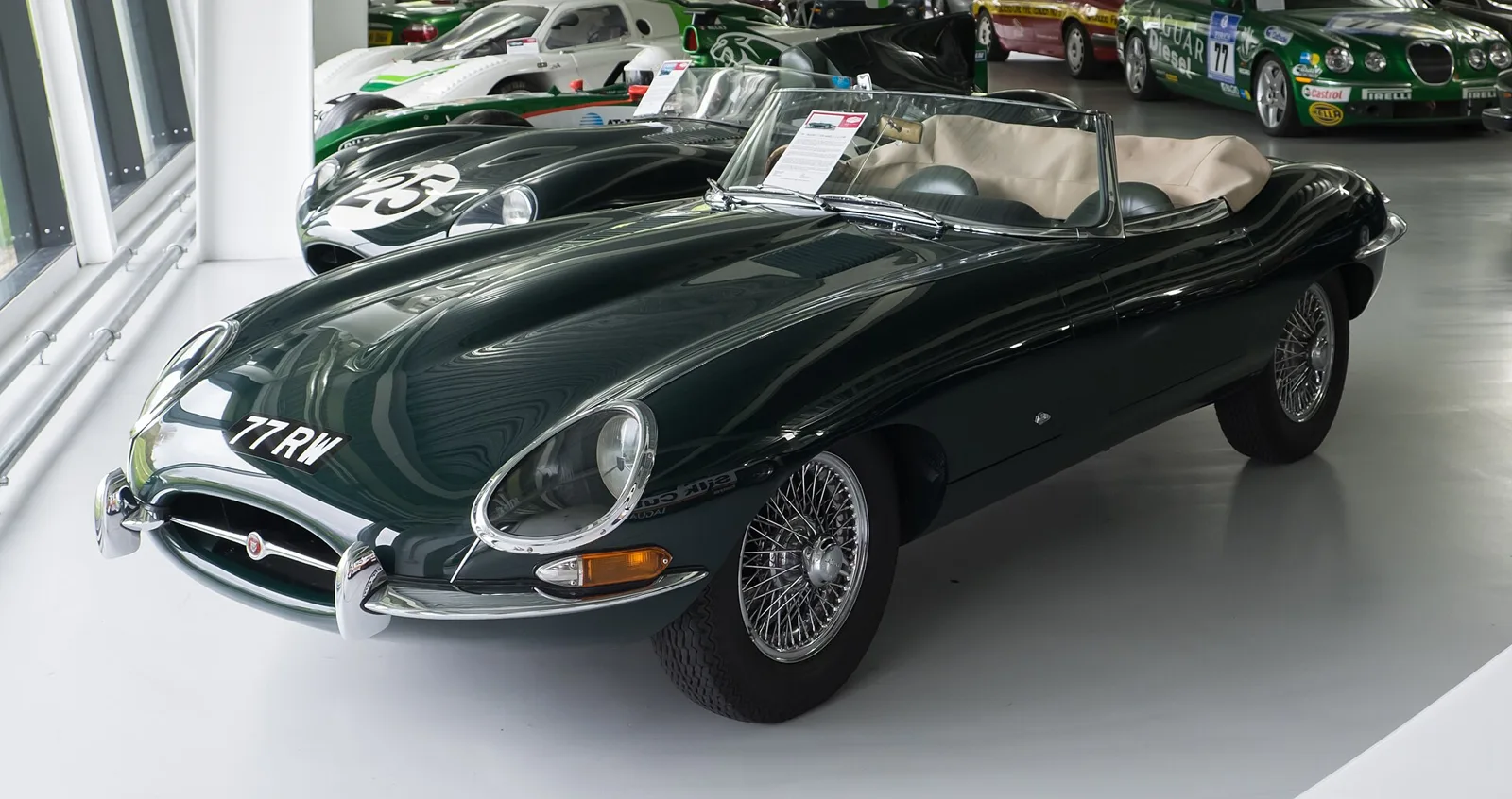
The Jaguar E-Type is a British front-engined sports car built by Jaguar from 1961 to 1974, based on the Le Mans-winning D-Type and shaped by aerodynamicist Malcolm Sayer. It paired a claimed 150 mph top speed with a largely unitary body and four-wheel disc brakes, and topped a 2008 Daily Telegraph list of beautiful cars.
The man who shaped the Jaguar E-Type refused to be called a stylist. Malcolm Sayer had engineered aircraft through the Second World War, and at Jaguar he insisted that he was an aerodynamicist and no hairdresser. His curves came from equations, and in March 2008 they put the E-Type at the head of The Daily Telegraph's online ranking of the 100 most beautiful cars of all time.
How did a Le Mans racer become the Jaguar E-Type?
The E-Type, sold as the XK-E in North America, was Jaguar Cars Ltd's front-engined British sports car from 1961 until 1974. Its parent was the D-Type racing car, winner of Le Mans in three successive years from 1955.
After a decade of success at that race, Jaguar's racing department was told to turn its D-Type thinking into a road car that would replace the XK150. William Heynes, the Technical Director and Chief Engineer, drew up the specification for the first prototype, E1A, in 1957. Sayer had sketched the first design concepts during 1956, and the car first ran in May 1957. It had a monocoque body, Jaguar's independent rear suspension and the XK engine.
E1A never went on sale. It became a rolling test bed for steering, brakes and suspension, and, unusually for a prototype, Jaguar showed it to a journalist and ran it on public roads. It was scrapped in late 1959. Jaguar's Lyons, who had shown little interest at first, warmed to it, and work began on E2A.
E2A, built in 1960, took another route: a steel chassis under an aluminium body, completed as a racing car because Jaguar judged a track the better proving ground. It ran a 3-litre XK engine with Lucas fuel injection. After retiring from Le Mans it crossed the Atlantic for the privateer Briggs Cunningham, then returned to England in 1961 as a test vehicle. Roger Woodley, Jaguar's customer competition manager, took it over in 1970 on condition that it never raced. His wife still owned it in 2008, when it sold at the Bonham's Quail auction for US$4,957,000.
The production car's design and development began in 1957. It was shown in Geneva in March 1961, with the debut dated 15 March, and the first Series 1 cars went to export customers only. British buyers waited four months, until July 1961.
Sayer called himself an aerodynamicist, not a hairdresser, and the E-Type is the proof.
Who was Malcolm Sayer, and how did he draw the E-Type?
Sayer was born in Cromer, Norfolk, on 21 May 1916. His father taught maths and art, an odd pairing that suited the son, who won an Empire Scholarship at 17 and took first class honours in aeronautical and automotive engineering at Loughborough. During the war he worked at the Bristol Aeroplane Company, a reserved occupation that kept him out of uniform.
After a short, unsatisfying spell in Iraq, where a planned engineering faculty at Baghdad University turned out to be unrealistic, he returned to Britain in late 1950. Heynes interviewed him for Jaguar and recognised the mathematical, aircraft-minded approach to airflow. Sayer joined the engineering drawing office in early 1951.
His method was calculation first. With a slide rule and seven-figure log tables he worked out formulae of his own for drawing curves, the kind of job complex Computer Aided Design software handles today. He wanted a body to work aerodynamically and look right at the same time. That approach shaped the competition cars of the 1950s: the C-Type, which won Le Mans in 1951 and 1953, the D-Type, the E-Type and the XJ13.
No single pair of hands finished the E-Type. Sayer owned the overall form; Lyons oversaw detailing; Heynes led the body engineering that made production feasible. Cyril Crouch took the drawings and developed them into a steel monocoque, and the sheet metal craftsman Bob Blake, who had worked with Sayer since the late 1950s, crafted the fixed head coupe. The car had begun life as a roadster. Blake later became Jaguar's first Modelling Manager, and Claude Baily, Norman Dewis, Tom Jones and Bob Knight also played key parts.
What did the D-Type give the E-Type?
Its structure and its shape. The D-Type, built from 1954 to 1957 purely to win Le Mans, kept the C-Type's straight-six XK engine but changed everything around it. The cockpit tub was an aluminium alloy monocoque, an elliptical section with a small cross-section that added stiffness and cut drag. Picture an eggshell beside a birdcage: the shell carries its loads in its skin, while the cage needs a frame. An aluminium tubing subframe at the front held the engine, steering and front suspension, and fuel sat in the tail in a deformable bag, as in aircraft.
Sayer refined the shape in a wind tunnel at Loughborough using one-eighth scale models, then with full-size tests at RAE Farnborough. At its 1954 Le Mans debut the D-Type reached 172.8 mph (278.1 km/h) on the Mulsanne Straight, while the winning 4.9 litre Ferrari managed 160.1 mph (257.7 km/h). Later cars touched 192.4 mph (309.6 km/h), helped by a fin behind the driver that kept them steady.
The D-Type then won three Le Mans races. Mike Hawthorn and Ivor Bueb took the 1955 race, overshadowed by the crash that killed the driver Pierre Levegh and many spectators, after which Mercedes withdrew. The Edinburgh team Ecurie Ecosse won in 1956 and finished first and second in 1957, when D-Types filled five of the top six places.
The road car inherited the all-round disc brakes and much of the body shape and construction detail. For several years the E-Type was the D-Type in civilian clothes.
Did Enzo Ferrari really call it the most beautiful car ever made?
The story goes that at the debut Ferrari paid it that compliment. It has not been fully confirmed, which makes it a rumour that happens to suit the car.
The documented praise is plenty. In 2004 Sports Car International magazine ranked the E-Type first among the top sports cars of the 1960s. In 1996 the Museum of Modern Art in New York hung a blue Series 1 roadster in its design collection for good, one of just six cars so honoured, and London's Victoria and Albert Museum holds a Series 1 roadster too.
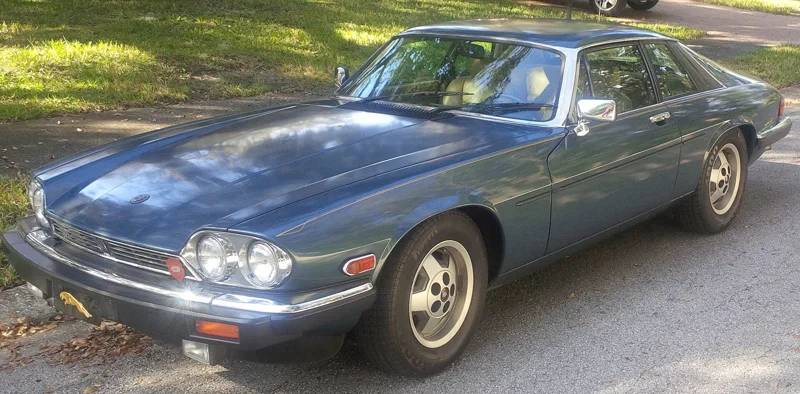
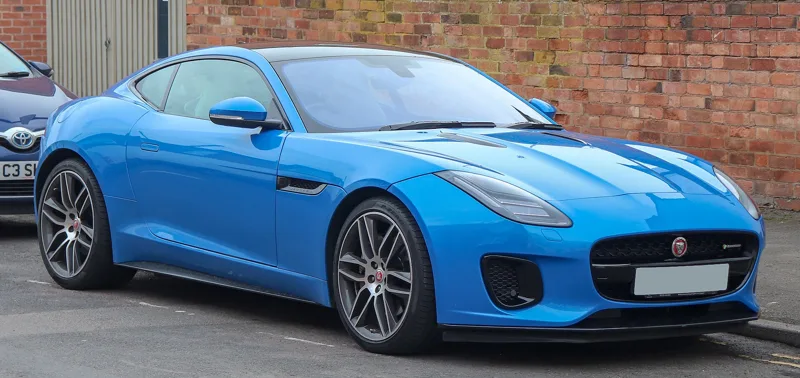
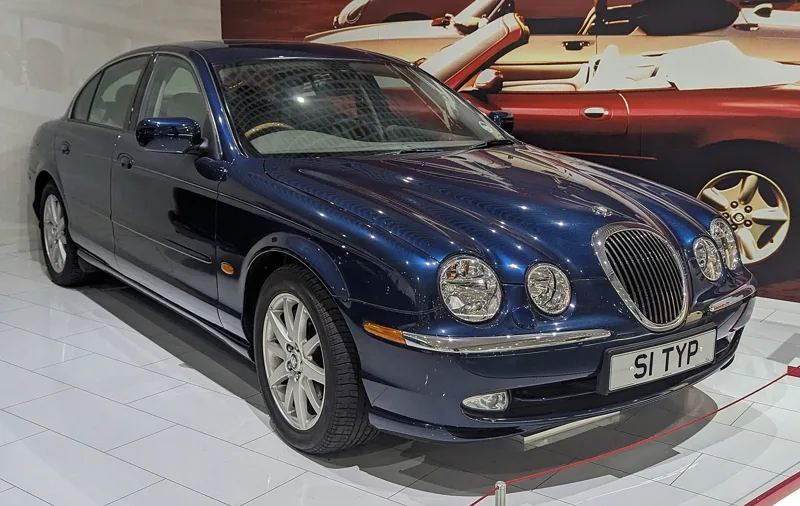
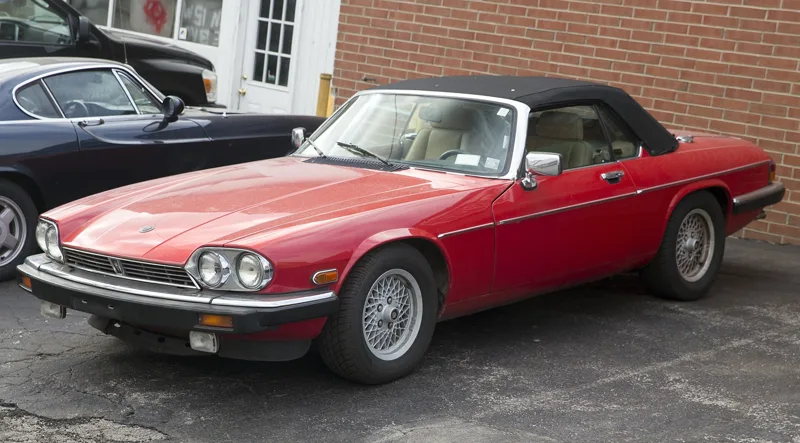
Jaguar kept using the shape after the car ended. A long bonnet, strong rear haunches and the same stance resurfaced in the XK8 coupe by the late design director Geoff Lawson, and carried on under his successor Ian Callum.
Why was the E-Type built so differently from other sports cars of 1961?
It dropped the ladder-frame chassis. Most cars then rested on two long rails joined by cross-members, with the body fitted on top. The E-Type instead carried its engine, front suspension and front bodywork on a subframe that bolted straight to the body tub. The first cars weighed only 1,315 kg (2,899 lb).
The rest of the specification pointed the same way. R J Knight designed the independent coil-spring rear suspension, the front used torsion bars, and the car had power-assisted disc brakes at all four wheels, mounted inboard at the rear. With rack-and-pinion steering, a largely unitary body and a claimed 150 mph (240 km/h), the package prompted changes across the industry.
The brakes mattered most. Jaguar was among the first makers to fit four-wheel discs as standard on production cars, beginning with the XK150 in 1958, and Austin-Healey and MG did likewise, leaving Mercedes-Benz, Porsche, Alfa Romeo, Maserati and Ferrari behind.
The car came as a fixed head coupe (FHC) or an open two seater (OTS). In 1966 a 2+2 version of the coupe arrived, 9 in (229 mm) longer, with different roof angles and an optional automatic gearbox.
How fast was the Jaguar E-Type?
Jaguar claimed 150 mph and a 0-60 mph (97 km/h) time under seven seconds, and independent testers landed close. Motor tried a UK-specification 4.2 coupe in October 1964 and logged 150 mph (241 km/h), 7 seconds to 60 mph and 14.9 seconds for the quarter mile. The testers said passing 100 mph (161 km/h) within that quarter mile never failed to astonish them. Autocar followed in May 1965 with 153 mph (246 km/h), 7.6 seconds and 15.1 seconds, and judged it the fastest car the magazine had tested.
The original engine was a 3.8-litre six with three SU carburettors. In October 1964 it grew to 4.2 litres (4,235 cc), on a redesigned, longer block with bores 5 mm larger. Output stayed at 265 bhp (198 kW) and the top speed at 150 mph (241 km/h). Both were claimed to run 0-60 mph in around 6.4 seconds. Torque rose 18% from 240 to 283 lb ft (325 to 384 N m), and peak power moved to 5,400 rpm from 5,500 rpm. For drivers, that meant crisper throttle response without a downshift.
American emissions rules then took some of it back. On the 1968 Series 1.5 cars sold there, twin Zenith-Stromberg carburettors replaced the triple SU set, and claimed power fell from 265 to 246 hp (198 to 183 kW), with torque down from 283 to 263 lb ft (384 to 357 N m).
What is a Jaguar E-Type Series 1?
That depends on who is counting. Later updates were officially named Series 2 and Series 3, so the earlier cars gradually became Series 1. Because the cars were partly hand made and changed in small steps, the boundary is fuzzy. It matters, because Series 1 E-Types, roadsters above all, often outvalue the Series 2 and 3 cars.
Two broad groups sit inside Series 1. Cars built from 1961 to 1964 had 3.8-litre engines and, on nearly all of them, a Moss four-speed gearbox with no synchromesh on first. Those from 1965 to 1967 had the 4.2-litre engine, reclining seats, an alternator instead of a dynamo, negative earth electrics, a more dependable brake servo and an all-synchromesh gearbox of Jaguar's own. Styling stayed put. A boot badge reading "Jaguar 4.2 Litre E-Type" marks the later cars.
Rarities lie within those groups. The first 500 had flat floors and bonnet latches on the outside that needed a tool to open. Later floors were dished for legroom and the latches moved inside. At the other end, a few cars were built with their headlight covers removed for better illumination. Enthusiasts call them Series 1.25, though Jaguar counts them as Series 1, and nobody knows how many exist. Jaguar built 7,828 3.8-litre Series 1 roadsters and 6,749 of the 4.2-litre kind, and 1,508 Series 1 convertibles for 1967.
To spot one, look for headlamps behind glass (until 1967), a small front opening, indicators and tail-lights set above the bumpers and exhausts that exit beneath the number plate. The Series 2 and 3 cars for North America gained a bigger grille, wider arches and larger bumpers, plus a larger radiator and cooling system, because the Series 1 was notorious for overheating.
What does a Jaguar E-Type cost? E-Type price at auction
| Car | Year sold | Price |
|---|---|---|
| 4.2-litre Series 1 roadster, matching numbers, original paint and interior | 2013 | $467,000 |
| 3.8-litre 1961 flat floor Series 1 | 2014 | $528,000 |
| E2A prototype (Bonham's Quail auction) | 2008 | US$4,957,000 |
| 1963 Lightweight Competition, one of twelve built | 2017 | $7,370,000 |
| 1955 D-Type (RM Sotheby's, Monterey) | 2016 | $21,780,000 (GBP 16,641,143) |
As of the end of 2014 the priciest regular production E-Types to sell at auction were a 4.2-litre roadster and an early 3.8-litre flat-floor car. The 4.2-litre roadster had under 80,000 miles (130,000 km) behind it and 45 years with the original buyer's family. The 3.8-litre car was an early flat-floor example. Since the 4.2-litre Series 1 is usually the priciest version, the higher price for the flat-floor car shows how much an early detail can be worth.
Racing lightweights sell for much more. The 1963 Lightweight wore the patina of decades, though it had been repainted and carried a factory-supplied engine that did not match its numbers. The D-Type, the racing car the E-Type grew from, is the most expensive Jaguar ever sold at auction.
What were the Lightweight and Low Drag E-Types?
Jaguar designed the Lightweight E-Type for competition, as a racing successor to the D-Type. It planned 18 but reportedly built about a dozen. Two were converted to low drag form, two were crashed and written off, and one of those has since been rebuilt.
The Low Drag Coupe was a one-off technical exercise, eventually passed to one of Jaguar's racing drivers. It is now thought to sit in the private collection of Viscount Cowdray.
What should a buyer or driver know about the E-Type?
Start with the value ladder. Series 1 cars, roadsters especially, sit above Series 2 and 3, and within Series 1 the earliest flat-floor cars and the 4.2-litre cars draw particular attention. The headline auction results lean on matching numbers, original paint and interior, and low distance.
The 4.2 has a genuine driving case. It brought sharper throttle response, an electric cooling fan, an all-synchromesh gearbox, more comfortable seats and improved brakes and electrics. The 3.8, by contrast, offers leather-upholstered bucket seats and an aluminium-trimmed centre console, which gave way to vinyl and leather in 1963. Overheating was the known weakness of the earliest cars.
Where this goes next
Jaguar has spent recent years finishing what the 1950s left undone. In 2014 it announced that it intended to build the remaining six lightweights, at approximately GBP 1 million each. In March 2016 it said it would hand-build the nine XKSS roadsters destroyed in the Browns Lane fire of 12 February 1957, using the lost cars' chassis numbers, with each expected to sell for more than GBP 1 million.
For the D-Type itself, Jaguar announced 25 "continuation" cars, hand-built at its Warwickshire workshop, with a choice of 1955 short-nose or 1956 long-nose bodywork. They were unveiled at Salon Retromobile in Paris in 2018. Original D-Type production is put at 71 by some counts and 75 by Jaguar.
An electric E-Type is the other thread. In September 2017 Jaguar unveiled the E-Type Concept Zero, an electric revival of the 1968 Series 1.5 roadster. It has a 40 kWh battery, reaches 60 mph in 5.5 seconds and offers a range of 168 miles (270 km) on a full charge. The pack fits where the original six-cylinder engine sat, and the electric motor replaces the transmission. In August 2018 Jaguar confirmed it would sell all-electric E-Types from summer 2020, but the plan was halted in 2019.
Sayer's own follow-up project was quieter. In 1967 he began outlining styling ideas for a successor to the E-Type, which became the V12 Jaguar XJS of 1975. It never reached the E-Type's standing, but it earned praise as a grand tourer and stayed in production for 21 years. Sayer died of a heart attack in Leamington Spa on 22 April 1970, a month before his 54th birthday. Plaques now remember him at Loughborough University, in Cromer, at Great Yarmouth Grammar School and in Leamington Spa, where a housing development opened in 2017 as Sayer Court.