How a steel bar that twists under load became the spring in tanks, Porsches and Chrysler cars, and why it still appears in trucks and military vehicles.
A torsion bar suspension uses a steel bar fixed at one end to the chassis, with a lever at the other that twists the bar as the wheel moves. The bar acts as the main spring. The design appeared on Leyland cars in the 1920s, became common in tanks and was used on Citroen, Chrysler and Porsche cars.
Torsion bar suspension, also known as torsion spring suspension, relies on a twisting bar to carry most of the vehicle's weight. The bar's fixed end sits on the chassis, and its free end drives a lever, the torsion key, which connects to a suspension arm, a spindle or the axle. Wheel travel rotates the bar about its axis, and the bar's stiffness resists that rotation.
How does a torsion bar act as a spring?
The bar behaves like a coil spring that is laid out in a straight line. Its effective spring rate depends on its length, its cross section, its shape, the material it is made from and how it was manufactured. Changing any of these factors changes how stiff the suspension feels and how much load it can carry.
The geometry is simple. The bar is anchored at one end, and the lever at the other end converts the vertical motion of the wheel into a rotation of the bar. Because the bar is elastic, the wheel can move through its travel and the bar returns to its resting position once the load is removed.
Engineers can change the ride height by changing the bar or the key. In many systems a set of bolts connecting the bar to the frame cross member adjusts the ride height, which is why these suspensions are so easy to tune.
A bar that twists under load is one of the simplest springs in engineering, and one of the oldest.
Why did torsion bars spread from tanks to cars?
Torsion bars gained ground in the early twentieth century and were adopted in armoured fighting vehicles around the Second World War, thanks to their robustness on rough terrain. Early automobiles had relied heavily on leaf springs, and Citroen's innovations brought torsion bars into cars for their greater flexibility and comfort.
Military designers found the bar attractive for its toughness. The Swedish Stridsvagn L-60 tank of 1934 was the first military use of the system. Its suspension came from a German team, and the Porsche employee Karl Rabe was among those involved and held his own patents on the design.
| Vehicle type | Examples | Notes |
|---|---|---|
| Wartime tanks | Tiger and Panther, many World War II tanks | Double torsion bars in the Panther |
| Postwar tanks | M26 Pershing, M46/M47/M48 Patton, M60, M1 Abrams | Torsion bars remain common |
| European tanks | T-72, Leopard 1, Leopard 2 | Torsion bars in combat vehicles |
| Road vehicles | Trucks and SUVs from Ford, Chrysler, GM, Mitsubishi, Mazda, Nissan, Isuzu and Toyota | Used in many modern trucks and SUVs |
Tanks remain a major home for the design. Many contemporary main battle tanks use torsion bar suspension, including the American M1 Abrams, the German Leopard 2 and the Chinese MBT-3000, while the newest generation, such as the Russian T-14 Armata, uses an adjustable hydraulic suspension instead. Torsion bars suit tanks because of their small size, large load capacity and relative ease of service.
What are the advantages of a torsion bar?
The main advantages are a soft ride, thanks to the elasticity of the bar, along with durability, easy adjustment of ride height and a small profile across the width of the vehicle. The system also takes up less interior volume than coil springs, which leaves more room for passengers and cargo.
Torsion bars became especially popular on mass-production road cars in the middle of the twentieth century, at the same time that unitary body construction was spreading. Designers liked the bars because they could be mounted to the reinforced bulkhead of the central structure. Independent front suspension with coil springs and MacPherson struts, by contrast, required strong turrets in the frontal structure.
What are the drawbacks of torsion bars?
A torsion bar usually cannot provide a progressive spring rate, which coil springs can offer. Longitudinal torsion bars extend under the passenger compartment, and they cut into interior space by raising the floor. In transverse systems, the length of the bar is limited by the width of the vehicle.
Swapping one torsion bar for another with a different spring rate is usually an easy task in cars with this type of suspension. That flexibility helps tuning, but the bar's large travel and elasticity also cause a rocking motion in tanks, which is why a gun stabiliser is needed to compensate.
How did the Panther tank's bars differ?
The German World War II Panther tank used double torsion bars. The bars needed to be longer than the tank's width to give the required spring rate and maximum elastic bend angle from the steel alloys then available. Its designer, Ernst Lehr, solved this by folding each bar in half.
One rod was attached to the suspension arm and the other mounted to a nearby point on the frame.
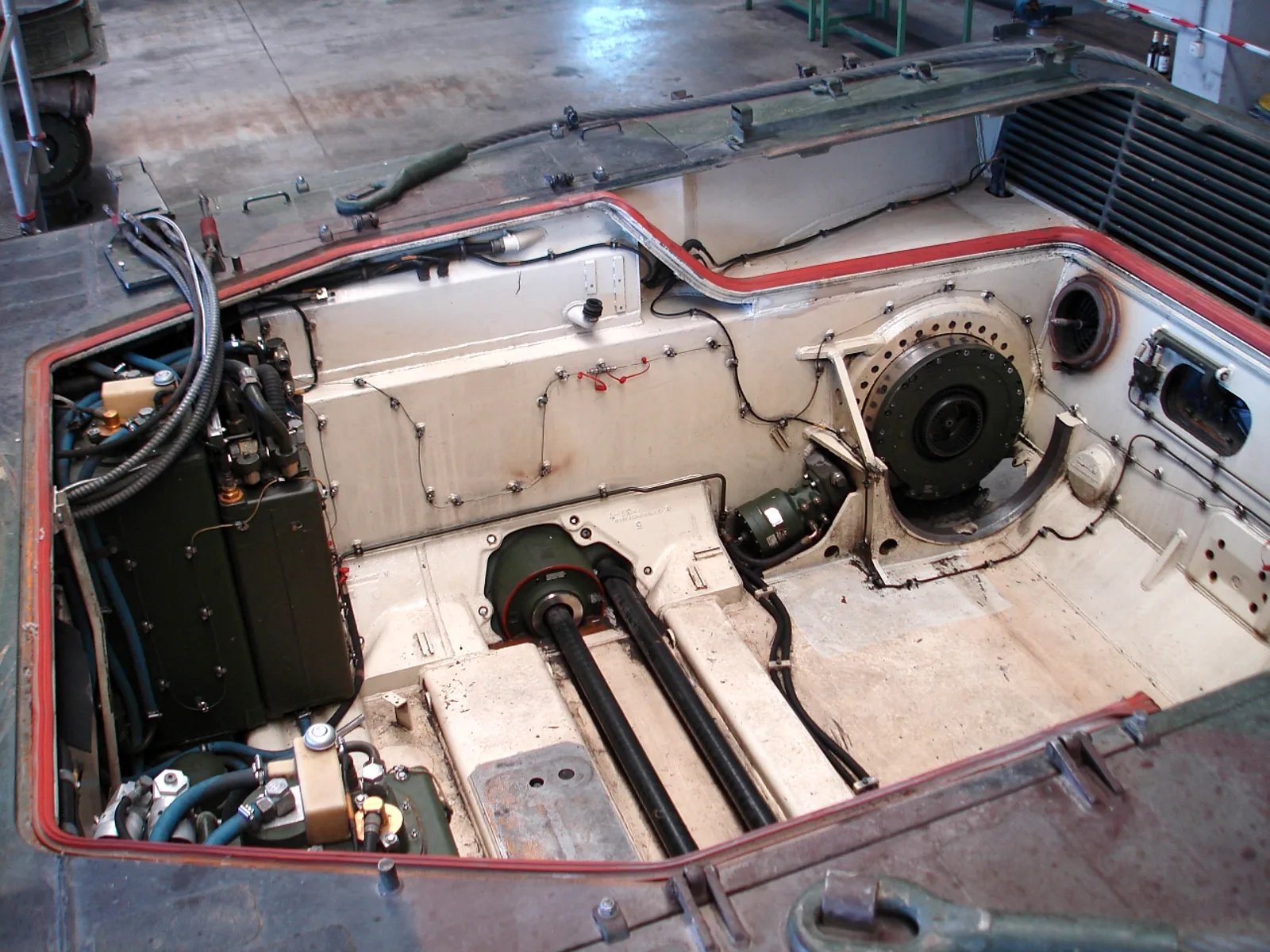
The arrangement had a drawback. The torsion bars in the Tiger and Panther tanks, and in many other tanks of the period, blocked the space needed for an escape hatch through the bottom of the hull. Because the absence of leaf, coil or volute springs often left the hull side clear, a side escape hatch could still be added.
Who first used torsion bars in cars?
The first vehicle to use torsion bars was the Leyland Eight, designed by J. G. Parry-Thomas and produced from 1920 to 1923. Its rear suspension was patented in 1919, although Leyland later described it as torsion bar assisted, since the bars only complemented the leaf springs.
Parry-Thomas patented a true torsion bar design in 1923, but his death in a car crash in 1927 stopped its development.
Porsche patented the torsion bar in 1931 and later used it in many designs, so the invention is often credited to the company. The front-wheel drive Citroen Traction Avant of 1934 was the first serially produced car to use independent front torsion bar suspension. Its trailing dead axle was also sprung by torsion bars, and the flexible axle beam gave the wheel location of a twist beam axle.
Which carmakers adopted the system?
Torsion bars spread widely across the car industry. Renault, Citroen and Porsche and Volkswagen used them in the 1930s, and smaller makers such as Mathis and Rohr did too. Packard used torsion bars at both front and rear in the 1950s, interconnecting the two systems to improve ride quality.
Morris Minor and Oxford models from the late 1940s used a front torsion bar system closely resembling the Citroen design, and the Jaguar E-Type of 1961 used a similar front arrangement with a coil spring rear suspension. In America, Chrysler used torsion bars across its products from the 1957 model year, although its Torsion-Air suspension covered only the front axle. The longitudinal layout remained until the K-car arrived in 1981.
General Motors first used torsion bars on its light-duty pickups in 1960, and it extended them to passenger cars in 1966 with the E-platform vehicles, including the Oldsmobile Toronado and Cadillac Eldorado. Porsche used four-wheel torsion bar suspension on its 356 and 911 series from 1948 until 1989, when the 964 arrived.