From a 1919 patent and 1973 GM fleet cars to the Takata recall and 2023 Indian rules, how the airbag works and why it has spread.
An airbag is a fabric cushion that inflates within milliseconds of a collision, triggered by crash sensors and an electronic control unit. Commercial designs appeared in the 1970s, and airbags became common in many markets during the late 1980s and early 1990s.
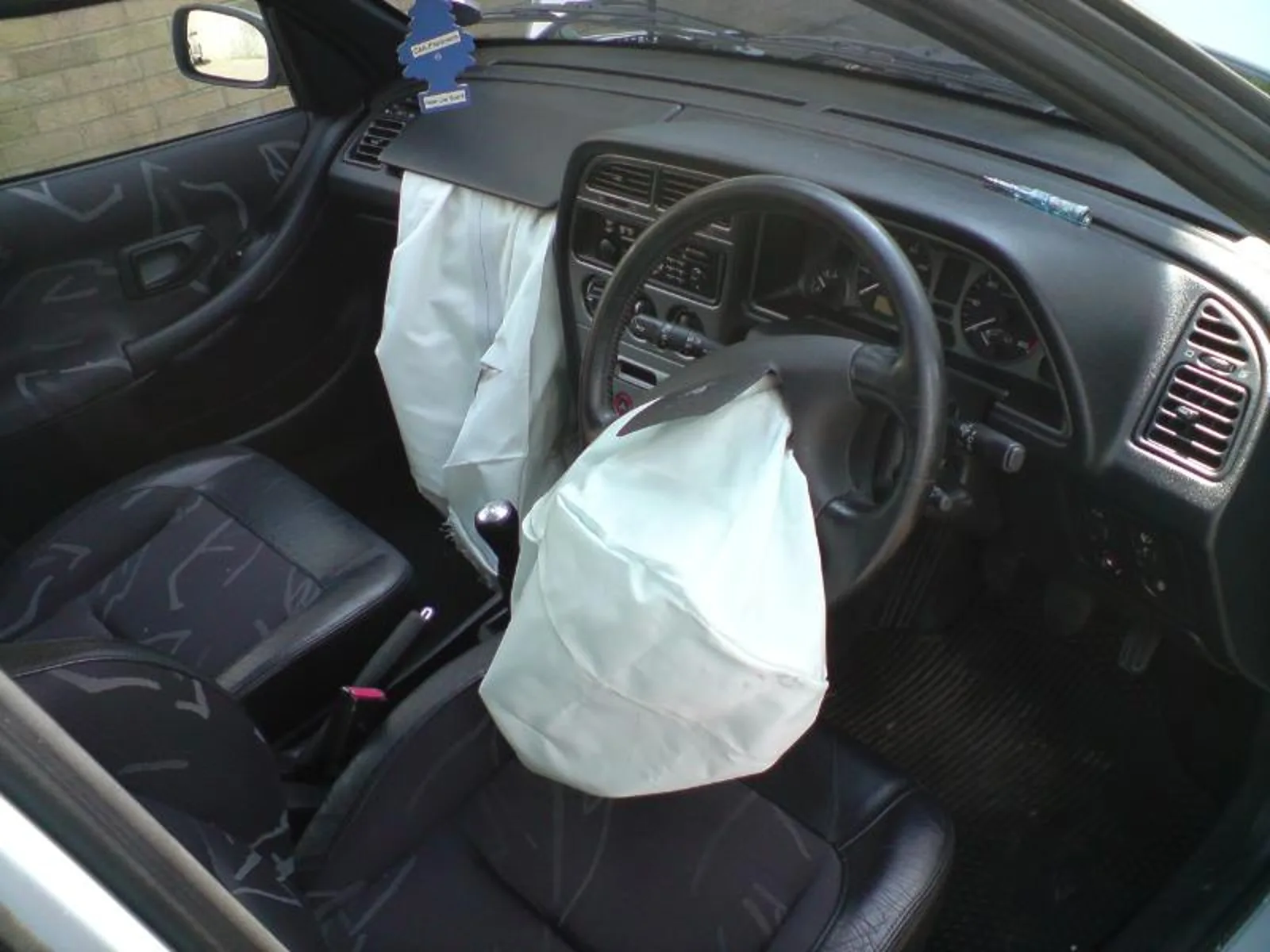
Airbags are supplemental inflatable restraints that cushion occupants during a crash. They inflate in a fraction of a second and then deflate, and they work alongside seat belts rather than replacing them.
What is an airbag made of?
An airbag module combines a fabric cushion, an inflation module and an impact sensor, and the car's electronic control unit decides when it fires. Modern vehicles may carry up to ten modules, from driver and passenger bags to knee, side-curtain and pedestrian designs.
Airbags count as passive restraints because the occupant does nothing to use them. Seat belts are called active restraints, since the occupant must act to fasten them. Those terms are different from active and passive safety, which describe systems that prevent crashes and systems that limit their effects.
Aviation safety reverses the meaning, which can confuse readers. Vehicle safety engineers are generally careful with the language, although advertising does not always follow that care when it promotes safety features.
A fabric bag that fills in milliseconds, is designed to fire once, and then deflates after the crash.
How does an airbag know when to fire?
Crash sensors pass the collision type, angle and severity to the airbag electronic control unit, which runs a crash algorithm to decide whether to deploy. Firing circuits then set off one or more modules through a pyrotechnic process designed to be used once.
In a frontal crash the decision is typically made within 15 to 30 ms of the crash starting. Both driver and passenger bags are usually fully inflated within about 60 to 80 ms of first contact, and a late or slow bag can raise the risk of injury from the bag itself.
Inflation is very fast. Solid propellant ignites and produces inert gas that fills the bag in approximately 20 to 30 ms, and the whole deployment and inflation process takes about 0.04 seconds from the onset of a crash.
The sensor is now usually a MEMS accelerometer, a small integrated circuit with a micromechanical element that moves under rapid deceleration and changes capacitance. The ADXL-50 from Analog Devices is the most common in use, while early attempts with mercury switches did not work well.
Who patented the first airbag?
The earliest idea is usually traced to a 1919 US patent by two Birmingham dentists, Arthur Parrott and Harold Round, which was approved in 1920. The automobile airbag is credited independently to John W. Hetrick, whose patent was granted on 18 August 1953.
Hetrick, an industrial engineer and US Navy member, combined his torpedo work with a wish to protect his family on the road. His design used compressed air released by a spring, bumper contact or the driver, and he filed on 5 August 1952. The patent number was 2,649,311.
The first commercial use did not come until after the patent expired in 1971, when a few experimental Ford cars had airbags fitted. Hetrick was unable to attract investment from the major manufacturers of his time, which left the design with little economic value to him.
German engineer Walter Linderer filed a patent in October 1951 that was issued on 12 November 1953, about three months after Hetrick's. In 1964 the Japanese engineer Yasuzaburou Kobori began work on an explosive-inflated safety net, and he later earned patents in 14 countries before his death in 1975.
The next big step came in 1967, when Allen K. Breed invented a ball-in-tube crash sensor that could inflate a bag in under 30 milliseconds. His system used a small explosion of sodium azide rather than compressed air, the first time that approach was used.
Which carmakers introduced airbags in the US?
General Motors began offering cars with airbags in the early 1970s, starting with government fleet 1973 Chevrolet Impala sedans. The Oldsmobile Toronado became the first domestic US vehicle with a passenger airbag in 1973, and GM sold its system as the Air Cushion Restraint System, or ACRS.
The early GM fleet had seven fatalities, and one of them was later suspected to have been caused by the airbag. Two of the 1973 cars were crash tested after 20 years, and their airbags deployed perfectly. An early example of the airbag cars survives as of 2009.
In 1974 ACRS became a regular production option on full-size Cadillac, Buick and Oldsmobile models. It included a driver-side airbag, a driver knee restraint and a passenger-side bag that protected both front occupants. GM marketed the airbags as a substitute for shoulder belts, and these cars had lap belts only.
Prices for the Cadillac option were US$225 in 1974, $300 in 1975 and $340 in 1976, which is US$1,924 in 2025 dollars. GM dropped the option for the 1977 model year, citing a lack of consumer interest.
Chrysler fitted driver-side airbags as standard on its 1988 and 1989 models. American cars became widely equipped only in the early 1990s, after Ford and GM had spent years lobbying against air-bag requirements.
How did airbags reach Europe?
Airbags were almost unheard of in Europe until the early 1990s. By 1991 BMW, Honda, Mercedes-Benz and Volvo offered them on some higher-end models, and Ford and Vauxhall/Opel brought them into their ranges in 1992. Citroen, Fiat, Nissan, Hyundai, Peugeot, Renault and Volkswagen followed shortly afterwards.
Mercedes-Benz introduced the airbag in West Germany in 1981 as an option on its flagship S-Class (W126). Its system tensioned the seat belts first and then deployed the airbag, which made belt and bag one restraint rather than rival options.
Porsche's 944 Turbo became the first car with standard driver and passenger airbags in 1987, and the Honda Legend brought the first airbag to a Japanese car the same year.
By 1999 a new mass-market car without an airbag, at least as an option, was hard to find. Audi was slow to adopt airbags widely and relied on its cable-based procon-ten system until then. The spread of airbags has been linked to a sharp fall in deaths and serious injuries on European roads since 1990.
When did the US require airbags?
The US government amended Federal Motor Vehicle Safety Standard 208 on 11 July 1984, so that cars built after 1 April 1989 needed a passive restraint for the driver. An airbag or an automatic seat belt could meet the rule. Light trucks were not required to have airbags until 1997.
The Intermodal Surface Transportation Efficiency Act of 1991 required airbags for the driver and front passenger in cars and light trucks built after 1 September 1998. The 1998 amendment to FMVSS 208 made dual front airbags mandatory and also required reduced-power, second-generation bags.
The National Highway Traffic Safety Administration estimated that airbags had saved over 4,600 lives by 1 September 1999. Early 1990s installations had also caused some deaths and injuries, and that led to new rules in 1998 that required better protection for occupants of different sizes, whether or not they wore belts, with less risk to children.
Which countries require airbags now?
Several Latin American markets now require dual front airbags in new cars, and the earliest of those rules dates back to 2013 in Ecuador. India has set its own rules, including a six-airbag minimum for passenger vehicles sold after October 2023. The table below lists the main dates and requirements.
| Market | Requirement | Date |
|---|---|---|
| Ecuador | Dual front airbags in new models | From 2013 |
| Argentina | Front airbags, except micro vehicles | From January 2014 |
| Brazil | Dual front airbags on all new cars sold | From 1 January 2014 |
| Uruguay | Dual front airbags on all new cars sold | From July 2014 |
| Chile | Dual front airbags on all new cars sold | From December 2016 |
| Colombia | Dual front airbags on cars made or imported | From 1 January 2017 |
| Mexico | Dual front airbags on all new cars sold | From 1 January 2020 |
| India | Dual front airbags for new models; six airbags for passenger vehicles | New models from 1 April 2021; six airbags from October 2023 |
Europe works differently. Some countries follow the ECE vehicle regulations rather than US standards, and ECE airbags are generally smaller and inflate less forcefully because those specifications are based on belted crash test dummies.
The European Union and the United Kingdom have no direct legal requirement for airbags on new cars, yet almost every new car sold in Europe has front and side airbags. The Euro NCAP rating encourages a whole-car approach, since a good rating can only be achieved by combining airbags with other safety features.
How have airbag designs changed?
Airbags have moved from frontal bags to side torso, side curtain, centre, knee, rear and pedestrian designs, with curtain and pedestrian bags among the later additions. Variable-force systems now tailor deployment to crash severity and occupant size, and some newer front passenger bags use three chambers.
Volvo offered side-torso airbags as an option on the 1995 Volvo 850 in 1994 and made them standard on cars built after 1995. Saab added combined head and torso airbags in 1997 with the 9-5, and BMW fitted tubular head side airbags to its 7 Series and 5 Series that year.
Some estimates credit curtain airbags with cutting brain injury or deaths by up to 45% in side impacts with SUVs. Toyota offered a roof-deployed curtain airbag on the Progres from May 1998, and Volvo made curtain airbags standard on all new cars from 2000, except the first-generation C70.
More recent features include the 2008 Toyota iQ, which had the first production rear-curtain shield airbag, and the 2009 Toyota rear-seat centre airbag on the Crown Majesta. The Volvo V40, introduced in 2012, had the world's first pedestrian airbag as standard and ranked highest at 88% in EuroNCAP pedestrian tests.
In 2019 Honda announced a passenger airbag with three inflatable chambers joined by a sail panel, developed with Autoliv. It first appeared in 2020 on the Acura TLX for the 2021 model year. Mercedes-Benz began offering rear passengers frontal protection in September 2020 on the W223 S-Class.
What are the risks and limits of airbags?
Airbags protect many occupants, but they can injure and occasionally kill, especially people very close to the wheel or sitting out of position. Between 1990 and 2000 the NHTSA identified 175 airbag fatalities in the United States, and 104 of the victims were children.
A rear-facing infant seat in the front places a child's head close to the airbag, which can cause severe head injury or death when it deploys. Some modern cars include a switch to disable the front-passenger airbag for this reason.
Side impacts are another weakness. The first front airbags did little for side collisions, which bypass the crumple zone, and airbags deploy only once, so they do not protect in a second impact during the same incident.
Deployment releases dust and gases, usually from cornstarch or talcum powder that lubricates the bag. The steering wheel boss and dashboard panels are not designed to be reused after a deployment, so even minor collisions with deployment can be costly.
A US study put the serious head injury risk at 5.495% for occupants at 40-48 km/h (25-30 mph), and said airbags cut it by 80.5% to 1.073%.
What was the Takata recall?
Takata made some of the most serious recent airbag failures. Its ammonium nitrate-based inflators could rupture after long exposure to hot, humid climates and send metal shards at the driver. As of December 2022 the defect had caused 33 deaths worldwide, with up to 24 in the US.
NHTSA called back over 33 million vehicles in May 2015 and levied a $70 million fine on Takata in November 2015. Toyota, Mazda and Honda said they would not use ammonium nitrate inflators, and Takata filed for bankruptcy in June 2017.
The chemistry of older inflators was also a concern. Early designs used sodium azide, but little or no toxic sodium azide has been found on used airbags. Modern airbags use guanidine nitrate, and researchers are still looking for compounds with less toxic reactants.
Where else are airbags used?
Airbags have also been used in aircraft, spacecraft and motorcycles. The Luna 9 and Luna 13 landers used airbags to bounce along the surface after landing, and the Mars Pathfinder lander used an airbag landing system with aerobraking and parachutes.
The US Army's UH-60A/L Black Hawk and OH-58D Kiowa Warrior helicopters carry the Cockpit Air Bag System, developed through a contract with Simula Safety Systems. Boeing's Starliner capsule relies on six airbags to soften its ground landing.
Motorcycle use is growing. Honda introduced the first production motorcycle airbag safety system on its Gold Wing in 2006, and MotoGP has made suits with integrated airbags compulsory since 2018. Helite and Hit-Air have commercialised equestrian airbags, and skiing and snowboarding have started to adopt them too.
Maintenance matters as well. Some airbag control systems may stay powered for up to 30 minutes after the battery is disconnected, and in Germany airbags are regulated as hazardous explosive devices, so only trained auto mechanics may service them.