Turn 10's third Forza Motorsport, with more than 400 cars, a rewind feature, a community storefront and an accessibility mode that reached far beyond the usual sim crowd.
Forza Motorsport 3 is a 2009 Xbox 360 driving simulator from Turn 10 Studios and the third Forza Motorsport title. It offered more than 400 customisable cars from 50 manufacturers, over 100 racetrack variations and an assist mode that opened the sim to players using assistive technology.
Forza Motorsport 3 is a 2009 driving simulator from Turn 10 Studios, built for Xbox 360. It was the third main Forza Motorsport release and the sequel to Forza Motorsport 2, and it arrived with a garage that ran beyond the usual sim catalogue, a wider accessibility footprint than any earlier entry and a community layer built into the game itself.
When did Forza Motorsport 3 come out?
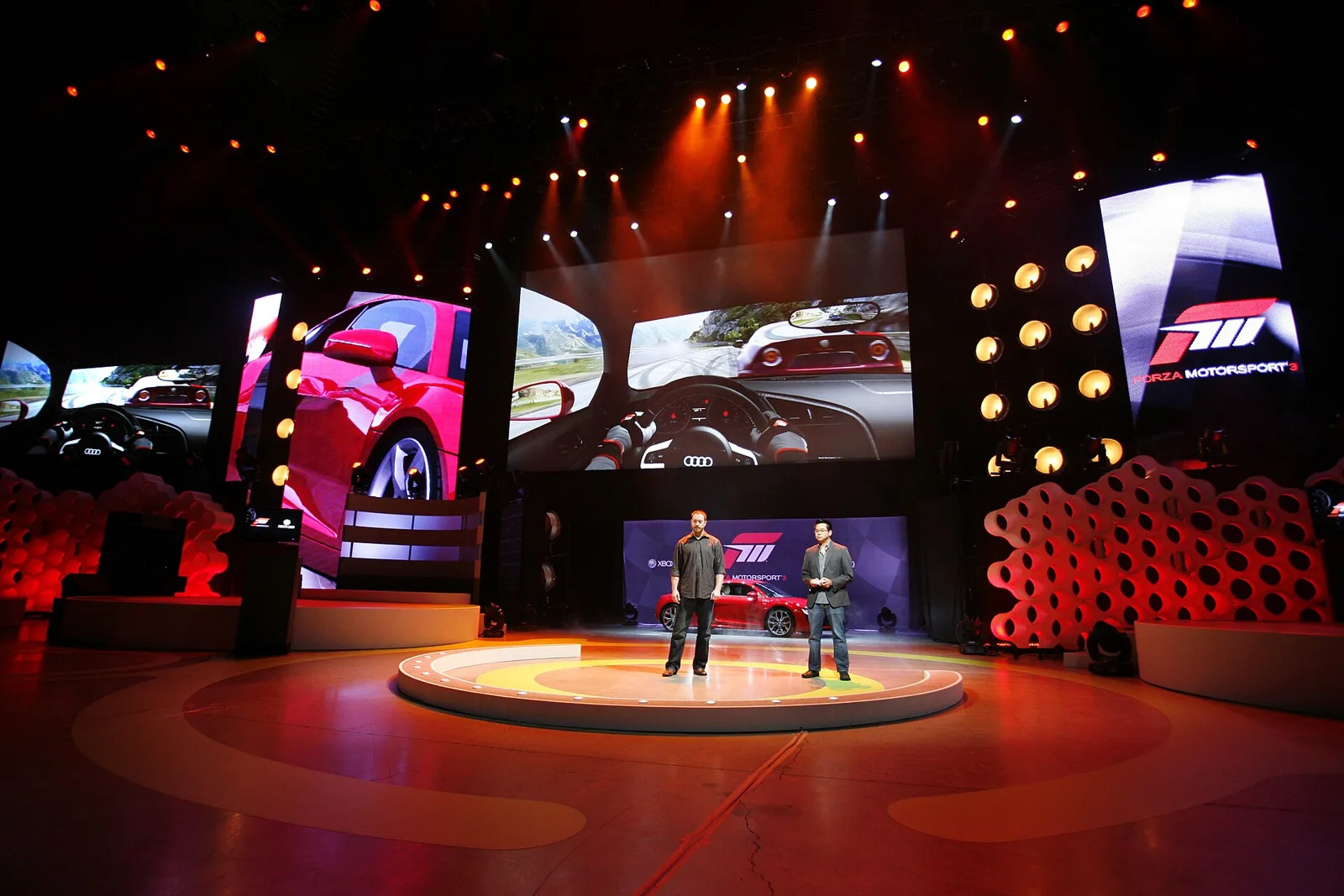
Forza Motorsport 3 launched in 2009 for Xbox 360, following Forza Motorsport 2 as the third numbered entry. Game director Dan Greenawalt outlined the physics and features at E3 2009, where the team promised a steady 60 frames per second.
Several editions gave players different levels of extras. A Limited Edition bundled a Forza branded USB stick, a key chain, a VIP membership for the online auction house and storefront, an exclusive five-car pack and a Forza theme for the dashboard. A black Xbox 360 Elite console bundle was also announced in September 2009.
The Ultimate Collection arrived in October 2010 and gathered every piece of downloadable content in one package. It also added newer models, including the Plymouth 'Cuda, the Jaguar D-Type, the Lancia 037 and the Porsche 550.
A sim that opened its doors wider than any before it, with an assist mode, a rewind button and more than 400 cars.
What changed in the driving?
The driving model moved on in several places. An in-car camera view joined the familiar chase perspectives, while one-button assisted driving lowered the barrier for newcomers. Vehicles could now roll over and reveal detailed undercarriages, a sign of more physical handling and damage.
Drifting, drag racing and crossover-style SUVs joined the mix. Generic stock cars appeared for the first time in the series, and paint and upgrades were opened to every car rather than only production and tuner models. Certain production cars could also be raised to race class ratings R3, R2 and R1.
The changes made the game more approachable without thinning it out. Newcomers could lean on the assist mode and the rewind feature, while experienced drivers could switch the aids off and deal with a harder feel, since the AI and difficulty settings shaped how forgiving each race felt.
How many cars and tracks were included?
The core game offered more than 400 customisable cars from 50 manufacturers, and the Ultimate Collection pushed the garage past 500. Over 100 racetrack variations supported the calendar, with up to eight cars sharing a track at any one time.
The garage ranged from production road cars to purpose-built race machinery, including cars drawn from the American Le Mans Series. The variety meant that a player could move from a tuned hatchback to a sports prototype without leaving the same menu structure.
| Specification | Detail |
|---|---|
| Developer | Turn 10 Studios |
| Platform | Xbox 360 |
| Series position | Third installment, sequel to Forza Motorsport 2 |
| Cars | More than 400; more than 500 in Ultimate Collection |
| Manufacturers | 50 |
| Racetrack variations | More than 100 |
| Season events | More than 200 |
| Frame rate target | 60 frames per second |
| Discs | Two, with one used for gameplay |
Two venues made their debut in the series: Circuit de la Sarthe and a Catalunya layout. They joined a set of licensed real-world venues that included Road Atlanta, Road America and Laguna Seca, giving the series a broader spread of classic and modern tracks.
How did the season and events work?
The single-player season built a personalised racing calendar of more than 200 events, spanning circuit, oval, drag, drift and timed races. The calendar was tailored to each player's tastes, so two players working through the same season could end up in very different races.
Online play had its own tools. A new game rules editor let players build custom rules for private matches. Public matches relied on a matchmaking system with fixed hoppers of A to R class races, and players could not set the rules for those.
Xbox Live scoreboards ranked the greatest racers alongside the most prolific tuners and painters, so the community had its own leaderboards beside the racing ones.
Could players trade cars and designs online?
Yes. A community storefront let players sell car designs, setup files and logos, and an auction house let Xbox Live members bid for cars and paint jobs with in-game currency. Sellers could cap how many copies of each design were available.
The storefront was a redesigned home for user content, and it was not open to Xbox Live Silver members. That restriction kept the marketplace to a defined group of members while still giving creators a way to earn from their work.
The auction house used timed listings. A car went up for a set period and a set amount of in-game currency, and buyers could out-bid one another. Personalised paint jobs could also be bought and sold there.
What accessibility features did it offer?
The standout feature was an assist mode that handled acceleration and braking automatically, leaving steering as the only input. That reduction let players use switch access and other assistive devices, opening the game to people with severe disabilities who could not operate a standard controller.
Forza Motorsport 3 drew wide praise for that approach. AbleGamers recognised it with a 2010 award for Mainstream Accessible Game of the Year, which reflected how far the design had reached beyond the usual sim audience.
The rewind feature offered another safety net. It let drivers turn back time to correct a mistake on track, with no limit on how often it could be used, though a 30 second wait applied between rewinds. It was one of many assists available in the game.
How were the sound and physics built?
The sound team recorded real engines on chassis dynos, using the same microphone and input setup each time so the results stayed consistent. They also recorded tyres on different surfaces, because tyre noise is a key signal for grip at the limit.
On the physics side, the update brought tyre deformation and the ability to flip cars. The AI was built to make mistakes under pressure, with the frequency depending on the difficulty setting. Photo Mode models gained ten times more polygons per car, and custom code and debug menus sat on top of the FMOD API.
Video work ran alongside the audio. The Project Blackjack team used capture cards to make the E3 2009 trailer, and an in-game video editor let players assemble clips and upload them to the Forza website.
What downloadable content came out?
The packs included the Motorsports Legends Car Pack, a Hyundai Genesis Coupe offer, the Hot Holidays pack with a 2010 Ferrari 458 Italia, the Nurburgring GP Strecke and the Community Choice Classics. The paid content was removed in October 2013.
The Motorsports Legends pack brought ten classic cars and two extra tracks. Among the cars were a 1960 Chevrolet Corvette, a 1964 Aston Martin DB5 and a 1965 Shelby Daytona, and a redeemable code for the pack came inside new copies of the game.
Later packs leaned on nostalgia. The Community Choice Classics pack, released on 14 December 2010, offered a DeLorean, an AMC Javelin, a Chevrolet El Camino, a De Tomaso Pantera, a BMW 2002 and a Ferrari 250. The Stig's Garage pack added an SLS AMG, a Koenigsegg CCX and a Lexus LFA, but it was limited to Ultimate Collection buyers, which annoyed owners who had purchased the game earlier.
How did critics and players respond?
Critics gave the game universal acclaim on Metacritic, matching the strong reception its two predecessors had earned. IGN called it among the best racing games of the generation, and The Daily Telegraph and 411Mania both gave it nine out of ten.
Not everything earned praise. Several reviewers pointed to the small grid, with only eight cars in public races, and to the lack of tuning during public multiplayer matches. Custom public races were also unavailable, and Turn 10 tried to counter the complaint by adding lobbies such as the Playground, which allowed Tag Mode in public races.
Wired gave the game eight stars out of ten and judged that the developer had met its aim of a realistic experience across 100 real-world tracks. Famitsu in Japan built a total of 36 out of 40 from four nines. The few lower scores did not change the overall picture of a highly regarded release.
What awards did it win?
The game collected a long list of honours, including Best Driving Game at the 2009 Spike Video Game Awards, Racing Game of the Year at the 13th Annual Interactive Achievement Awards and GameSpot's Driving Game of the Year for 2009. IGN gave it the top Xbox 360 racing prize for the year.
G4TV, CNNTech and GameTrailers each named it the best racing game of 2009. The 2009 Crystal Award also went to it as Driving Game of the Year, and AbleGamers gave it an accessibility award the following year.
What was the soundtrack like?
Lance Hayes, known as DJ Drunken Master, composed the mostly ambient electronica score. It reached retail and digital download in December 2009 with thirteen tracks and over an hour of music. That left thirteen tracks on the album once the cuts were made.
Four tracks were cut from the official release, possibly because of the time limit on the disc. Licensed music from The Hives and Hard-Fi also featured, along with some game interface sounds drawn directly from the score.
What is the game's legacy?
Forza Motorsport 3 is best known for its accessibility work and its community features. Its paid and free content left the store in October 2013, before Forza Motorsport 5 arrived. The storefront, auction house and scoreboards were its most distinctive community features.
The storefront, auction house and leaderboards for tuners and painters gave the community a role that few racing games had offered before. Turn 10 added scoreboards for the most prolific tuners and painters alongside the top racers, rewarding creativity as well as speed.
Taken together, the storefront, the auction house, the rules editor and the video tools made Forza Motorsport 3 as much a social space as a driving game. Creators sold their designs through the storefront, while collectors chased particular cars through timed auctions in the auction house.