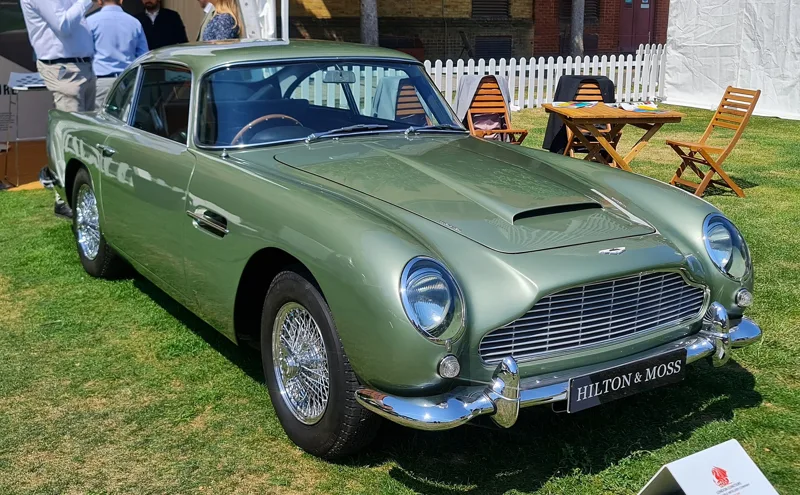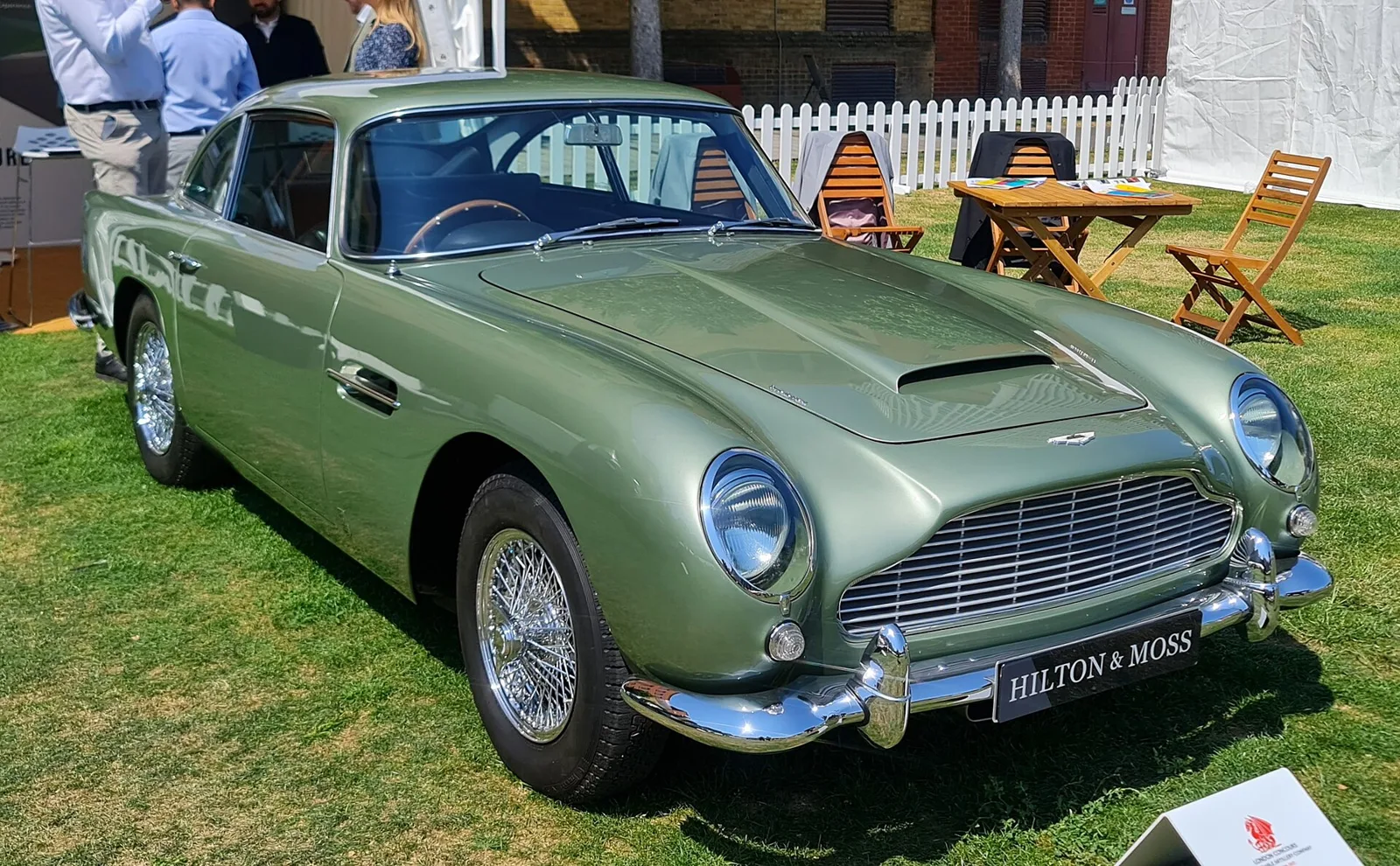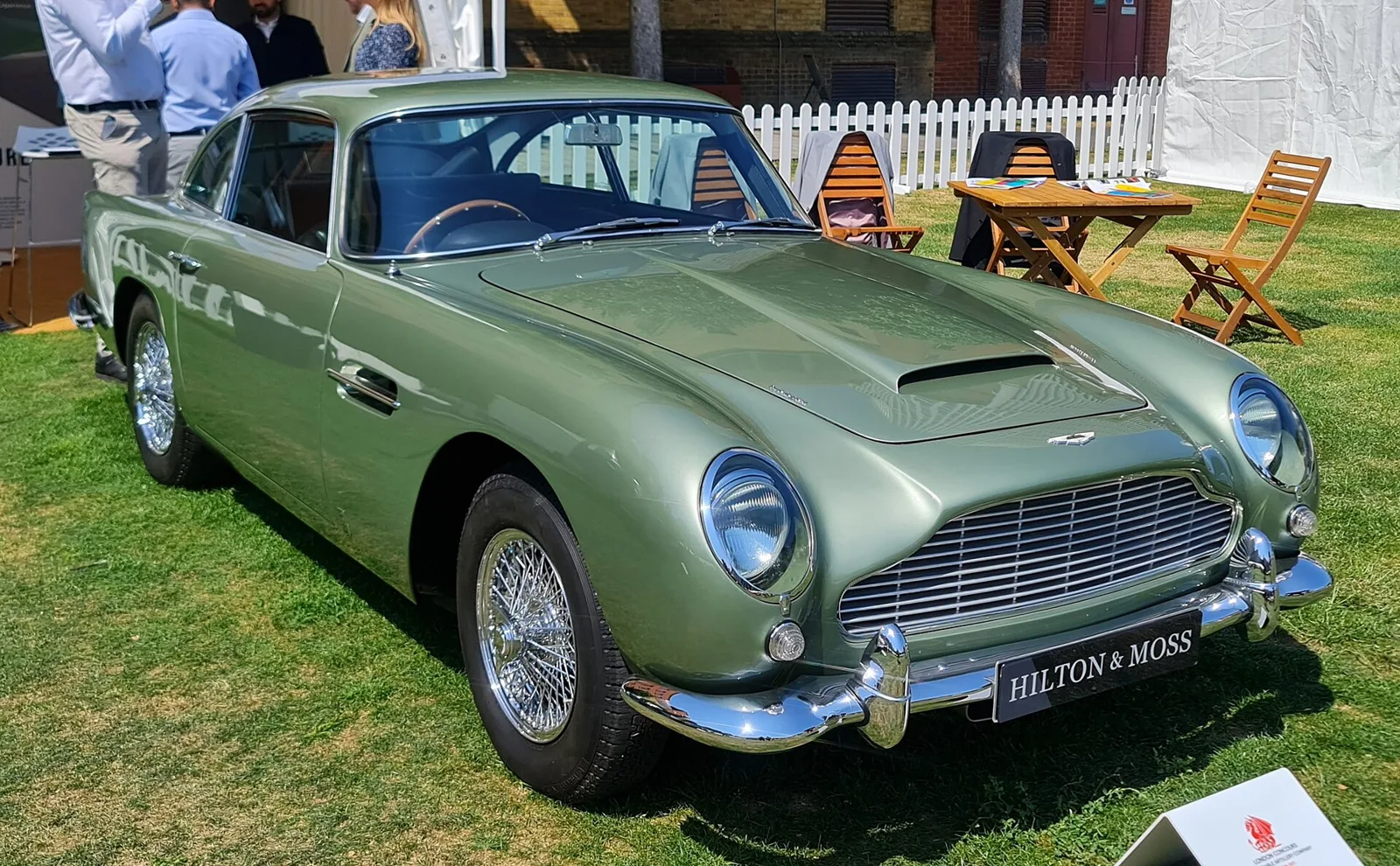
A 1963 British grand tourer with a Touring-built body, a 282 bhp straight-six and a film role that made it the most famous car in the world.
Launched in September 1963 as a development of the DB4, the Aston Martin DB5 used a 4.0-litre straight-six making 282 bhp. Its Touring-built body and its role in Goldfinger, released in 1964, made it a fixture of Bond history.
The Aston Martin DB5 is a British grand tourer that was built from 1963 to 1965 and styled by the Italian coachbuilder Carrozzeria Touring Superleggera. It evolved from the final series of the DB4, and its name comes from David Brown, who had built up the company from 1947. Its fame rests mainly on the James Bond films, which made it one of the most recognisable cars of its era.
Beyond the film work, the DB5 was a refined two-door grand tourer with a 2+2 seating layout and a generous specification. It remains a benchmark for the marque's postwar sporting cars, and its reputation rests on that combination of style, engineering and cinematic fame.
Where did the Aston Martin DB5 come from?
The DB5 grew out of the DB4, and its body was designed by Touring Superleggera, the Italian firm that had shaped the earlier cars. The name carries the initials of David Brown, the industrialist who had driven Aston Martin's postwar development since 1947.
The DB5 was built at Newport Pagnell, the same Buckinghamshire works where the company later revived the model. Its hand-built construction and small production run meant that each car carried a little of the factory craft that made the marque famous.
The car was first driven by the fictional spy in Goldfinger (1964), and it has since become a fixture of British motoring culture. In 2013 it featured on a British Auto Legends postage stamp issued by Royal Mail, a tribute to its place in the national story.
Production ran from 1963 to 1965. Those years were short, but the car's influence has lasted far longer than the production run, partly because the film appearances kept it in public view.
A 1963 grand tourer whose film role turned it into the most famous car in the world, with replicas still being built for buyers today.
How did the DB5 differ from the DB4?
Compared with the DB4 Series V, the DB5 gained a bigger all-aluminium engine, now 4.0 litres instead of 3.7, plus a ZF gearbox and three SU carburettors. The new engine produced 282 bhp (210 kW) and took the car to 145 mph (233 km/h).
The engine had first appeared in the high-powered DB4 Vantage from March 1962, and it became the standard Aston Martin power unit when the DB5 launched in September 1963. The DB5 therefore inherited a proven powertrain rather than a new one.
Standard equipment was lavish for the period. Buyers found reclining seats, wool-pile carpets and electric windows, plus twin fuel tanks and chrome wire wheels, along with a fire extinguisher.
The interior was finished in full leather, and the reclining seats and electric windows gave it a comfort level that suited long-distance touring. Few rivals of the period offered such a complete standard specification.
The body was a magnesium-alloy construction built to the Superleggera patent technique. All models had two doors and a 2+2 seating configuration, and boot lid styling was the one visible difference from the DB4 Mark 5.
What was the DB5 engine like?
The DB5 used a 4.0-litre inline-six measuring 3,995 cc, with a bore and stroke of 96 mm by 92 mm. It was fed by three SU carburettors, and it produced 282 bhp (286 PS; 210 kW) at 5,500 rpm. In net terms the output was 210 bhp (213 PS; 157 kW).
Aston Martin quoted two power figures for the standard engine, a gross 282 bhp and a net 210 bhp. The difference reflects how the output was measured, and the net figure gives a more realistic picture of the power delivered to the road.
Torque was 288 lb ft (390 N m) at 3,850 rpm, which gave the car strong mid-range pull for a grand tourer of its size. The car weighed 1,502 kg (3,311 lb) and reached 60 mph (97 km/h) in about 8 seconds.
Like the DB4, the DB5 had a live rear axle. The original gearbox was a four-speed manual with optional overdrive, but the more robust ZF five-speed took over, although some of the first DB5s kept the older David Brown unit.
A three-speed Borg-Warner DG automatic was available as an alternative. The automatic was later switched to the Borg-Warner Model 8, a change that came just before the DB6 arrived.
What were the DB5 Vantage and convertible?
The high-performance DB5 Vantage arrived in 1964 with three Weber carburettors and revised camshaft profiles. Output rose to 325 bhp (330 PS; 242 kW) at 5,500 rpm, and the run amounted to 65 coupes.
In December 2025 Aston Martin completed a restoration of a rare 1965 Vantage at its Newport Pagnell works. The three-year project cost 400,000 pounds sterling and took 2,500 hours. The car was one of only 39 built, and it had a higher-output engine and right-hand drive.
The Vantage was bought second-hand for 900 pounds in 1973 and had been left to decay from the late 1970s. Its owner had been determined to restore it, and the estimated value of the finished car is 1 million pounds.
The convertible DB5 was also made by Touring, with 123 units produced between 1963 and 1965. Only 19 of the original cars were left-hand drive, and a dozen came with a factory Vantage engine. A steel removable hardtop was a rare factory option.
Between October 1965 and October 1966 the factory finished 37 more convertibles from its remaining DB5 chassis. These Short Chassis Volantes were the first Aston Martins to carry the Volante name, and they used DB6 split bumpers and Triumph TR4 rear lights.
Shooting-brake versions were rarer still. A prototype was built for David Brown, who was a keen hunter and dog owner, and 11 or 12 coupes were modified by the coachbuilder Harold Radford. A shooting-brake DB5 changed hands for $1.765m in August 2019, a price that set the mark for that body style at auction.
The DB5 also reached a wider audience through toys and models. Corgi Toys produced a model of the Goldfinger car that became the biggest selling toy of 1964, and Airfix sold a 1:24 scale plastic kit from 1966 to 1970. The Danbury Mint released a 1:24 die-cast version in 2006, and Hot Wheels Elite produced a Goldfinger model in 2015. LEGO released a 1:8 scale set in 2018 and a Speed Champions version in August 2022.
Junior Edition electric replicas at two-thirds scale were produced by the Little Car Company in Bicester with Aston Martin Lagonda. Prices ranged from 35,000 to 90,000 pounds, and each model was modelled on 3D scans of an original car.
Why is the DB5 linked to James Bond?
The DB5 became famous after the special effects expert John Stears modified one for James Bond in Goldfinger in 1964. In the novel Bond drove a different DB model, so the film needed a change of car, and Stears won over the company to lend its prototype.
There were four Goldfinger DB5s in total. Two were used for filming and two for promotion. The first filming car, DP/216/1, had been the original prototype and was finished in Dubonnet Red. Its gadgets were later removed and the car was resold.
Two publicity cars were shown at the 1964 New York World's Fair to help sell the film. One later went to the Louwman Museum in The Hague, and the other went under the hammer at RM Sotheby's in August 2019 for 6.4 million dollars, with an unnamed buyer.
The second filming car, DB5/1486/R, had no gadgets for its driving scenes. After filming, the team added the rear bullet shield, the pop-out gun barrels and a revolving number plate, and it was used for promotion. Sales of the DB5 rose after the film, and the car was described as the most famous car in the world.
Which DB5s appeared in later Bond films?
The same car, registration BMT 216A, was used again in Thunderball a year later. The DB5 has since become the quintessential vehicle for the Bond character, and it has reappeared in many later films.
A different DB5, registration BMT 214A, appeared in GoldenEye in 1995. In that film it was Bond's personal car without gadgets, but it had a champagne cooler and a fax machine. Another DB5, with Bahamian plates and left-hand drive, appeared in Casino Royale, where Bond wins it from the villain in a card game.
A GoldenEye car went under the hammer at Christie's in 2001, and that sale set a record price for Bond memorabilia that the Guinness Book of Records still lists. It later moved to the London Film Museum after a period at the Beaulieu Bond exhibition.
The 2015 film Spectre showed the rebuilt car at the end, and the DB5 appeared in Skyfall as well. Skyfall's car was destroyed in the finale, and a 1/3rd scale model was built for the destruction scenes.
For No Time to Die, the plan was to build replicas rather than use existing cars. Eight replica DB5 stunt cars were built, and the chase car sold for 2.92 million pounds at a charity auction in London in 2022.
The Goldfinger-themed reproductions that Aston Martin later produced were meant to recreate the look of the film car rather than to copy the original gadgets exactly, and they reflected the long pull of the Bond connection.
Were new DB5s built after 1965?
In 2020 Aston Martin began building 25 new Goldfinger-themed DB5s at its factory in Newport Pagnell, where the first DB5s had been built. The programme formed the next phase of its Continuation work, which had started in 2017 with the reborn DB4GT.
Wherever possible the company used the same manufacturers as the original 1963 to 1965 run. The transmission came from ZF Friedrichshafen and the interiors were trimmed in Connolly leather, while the engine was a straight six on triple SU carburettors, linked to a five-speed ZF manual gearbox.
The new cars used most of the gadgets seen in the film, including a smoke screen, a simulated oil slick delivery system, revolving number plates and a rear bullet shield. Wherever possible the company used the same suppliers as the original run, and each car was intended to sell for about 2.75 million pounds.
What are the Aston Martin DB5 specifications?
The table covers the standard coupe, the Vantage and the modern Goldfinger-themed cars. It brings together the engine, weight and performance figures in one place for quick comparison.
| Specification | Detail |
|---|---|
| Engine | 4.0 L (3,995 cc) inline-six, three SU carburettors |
| Bore by stroke | 96 mm by 92 mm |
| Standard power | 282 bhp (286 PS; 210 kW) at 5,500 rpm |
| Weight | 1,502 kg (3,311 lb) |
| Standard torque | 288 lb ft (390 N m) at 3,850 rpm |
| Top speed | 145 mph (233 km/h) |
| 0-60 mph (97 km/h) | About 8 seconds |
| Vantage power | 325 bhp (330 PS; 242 kW) at 5,500 rpm |
| Vantage production | 65 coupes |
| Convertible production | 123 units, 1963 to 1965 |
Frequently asked questions
How much power did the DB5 make?
The standard DB5 produced 282 bhp (286 PS; 210 kW) at 5,500 rpm, while the Vantage raised that to 325 bhp (330 PS; 242 kW). Net output for the standard car was 210 bhp (213 PS; 157 kW).
How many DB5 convertibles were built?
Aston Martin built 123 convertible DB5s between 1963 and 1965, and the company recorded that only 19 were left-hand drive. Fitting a factory Vantage engine was an option taken by a dozen of them.
Which DB5 sold for the most money at auction?
The shooting-brake version reached the top price for its type, with one car selling for $1.765m in August 2019. Goldfinger-related DB5s have also sold for multi-million-dollar sums.
Did the DB5 race?
No competition record is listed for the DB5. It was built as a grand tourer, and its fame comes from road use and its appearances on film rather than from motorsport.