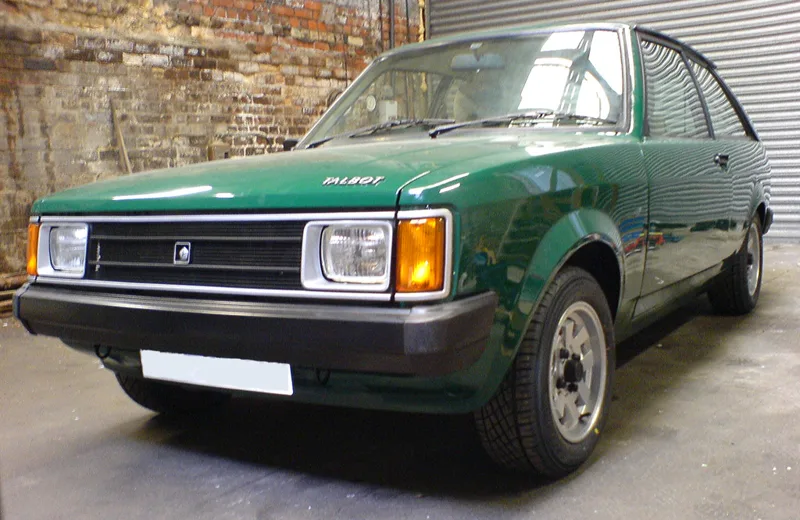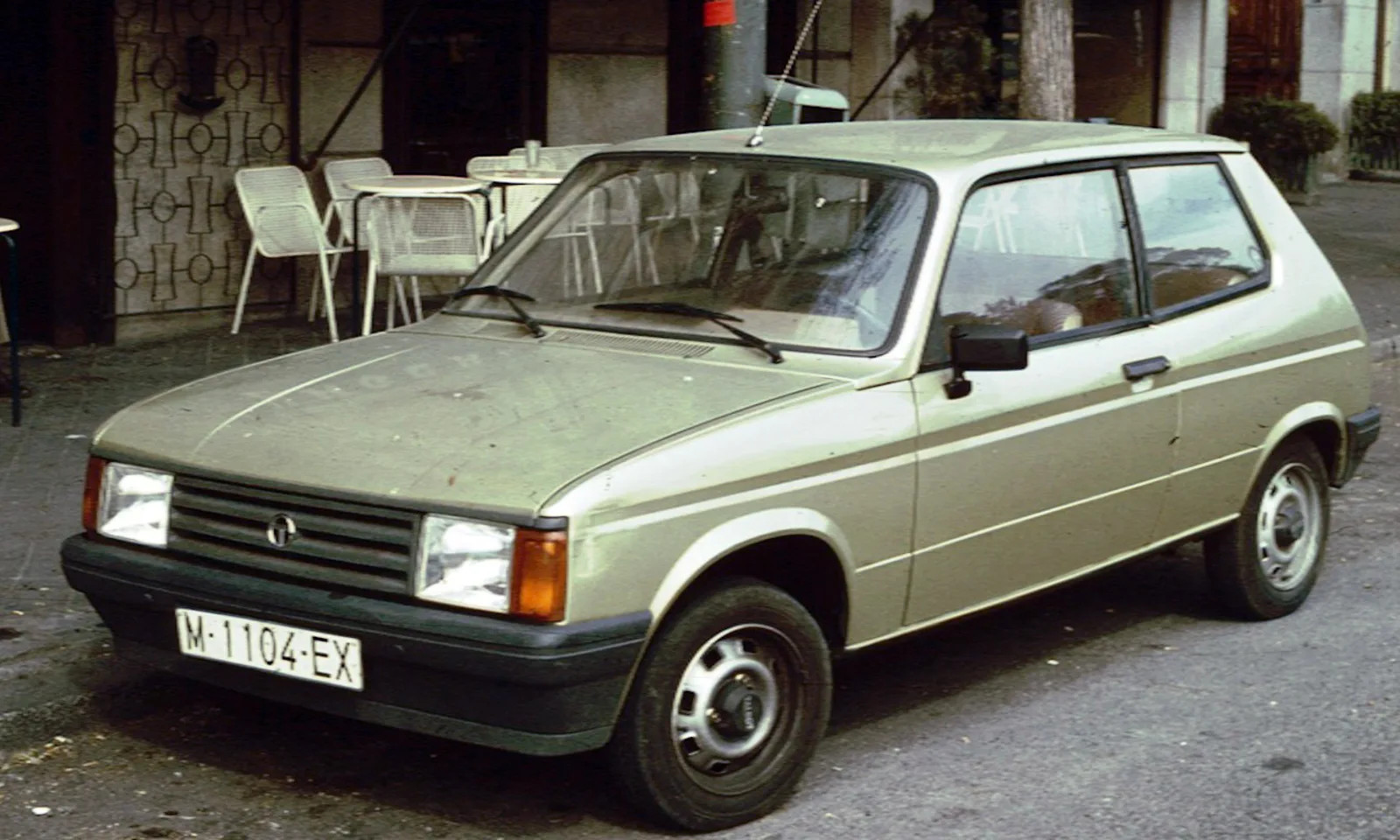
Built at Poissy from 1981, the Talbot Samba was the last new Talbot, a factory cabriolet and a Group B rally car.
Built by PSA at Poissy from 1981, the Samba was a Peugeot 104 based city car sold as a Talbot. It was the last new Talbot, and production ended in May 1986 after 270,555 cars had been built. Pininfarina also made 13,062 cabriolets.
The Talbot Samba was a city car that PSA built at the former Simca factory in Poissy, France, and sold under the Talbot name from 1981 to 1986. It was based on the Peugeot 104, and it was the last new Talbot to be launched. When production ended, the Samba effectively closed the chapter on Talbot passenger cars.
Why did PSA develop a new Talbot city car?
PSA was formed in 1976, when Peugeot bought out Citroen. In 1979 it took over Chrysler Europe, and one of its first moves was to rebrand the models built in the French and British factories as Talbots. The Scottish-built Chrysler Sunbeam was the only small car in the inherited range.
The Sunbeam had been a stopgap for the Linwood works, and it used the running gear of the earlier Avenger. Chrysler had started work on a shortened Horizon, dubbed C2-short, but financial trouble and plans to sell Chrysler Europe cut that project short.
PSA decided Linwood would be too costly to keep open, and its closure ended both the Avenger and the Sunbeam. That left the Talbot range without a small car, which made a new model a priority.
A Peugeot 104 derived city car that became Talbot's last new model, a Pininfarina cabriolet and a Group B rally car.
Why was the Samba based on the Peugeot 104?
On the eve of the new decade, PSA's city cars were based on the front-wheel drive Peugeot 104, which dated from 1972. It came as a three-door and a longer five-door. Citroen rebadged the short 104 as the LN, and the long chassis formed the base of the five-door Citroen Visa.
In 1979 PSA decided its new small Talbot would also use the 104 rather than the Horizon. The project was known internally as C15, and it was later renamed T15 to reflect the change of brand from Chrysler to Talbot.
The new car was launched in 1981 to replace the Sunbeam when Linwood closed. Its wheelbase sat between the three-door and five-door 104, which put the Samba slightly below superminis such as the Ford Fiesta and above city cars such as the Austin Metro.
How was the Samba styled?
Styling was handled by the British design centre at Whitley, Coventry, which had done the work on earlier Talbot and Chrysler Europe models. The stylists had to keep the body structure of the 104, and they were reportedly given Peugeot's own facelift proposal as a starting point.
The result looked more modern than its progenitor. Only the bonnet and tailgate were shared with the 104, and the car gained a distinctive front end in the Chrysler and Talbot international style.
What engines did the Samba launch with?
Production began in October 1981, and the car was officially launched as the Talbot Samba that December. Unlike the Horizon, the Samba was assembled only at Poissy, not in both France and England.
The engines were three versions of the PSA X four-cylinder, shared with the Peugeot and Citroen siblings. The base LE and LS used a 954 cc XV, the GL a 1124 cc XW, and the top GLS a 1360 cc XY. Outputs were 45, 50 and 72 PS (33, 37 and 53 kW) respectively.
The engine sat tilted 72 degrees backwards, so the spare wheel could live under the bonnet without a lift. Step-down pinions linked the engine to the gearbox. Only the GLS offered a five-speed transmission.
The GL was rated Europe's most economical car on the official EEC fuel figures. It beat the Renault 5 on that score, but later lost the title to the Austin Metro.
What was the Samba cabriolet?
Peugeot added a more glamorous two-door cabriolet to the three-door hatchback to help it stand out. It was announced at the hatchback's launch, but the first examples did not arrive until 1982. The Italian coachbuilder Pininfarina designed and built it, and the car used the 1360 cc engine only.
Two power outputs were offered, 53 or 59 kW (72 or 80 PS). The lower version was dropped after 1984, when a revised cabriolet arrived with the later 104 dashboard, twin carburettors and a lined hood. Pininfarina built 13,062 Samba cabriolets in total.
How did the Samba Rallye begin?
Building on rally results from the Simca 1000 and the Talbot Sunbeam, PSA introduced the Samba Rallye in 1983. It used the 1219 cc XZ version of the X engine, rated at 66 kW (90 PS), and came in white or red with a hood scoop and side stripes.
The 1984 car used the 1360 cc unit, rated 59 kW (80 PS), and dropped the stripes. The Samba Rallye Group B also preceded the Peugeot 205 T16, with a 1285 cc engine producing 96 kW (130 PS).
What made the Group B Samba special?
The Peugeot Talbot Sport group, led by Jean Todt, decided to homologate the Samba Rallye in Group B. In January 1983 the Samba type SRE was homologated, and around two hundred examples were produced, mainly for private drivers.
The car weighed 675 kg (1,488 lb), thanks to fibreglass body parts for the doors, rear hatch and engine cover. It had coil-over suspension, AP Lockheed four-piston calipers at the front and an aluminium roll bar. The overhead camshaft engine grew to 1285 cc and produced 130 hp (96 kW).
The rally car also had a faster steering rack, Makrolon windows, a hydraulic handbrake and a reinforced rear axle. It was paired with a short gearbox and a self-locking differential.
What was the SR2 evolution?
In January 1984 the Samba Rallye evolution, the type SR2, was homologated. It had wider tracks, a triangulated front axle, a new engine cradle and a fibre front bumper with brake cooling scoops.
The engine rose to 1,296 cc and 136 hp (100 kW), with a more aggressive camshaft and larger intake ducts. The Peugeot team offered a catalogue of Group B parts, and small workshops built private cars beyond the original two hundred.
Did the Samba win any rallies?
The car notably won the 1985 Al Fito Hill Climb with the Spaniard Paulino Diaz. Hill climbing suited the car, which weighed 675 kg and was at the right weight for that discipline.
Two engine specialists, Mathiot and Brozzi, produced the ultimate evolutions. They enlarged the engines to 1,440 and 1,550 cc by changing the bore, and rally regulations required the car to carry ballast to meet the minimum weight of 750 kg (1,653 lb).
How did the Talbot brand end?
In 1982 the Talbot Group was merged into Peugeot within PSA. The Whitley design studio was dissolved, and some of its designers moved to British Leyland. PSA had already begun preparing a successor drawn from the Citroen AX.
The Samba sold reasonably well in 1982 and 1983, but sales then began to fall. Part of the reason was the aging design, and part was the very popular Peugeot 205, which created strong internal competition for the little Talbot.
What special Samba models were made?
To sustain interest, PSA produced several concept and special versions. The Copacabana was a concept with body elements painted in garish colours. The 1984 Samba Sympa was aimed at young buyers and came in silver metallic with a choice of yellow, red or blue highlights.
The Samba Bahia, sold as the Samba Trio in the UK, arrived in 1985 with a 1.1 litre engine, denim-covered seats and a sunroof. The Samba Style then offered a radio and sunroof as standard, to help sell the last series.
When did Samba production end?
The Samba's run finished in May 1986, with 270,555 cars built. The Citroen AX was launched without a twin in 1986, and the Arizona family hatchback became the Peugeot 309 at the end of 1985.
The brand survived for a while on the Talbot Express van, which lasted until 1994. Only 12 Sambas remained on UK roads as of 2018.
What was the Jeremy Clarkson video?
Jeremy Clarkson's 2009 DVD Duel featured a 1984 Samba Cabriolet, which was launched from a catapult into a wall. Just before impact, a nearby speed camera logged 164 mph (264 km/h), after which the car exploded.
What are the Talbot Samba specifications?
| Specification | Detail |
|---|---|
| Production | Poissy, France, from October 1981 |
| Brand | Talbot, 1981 to 1986 |
| Base engines | 954 cc, 1124 cc and 1360 cc PSA X engines |
| Base power | 45, 50 and 72 PS (33, 37 and 53 kW) |
| Cabriolet power | 53 or 59 kW (72 or 80 PS) |
| Samba Rallye 1983 | 1219 cc, 66 kW (90 PS) |
| Group B | 1285 cc, 96 kW (130 PS); 675 kg (1,488 lb) |
| SR2 evolution | 1,296 cc, 136 hp (100 kW) |
| Cabriolet production | 13,062 built by Pininfarina |
| Total Samba production | 270,555 by May 1986 |