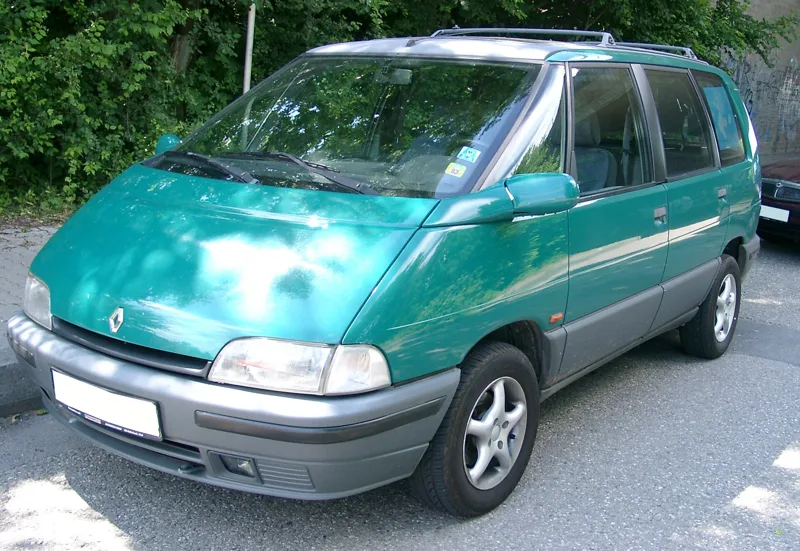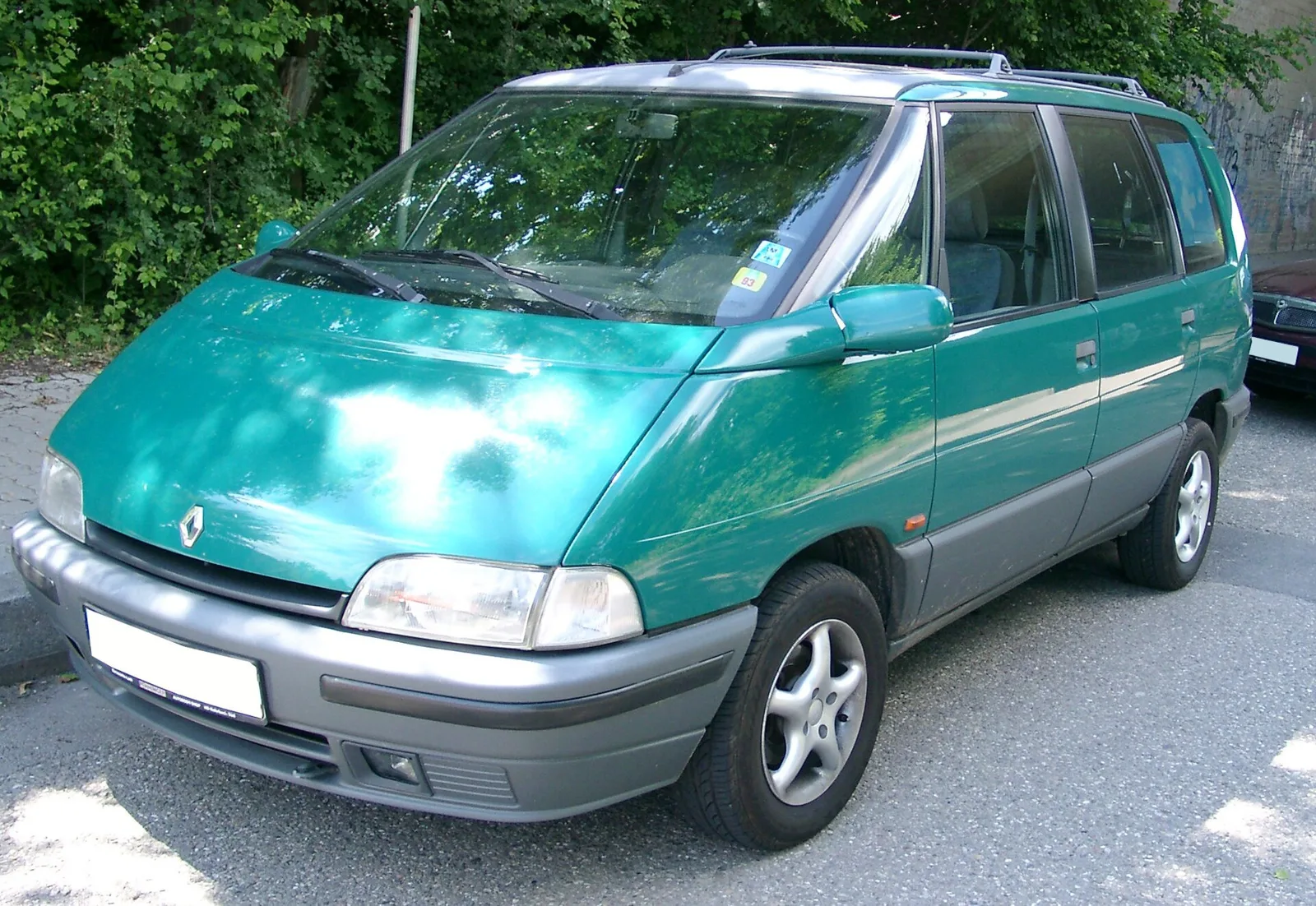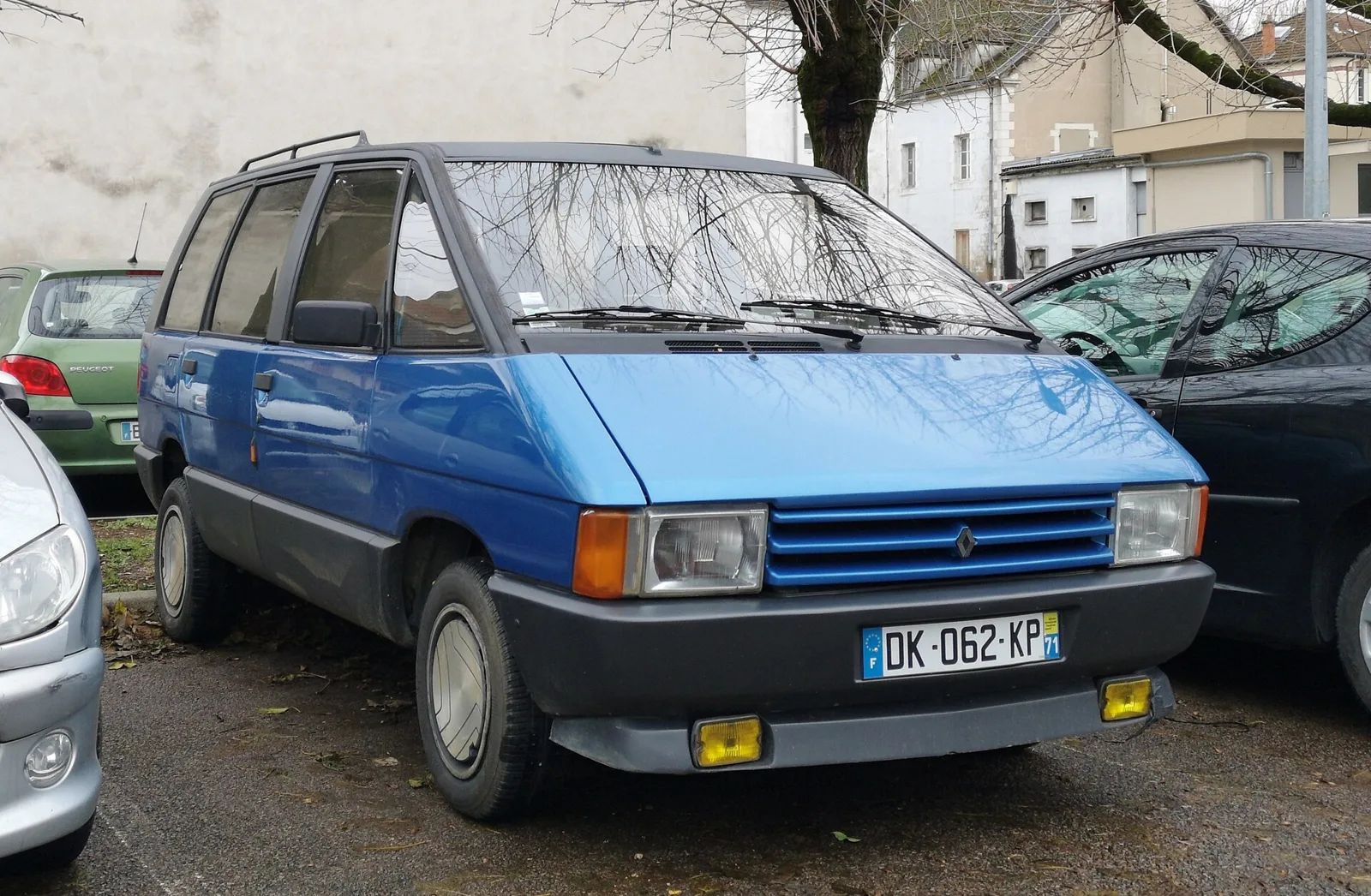
A people carrier that began as a Matra project, borrowed R18 mechanics and gave Europe a cabin that could be rearranged at will.
The Renault Espace I was the first generation of Renault's large people carrier, built from 1984 to 1990. Matra developed it on R18 mechanics with a flat floor and modular seats, and Renault gave it the badge. The launch 2-litre petrol made 110 PS, and 5,745 cars were sold by the end of 1984.
Before the Espace, Europe's large people carriers were mostly commercial vehicles with a passenger body added on. Renault's first Espace changed that, offering a driving feel closer to a saloon inside a tall, flexible cabin. It went on sale in 1984 and stayed in production until late 1990.
Where did the Espace I come from?
The Espace began at Matra in the late seventies as a replacement for the Matra-Simca Rancho. After a visit to Chrysler in the United States, Matra's engineers developed the P16 and then the P23, which Renault approved in December 1982. Renault insisted the new car carry its own badge, and the project moved swiftly towards production in 1984.
The first sketch came from the Greek-born designer Antonis Volanis, who had already drawn the Matra Bagheera and Murena. Philippe Guedon's team refined the design, and a second, much smaller version only 3.80 metres long was shown to PSA alongside it. PSA turned the project down, fearing that a product of such a niche would be hard to justify.
Peugeot suggested offering the car to Citroen, but Citroen's design centre said it did not need outside help. Matra then approached BMW, with which it had consulting and composite-materials ties, and Renault stepped into the talks before BMW had seen a prototype. Renault was keen to exploit the difficulties of its historic rival Peugeot, and it ultimately won the deal.
The price of that deal was steep for Matra. Matra took back Peugeot's 49% stake and sold it on to Renault, which required the Espace to carry the Renault badge and Matra to stop making the Murena at once. The Murena had sold about 12,000 examples in two and a half years, and its departure left Matra with a car that could not be marketed under its own name.
The timetable was tight. The car was due to launch in spring 1984, and with 1983 already under way the team had to move quickly. The first running prototype was built in April 1983, and two months later Renault and Matra finalised their agreement. By the end of that year, after many road tests, Renault certified the car's mechanical reliability and gave the go-ahead for pre-series production, which began in January 1984.
A people carrier born at Matra, sold from 1984 with a cabin that could be reconfigured at will.
How was the P23 built to be light?
The P23 used a light frame that was galvanised by dipping it in a hot bath, a process that gave exceptional strength and total protection from rust. Matra used 33 kg of zinc on the frame, and the coating allowed the company to guarantee the car against corrosion for ten years. The weight of the P23 stayed at 1,225 kg.
Liquid-bath zinc coating was already a Matra habit. It had first been used on the Murena, which was the earliest car to receive the treatment. The body, in keeping with Matra's aim of cutting weight and improving passive safety, was made of fibreglass.
Engineers also had to win homologation for the large, flat windscreen, whose dimensions were revolutionary for those years. Those difficulties were minor.
Why was the cabin so flexible?
The Espace's cabin used a flat floor with sliding and folding seats, arranged in three rows of separate seats: a pair at the front, a trio in the middle and a pair at the rear. Each seat could be moved, folded or turned, and the layout could be changed to suit the load of the day.
The flat floor was partly a safety net. Matra worried that the car might fail in the market, so it designed the flat floor and interior modularity as a fallback, with pick-up and van versions also drawn up that could enter production quickly if sales disappointed. The idea was meant as insurance, yet it became the basis of the whole Espace concept.
On the richer trims the front seats could be turned backwards, but only with the car stationary, so passengers could sit face to face and share a meal during a stop on a long trip. The designers clearly had social use in mind, as well as load carrying, and the large glazed areas made the interior bright and airy.
Luggage capacity was generous. With the two central and rear rows of seats in place, the load area was at least 850 litres. With those two rows removed, it could reach 3,000 litres, which made the Espace a practical tool for moving things as well as people.
The underpinnings were just as deliberate. The P23 had a rear suspension fully patented by Matra that kept the car level as the load changed. Its only drawback was a slight softness in quick changes of direction, which did not spoil the car's good road behaviour. That suspension is found today on almost all modern people carriers.
What engines did the Espace I offer?
At launch the Espace I had a single engine: a 2-litre petrol unit with a carburettor, derived from the base version of the Renault 25 flagship. Its displacement was 1,995 cc (121.7 cu in), and it made 110 PS (81 kW; 108 hp). It was matched to a five-speed manual gearbox.
The engine layout was longitudinal, placed overhanging the front axle to limit how far it intruded into the cabin. The mechanical base was closely derived from the R18 and its coupe version, the Fuego, which meant proven and reliable mechanics. The front used independent wishbones, while the rear kept a rigid axle controlled by a Panhard rod, with rack-and-pinion steering.
A 2.1-litre diesel joined the range later, with up to 88 PS. In 1988 the old 2-litre petrol was detuned to 103 PS, and a fuel-injected 2-litre with 120 PS arrived with the TXE trim and the Quadra four-wheel-drive version. The Quadra's propeller shaft was made from composite material.
From 1989 the injected 2-litre gave way to a 2.2-litre unit rated at 110 PS. It had less peak output than the engine it replaced, but better torque, which meant more pulling power at low revs. It was the only catalysed engine in the Espace I's history, and it was not offered in some markets, Italy among them.
Engine range at a glance
| Engine | Displacement | Output | Period |
|---|---|---|---|
| Petrol, carburettor | 1,995 cc (121.7 cu in) | 110 PS (81 kW; 108 hp) | Launch engine, 1984 |
| Petrol, detuned | 2 litres | 103 PS | Revised in the 1988 facelift |
| Petrol, fuel-injected | 2 litres | 120 PS | TXE trim and Quadra |
| Diesel | 2.1 litres | 88 PS | Added after launch |
| Petrol, catalysed | 2.2 litres | 110 PS | From 1989, not sold in every market |
How did the Espace I sell at first?
Sales began slowly, with only nine cars sold in the first month of availability. The public found it hard to take in a car so unlike the saloons it knew, but the figures soon turned, and 5,745 cars had been sold by the end of 1984, more than 2,600 of them in France alone.
Demand grew so fast that Renault had to add further assembly lines at Dieppe, the plant where its more sporting cars were normally built. The range was also widened by the arrival of the diesel.
In June 1985 a richer trim called 2000-1 arrived. It added velvet upholstery and paid tribute to Stanley Kubrick's film 2001: A Space Odyssey, whose French title, 2001, l'Odyssee de l'Espace, linked neatly to the car's own name.
The trim levels initially planned were two, GTS and TSE, and in the following years there were only updates to the trim levels. By June 1987 more than 50,000 cars had been produced, a sign that the market had accepted the idea.
What changed with the 1988 facelift?
The January 1988 facelift gave the Espace a new front with an updated grille, a more convex and less angular shape, and new light clusters with white indicators. The basic 2-litre petrol engine lost power, falling to 103 PS, while a fuel-injected 2-litre with 120 PS joined the range.
The 120 PS engine was matched to the new TXE trim and was also fitted to the Quadra. The update came during a phase of growing sales, when output had already passed 50,000 cars. Four-wheel drive was rare in the people carrier segment, and the Quadra stood out because of it. Its propeller shaft was made of composite material.
The last changes came late in the first generation's life. In 1989 the injected 2-litre was retired in favour of the 2.2-litre catalysed unit, and in 1990, for the final production year, an extra-cost pneumatically suspended rear axle was offered on a few top-of-the-range trims.
How did the Espace compare with its rivals?
Against the European standards of the time, the first Espace was a large vehicle. Its 4.25 metres (13.9 ft) came within a few centimetres of the BMW 3 Series E30, while the Alfa Romeo Giulietta was only one centimetre shorter. The Dodge Caravan was a clearer contrast, since that American car was nearly 30 cm longer and sat a step higher in the market.
The shape was unusual too. The windscreen and the short bonnet formed a single sloping plane set at 58 degrees, and the drag coefficient of 0.32 was a notable figure for the time and for this kind of car. Some specialist magazines compared the nose with that of the TGV, the French high-speed train already in service for years.
Other carmakers also tried large people carriers in the first half of the eighties, including the Dodge Caravan, which most knew as the Chrysler Voyager, and the Mitsubishi Space Wagon. At least in their early years on sale these models were not offered on the European market.
Why does the Espace I still matter?
It was the first people carrier to bring the concept to Europe. Its rivals on the Old Continent were largely commercial-vehicle derivatives such as the Volkswagen Transporter or the Fiat Ducato, which offered less than the newcomer. The Espace combined the driving feel of a normal saloon with a very generous, adaptable cabin.
The Espace also showed how to pack a lot of flexibility into a car. Its flat floor and modular cabin were the basis of the success the Espace enjoyed, its patented rear suspension layout turns up on almost all modern people carriers, and the specialist press has discussed its historic importance on many occasions.
Its length of 4.25 metres (13.9 ft) placed it close to a BMW 3 Series E30 and only a little longer than the Alfa Romeo Giulietta. The Dodge Caravan, on the other side of the Atlantic, was nearly 30 cm longer again.