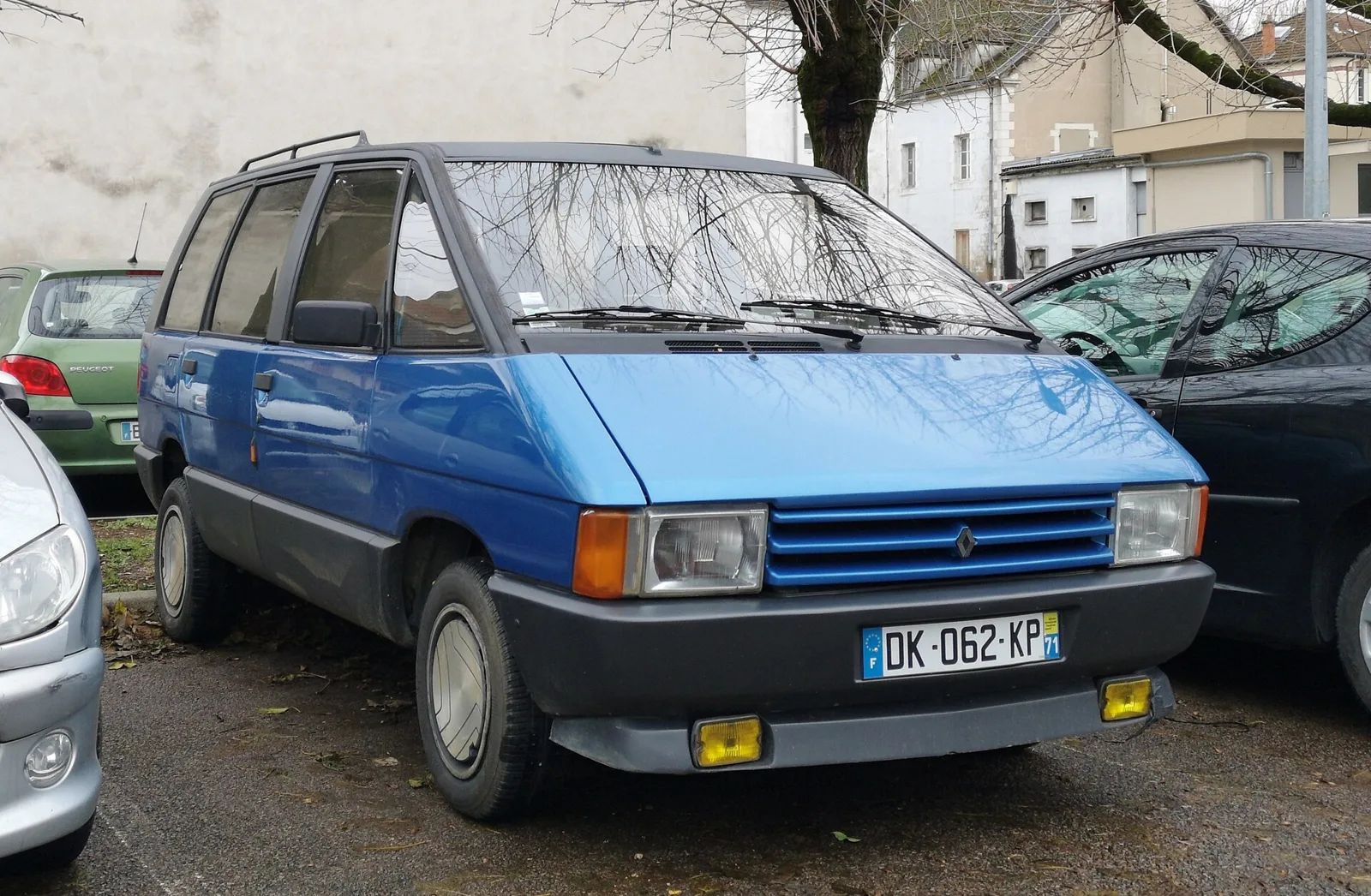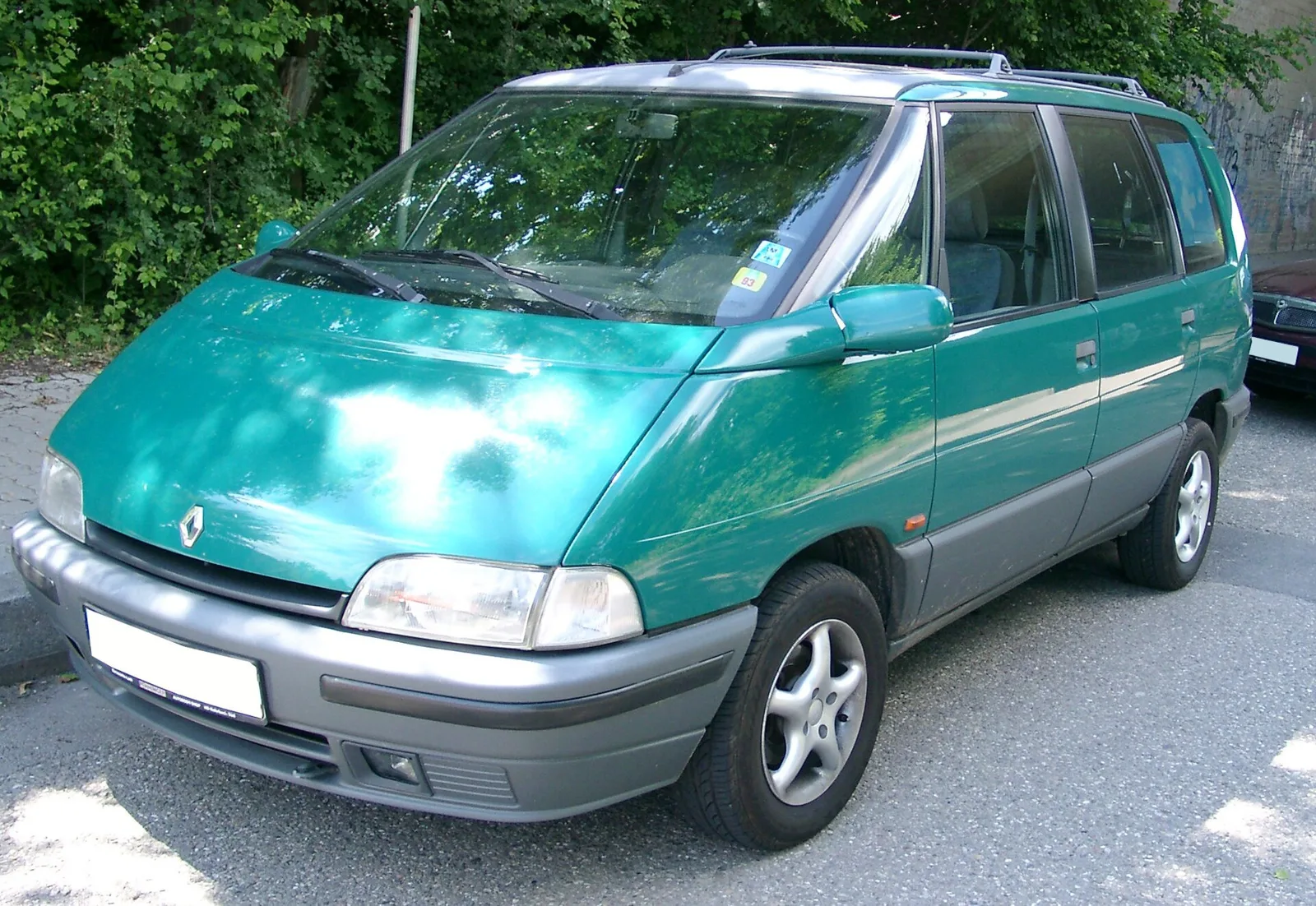
The second-generation Espace, a people carrier built at Romorantin from 1991 to 1996, and the V10 concept that grew out of it.
The Renault Espace II was a people carrier built at Romorantin from 1991 to 1996, with launch engines from a 1,995 cc petrol to a 2,849 cc V6. Its Espace F1 concept used an 810 PS V10 and had no production follow-up.
The Renault Espace II was the second generation of Renault's people carrier, built from 1991 and sold until September 1996. It grew large enough to join the large people carrier class, and its Espace F1 concept became famous among enthusiasts.
Where did the Espace II come from?
Work on the successor to the first Espace began in 1986 under the project name J63 at Renault and P36 at Matra. Renault considered sheet steel to raise output, weighed the far higher production costs, and in 1988 chose the Matra design called Espace Prime.
The first car had shown that buyers would take to this kind of vehicle, and the market for people carriers looked far from saturated. Renault weighed moving from fibreglass to sheet steel, which could raise the production rate of a successful model but would cost far more to make.
Uncertain which route to take, the company split the work among its own design centre, the American subsidiary of AMC and Matra. Two scale models came from the Renault design centre by the end of 1986. In March of the next year, two more models came in, one from AMC and one from Matra.
The Matra proposal, called Espace Prime, was one of the two projects accepted after a first review of the four submissions, and it was the design finally chosen after a second review in February 1988. The styling still changed during those reviews, and the changes carried the hand of Aime Saugues, already the author of the first Espace's lines.
The first Espace kept gathering ever greater acclaim until the end of its production, with a consistently positive trend. Matra was to assemble the new car, so stopping the first generation abruptly, just to replace its dies with those of the second, would have been pointless and unfruitful. The Romorantin plant was enlarged with a new wing called Romo 3, so that the first Espace could keep running while the second was prepared.
Testing was extensive, and the Espace II was road-tested to verify the reliability of its mechanics. About 25 prototypes and mules covered some 800,000 km (497,000 miles) on road and track, and a further forty prototypes were assembled in 1990 to test the new lines. Camouflaged images began to appear in the specialist press in the second half of 1989.
The Espace II reached the market at the beginning of 1991. Its public presentation came in March, at the Geneva Motor Show.
A people carrier that grew 18 cm, moved into a bigger segment and produced a V10 concept nobody expected.
How did the Espace II look?
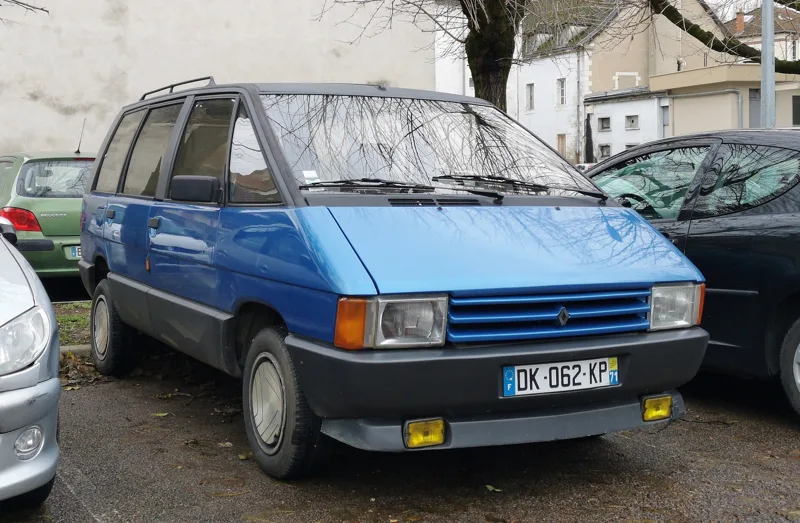
The Espace II was rounder than the first car, with smoother, blunter surfaces replacing its edges. Its body was 18 cm longer than the first generation's, which helped establish the Espace in the large people carrier segment, and the front strip that joined the mirrors was one of its signature details.
Aime Saugues drew the lines, as he had for the first Espace. Philippe Guedon, president and managing director, had tasked the Matra designer with shaping the new people carrier, and the new shape traded the first car's sharp corners for smoother surfaces.
At the front, the exterior mirrors, their mounts and a strip at the base of the windscreen formed a single feature. The strip ran the full width of the car and joined the mirror on the far side. The rear and the lamp units followed the same rounder logic, and the glass was redrawn for better visibility.
The body's growth mattered. The first Espace had sat between the mid-size and upper segments, so the 18 cm added length helped the second car enter the large people carrier segment.
Inside, the rectangular motifs of the first dashboard gave way to rounded units, with round control knobs that the earlier car had lacked. Boot capacity stayed close to the first car's, although the optional third row of seats drew criticism for the luggage space it took.
Structure, suspension and brakes
The Espace II kept the sheet-metal cage of its predecessor, with lightweight bodywork fitted over it. This time the panels used Sheet Moulding Compound, a mixture of polymers and glass fibre, which suited mass production better because it was easier to mould.
Lightness stayed a requirement, and the steel structure was galvanised to resist rust. The front suspension used independent wishbones with coil springs and telescopic hydraulic dampers, a layout carried over from the first car. The rear used a new semi-independent layout with a torsion beam.
Ventilated disc brakes were generally fitted at the front. The rear used drums on the 2-litre petrol, the front-drive 2.2 and the 2.1 diesel, while the 2.2i Quadra and the 2.8 V6 had more capable discs.
Engine range at launch
| Engine | Displacement | Output |
|---|---|---|
| 2.0i petrol | 1,995 cc (121.7 cu in) | 103 PS (102 hp) |
| 2.2i petrol | 2,165 cc (132.1 cu in) | 107 PS (106 hp) |
| 2.8 V6 petrol | PRV, 2,849 cc (173.9 cu in) | 150 PS (148 hp) |
| 2.1 dT diesel | 2,068 cc (126.2 cu in), turbocharged | 88 PS (87 hp) |
The 2.8 V6 was the first V6 fitted to a standard Espace, using the PRV unit of 2,849 cc. The 2.1 dT was the only turbocharged engine in the launch range, and it was also the only diesel.
Which versions and gearboxes were offered?
Most Espace II cars were front-wheel drive, with the engine forward, an arrangement known as the all forward layout. The 2.2 petrol could also be ordered as the Quadra with four-wheel drive, and a five-speed manual served the whole range.
In Italy the 2.2i was sold only with four-wheel drive, while other markets could also order it with front-wheel drive. Only the 2.8 V6 could be specified with a four-speed automatic instead of the manual.
How did the diesel and the range change?
The diesel gained a catalytic converter at the end of 1992, when it was the only engine in the range without one. In 1993 production began in China as the Renault Univers, a model for the local market only. In 1995 a variable-geometry turbocharger lifted the diesel from 88 PS (87 hp) to 92 PS (91 hp).
The catalytic converter was needed to meet the Euro 1 standard in force from 1 January 1993. The 1995 car, called the Espace 2.1 dTv, also raised top speed from 162 km/h (101 mph) to 167 km/h (104 mph). It joined the fixed-geometry diesel rather than replacing it.
The rest of the range stayed unchanged from its 1991 debut until September 1996, when the third generation took over.
What was the Espace F1?
The Espace F1 was a concept built from the Espace II. It was lowered, widened and fitted with a V10 derived from the one used in that year's Formula 1 season. It produced 810 PS (799 hp) and never reached production, but it became famous among enthusiasts.
The widened wheel arches hurt its aerodynamics, which held its top speed to 312 km/h (194 mph). Its 0 to 100 km/h sprint took 2.8 seconds.
With the engine mounted amidships, the driver had to put up with around 60 degrees C of heat and roughly 100 decibels of noise. Like any car fitted with a Formula 1-derived engine, the Espace F1 could only be started from outside, not from the cabin.
It remained an engineering curiosity rather than a production car, and no production version followed it.
Production and the end of the generation
Romorantin had been the true engine of the first generation's success, and it remained the home of the second. The Espace II was produced there, at the Matra plants. In China the car was assembled as the Renault Univers from 1993, for the local market only.
Production of the second generation ran until September 1996, and the third generation replaced it. The last examples were delivered during the first months of 1997.