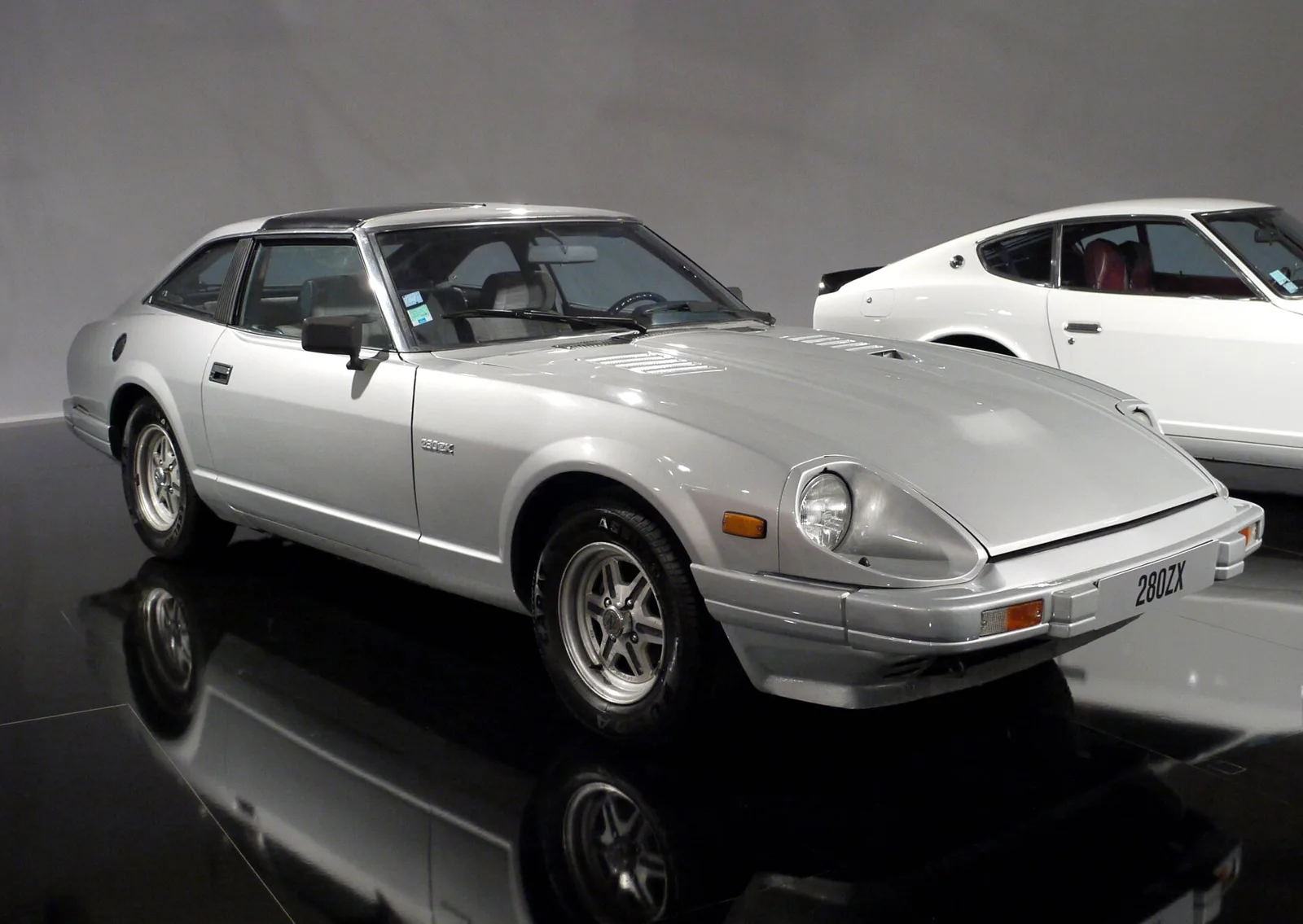
The 1978 second-generation Z-car kept the L28 six but traded razor sharpness for comfort, aerodynamics and, from 1981, a turbocharged model that was Japan's first.
The Nissan S130 was the 280ZX, a second-generation Z-car built in Japan from 1978 to 1983. It kept the L28 inline-six, became a softer grand tourer and gained a turbocharged model in 1981.
The Nissan S130 was a sports coupe that Nissan built in Japan from 1978 to 1983. It was sold as the Datsun 280ZX in export markets and as the Fairlady Z in Japan, and it was the second-generation Z-car. The car replaced the Fairlady Z (S30) in late 1978 and was succeeded by the Nissan 300ZX in 1984.
Why did Nissan redesign the Z-car as the 280ZX?
The 280ZX was a complete redesign that kept only the L28 inline-six and some driveline components from the 280Z. Compared with the more overtly sporting earlier models, it was a much softer and heavier car, with more emphasis on driver comfort and refinement than on driving feel.
Softer suspension, better sound insulation, more comfortable seats and a long list of equipment, including high-end audio systems, defined the new car. The exterior was evolutionary, with a less rounded body and better integrated safety bumpers. Most of the design effort went into a far more modern interior.
The result was a grand tourer rather than a sports car, especially in the plush Grand Luxury versions. Emissions controls and aerodynamics were markedly improved over the first-generation cars, and weight came down a little, as long as buyers kept the options list short.
The Z-car grew up in 1978, trading some of its edge for comfort, aerodynamics and the first turbo built in Japan.
What did the 280ZX change under the skin?
The 280ZX took its front suspension from the concurrent Bluebird 910, with MacPherson struts in front and semi-trailing arms at the rear. The two-seater's wheelbase stretched to 91.3 in (2,319 mm), up from 90.7 in (2,304 mm) on the predecessor.
The body was reworked with wind-tunnel testing in mind. Closing the open grille of the first-generation Z-car and making other refinements cut the drag coefficient from 0.467 to 0.385, and the lift coefficient fell from 0.41 to 0.14. The car also reached nearly 50/50 weight distribution in both body styles.
The rear was stretched to fit an 80 L (21.133 US gallon) fuel tank. Better aerodynamics brought improved fuel economy and high-speed stability, which had been one of the known weak points of the first Z-car. Many parts, including the rear axle and power steering, came from the Datsun 810 luxury sedan.
Was the 280ZX slower than the 240Z?
Early 280ZX models were, in practice, slower. A common belief holds that the L28 made less power than the L24 of the 1970 240Z or the L26 of the 260Z. The real reason was that Nissan adopted the SAE net standard for measuring power, which gave lower figures than the earlier gross ratings and also included the effects of emissions equipment.
Nissan deliberately gave up some outright acceleration for fuel economy. The early 1979 cars were rated at 135 hp (101 kW), which made them slower than the 240Z, partly because of extra weight and taller gearing. That deficit was not addressed until the 280ZX Turbo arrived in 1981.
Power steering was another area that drew criticism. The first cars had either unassisted rack-and-pinion steering or a recirculating-ball system with assistance taken from the Datsun 810, and neither impressed period road testers. A new power-assisted rack-and-pinion arrived for the 1981 turbo before being fitted to the naturally aspirated models in 1982.
What were the 280ZX names and markets?
In North America and Australia the car was branded the Datsun 280ZX, while in Japan it was the Fairlady Z. For the 1979 model year the American cars were co-branded Datsun by Nissan, and that wording ran through 1983. Those were transitional years as Nissan began to phase in its new global brand.
The Japanese market received both 2.0-litre and 2.8-litre engines. The 2.0-litre Fairlady 200Z used the L20 engine common in Nissan family cars of the period. The smaller engine helped the car meet Japanese dimension rules, while the 2.8-litre models were treated as the top-level luxury version. Export markets all received the L28 version.
In Japan the Fairlady was joined by a sedan and coupe derived from the Skyline, called the Nissan Leopard TR-X. Those cars were sold at Nissan Bluebird Store locations.
Which North American trims did the 280ZX offer?
Two trims were offered in North America: a stripped two-seater and a fully equipped 2+2 in GL specification. The GL kit could also be ordered on the two-seater, bringing the complete equipment list with it. Leather seats were an option, and a digital instrument cluster was offered from 1982.
The T-bar roof was available on both body styles from 1980, but only with the GL package. Its roof panels could be lifted out and kept in bags stowed behind the seats. A Blackout package, which removed most of the chrome brightwork, was offered on the standard two-seater.
How did South Africa receive the 280ZX?
The South African magazine CAR gave the model its first coverage in October 1981, in a dedicated feature. The local Nissan plant, then known as Nissan Datsun South Africa, was expected to produce about 500 units.
The South African engine was an L28-E six, close to the international unit, although its cylinder cover still carried the Datsun name. The same engine powered the locally built Datsun Laurel 2.8 SGL, Nissan's flagship in South Africa at the time, and local engines had not yet moved to the Nissan badge.
What changed in 1979 and 1980?
Early reviews of the 280ZX were mixed. Some critics lamented the transformation of the Z-car into a grand tourer, while others praised the gains in refinement and comfort. Sales soon proved the Nissan designers right, and the 280ZX became a commercial success.
In 1979 Datsun homologated a high-downforce whale-tail spoiler by building 1,001 280ZX-R cars. That allowed the spoiler to be used in IMSA and SCCA racing. The cars also had distinctive decals and ZX-R logos. Don Devendorf, a successful IMSA racer, helped develop the spoiler.
The 280ZX Turbo was first presented in late 1979, with an AiResearch turbocharger on the L28E engine. It produced 200 PS DIN (147 kW; 197 hp), and it was the first turbocharged production Japanese car. In 1980 a limited 10th anniversary model followed, with 3,000 built, 2,500 in black and gold and 500 in red and black.
What was the 1981 turbo like?
A turbocharged model with the L28ET engine was introduced to the US export market in 1981. Output was 180 bhp (134 kW; 182 PS), reached at 5,600 rpm, and torque hit 203 lb ft (275 N m) at 2,800 rpm. Japan received the 2-litre L20ET turbo in manual and automatic forms.
Nissan worried about the reliability of its five-speed manual with the extra torque of the 2.8-litre turbo, so no manual was offered with the L28ET in 1981. Europe and Australia continued to receive only the naturally aspirated 2.8-litre engine. The 2.8-litre turbo was never sold in Japan, because the government would only approve turbochargers on engines below 2 litres.
The turbo used a single Garrett AiResearch TB03 with an internal wastegate and no intercooler. Boost was limited to 6.8 psi (0.47 bar), with compression lowered to 7.4:1 by dished cast aluminium pistons. Changes included a higher-volume oil pump, an oil cooler on automatics and Nissan's Electronic Concentrated Control System.
The revised rear suspension introduced with the turbo was carried into 1982 and 1983, and it reached the non-turbo cars from mid-1982. Car and Driver complained in a 1981 comparison that the turbo's brakes faded badly during a lap of its test track, even though the acceleration matched other sports cars of the era.
What changed in the 1982 Series II facelift?
Nissan facelifted the 280ZX in 1982, and the car is now usually called the Series II. Changes included revised NACA ducting in the bonnet, new alloy wheels with 14-inch six-spoke designs on non-turbo cars and 15-inch four-spoke designs on turbos, and a new pinstripe tail-light style. The bumpers became body coloured and wrapped further round the car.
The 1982 model was also the first to offer a voice warning system, which told the driver when the headlights were left on after the car was switched off, or when the parking brake was on while the car was moving. Power steering became standard with a new rack-and-pinion system, and the exhaust exited from the left rather than the right.
Certain models also swapped their half shafts from universal joints to constant velocity joints. The 1982 non-turbo car used an uprated engine, with the L28E for export rated at 145 hp (108 kW) instead of 135 hp (101 kW).
How did the 280ZX perform on the road?
A naturally aspirated 1982 Datsun 280ZX reached 60 mph (97 km/h) in 9.1 seconds, 1.2 seconds behind the Corvette of that year. The turbo manual took 7.4 seconds to 60 mph, while the automatic managed 7.1 seconds. The Aston Martin Volante, which cost nearly seven times as much, needed 8.9 seconds, and the Ferrari 308GTSi took 7.9 seconds.
Only the Porsche 911SC beat the turbo Z-car's acceleration among US-market cars in 1982. The 1982 Turbo, with revised spring rates and sway bars, was reviewed as the most sporting Z-car since the original 240Z of 1970. The 1982 turbo manual used a Borg-Warner T-5 five-speed, a rare non-Japanese transmission for Nissan.
Did the 280ZX win races?
The 280ZX had success in several racing classes, particularly in the United States. Bob Sharp Racing won the 1979 SCCA C Production category, and Electramotive cars took the IMSA GTU championship in 1979 and 1980. The Electramotive turbo car won the IMSA GTO championship in 1982 and 1983.
The 1983 Electramotive turbo made more than 700 hp (522 kW), and its terminal speed over the standing quarter mile was 140 mph (230 km/h). Actor Paul Newman raced with the Bob Sharp Racing team and also helped promote the car in a series of commercials.
What are the Nissan S130 specifications?
| Specification | Detail |
|---|---|
| Production | 1978 to 1983; succeeded by the 300ZX in 1984 |
| Engine | L28 2.8-litre inline-six, retained from the 280Z |
| Turbo engine | L28ET, 180 bhp (134 kW; 182 PS) at 5,600 rpm, 203 lb ft (275 N m) at 2,800 rpm |
| Early 1979 output | 135 hp (101 kW), SAE net |
| 1982 export non-turbo output | 145 hp (108 kW) |
| Japanese turbo output | 200 PS DIN (147 kW; 197 hp), 1979 presentation |
| Wheelbase | 90.7 in (2,304 mm) predecessor; 91.3 in (2,319 mm) two-seater |
| Drag coefficient | 0.467 reduced to 0.385 |
| Lift coefficient | 0.41 reduced to 0.14 |
| Fuel tank | 80 L (21.133 US gallons) |
| Turbo boost | 6.8 psi (0.47 bar), with 7.4:1 compression |
| Turbo 0-60 mph | 7.4 seconds (manual or automatic 7.1 seconds) |
| Turbo top speed | 130 mph (209 km/h) |
| Limited-edition run | 1,001 280ZX-R cars in 1979; 3,000 10th anniversary cars in 1980 |