A racing saloon that began as a discreet project by a Daimler-Benz engineer, became AMG's first car and ended its life as a test rig for aircraft landing gear.
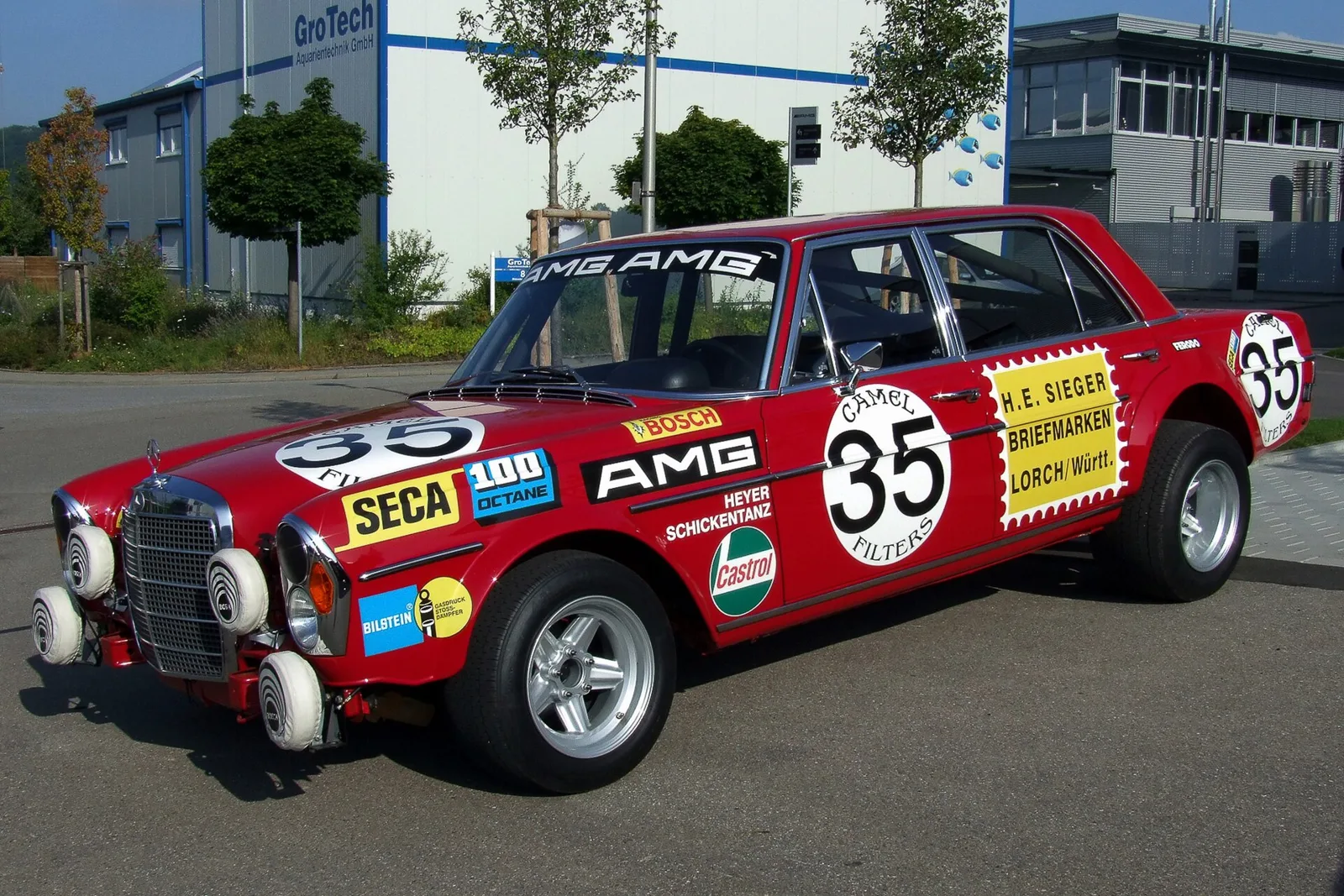
The 300 SEL 6.8 AMG was a racing saloon that AMG built in 1971 on a 300 SEL 6.3 platform, using a V8 bored out to 6.8 litres. Nicknamed the Red Pig, it finished second overall at the 24 Hours of Spa.
The Mercedes-Benz 300 SEL 6.8 AMG was a racing saloon that began in 1967 as a discreet project by the Daimler-Benz engineer Erich Waxenberger and became AMG's first car. Nicknamed the Red Pig, its 6.8-litre V8 took it to second place overall at the 24 Hours of Spa in 1971. The car then ran a short racing career before it went to work on aircraft test rigs.
Where did the 300 SEL 6.3 racing project start?
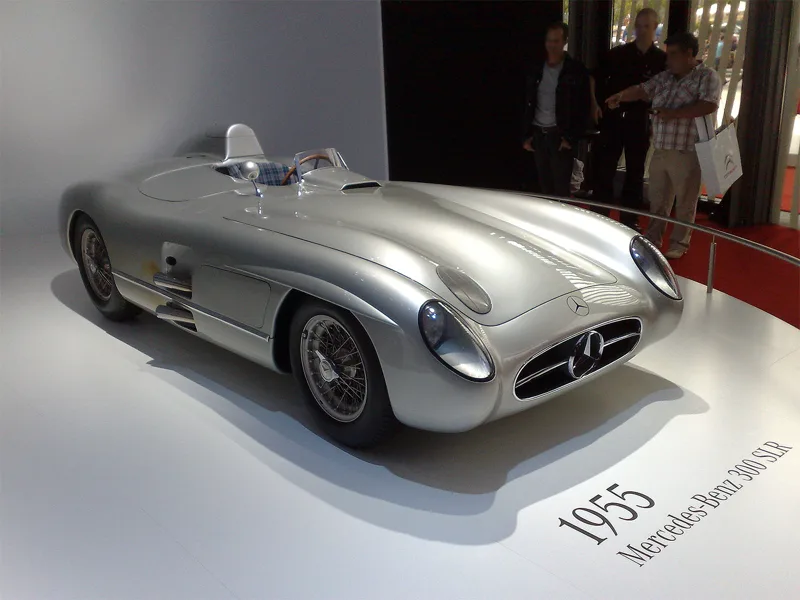
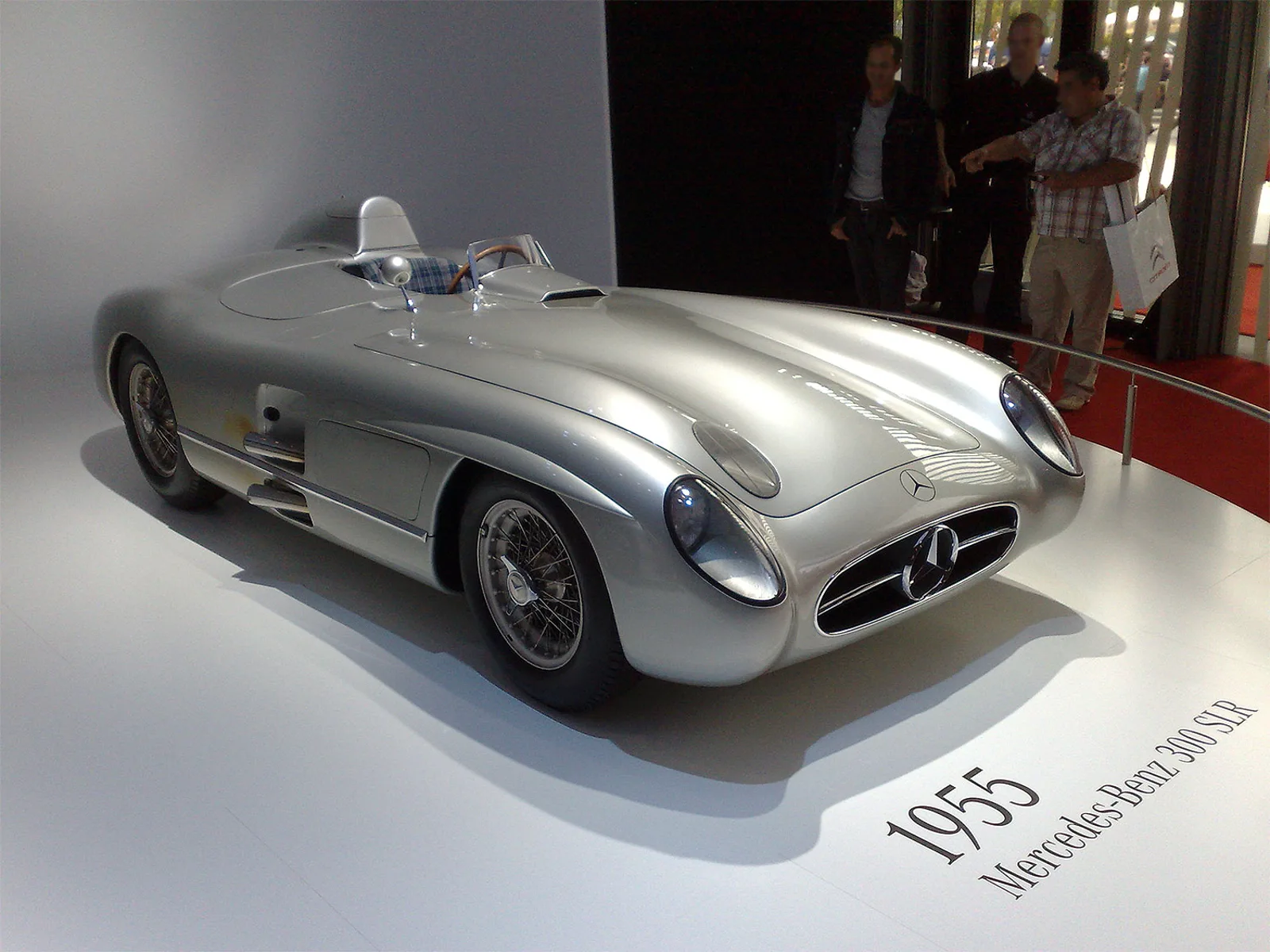
The project began in 1967, when the engineer and driver Erich Waxenberger fitted the V8 of the Mercedes-Benz 600 into a Type 109. Daimler-Benz had stopped official racing after the 1955 Le Mans accident, in which a 300 SLR flew into the crowd and killed more than 80 people, so the work stayed discreet.
The engine and transmission together weighed 400 kg and barely fitted into the engine bay. Rudolf Uhlenhaut, one of the company's managers, liked the car so much that the decision for series production came at the end of 1967, and it was sold as the 300 SEL 6.3.
Before going on sale, the 6.3 ran road tests on the factory circuit at Untertuerkheim, alongside the C 111 Type I.
A discreet experiment on a Mercedes saloon became the Red Pig, and at Spa in 1971 it finished second overall.
How did the 300 SEL 6.3 win at Macau?
In May 1969 Waxenberger lined up two 300 SEL 6.3s, both run privately, at the six-hour event on Macau's Guia circuit. The number 51 car later crossed the line first overall. Daimler-Benz had refused the proposal to race the car in 1968, but Waxenberger went ahead anyway.
The number 51 car started from pole, a time of 3 min 15 s 07 set by the pairing of Waxenberger and Albert Poon. Poon drove for roughly twenty minutes, and Waxenberger finished at the wheel, winning after 5 h 57 min 10 s 22 at 102.9 km/h on average. Car no. 52, shared by Jan Bussell and Ted Moorat, was second on the grid and came home third behind a Porsche 911S, after 5 h 59 min 5 s 35 on the road.
The company still refused to enter officially. Waxenberger later became head of the competition department of the German maker.
What happened when the 300 SEL 6.3 raced at Spa in 1969?
Daimler-Benz sent three 300 SEL 6.3s to Spa, where the 24-hour race ran on 26 and 27 July 1969. The qualifiers were car no. 4 with Jacky Ickx and Hans Herrmann in second place, car no. 5 with Rauno Aaltonen and Dieter Glemser in fourth, and car no. 7 with Kurt Ahrens and Waxenberger in sixth. Car no. 7 does not appear in the official entry list.
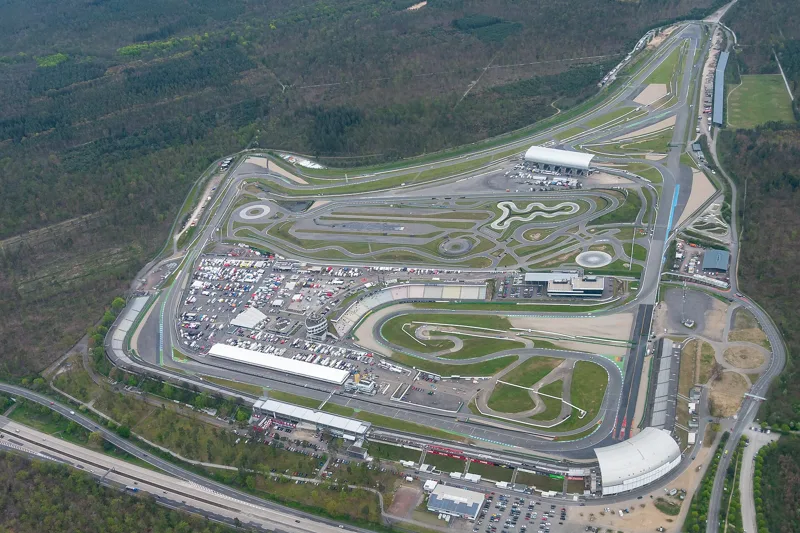
Tyres were the weak point. A few weeks before the race the cars had run a 24-hour test at Hockenheimring, and one set of tyres lasted only 20 laps despite aluminium wheels with finned rims to help cooling. Delamination remained the weak point, and withdrawing the cars was considered, though the announcement brought booing from the fans.
All three stayed in the race, but the board of directors ended the campaign Waxenberger had planned for the European touring car championship. It also banned any further racing with the 300 SEL 6.3, citing safety.
Who built the 300 SEL 6.8 AMG?
AMG was founded in 1967 by Hans-Werner Aufrecht and Erhard Melcher, two former Mercedes-Benz engineers who specialised in tuning cars. They had admired the 6.3 at its Geneva presentation in 1968 but could not afford one, so in 1969 they found a wreck to serve as the base for a racing variant.
Two years and 500 hours later, the car was complete. Melcher took charge of the engine and Aufrecht of the bodywork. Waxenberger, who had already worked on the 6.3, obtained an engine bored out to 6.8 litres, and AMG set out to meet the new 1970 touring car regulations, a mix of the old Group 2 and Group 5 rules.
The team wanted to take it to Spa's 24-hour race, which started on 24 July 1971.
How did the 6.8 AMG perform at its first races?
Its first race was at the Salzburgring in June 1971, where Waxenberger, entered as Enrico, qualified second and finished third. In July, Helmut Kelleners crashed the car at Hockenheim, and the founders rebuilt it completely before the 24 Hours of Spa.
The ADAC-Bavaria-Rennen on 19 and 20 June 1971 was a 12-lap endurance race over a 4,255 m circuit, or 51.06 km. Waxenberger had to race under a pseudonym because, as a Daimler-Benz development engineer, he was barred from motor racing. The red car carried no. 117.
On 4 July 1971 AMG gave a red 300 SEL 6.8 AMG, carrying no. 35, to Helmut Kelleners for the Suedwest-Pokal at Hockenheimring. Triumph International was the first sponsor on the car. It weighed 1,635 kg, had a 428 PS V8 and passed 260 km/h at the Ostkurve chicane. Leaving the track there was unavoidable, but Kelleners was unhurt, and he handed the keys to Hans-Werner Aufrecht with a remark that they would not be needed again.
Why was the Red Pig so famous at Spa in 1971?
Driven by Hans Heyer and Clemens Schickentanz, the Red Pig started fifth out of sixty cars at the 24 Hours of Spa on 24 and 25 July 1971. It finished second overall after 308 laps, eleven laps behind the winning Ford Capri, and it took the class win.
It had qualified fifth in 4 min 14 s 5, and it topped its class in qualifying despite competition from the Ford Capri RS, the BMW 2800 CS, the Opel Commodore, the Chevrolet Camaro Z28 and the much lighter Alfa Romeo Giulia GTA. Grauls and Hoffman had taken pole in the Camaro Z28.
Glemser led early in a Capri, and the Camaro of Grauls and Hoffman followed. By midnight the BMWs had been left behind, and the AMG ran third behind two Capris. Niki Lauda's BMW gearbox failed early on, while Jochen Mass and Gerry Birrell retired with a cylinder head gasket failure. The Red Pig ran through the rain and the retirements without a mechanical failure, and German television's Tagesschau covered the result, which helped AMG's reputation grow.
Fans and journalists gave it the nickname Rote Sau in German, Red Pig in English and cochon rouge in French. The name came from the livery and from the rumbling and bangs of its huge engine.
What other races did the Red Pig enter?
The car ran at Paul Ricard in September 1971, at Hockenheim in November, at Le Mans in testing, at Spa and at the Nurburgring in 1972, before its final appearance at the Norisring. Several of these outings ended in mechanical trouble, and the rule changes of 1971 and 1972 closed the door on the rest.
Paul Ricard and Hockenheim
The 2x6 Hours of Paul Ricard on 11 and 12 September 1971 had two six-hour heats and drew Graham Hill and Jacky Ickx. AMG entered the Red Pig as no. 11, and it qualified fifteenth. A second AMG, silver grey and numbered 12, was run by the private entrant Klaus Behrmann, with Jose Dolhem and Jean-Pierre Jabouille, and it qualified twenty-sixth. In the first heat the Red Pig retired after 264 laps with a rear suspension failure, and Behrmann's car finished fifth. In the second heat the Red Pig finished eleventh, while Behrmann's car retired with an oil pressure failure.
For the last non-championship race of the 1971 season at Hockenheim, on 28 November, the car was repainted yellow for a sponsorship deal with the Hannan Alt Brewery. Hans Heyer drove it as no. 31 and finished seventh in its class and twelfth overall.
The 5,000 cc ban
Late in 1971 the FIA rewrote the European touring car rules, barring anything above 5,000 cc, and the AMG was shut out. Even so, the car was back at the Le Mans preliminary tests on 18 and 19 March 1972, painted yellow again but this time sponsored by Briefmarken Sieger, with Heyer at the wheel as no. 48.
A start in the Le Mans 24 Hours of 10 and 11 June 1972 was not possible. In those tests the car touched 285 km/h on the Hunaudieres straight, the fastest speed ever logged for it.
Spa Cup, Nurburgring and Norisring
On 6 May 1972 the Red Pig, carrying no. 2, took part in the Spa Cup, a round of the Belgian touring car championship. Heyer qualified it eleventh, but sources disagree on whether it finished or failed to start.
On 24 and 25 June 1972 the car, now no. 1, ran in the 24 Hours of the Nurburgring, because the 5-litre ban had been lifted during the year. Heyer and Thomas Betzler qualified fourth in 9 min 27 s 6. The Red Pig led after the first lap, but overheating sent it back to the pits, and a locked differential later ended the run.
On 6 August 1972 the car, with no. 56, ran the 200 miles of Nuremberg at the Norisring, a support event for the Interserie sports car series. Heyer took pole, and this was the last racing appearance of the 300 SEL 6.8 AMG.
In 1972 the FIA banned cars over 5 litres from the touring car championship, which ended the racing career of the car.
How did Matra use the car after racing?
At the end of 1972 AMG agreed to sell the car to the French aeronautics company Matra, after some major modifications. Matra wanted a prototype for measuring friction on aircraft landing gear, and the car's speed and acceleration were needed to imitate take-offs and landings.
The car was lengthened and converted to six doors to house the test equipment. Behind the front seats sat a rig holding aircraft tyres. Through a floor opening, the tyres could be pressed onto the road surface at speeds above 200 km/h, with a load of 600 to 800 kg. The trace of this car has been lost, and it is presumed destroyed.
Sources say five examples were built, three for racing and two for testing. Only one is said to have survived,.
Why is the Red Pig still remembered?
The Red Pig has stayed in the public eye through replicas, television and video games. Mercedes-AMG began building a faithful replica in 2006, and another replica was sold at Sotheby's in Paris in February 2020 for 432,500 euros.
The 2006 replica appeared on television shows such as SuperCars Exposed, the Dutch programme RTL Autowereld and the American series Ultimate Factories. Jay Leno showed it in 2015 on his web series Jay Leno's Garage, and the car features in games such as Gran Turismo and Project CARS.
At the 2022 Belgian Grand Prix, the Petronas team of Mercedes-AMG celebrated 55 years of AMG, running the W13 E Performance cars of Lewis Hamilton and George Russell. The livery nodded to the 300 SEL 6.8 AMG through a special logo and a big vintage number on white.
What engine and chassis did the 6.8 AMG use?
The 6.3's V8 was bored out to 6,834 cc (6.8 litres) in 1971. Output climbed from 250 PS (184 kW; 247 hp) to 428 PS (315 kW; 422 hp), while torque went from 500 to 608 Nm (369 to 448 lb ft). The original Bosch mechanical injection system was kept.
The bore grew from 103 to 107 mm, while the stroke stayed at 95 mm. Engineers reworked both cylinder heads around the valves to lift compression, polished the intake and exhaust manifolds, and sharpened the camshafts. An additional oil cooler was fitted.
Hockenheim test figures for the 6.8 AMG
| Measure | Figure |
|---|---|
| Top speed | 265 km/h (165 mph) |
| 0 to 100 km/h | 6.1 s |
| Theoretical top speed at 6,000 rpm | 282 km/h (175 mph) |
| 0 to 160 km/h | 12.6 s |
| Fuel consumption | 37 l/100 km (7.6 mpg-imp; 6.4 mpg-US) |
| 0 to 200 km/h | 19.8 s |
How did the chassis and body change?
The manual five-speed gearbox was converted to a ZF Type S 5242 unit, a gearbox also used in Maserati and Aston Martin cars at the time. Its ratios ran from 2.75 in first to 0.833 in fifth, with reverse at 2.73. The differential ratio was 2.69 with 70% slip, and spare differentials of 2.82 and 3.89 were carried.
Weight was the main worry. The original body weighed 1,800 kg (3,968 lb), while the 1970 standard maximum was 1,765 kg (3,891 lb). The bumpers were removed, the glazing was replaced by Plexiglas and the doors were remade in aluminium, bringing the car to 1,635 kg (3,605 lb).
The enlarged wheel arches took magnesium Penta rims from the C 111 Type I test car, 10 inches wide at the front and 12 inches at the rear. Dunlop Racing tyres went on the front and rear. A 15-litre auxiliary tank was fitted in the boot, and four Bosch headlamps lit night races.
Inside, the rear bench, door panels and wood dashboard were kept, while the steering wheel was replaced. The driver sat in a Recaro racing bucket with four-point harnesses, and a roll bar guarded the occupants.