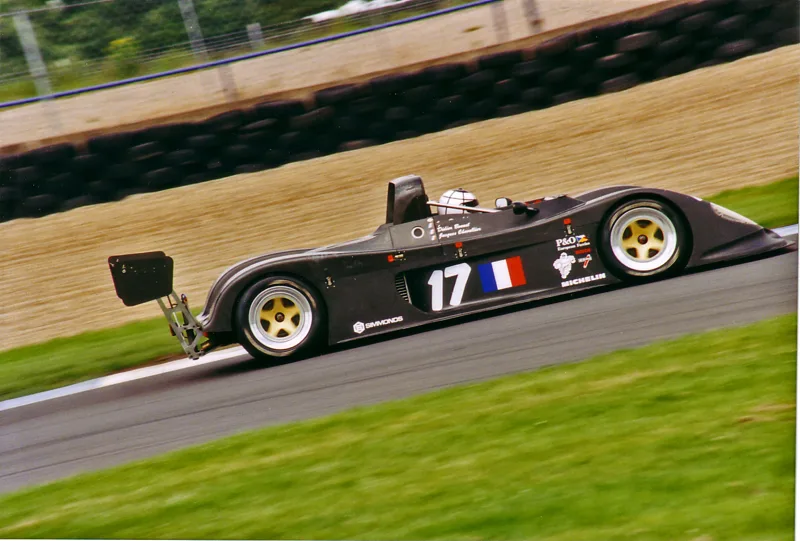
Five cars, a Cosworth V8 and a short works career that ended in 1983, with Zakspeed taking the chassis on to Interserie titles.
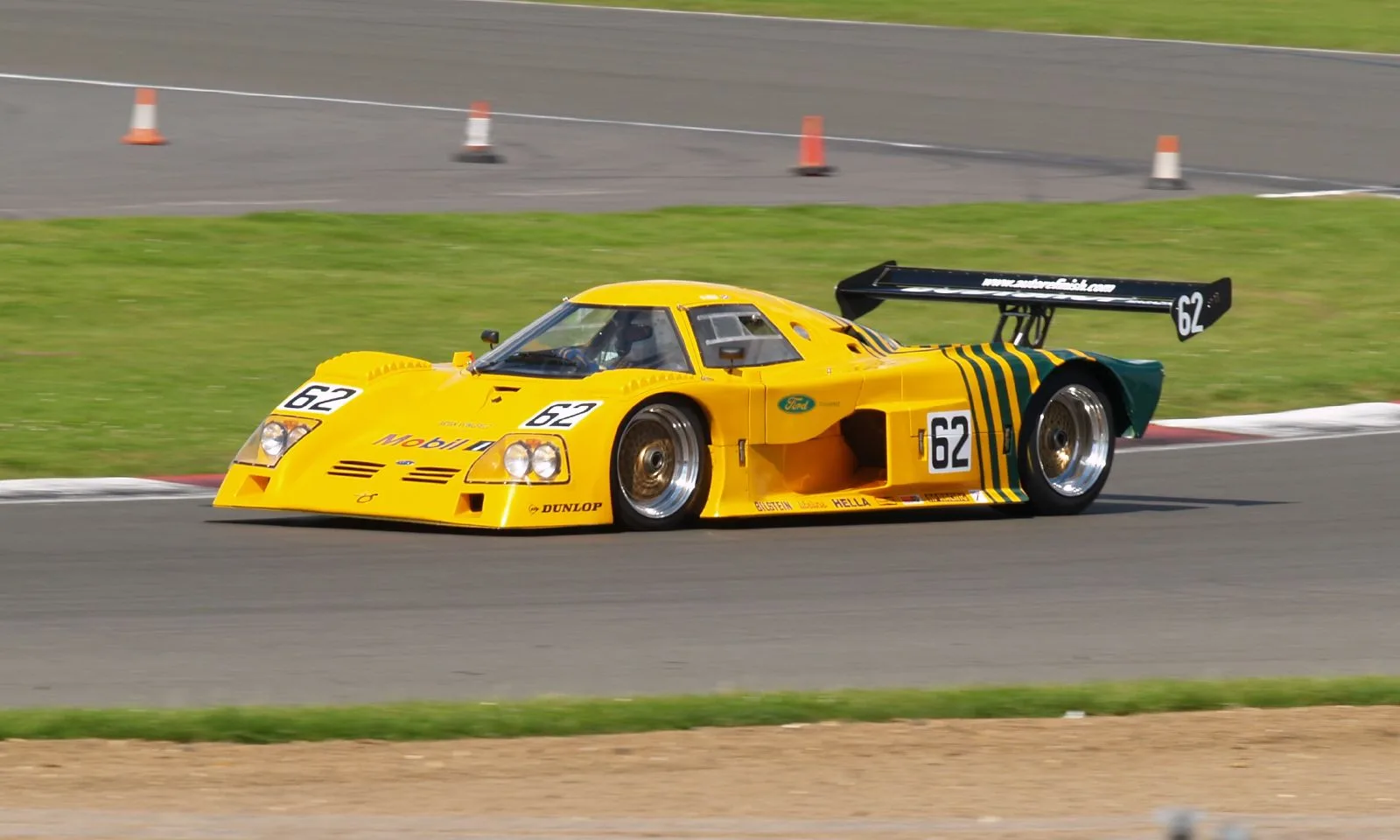
Built by Ford in 1981, the C100 ran first as a Group 6 car and later in Group C, with a Cosworth DFL V8 under its bodywork. Five were made, and Zakspeed later used its chassis to win the Interserie title.
The Ford C100 was a sports racing car that Ford built in 1981 and ran first as a Group 6 machine and later as a Group C car. Only five were built. Its best days came in qualifying and in a handful of wins, but reliability problems kept it from the sustained success that the Zakspeed cars which followed would go on to achieve.
Where did the Ford C100 come from?
Ford Motor Company began the C100 project in 1981. The car was intended to use a Cosworth V8, and it first appeared with a 4-litre Cosworth DFL engine. The design was penned by Len Bailey, who had earlier worked on the GT40, and it had a shovelled nose at the front and a tall decking over the rear.
Bailey became disillusioned and left before an updated version was ready for the 1982 season. Tony Southgate was then asked to review the car. He was unimpressed, and he pointed to a misplaced steering rack and a rear suspension that seemed to have been drawn for a different car.
Fast in qualifying and short on reliability, the C100 gave way to Zakspeed's cars, which won the titles that the Ford never could.
Who redesigned the C100 and why did Ford change its plans?
The original cars used a simple aluminium chassis. An updated version, built for Alain de Cadenet, moved to a stronger aluminium honeycomb chassis, and Thompson went on to redesign the suspension at both ends. The change produced a significant drop in lap time, and it impressed Ford enough to offer Thompson a contract to redevelop the C100 for 1983.
Thompson redeveloped the car from scratch, keeping only the windscreen. The new cars used the same honeycomb monocoque as the de Cadenet machine, although the body was initially made of glassfibre. Thompson and Keith Duckworth then worked on a turbocharged version of the DFL V8 and on fitting it to the chassis.
The project ended abruptly. A week after the redeveloped car made its maiden test at Paul Ricard, Ford withdrew from the programme. The test had used a standard DFL because the turbo engine was not yet ready. Thompson later claimed the updated car produced 4,000 lb (1,814 kg) of downforce in sprint configuration and was superior to the Porsche 956. The car did show high-speed understeer in testing, which Thompson blamed on too little front-end downforce.
Which engines did the C100 use?
The C100 started life with the 4-litre Cosworth DFL V8. Private owners took the car in 1983 and fitted a 3.3-litre variant of that V8. The V8 was the heart of the car throughout its competition life, and its power delivery shaped the way it was driven.
After Ford's involvement ended, Zakspeed took the car further. Its C1/4 used a stiffer aluminium honeycomb chassis, reworked aerodynamics and a 1.8-litre turbocharged in-line four borrowed from the Group 5 Ford Capri. That turbo four produced around 560 hp (568 PS; 418 kW). A version with the 4-litre DFL V8 was called the C1/8.
How did the C100 debut in 1981?
Ford had planned to enter the C100 at the 1981 24 Hours of Le Mans, but it did not attend. Its real debut came at the Brands Hatch 1000 km, held three months later. Winkelhock and Ludwig shared the works entry and qualified first, 1.1 seconds quicker than Edwards and de Villota in the works Lola T600.
The pole was not converted into a win. A gearbox failure ended the C100's race after 40 laps, and the Edwards and de Villota Lola went on to take the victory.
How did the C100 race in 1982?
Four more chassis followed for 1982, entered in the Deutsche Rennsport Meisterschaft (DRM) and the FIA World Endurance Championship (WEC). Ludwig retired at Zolder to open the DRM season, then came tenth at Hockenheimring in the second round. He had completed enough laps to be classified even though he retired after 17.
Ford Germany entered one C100 for the 1000 km Monza, the opening round of the WEC season. Winkelhock, Ludwig and Marc Surer shared the car, and overheating ended its run after 18 laps. At the six-hour race at Silverstone, Winkelhock and Ludwig became the first drivers to finish a race in the C100, taking eighth overall and fifth in the Group C class. They then retired at the 1000 km Nurburgring with a differential failure after 31 laps, but this was still enough to be classified twentieth.
Le Mans was less kind. Ford entered four cars, but only two took the start. Both were lost to electrical failures, after 71 and 67 laps. The DRM then brought better results. Winkelhock finished second at the Norisring, giving the C100 its first podium, one second behind Jochen Mass in a Porsche 956. Ludwig was eighth there, two laps down.
At Hockenheimring Ludwig won by just under five seconds from Klaus Niedzwiedz, who was in a Zakspeed Capri Turbo. A later Hockenheim round ended with a transmission problem after 28 laps for Ludwig. At Spa, one C100 retired after 124 laps with a fuel pump failure, while the other finished 123 laps and was classified eighteenth overall and ninth in Group C.
The DRM finale at the Nurburgring produced the C100's best result. Ludwig won by more than 37 seconds from Niedzwiedz's Capri. Ford then took three cars to Brands Hatch, and the C100s were dominant in qualifying, with Surer, Ludwig and Winkelhock on pole. Lancia LC1s finished third and fourth, nearly two seconds adrift. Palmer and Wilson brought their car home fourth, and second in class. Ludwig was the best-placed C100 driver across the WEC and the DRM. His season closed with eleven WEC points, which left him joint 39th, and 83 DRM points for fourth.
What happened to the C100 in 1983?
Ford ended the C100 programme in 1983 and sold chassis #04 to Peer Racing. The team fitted the 3.3-litre DFL and put David Kennedy and Martin Birrane into the new Thundersports series. Their first race at Brands Hatch ended in a crash, and they skipped the 1000 km Silverstone. At the second Brands Hatch round they took second, a lap behind the Lola T530-Chevrolet of John Foulston and Brian Cocks.
Francois Migault joined the team for Le Mans, but a fuel pressure problem forced retirement after 16 laps. At Thruxton a puncture broke the suspension after nine laps. Jim Crawford then replaced Birrane at Donington Park, and the car won by a lap, ahead of the Lola T594-Mazda shared by Pete Lovett and Jeff Allam. It was the C100's last victory, and also its last finish. A practice accident stopped the car at the Brands Hatch 1000 km, and Kennedy and Rupert Keegan crashed out of the final Thundersports race. That was the last time a C100 appeared in a major race.
What did Zakspeed do with the C100 chassis?
Zakspeed concentrated on the DRM in 1983 and arrived at Zolder with a C1/4 and a C1/8 for the opener. Ludwig drove the C1/4 and Niedzwiedz the C1/8, but neither was classified. The next round at Hockenheimring went to Niedzwiedz, who won by more than a minute and set the fastest lap.
At AVUS a turbo failure ended Ludwig's race after three laps, although Niedzwiedz came home third. Ludwig then finished second at Mainz Finthen Airport, while Niedzwiedz was fifth. Niedzwiedz finished the season third in the DRM and Ludwig fifth. The Zakspeed cars were far more successful than the C100 had ever been.
How did Zakspeed fare in the Interserie in 1983 and 1984?
After the DRM, Zakspeed turned to the Interserie. Jorg van Ommen won at Siegerland in the C1/4 and took the fastest lap, and he added second in the next race. He finished sixth in the driver's standings despite racing in only two events. Ludwig was second at the final round at Hockenheim.
The C1/4 sat out 1984, while the C1/8 contested the complete DRM and Interserie calendars. Niedzwiedz won at Zeltweg, taking both heats, and then dominated at the Nurburgring. Gearbox trouble limited him to tenth at Norisring, but he won again at Most and was second at Siegerland behind Henri Pescarolo in a Joest Porsche 956.
Niedzwiedz took the Interserie championship in 1984 by 20 points from Roland Binder in a Lola T296 BMW. He finished twelfth in the DRM standings. By then the Zakspeed cars had far outstripped the Ford originals in results.
How did the Zakspeed cars perform in 1985?
In 1985 Zakspeed went back to the C1/4 alongside the C1/8. Niedzwiedz stayed with the team to defend his Interserie crown. He began with fourth at the Nurburgring and third at Hockenheim, and at Wunstorf he switched to the C1/4 and finished fourth again. Franz Konrad drove the C1/8 at AVUS, while Niedzwiedz was sixth overall after retiring from the second heat.
Jan Thoelke took fifth at Erding in the C1/8, and the Kumsan Tiger Team took over that car. The DRM's only dedicated race that year, at Norisring, saw Niedzwiedz finish 13th. Ludwig came back to the team for Siegerland, where he was third, and he repeated that result at the Nurburgring. Niedzwiedz finished the season ninth in the driver's championship, with Thoelke 13th, Ludwig 18th and Konrad 19th.
What happened to the C1/8 after 1985?
The C1/4 was laid up after 1985 and did not race again. In 1986 Zakspeed selected Dauer to drive its C1/8, while Thoelke ran his own C1/8 in several events, both as a privateer and under the Derichs Rennwagen name. The DRM had been replaced by the Supercup that year, and the C1/8 finished ninth at Hockenheim in the first round.
Dauer finished seventh at Zeltweg, then eighth at both Most and Siegerland, and he took fourth at the second Zeltweg round. He was 13th in the Interserie. At the Kyalami 500 km he retired on lap 61 with fuel injection problems.
In 1987 the C1/8 was used only twice. Dauer then ran it for Victor Dauer Racing at Hockenheim and at Most, where he finished fifth. He spent most of that season in a Porsche 962C, and he finished fifth overall in the standings.
For 1988 Mike Baretta was given the C1/8. By then it was past its best, and Baretta never finished higher than tenth in any round. The car was still fairly reliable, and that helped him finish joint-fifth in the championship with Walter Lechner. That gave him joint fifth with Walter Lechner, and he was the leading driver not in a Porsche. The C1/8 made no further starts after 1988.
What are the Ford C100 specifications?
| Specification | Detail |
|---|---|
| Built | 1981, five cars in total |
| Category | Group 6, later Group C |
| Original engine | 4-litre Cosworth DFL V8 |
| Engine from 1983 | 3.3-litre Cosworth DFL V8 |
| Chassis | Aluminium honeycomb monocoque on the redeveloped car |
| Claimed downforce | 4,000 lb (1,814 kg) in sprint configuration, per Thompson |
| C1/4 engine | 1.8-litre turbocharged in-line four, about 560 hp (568 PS; 418 kW) |
| C1/8 engine | 4-litre Cosworth DFL V8 |
| Best win, Ford era | DRM finale at the Nurburgring, 1982 |
| Last win | Donington Park Thundersports race, 1983 |
| Zakspeed Interserie title | Niedzwiedz, 1984, by 20 points |