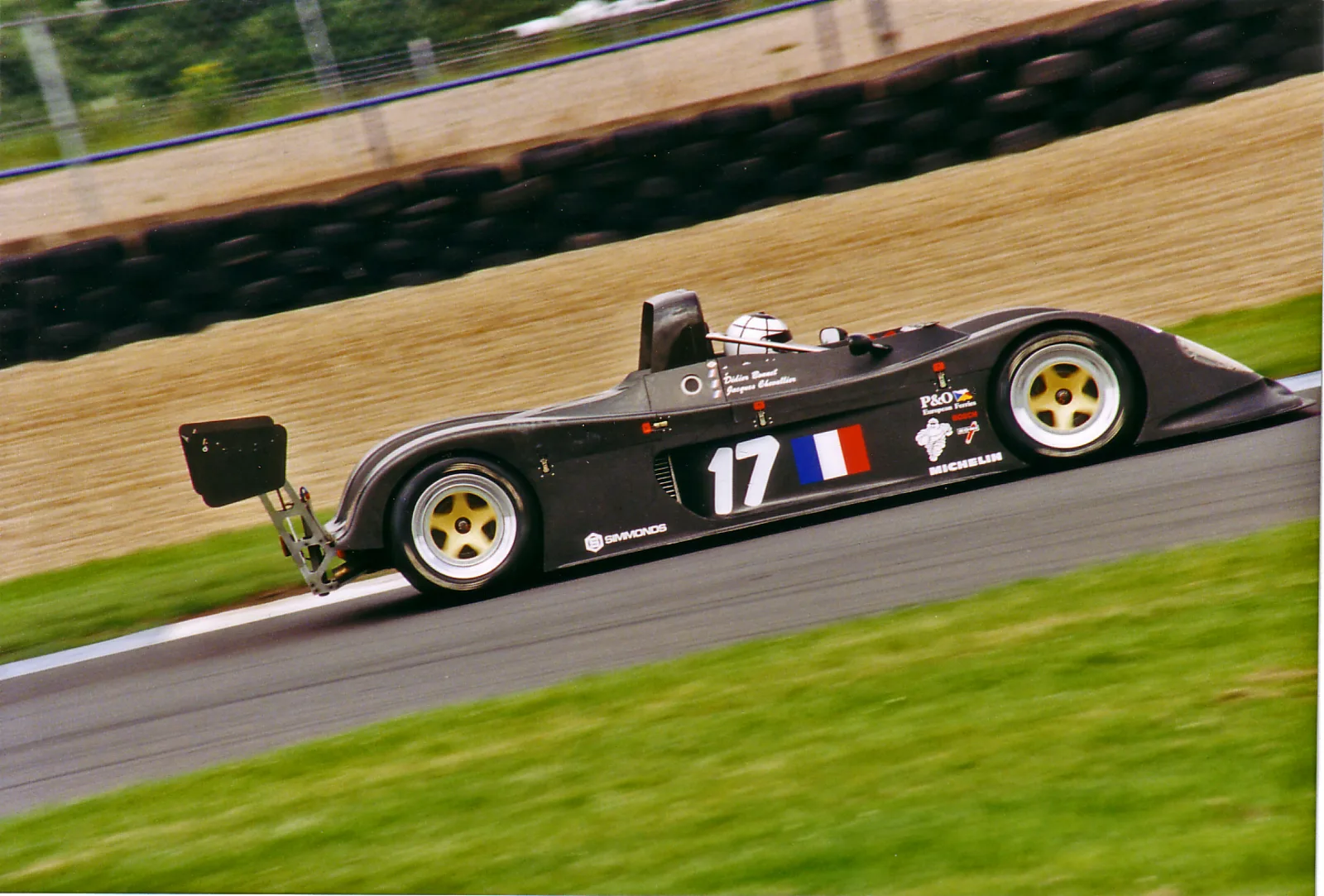
An open-top, carbon-bodied prototype that switched engines several times before it was updated into the LMP299 for the 2000 season.
Debora Automobiles built the LMP296 in 1996 as a Le Mans prototype for the 24 Hours of Le Mans. Its first engine was a turbocharged 2-litre Cosworth four, and several other units were tried before the car was updated into the LMP299 for the 2000 season.
Debora's LMP296 was an open-top prototype that Didier Bonnet Racing and the Waterair Sports team ran through the mid-1990s. Its aluminium honeycomb monocoque carried carbon fibre bodywork, and its engine changed several times before the team settled on a 3-litre BMW straight-six. The car was then updated into the LMP299 for the 2000 season.
What was the Debora LMP296?
This was a Le Mans prototype made by Debora Automobiles in 1996, intended for the 24 Hours of Le Mans. It began life with a 2-litre turbocharged Cosworth straight-four and raced with several engines over its career. Two cars are known to have been built.
Together with the LMP297, the LMP296 helped Waterair Sport win the SR2 Team's Championship in 1998. Its racing life therefore ran from the early Le Mans pre-qualifying rounds to the International Sports Racing Series and, finally, into the LMP299 designation.
An open-top carbon prototype that changed engines several times and then found a regular home in SR2 racing.
Who designed the LMP296?
Roger Rimmer developed the chassis of the LMP296, while Didier Bonnet designed the bodywork. The result was an aluminium honeycomb monocoque with open-top carbon fibre bodywork, built for the 24 Hours of Le Mans in 1996. The car was first entered in the pre-qualifying session that year.
The chassis used a double-wishbone suspension developed by KONI, with Michelin-shod 16-inch wheels and Alcon disc brakes with four-piston calipers. Power went to the wheels through a 5-speed Hewland FGC gearbox.
What engine did the LMP296 use?
The first engine was a 2-litre turbocharged Cosworth straight-four derived from the Ford Escort RS Cosworth unit and race-prepared by Fochesato, with a claimed maximum output of 370 hp (276 kW; 375 PS). Several other engines were tried before the team found its long-term unit.
In 1998 the team experimented with a 3-litre Alfa Romeo V6, then with 3-litre and 3.2-litre BMW straight-six engines. The Alfa Romeo V6 was fitted at Paul Ricard, but exhaust damage forced the car out of that race, and the team moved on.
The 3-litre BMW was fitted after the 1998 Le Mans race, when the car had run with a slightly larger 3.2-litre BMW S50 for the race itself. The 3-litre unit then went into the car for the rest of 1998, and it was the engine the LMP299 used from 2000.
How did the LMP296 start in 1996?
The LMP296 first entered the 24 Hours of Le Mans pre-qualifying session in 1996 under Didier Bonnet Racing. One of the two chassis entered, driven by Guillaume Gomez, finished 56th and was not allowed to take part in the main race.
Another car, driven by Edouard Sezionale, Jean-Claude Basso and Thierry Lecerf, was permitted to race and qualified 52nd. It did not start because of engine problems, so the weekend ended with no finish at Le Mans.
The car made its first racing appearance in the 1996 Le Mans Autumn Cup. Jacques Chevalier, Dominique Lacaud and Patrice Roussel finished fifth overall and second in the LMP2 class,.
How did the LMP296 perform in the International Sports Racing Series?
In 1997 and 1998 the LMP296 competed in the International Sports Racing Series. It was classed as an SR1 car in 1997 and as an SR2 car in 1998, when its best results came. Those results included class victories at Misano, Donington Park and the Nurburgring.
The 1997 season was difficult. The car retired after six laps at Donington Park, and it crashed on the formation lap at Zolder without making the start. Its only finish that year came at Jarama, where Herve Regout and David Dussau took fourth overall and third in class.
In 1998 the team ran the car under the Waterair Sports banner. Lionel Robert pre-qualified it 51st for Le Mans, and the car then completed 106 laps before a gearbox failure forced it out at around the ten-hour mark. Robert, Edouard Sezionale and Pierre Bruneau were the drivers in that race.
After Le Mans the car ran with the 3-litre BMW. At Misano, Sezionale, Cholley and de Castelli came home eleventh overall and claimed the SR2 class, the only SR2 entry on the grid. The car won the SR2 class again at Donington Park, finishing fifth overall with de Castelli and Francois Jakubowski.
The season ended with a seventh-place finish at the Nurburgring, where the LMP296 took the class victory. Waterair Sports then took a 1-2 in the SR2 category there, and they were crowned SR2 Team's Champions for 1998, finishing joint twelfth overall.
| Season | Event or series | Best result | What ended the campaign |
|---|---|---|---|
| 1996 | Le Mans pre-qualifying and Le Mans Autumn Cup | Qualified 52nd; fifth overall and second in LMP2 at the Autumn Cup | Engine problems stopped the Le Mans start |
| 1997 | International Sports Racing Series | Fourth overall and third in class at Jarama | Retired after six laps at Donington Park |
| 1998 | International Sports Racing Series | SR2 class wins at Misano, Donington Park and the Nurburgring | Gearbox failure at Le Mans after 106 laps |
| 1999 | Sports Racing World Cup | Class victories at Barcelona and Brno | Brno was the car's last finish |
What happened to the LMP296 in 1999?
In 1999 Pierre Bruneau took ownership of the car and ran it in his own team. Partnered by Marc Rostan and Martin Henderson, Bruneau opened the season with ninth overall and a class victory at Barcelona. The team took another class win at Brno later in the year.
Monza was a poor weekend, as the team finished last overall and last in class, eleventh and sixth respectively. At Spa-Francorchamps the car was ninth overall and second in class, and at Pergusa it retired. Donington Park brought a stronger third of six in class, with twelfth overall.
The car's last ever finish came at Brno, where it finished seventh overall and won its class as all the other SR2 cars retired. It retired from each of the remaining three events. Bruneau's squad was runner-up to Cauduro Tampolli Team in the SR2 team standings and finished eleventh in the overall team table. The LMP296's final season was therefore a mixture of class success and retirements for the team.
How did the LMP297 fit into the story?
The LMP297 ran alongside the LMP296 for Waterair Sports and Didier Bonnet Racing. Points from both cars made the team the 1998 SR2 Team's Champions, and the car was not used after 1999, when an entry for Donington Park never arrived.
The LMP297 made its International Sports Racing Series debut in 1997 at Donington Park with a 3-litre BMW straight-six, retiring after 22 laps. At Zolder it retired after 39 laps following an accident, and it finished for the first time at Jarama, where it took fifth overall and second in class. Its first finish came at Jarama, where Patrice Roussel and Bruno Boccard took fifth overall and second in class. Its first Le Mans pre-qualifying attempt that year, with a 2-litre Cosworth turbo, ended with a 46th place.
In 1998 Waterair Sports ran the LMP297 at the Nurburgring, where it finished tenth overall and second in class. Cholley and Bruneau then took class victories at Le Mans and Kyalami, both times as the only SR2 car to finish.
What was the LMP299?
The LMP299 was the updated version of the LMP296 for the 2000 season, fitted with a 3-litre BMW straight-six and classed in the SRL category. It raced for PiR Bruneau until 2002, when a 3-litre Nissan V6 was fitted for the final season.
The LMP299 debuted at the opening 2000 round in Barcelona, where Pierre Bruneau and Marc Rostan finished second in the SRL class and eleventh overall. Monza ended with an ignition problem after 56 laps, and at Spa-Francorchamps the team took sixth overall and third in the SRL category.
The team entered Le Mans but was not invited to race, although the car had been fitted with a 3.2-litre BMW straight-six for the event. The car then went to the 1000 km of Nurburgring in the American Le Mans Series, where it was classified as an LMP and finished fourteenth overall, tenth of the LMPs and third in the LMP675 subclass.
The year ended with a broken axle at Brno after three laps, a gearbox failure at Donington Park after 69 laps and a 17th overall finish at the Nurburgring. At Magny-Cours the car was twelfth overall and sixth in SRL. The team finished sixth in the SRL Team's Championship with 39 points.
Bruneau and Rostan were joint ninth in the SRL Driver's Championship, and the team's single ALMS race gave it 15 points and 16th place in the LMP Team's Championship.
How did the LMP299 fare in 2001 and 2002?
In 2001 the series was renamed the FIA Sportscar Championship, and the LMP299 was classed as an SR2 car. Arturo Merzario joined Bruneau and Rostan for the opening Barcelona round, where the team took eleventh overall and seventh in SR2. Monza ended in accident damage after 81 laps, and at Spa-Francorchamps the car retired after 55 laps.
Later in 2001 the team finished eleventh overall at Donington Park, fourth in SR2, and tenth overall at Mondello Park, also fourth in SR2. It ended the season ninth overall at the Nurburgring, seventh in SR2. Rostan was the highest-classified driver, tenth in the championship with 38 points.
In 2002 Philippe Hottinguer and Paul Daniels were picked for the opening round at Barcelona. Bruneau ran a two-car operation, buying a Pilbeam MP84 and running it alongside the LMP299, which had been refitted with a 3-litre Nissan V6. The LMP299 retired at Barcelona with a driveshaft issue after 35 laps, and at Estoril it finished eleventh and last overall, sixth in SR2.
Several drivers shared the LMP299 that year. Bruneau partnered Paul Daniels at Brno, but the pair did not start because of engine problems. At Magny-Cours Philippe Hottinguer returned alongside Daniels, and the engine failed after 61 laps. Daniels then drove with Rob Croydon at Dijon-Prenois.
At Dijon-Prenois the car finished ninth and last overall, sixth in SR2. At Spa it crashed out after 22 laps, and that was the last time the LMP299 was entered in a race.