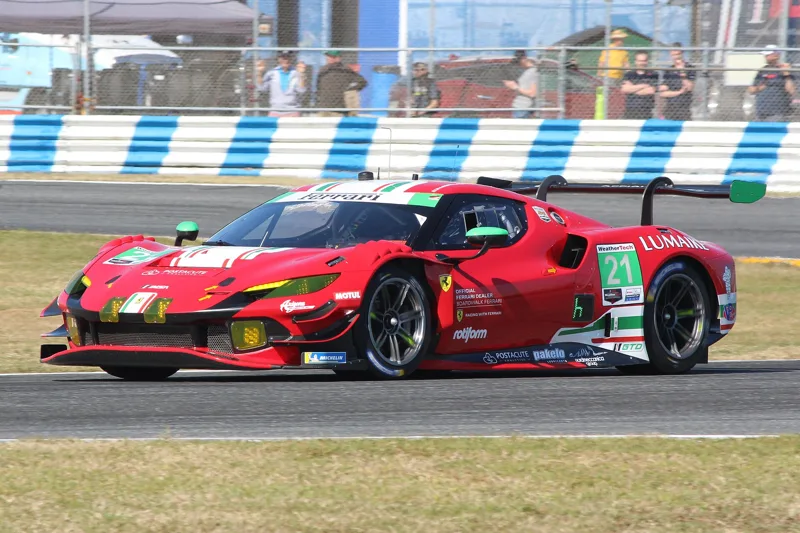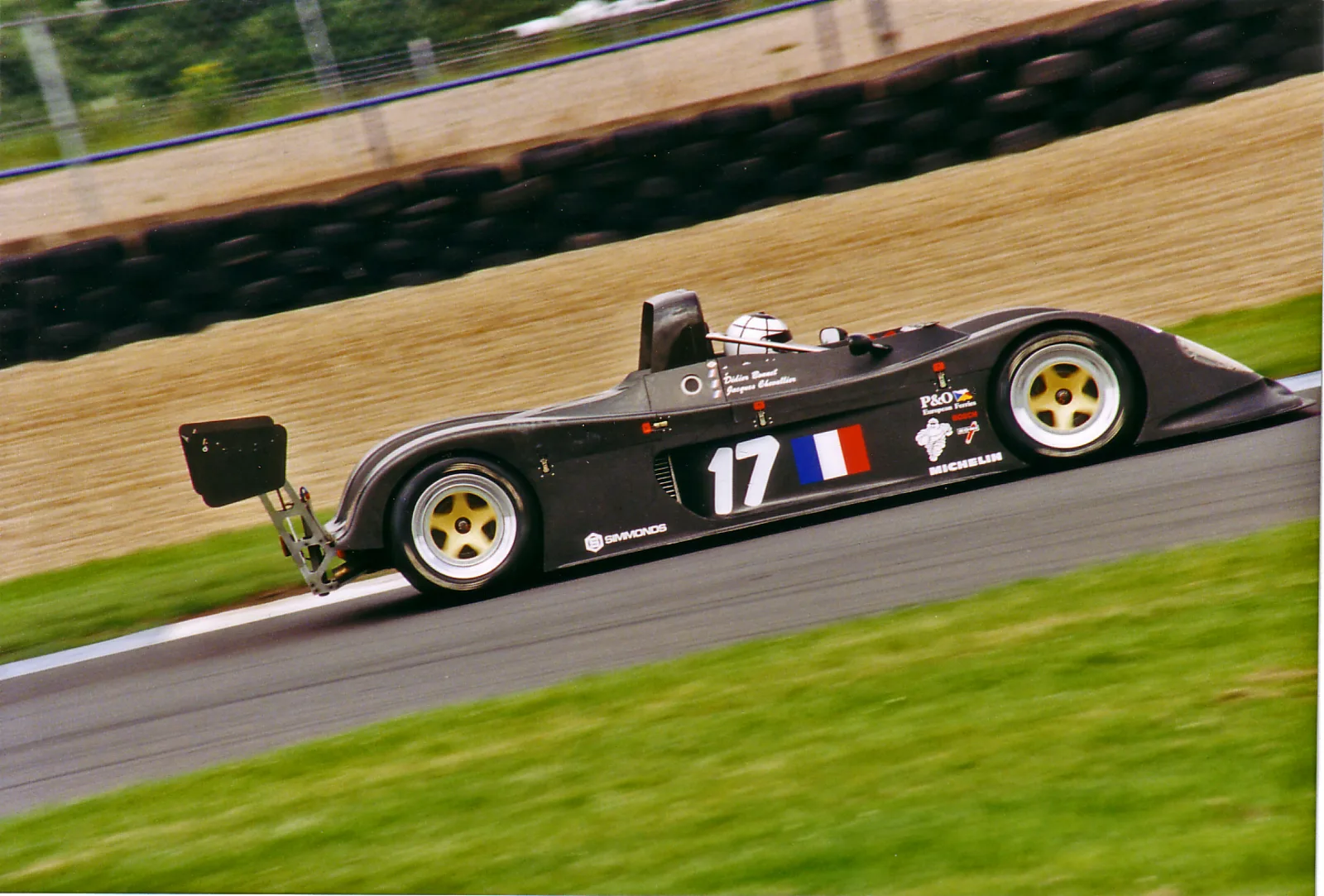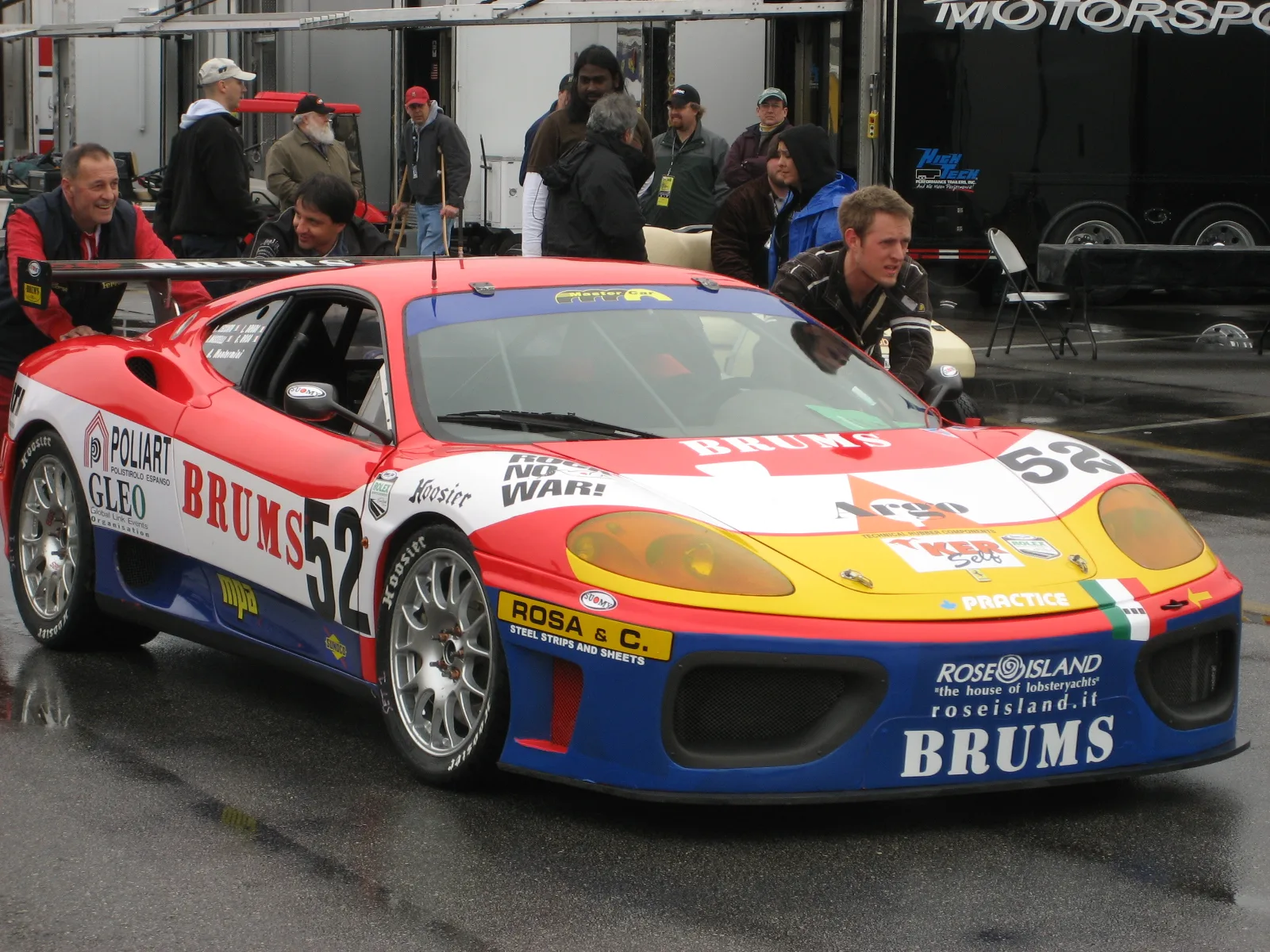
A Michelotto and Ferrari racer built from the 360 Challenge car, which took the 2001 FIA GT titles and later finished second overall at Daytona.
The Ferrari 360 Modena GT was a racing version of the 360 Modena road car, built by Michelotto with Ferrari for FIA N-GT and ACO GT racing. It won the FIA GT titles in 2001 and produced about 430 PS in GT form.
The Ferrari 360 Modena GT was a racing car built by Michelotto with Ferrari for two sanctioning bodies, the ACO's GT class and the FIA's N-GT class. It was derived from the 360 Modena road car, and in its first season as the N-GT it took the FIA GT team and drivers' titles for a Monaco team.
Its story runs from Ferrari's single-model Challenge series to a GT racer that Ferrari decided to develop itself, and on to a second-place finish overall at the 24 Hours of Daytona.
Where did the 360 Modena GT come from?
The car grew out of Ferrari's competition plans. In 1993 Ferrari decided to build a race model from a road model, so that fans could recognise it on track, and a Challenge series followed. In 2000 JMB Competition and Michelotto joined forces to build a car for the FIA N-GT class.
The 348 Challenge gave way to the 355 Challenge in 1995, and the 360 Challenge followed in 2000. Late in 1999, enthusiasm for the Challenge model led to the N-GT project, based on that version. In total, thirty-eight chassis were built.
JMB Competition, the Monaco team, was one of the main users of the Challenge car, and it became the partner in the new project. The car received its N-GT name in 2001, because of the FIA category in which it raced.
Built from a Challenge car and tuned for endurance racing, the 360 Modena GT won the FIA GT title in its first season.
Engineering the GT version
The GT was built in two forms, one for the FIA N-GT rules and one for the GT rules of the Automobile Club de l'Ouest. Because it had to race in endurance events, Ferrari and Michelotto wanted a car that was easy to drive. Electronic aids helped the driver, who could adjust the brake balance from the cockpit. The car also carried an anti-lock braking system and a Bosch ASR traction control system as standard.
The bodywork was heavily modified, with reinforcements in Kevlar and carbon fibre that also stiffened the car. The gearbox was the six-speed F1-type sequential unit that was optional on the road car, and its electronic management, carried over from the Challenge car, was reprogrammed for faster gear changes. The chassis and suspension were revised to speed up pit work, and the cooling air intakes were resized.
How much power did the 360 Modena GT make?
The GT's output is about 430 PS (316 kW; 424 hp), against 400 PS (294 kW; 395 hp) for the road car. The gain of 8% to 9% comes from a 30.8 mm air intake flange, a limit the ACO imposed to keep the field fair. Peak torque reached about 373 Nm (275 lb ft) at 4,750 rpm.
The engine uses twin overhead camshafts and five valves per cylinder. Ferrari's engineers also worked on fuel consumption, aiming for fewer pit stops than rival cars.
The 2001 season and the first title
In 2001 JMB Competition entered two chassis in N-GT form for the FIA GT Championship. At Monza the No. 63 crew of Andrea Garbagnati, Marco Lambertini and Batti Pregliasco crashed out after sixty-two laps, and No. 62 of Christian Pescatori and David Terrien retired with brake problems. On 16 April, at Brno, Terrien and Pescatori finished second behind the Porsche of RWS Motorsport. Early in May they won the 500 km of Magny-Cours by fifteen seconds, and at Silverstone the No. 62 crew won again.
The Monaco team struggled at Zolder, where No. 62 retired after eighteen laps and No. 63 never started because of an engine failure in practice. At the Hungaroring, Terrien and Pescatori took a narrow win, about two seconds ahead of the Porsche of Larbre Competition. At Spa, the entered No. 63 did not appear, and the lone No. 62 retired in the twentieth hour with an engine failure.
Late August brought another win at Spielberg for Terrien and Pescatori, with a lap in hand. At the Nurburgring they could only manage eighth. At Jarama in late September the Ferrari took its fifth victory of the season, almost twenty seconds clear of the Porsche of RWS Motorsport. JMB Competition finished the year with a third place at Estoril.
Who won the 2001 titles?
JMB Competition and RWS Motorsport both finished on sixty-two points, but the Monaco team took the team title on victories, with five against two. David Terrien and Christian Pescatori won the drivers' title, three points clear of Luca Riccitelli of RWS Motorsport, with sixty points in total.
Peter Kutemann also entered a third chassis under his own name, numbered 99, and finished seventh at Estoril alongside Iradj Alexander.
The 2002 runner-up season
In 2002 the car became the Ferrari 360 Modena GT, and JMB Competition changed its name to JMB Racing. The team ran four cars, numbered 50 to 53, with Pescatori and Andrea Montermini in the first and Andrea Garbagnati and Andrea Bertolini in the second. At Magny-Cours, No. 50 won and No. 51 also finished on the podium.
At Silverstone, No. 50 won by a lap over the Porsche of Autorlando Sport, and the Ferrari No. 51 again took third. No. 52 was damaged in practice and did not start, and it was not repaired in time to take part at Brno. At Anderstorp, No. 51 recorded its best result of the season with second place, while No. 50 settled for fourth.
At the 500 km of Oschersleben, No. 51 finished just off the podium, and at the 24 Hours of Spa, No. 50 placed fourth overall and runner-up in N-GT, five laps down on the Porsche of Freisinger Motorsport. Pescatori finished the season as runner-up in the drivers' standings, and JMB Racing was runner-up in the team standings.
Daytona and the other entrants
The car finished second overall at the 24 Hours of Daytona in the year after its runner-up season. Michelotto's racer had by then been run by several teams, including outside entrants in the 2002 FIA GT rounds. Among them, Scuderia Sant Ambrous won its class at Spa in the National category and finished tenth overall.
Mastercar entered a 360 GT for Franco Bertoli, Santi De Filippis and Carlo Commis, and it finished eleventh at Enna-Pergusa. Team Veloqx ran three more 360 GTs at Donington, and one of them, No. 83, finished third at Estoril.
The 2003 season
For 2003 no fewer than eight Modenas were entered through the year. Team Maranello Concessionaires ran Tim Mullen and Jamie Davies on No. 88, and Kelvin Burt and Darren Turner on No. 89. Star Rent Competition fielded Steeve Hiesse with Guillaume Gomez on No. 58, and MenX ran Robert Pergl with Tomas Enge on No. 57.
JMB Racing entered Andrea Bertolini and Fabrizio de Simone on No. 52, and Peter Kutemann with Antoine Gosse on No. 53. In early April at Barcelona the Modenas claimed a one-two-three, with No. 52 winning. At Magny-Cours the Davies and Mullen crew won, and Gomez and Hiesse completed the podium. At the Enna-Pergusa round on 12 May, Bertolini and de Simone lost out to a Porsche, and on 25 May at Brno they were second again. At Donington the best Modena, No. 88, finished only fifth in class and fifteenth overall.
What are the Ferrari 360 Modena GT specifications?
The 360 Modena GT produced about 430 PS (316 kW; 424 hp) in its GT form and about 373 Nm (275 lb ft) of torque. It used a six-speed F1-type gearbox, Bosch traction control and a 30.8 mm air intake flange set by the ACO.
| Specification | Detail |
|---|---|
| Base cars | 360 Modena road car and 360 Challenge |
| Categories | FIA N-GT and ACO GT |
| Road car output | 400 PS (294 kW; 395 hp) |
| GT output | About 430 PS (316 kW; 424 hp) |
| Torque | About 373 Nm (275 lb ft) at 4,750 rpm |
| Valvetrain | Twin overhead camshafts, five valves per cylinder |
| Gearbox | Six-speed F1-type sequential |
| Air intake flange | 30.8 mm diameter, ACO limit |
| Chassis built | Thirty-eight |