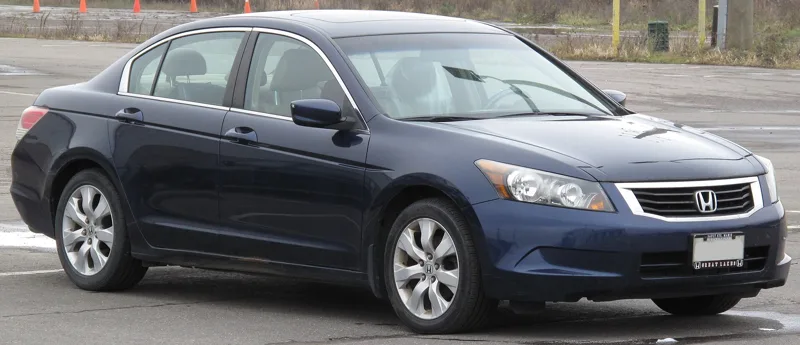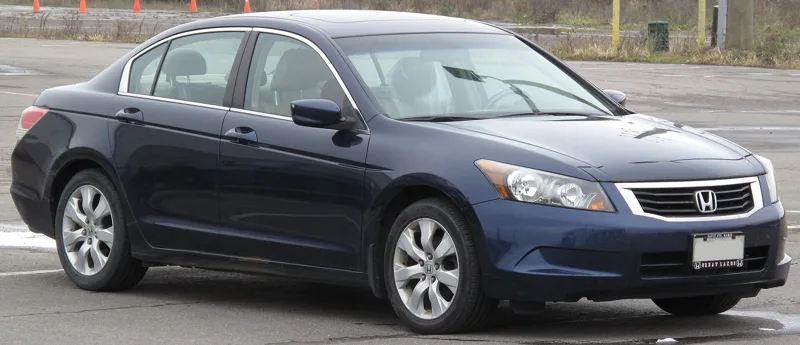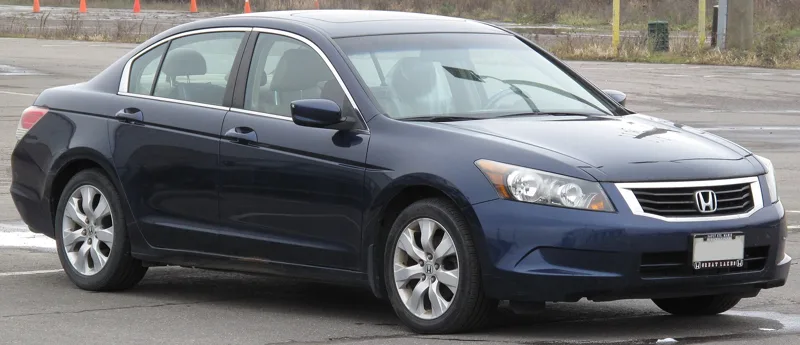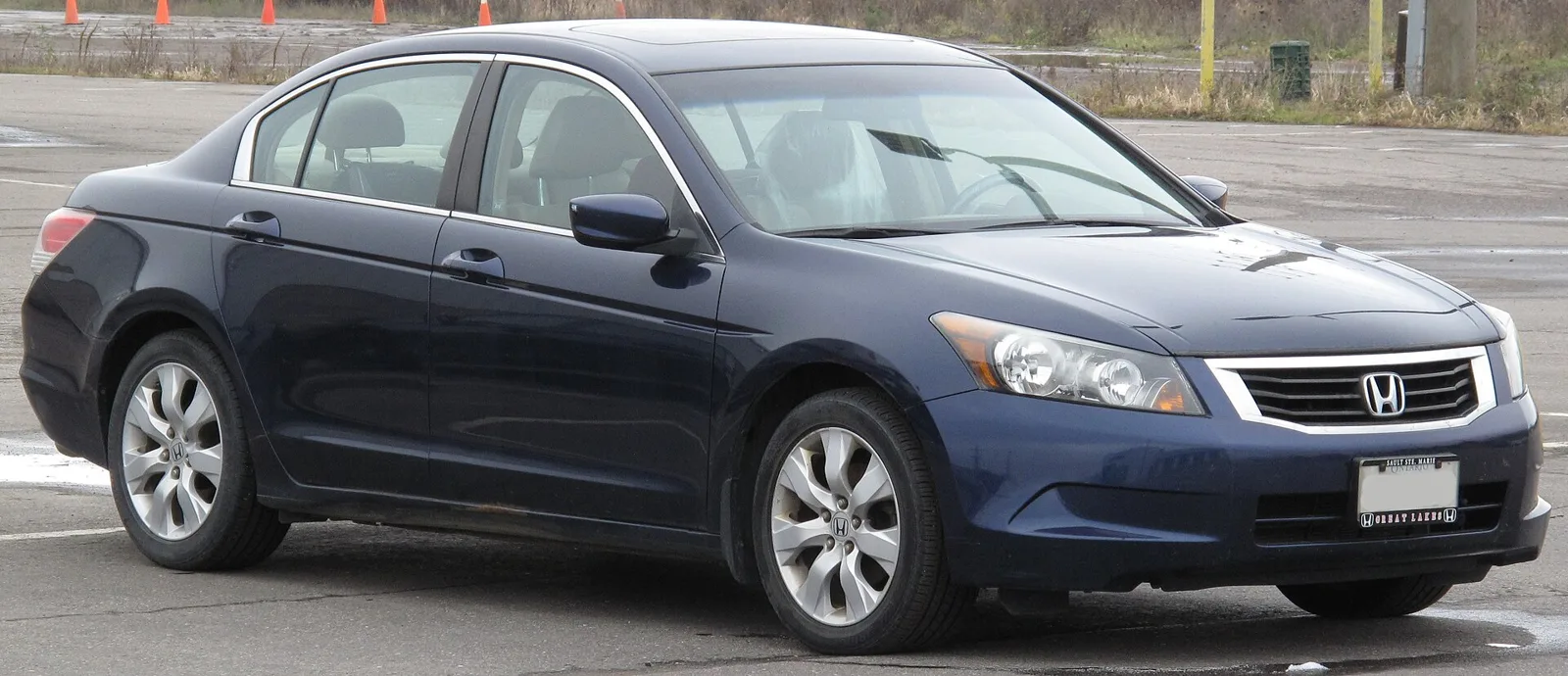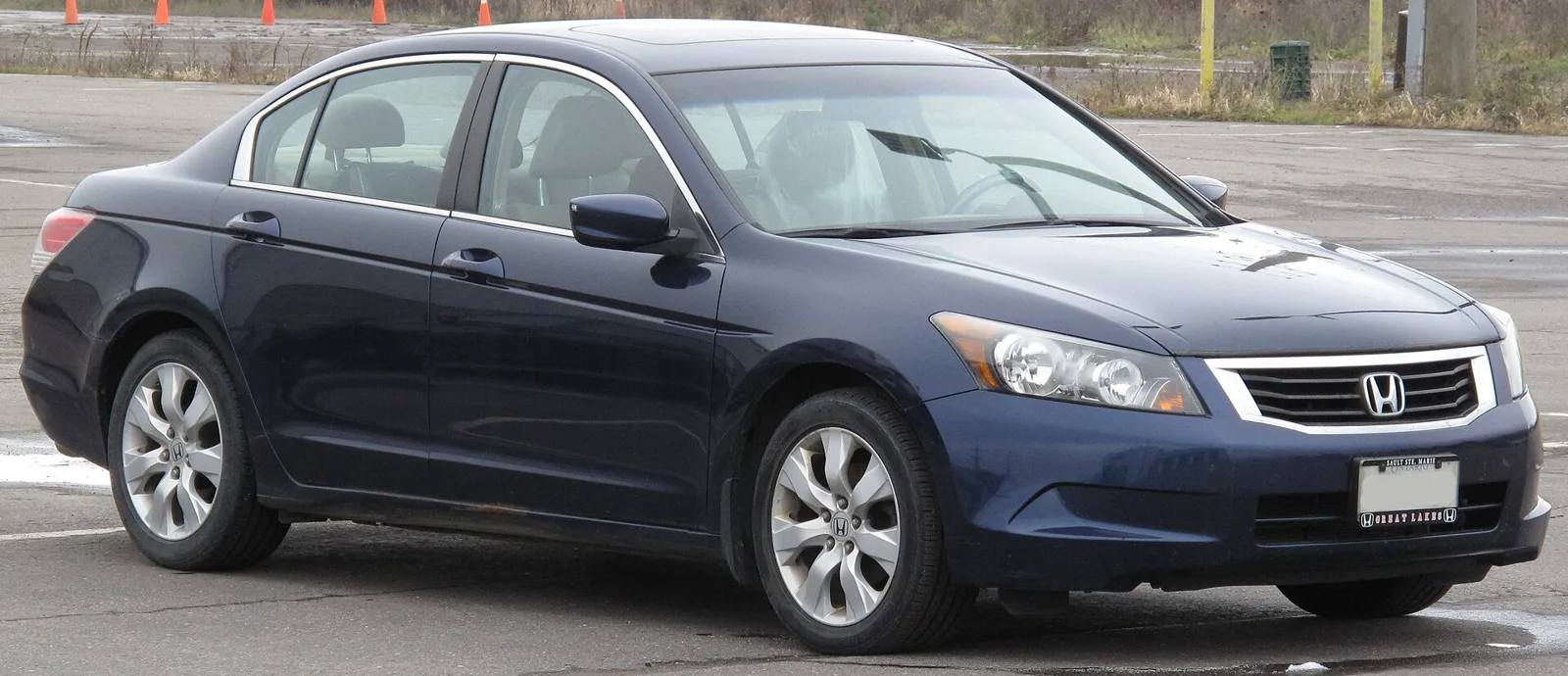
A bigger mid-size Accord from 2007, offered with four-cylinder and V6 power, that later faced brake and airbag controversies.
Introduced in August 2007 for the 2008 model year, the North American eighth-generation Accord was a mid-size sedan and coupe. It was 4 inches longer than its predecessor, offered four-cylinder and V6 engines, and was built in Ohio and Alabama.
The North American eighth-generation Honda Accord arrived in August 2007 as a 2008 model, a mid-size car sold as a sedan and a coupe. Outside North America the car also went on sale in parts of Asia and Australasia, and it was called the Honda Inspire in Japan. Its life in North America was marked by larger dimensions, a V6 option, a 2011 facelift and a long run of safety and recall stories.
How much bigger was the 2008 Accord?
The 2008 Accord was 4 inches (102 mm) longer and 3 inches (76 mm) wider than the car it replaced. The sedan offered 120 cubic feet (3.4 m3) of combined interior space, enough for the EPA to call it a nearly executive car.
The coupe was classed as a mid-size car, with 105 cubic feet (3.0 m3) of combined interior space. The extra size enlarged the interior of both body styles.
A larger mid-size Honda that grew by 4 inches and later faced brake-wear and airbag controversies.
How did the 2008 Accord reach the market?
Honda first showed the coupe as a concept at the 2007 show in Detroit, previewing a production two-door with the i-VTEC VCM V6. The production sedan and coupe were revealed on August 21, 2007, and US sales began in September.
The concept's hybrid plan was dropped, because Honda felt its hybrid system suited smaller cars better. No hybrid version was offered for this generation.
US sedan sales started on 12 September 2007, and the coupe followed on 20 September 2007. At the 2007 SEMA Show, Honda also unveiled a concept coupe, the HF-S, to display its Honda Factory Performance parts.
Which trims could buyers choose?
In Canada the 2008-10 sedan came in LX, EX, EX-L and V6 forms, with the LX using a 177 hp 2.4-litre four. The United States added the LX-P sedan and the LX-S coupe, and the LX-S swapped the smaller engine for a 190 hp unit.
The LX bundled brakes with brake assist, stability control, cruise control and keyless entry, with body-coloured handles and mirrors. Five-speed manual and automatic transmissions were both offered on the four-cylinder cars.
The EX added a 190 hp version of the inline four, a power moonroof, 17-inch alloys, an 8-way power driver's seat, a security system and a six-disc CD changer. The EX-L added leather, XM satellite radio, and optional navigation with hands-free Bluetooth.
V6 models carried a 3.5-litre i-VTEC V6 with VCM, rated at 268 hp, and came with a five-speed automatic. The V6 coupe came with 18-inch rims and a lip spoiler at the back, and the six-speed close-ratio manual used the non-VCM variant of the J35 engine.
The Accord was also sold in a PZEV form. PZEV versions were available for the four-cylinder and V6 cars with five-speed automatics, and their exhaust valve system worked differently at low and high revs.
What did the 2011 facelift change?
Both the sedan and coupe received a facelift for 2011, with new front fascias and updated tail lamps. Aerodynamic changes and a revised five-speed gearbox lifted fuel economy to 23 mpg in the city and 34 mpg on the highway.
The sedan gained reflective strips seen on the Japanese Inspire, and the EX-L V6 coupe got steering-wheel paddle shifters. USB connectivity arrived on all coupes and on EX and EX-L sedans.
In Canada the SE replaced the LX as the entry trim, with 16-inch alloy wheels, while in the US the SE sat between the LX-P and EX with leather upholstery. EX-L V6 models also gained memory seats.
Where was the Accord built?
The North American four-cylinder and V6 Accords were first assembled at Honda's Marysville Auto Plant in Ohio, which became the sole global source of the coupe. From mid-2009, most V6 sedans came from Lincoln, Alabama.
Honda's Anna, Ohio, engine plant made the four-cylinder engines, and the US plants supplied most Accords for North and South America.
How did the Accord sell outside North America?
The Inspire was the right-hand-drive version of the North American car, sold in Japan as the fifth-generation Honda Inspire. In South Korea the Accord helped push Honda past BMW, Mercedes-Benz and Lexus, with sales up 95 per cent in the first seven months of the year.
Guangzhou Honda began building the car in China in 2007, and the company was renamed Guangqi Honda in 2009. The model was also assembled in Thailand for Southeast Asia, Australia and New Zealand.
In Australia and New Zealand the car sat beside the Japanese-built European-spec Accord, so the smaller model was badged Accord Euro, and New Zealand got only the V6 as the Accord V6.
In October 2012 Honda and Proton of Malaysia teamed up under Japan's Abenomics plan. The result, the Proton Perdana, was a rebadged eighth-generation Accord that launched on 11 December 2013 for the Malaysian government and civil servants.
The Perdana replaced an ageing fleet of Mitsubishi Galant-based Proton Perdana V6 cars that had been in use since the 1990s.
The car arrived in the Middle East in November 2007 as a 2008 model. The GCC launch took place in Dubai on 6 November 2007, and Saudi releases came through Abdullah Hashim Company Ltd. at the same time, with both a 2.4-litre engine and a 3.5-litre V6 on offer.
How did the V6 and VCM system work?
The V6 i-VTEC VCM system shuts off two or three cylinders depending on the driving, which lifts fuel economy. Without VCM, highway economy drops by 4 mpg, and the V6 engines were re-rated in the 2009 model year.
PZEV engines worked in two modes. Below 2,500 rpm only one exhaust valve operates, creating a thermal reactor effect that cuts hydrocarbon emissions. Above 2,500 rpm a hydraulically actuated pin locks the rockers of both valves together.
Honda sold PZEV versions in only 15 states, because the margin on them was smaller for the maker. The list included California, Florida, Vermont, Connecticut, Arizona and Washington.
How did the Accord fare in safety testing?
The sedan scored Good in 13 of the 14 IIHS categories and won a Top Safety Pick. It lost that award over an Acceptable roof strength result, and it was regained for 2012 models, which were rated Good in the roof test.
An IIHS study of vehicle fatalities found the Accord had the lowest fatality rate among non-luxury midsize sedans, and only the Saab 9-3 beat it among luxury midsize sedans.
Standard safety for the 2008 model year included vehicle stability assist, traction control, tyre pressure monitoring, active front head restraints and dual chamber side impact airbags. Honda claimed the Accord was the first car of its size category to have stability and traction control as standard across the range.
What was the brake-wear class action?
In September 2009 a class action covered 2008 and 2009 Accords, certain 2010 Accords and some Acura TSX cars. It said a defect applied excess force to the rear wheels, wearing the rear pads every 15,000 to 20,000 miles.
A preliminary settlement was announced on April 6, 2010. Honda agreed to reimburse owners for part of earlier brake repairs and to pay up to $150 for redesigned brake pads, and final approval followed on July 29, 2010.
What happened with the airbag deployments?
Some 2008-2009 Accords had their passenger-side curtain airbags deploy unexpectedly, sometimes when doors closed or while the car was moving. Honda first refused to cover the issue under warranty, and in October 2015 it agreed to recall 300,000 Accords over a software fault in the airbag control unit.
At least 14 injuries were reported. In January 2014 Honda took part in an NHTSA engineering review, after the agency had received 300 complaints. On 4 August 2014 the regulator upgraded that work to a preliminary investigation covering at least 335,195 2008 Accords.
How did reviewers rate the Accord?
Reviews were mostly positive, and some drew comparisons with BMW's 3 and 5 Series for its styling, which was described as Germanic. Car and Driver placed the 2008 Accord EX first in a March 2008 four-cylinder comparison, and Edmunds.com InsideLine gave the same top spot to the LX-P and to the EX-L V6 with navigation.
MotorTrend was less enthusiastic. It said the Accord was too heavy and less nimble than its predecessor, and it criticised the polarising looks and the car's showing against the Chevrolet Malibu in its Car of the Year contest.
A March 2012 Car and Driver test placed the Accord second of six, behind the Volkswagen Passat. Consumer Reports made it the top mid-size pick, and Consumer Guide named it a Best Buy.
Car and Driver's 10Best list included the Accord in 2008 and 2009, and the nameplate has earned that honour 23 times, more often than any other vehicle. US sales rose 9.4 per cent as SUV buyers shifted to the V6.
Other honours included a 4 1/2-star rating from JB car pages for the 2008-2011 model, and the Accord became the most-searched vehicle on CarMax for four consecutive years.
What were the Accord's core specifications?
| Specification | Detail |
|---|---|
| Model years | 2008-2012, eighth generation |
| Introduced | August 2007 |
| Size change | 4 in (102 mm) longer, 3 in (76 mm) wider than before |
| Sedan interior | 120 cu ft (3.4 m3) |
| Coupe interior | 105 cu ft (3.0 m3) |
| Four-cylinder | 2.4 L i-VTEC inline-four, 177 hp (EX 190 hp) |
| V6 | 3.5 L i-VTEC V6, 268 hp, with VCM |
| Economy after 2011 | 23 mpg city, 34 mpg highway |
| PZEV | Sold in 15 states |
| Assembly | Marysville, Ohio; V6 sedans from Lincoln, Alabama from mid-2009 |
The eighth-generation Accord kept its four-cylinder and V6 choices from start to finish, and the 2011 update left those two basic powertrains in place. The sedan and coupe differed in interior space and body style.
Did the Accord become a Crosstour?
The Crosstour began as a crossover fastback built on the North American Accord, badged Accord Crosstour in 2010 and 2011. From 2012 to 2015 it became a separate model, simply called the Crosstour.