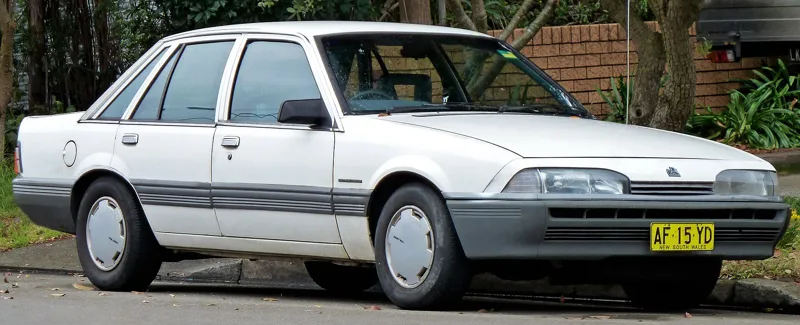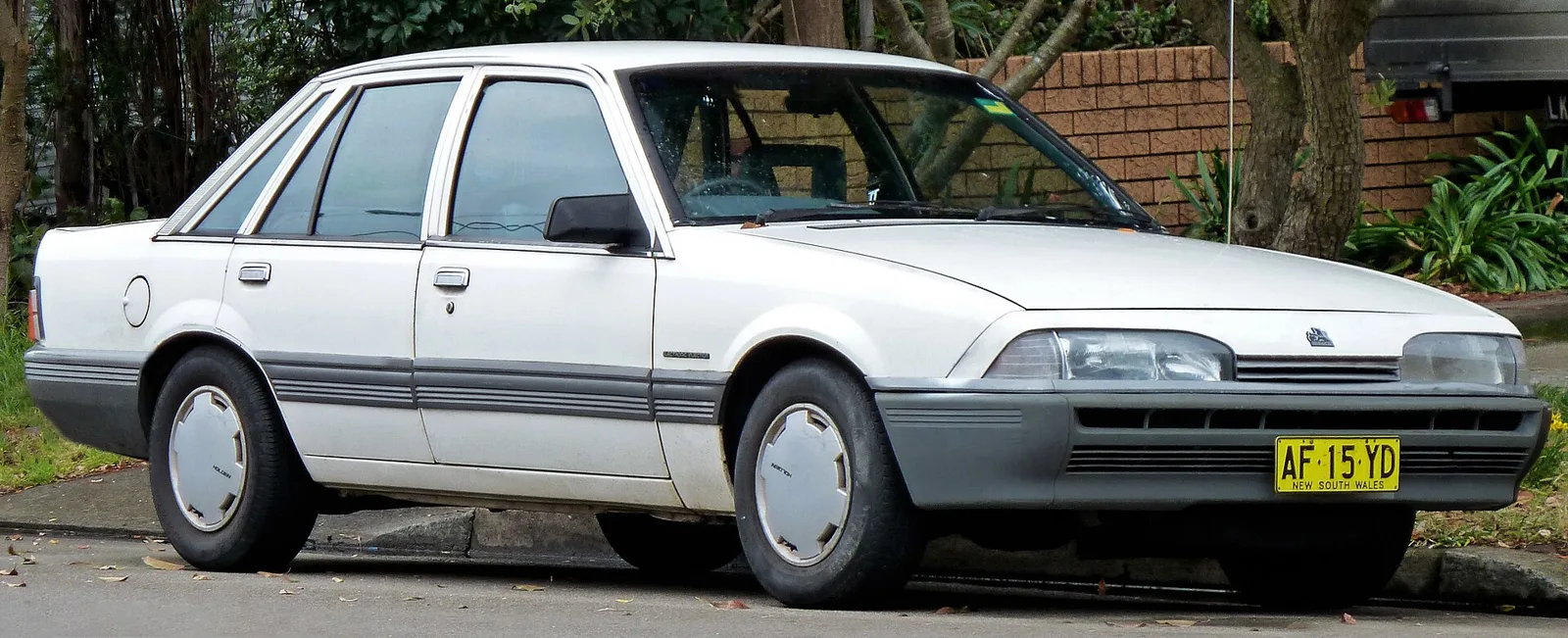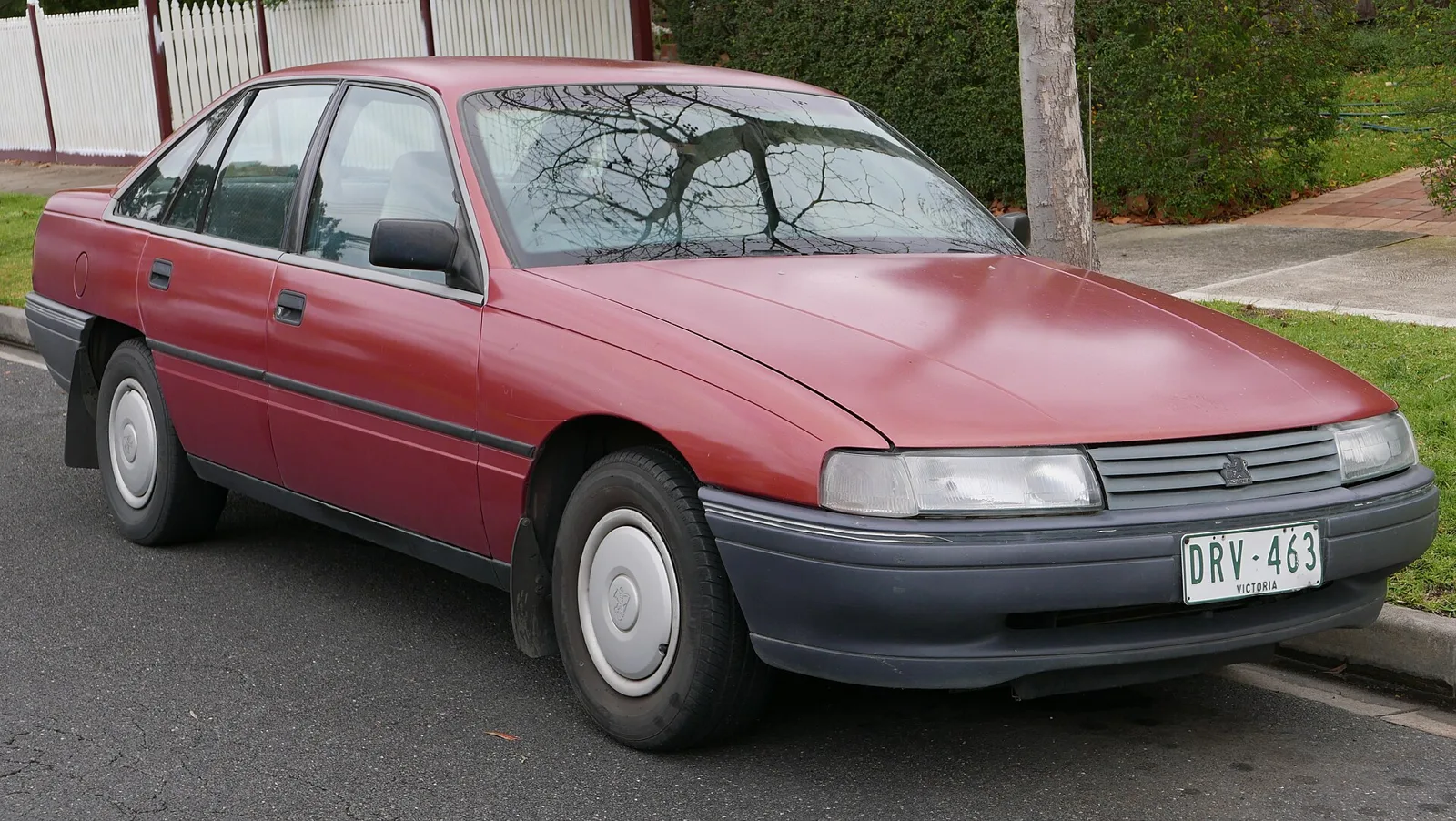
The 1988 VN was built on a European body with a Buick-derived V6, won Wheels Car of the Year a second time and later carried a Toyota badge.
Built from 1988 to 1991, the Holden Commodore VN was the opening model of a new generation. It was based on Opel Omega and Senator bodies, used a Buick-derived V6, and became the Toyota Lexcen in Australia. Holden built 215,180 of them.
The VN Commodore arrived in August 1988 on a body borrowed from Europe, a re-engineered hybrid of the Opel Omega and Opel Senator. It could now match the Ford Falcon for size, and it took Wheels' car of the year prize again before the model's three-year run ended.
The VN also became the base for a family of models. The Toyota Lexcen, the Statesman and Caprice, and the VG Utility all grew from the same body, which made it a useful foundation for Holden's range.
Where did the VN Commodore come from?
The VN opened a new generation of the Commodore, and it replaced the mid-size VL. Holden paired the new body with a Buick-derived V6 or its own 5.0-litre V8, and the program cost some A$200 million before the car went on sale.
Holden widened and stretched the VL floor pan to suit the donor body. The result could match the Ford Falcon for size, which was a notable change for a Commodore that had been regarded as mid-size until then.
The VN was also the first Commodore available as a coupe utility, which was a useful addition to the range. The VG Utility arrived in August 1990, and it was the first coupe utility Holden had offered since 1984.
An Opel-based Commodore with a Buick-derived V6 and a Toyota twin makes the VN one of the most unusual Commodores.
What engines did the VN use?
The VN's V6 was a Buick-derived LN3, built in Australia after the Nissan engine of the VL was dropped. Holden kept the 5.0-litre V8 as an option, and it gained power to 165 kW (221 hp) for the new car. Both engines used multi-point GM fuel injection.
The 3.8-litre V6 in the Executive made 125 kW (168 hp), and the V6 used three coil-packs for ignition. The four-speed Jatco automatic was replaced by the GM TH700, another four-speed unit.
A five-speed T-5 unit from Borg-Warner took over from the older gearbox. Holden also introduced a centre high-mount stoplight before July 1, 1989, because Australian rules required it on all passenger cars built from that date.
The Series II arrived in September 1989 with the EV6 engine. Changes included a new cast exhaust manifold, a revised camshaft sprocket and timing chain, and recalibrated ignition. Initial torque was reduced, and noise and vibration improved.
Export markets received a 2.0-litre four-cylinder with fuel injection, shared with the Opel Vectra A. In New Zealand it was sold as the Holden Berlina, a model that was never offered in Australia.
Which VN Commodore models were on sale?
The VN came as the Executive, S, SS, Berlina and Calais. The Executive was the base car at A$20,014, and the Calais, the top of the range, was priced from A$31,265. Each model had its own price point and package, which gave buyers a clear ladder from fleet to luxury.
- Executive: from A$20,014, with the 3.8-litre V6, a five-speed manual, power steering and 14-inch steel wheels
- S: from A$21,665, with a basic bodykit, sports trim and FE2 suspension
- SS: from A$25,375 in March 1989, with the 5.0-litre V8, a limited-slip differential, an SS body kit and unique alloys
- Berlina: from A$24,781, with a four-speed automatic and air conditioning
- Calais: from A$31,265, with cruise control, a power pack and a computer-assisted trip odometer
The Calais gained climate control in 1990, and its options included a 5.0-litre V8 with a limited-slip differential. The Berlina, by contrast, was the entry luxury version and was offered with a V8 as an option.
Why did the VN become the Toyota Lexcen?
Under the Button car plan, Australia reduced the number of models built locally and allowed some to be shared between makers. The VN was rebadged as the Toyota Lexcen in September 1989, named after Ben Lexcen, the designer of a 1983 America's Cup yacht.
The Lexcen replaced the Toyota Crown S120 in Australia. The same arrangement brought the Toyota Corolla and Camry into Holden showrooms as the Nova and Apollo.
What happened to the VN in New Zealand?
Assembly in New Zealand ran from 1988 to 1990, and the VN was the last Commodore built there. General Motors New Zealand closed its Trentham plant in late 1990, and the final locally assembled Holden, a 3.8-litre V6, came off the line on November 21, 1990.
New Zealand Berlinas used a 2.0-litre four-cylinder that was never sold in Australia, and the Calais for New Zealand was largely V6 powered. Twenty fully equipped Calais models were sold there with the four-cylinder motor after a cancelled Singapore order.
A New Zealand-only GTS was a limited run of 510 in early 1990. It carried a body kit, FE2 suspension and the V6, and it was offered in Vivid White or GTS Blue metallic.
How many VN Commodores were built?
Holden built 215,180 VN Commodores in its three-year life, with production ending in September 1991. The VG Utility arrived in August 1990 as the first coupe utility since 1984, and the Statesman and Caprice (VQ) followed in March 1990. Both the VG and the VQ extended the family using the VN's core engineering.
The VQ Statesman and Caprice were built on the VN Commodore base, with a longer wheelbase shared by the wagon and the VG Utility. They gave Holden a luxury flagship on the same engineering that carried the family cars.
Limited editions and dealer specials
Holden released a series of limited editions alongside the main range. The LE was limited to 100 sedans, each with the 3.8-litre V6, sold through the New South Wales dealer group and shown at Sydney Motor Show in October 1989 for $43,200.
The LS of July 1991 was the last and cheapest VN Commodore. Australia received 300 sedans at $28,990, and New Zealand took 130 sedans and 20 wagons.
The Challenger was a 50-sedan run sold through Holden dealers in Canberra from June 1990. The Vacationer of 1990 was another small special, built on the Executive with its own badging.
The DMG 90 was sold through a Queensland dealer group and built by HSV in 50 units. The BT1 was the police package for the Executive, available with either the V6 or the 5.0-litre V8.
How did HSV change the VN?
The SS Group A SV existed to homologate a racing Commodore, and it was based on the VN SS. Holden needed at least 500 road cars for FISA, but only 302 were built, and the Confederation of Australian Motor Sport gave Holden dispensation to race the car.
The SS Group A SV had a 4.9-litre V8 rated at 215 kW (288 hp) and a six-speed ZF S6-40 manual, and every car was painted maroon. It was built at Holden's Elizabeth plant and modified at HSV's Clayton facility in Victoria.
The Clubsport arrived in June 1990 as a four-door sedan with a 5.0-litre V8 rated at 180 kW (245 PS; 241 hp). HSV built 410 of them until August 1991.
How did the VN perform in motor racing?
The VN raced in the Group A era, the rules that governed many touring car series from the 1980s to the 1990s. Peter Brock returned to Holden for the first time since their 1987 split, teaming with Larry Perkins under Holden's two-pronged racing effort alongside the Holden Racing Team.
The Group A SV was rated at about 388 kW (528 PS; 520 hp) in race trim. It was slower through the corners than the VL, because it had less downforce, and it lost about two seconds a lap at Bathurst against its predecessor.
Brock's only Group A win for the VN came at Amaroo Park in 1992, in the first heat of round one of the Australian Touring Car Championship. The VP replaced the VN as Holden's front-line touring car in September 1992.
AUSCAR was a Bob Jane category based on NASCAR stock-car racing, and the VN was instantly successful there from the 1990/91 season. Brad Jones won three straight titles in a VN Commodore, and a VN NASCAR was also developed for Bob Jane with a 6.0-litre Chevrolet engine.
What made the SS and Calais different?
The SS was the sports flagship, with the 5.0-litre V8 at 165 kW (221 hp), a limited-slip differential and a bodykit with a front and rear lip, side skirts and a boot-lid spoiler. The Calais was the luxury top, offering a V8 with a limited-slip differential and, from 1990, climate control.
The SS came with a TH700 automatic or a five-speed T5 manual, along with driving lights, FE2 sports suspension and unique SS alloy wheels. Its interior used grey and red checker fabric, and it was offered in Atlas Grey, Phoenix Red and, later in the run, Alpine White.
The Calais added a computer-assisted trip odometer, an alarm and remote central locking, and its climate control arrived in 1990. Leather upholstery and a country pack suspension were the main options.
Where did the VN's parts come from?
The body came from Opel's Omega and Senator, and the Vauxhall Carlton II and Senator II shared it in the United Kingdom. The V6 was a Buick-derived LN3 that GM had used in US-market vehicles before Holden began building it locally.
The engine was initially imported before Holden took on local production. The move followed currency swings that had made the Nissan engine of the VL too costly to keep, so the VN's V6 became the family's economy engine.
The 5.0-litre V8 remained in the range, so buyers still chose between a V6 for economy and a V8 for performance, the same basic choice the VL had offered.
How did the Group A SV compare with the VL?
The VN Group A SV was lighter than its predecessor, at a homologated 1,250 kg (2,760 lb), which was lower than the VL SV. The weight saving was real, but the VN's bodywork was criticised for a lack of downforce.
Its nickname was the plastic pig, a name that came from its heavy use of plastic bodywork. Drivers complained that the lack of downforce hurt lap times, even though the car was faster in a straight line.
A tow from Dick Johnson's Sierra helped the VN reach 282 km/h (175 mph) at Bathurst, compared with the VL's roughly 270 km/h (168 mph) the year before.
Did the VN have a police special?
The BT1 was the police special for the Executive, available with the 3.8-litre V6 or the 5.0-litre V8. It came with extractors, a larger V8 fuel tank, a 200 km/h speedometer and a unique instrument cluster. Each police force ordered the pack to suit its own needs.
A transmission cooler, an SS exhaust pack and larger wheel nuts were also part of the package, which varied by police force.
Holden Commodore VN specifications
| Specification | Detail |
|---|---|
| Production | 1988 to September 1991; 215,180 built |
| Launch | August 17, 1988 |
| Engines | 3.8-litre V6 125 kW (168 hp) in the Executive; 5.0-litre V8 165 kW (221 hp) |
| Transmissions | Jatco four-speed automatic, then GM TH700; five-speed manual with the T-5 |
| Launch prices | Executive A$20,014; S A$21,665; SS A$25,375; Berlina A$24,781; Calais A$31,265 |
| Toyota Lexcen | From September 1989 |
| SS Group A SV | 4.9-litre V8, 215 kW (288 hp); 302 built |
| Clubsport | 5.0-litre V8, 180 kW (245 PS; 241 hp); 410 built |