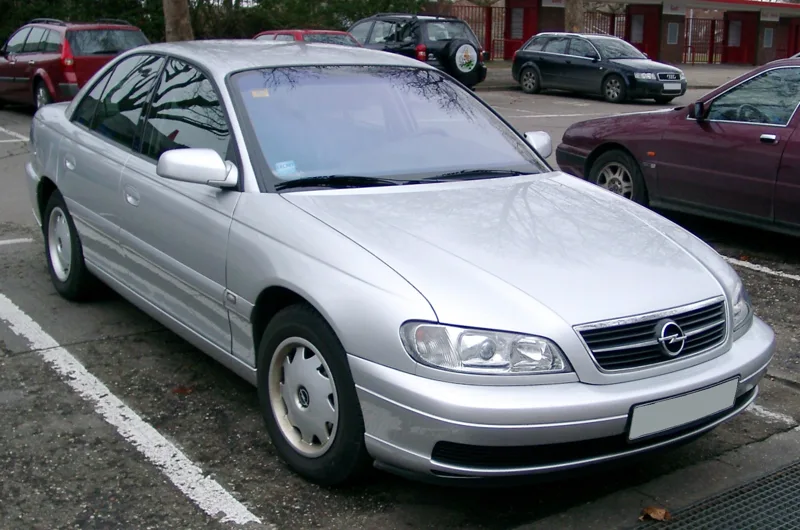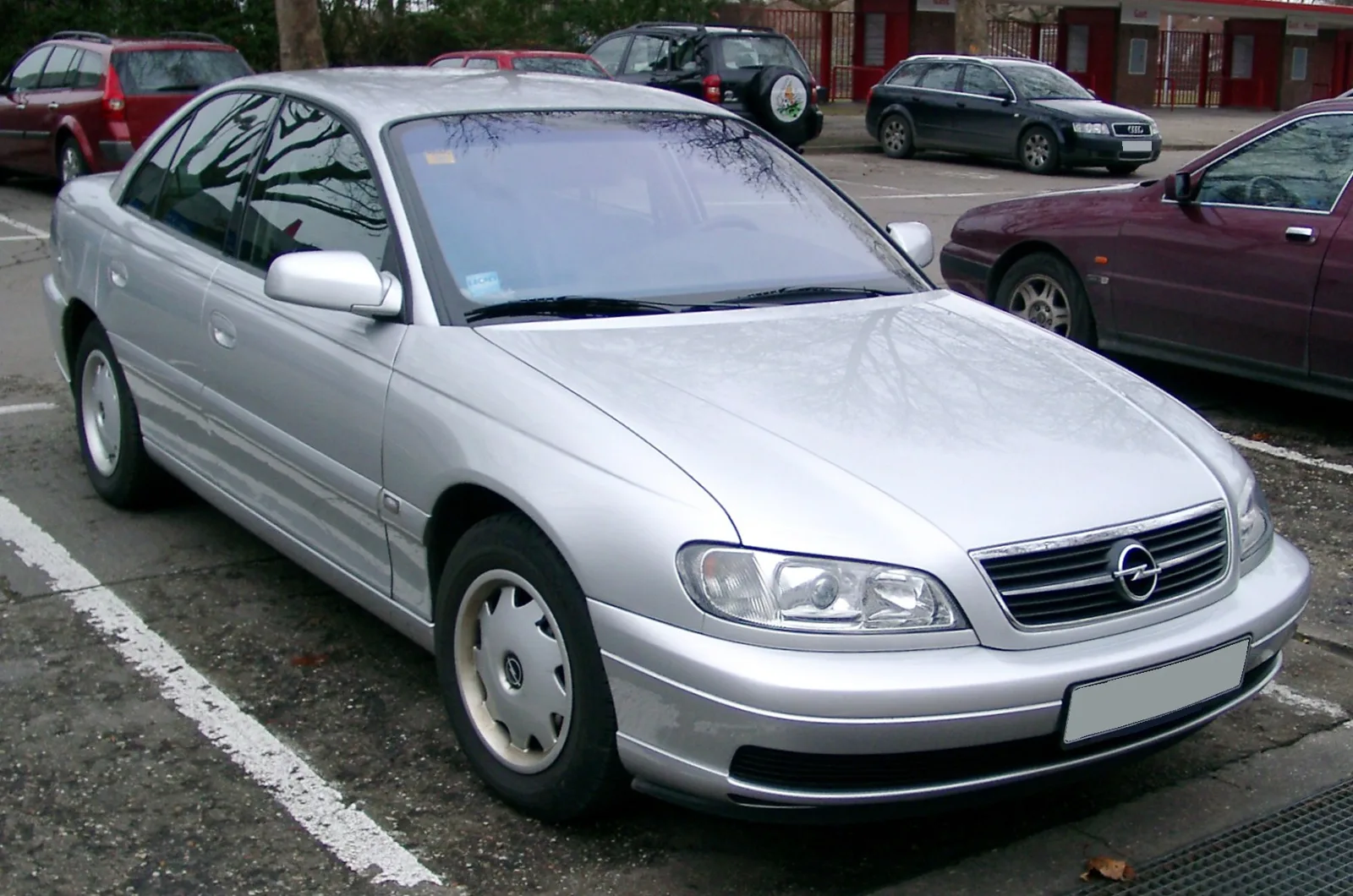
Opel's executive car won European Car of the Year for 1987, spawned a 377 bhp Lotus version and was rebadged from Britain to North America.
The Opel Omega was an executive car built from 1986 to 2003 in two generations. It replaced the Rekord, won European Car of the Year for 1987 and was rebadged worldwide, including as the Vauxhall Carlton and the Cadillac Catera.
The Opel Omega was an executive car that Opel built from 1986 to 2003 in two generations. The first Omega replaced the Rekord, and the second arrived in 1994. Rebadged versions appeared around the world, from the Vauxhall Carlton in Britain to the Cadillac Catera in North America.
Why did Opel build the Omega?
Opel built the Omega to replace the final Rekord. The body was an evolution of the company's design theme, engineered for aerodynamics because fuel prices were rising. The whole development programme cost 2.5 billion Deutschmarks, or 1.5 billion pounds.
Many of the Omega's technologies were new to Opel, though not to the volume segment as a whole. Electronic engine management and a self-diagnosis system were among them.
A drag coefficient of 0.28 was low for the period, and the Caravan managed 0.32. Production began in September 1986 and sales followed in November. In Britain the car wore the Vauxhall Carlton badge, the nameplate of the Rekord before it.
The Omega brought electronic engine management, ABS, an on-board computer and an air-conditioned glovebox. An LCD instrument cluster arrived in 1987, although it was dropped in 1991. The car also had a self-diagnosis system that authorised service stations could read.
Late in 1986 the Omega took the European Car of the Year title for 1987, beating the updated Audi 80 and the BMW 7 Series.
An executive car that won European Car of the Year in 1987 and went on to spawn a 377 bhp Lotus, a cancelled V8 and a long list of rebadges.
Which engines did the Omega A use?
The Omega A was longitudinal, with rear-wheel drive, and it came with a five-speed manual or a four-speed automatic. Engines ran from 1.8L, 2.0L and 2.4L four-cylinders up to 2.6L, 3.0L and 3.0L-24v sixes.
The 1.8L and 2.0L petrol fours came from the Family II design, while the sixes and the 2.4L four were based on Opel's older cam-in-head family. Diesel options included a 2.0L and 2.3L unit, and a 2.3L turbodiesel joined them.
Brazilian buyers knew the car as the Chevrolet Omega. It first used 2.0L I4 or 3.0L I6 engines from Opel, then a 2.2L I4 producing 116 PS (85 kW). The Brazilian range later used a locally produced 4.1L straight-six, tuned by Lotus, which made 168 PS (124 kW).
Which trims did the Omega A offer?
Four trims were offered, LS, GL, GLS and CD, arranged from the cheapest to the dearest. The LS was aimed at the fleet market, and in some markets its sedan was not sold to private customers at all.
The 1991 facelift changed the front and rear fascias and the interior materials, and it added sound deadening. The 1.8L base engine was dropped, the LS and GLS disappeared from the range, and Club and CD Diamant were added beside the CD.
Introduced in 1988, the Diamant package could be added to the GLS, LS and CD. It brought alloy wheels, metallic paint, tinted windows, a cassette stereo and leather trim, and it sold well enough that a similar package returned for the Omega B.
What was the Omega 3000?
The 3000 model was Opel's sporting take on the Omega A range. It had a 3.0L 12-valve straight-six producing 177 PS (130 kW), along with a lowered suspension, a limited-slip differential, different fascias and a rear spoiler.
It reached 220 km/h (137 mph) and needed 8.8 seconds to get from 0-100 km/h. In October 1989 an optional 24v engine arrived with a variable intake manifold, lifting output to 204 PS (150 kW), 240 km/h (149 mph) and a 7.6-second sprint.
The catalysed version of the original engine produced only 156 PS, and the uncatalysed model was discontinued in August 1988. In markets where it was badged as a Vauxhall, the car became the Carlton GSi 3000.
What was the Evolution 500?
Opel built 500 Evolution examples with Irmscher so that it could compete in the DTM. The road cars had a 230 PS (169 kW) three-litre six, which gave 0-100 km/h in 7.5 seconds and it reached 249 km/h (155 mph) flat out.
The racing version used on track had 380 PS (279 kW). It could reach 100 km/h in about 5 seconds and approach 300 km/h (186 mph). The programme did not achieve great success, despite the power on paper. Those 500 road cars existed to get Opel into the DTM at all, which made them the price of admission rather than a sales target.
What was the Lotus Omega?
The Lotus Omega was a high-performance version that Opel sanctioned in 1989 in cooperation with Lotus. It was sold as the Lotus Carlton in Britain, and its engine grew to 3.6 litres with two Garrett T25 turbochargers, producing 377 bhp (281 kW; 382 PS).
The car inherited a 45% limited-slip differential from a Holden Commodore, and its six-speed ZF gearbox came from the Chevrolet Corvette ZR1. Its engine management and ignition were also modified, borrowing from the Lotus Esprit. The base engine was Opel's standard 3.0-litre 24-valve unit, which Lotus took and reworked.
Weighing 1,663 kg (3,666 lb), the car reached 100 km/h from rest in 5.3 seconds and 160 km/h (99 mph) in 11.5 seconds. Estimates placed its top speed between 280 and 300 km/h, roughly 174 to 186 mph, so it ranked as the fastest production sedan of its time.
What was the Omega B?
The 1994 Omega B was an all-new car with a modern exterior, but it kept a traditional rear-wheel-drive chassis. Its engine range was entirely new, and it marked a fresh start for the executive car line.
The MV6 model was rebadged as the Cadillac Catera in the United States between 1997 and 2001. The Omega B platform also became the basis of the third-generation Holden Commodore from 1997.
Awards followed in 1995, including the Semperit Irish Car of the Year and the RJC Car of the Year for imports in Japan.
What engines did the Omega B use?
Compared with the Omega A, the engines changed little, apart from the switch from Opel's own 2.3-litre diesel to BMW's turbocharged inline-six, the M51. That unit was later updated to a Euro 2 compliant version during 1996.
In late 1999 a 2.2L 16v joined the range as the eventual replacement for the 2.0L, which soon left the catalogue. The following year a 3.2L V6 replaced the 3.0L, and a 2.6L V6 took the place of the 2.5L, a sign of how quickly the range was reworked.
What did the Omega B2 change?
The Omega B2 arrived in autumn 1999 as a facelift. It had revised front and rear styling, a new centre console and an electronic stability programme. The bonnet and grille were integrated, and new alloy wheel designs were added.
The engines changed too. A 2.2L 16v replaced the 2.0L, a 3.2L V6 replaced the 3.0L in 2000, and a 2.6L V6 replaced the 2.5L. A BMW-sourced 2.5 DTI common-rail diesel arrived in 2001.
What was the Omega V8 project?
Opel wanted a V8 to challenge BMW's 5 Series and Mercedes' E-Class, so it built prototype sedans and estates. The planned engine was the GM LS1 V8, and a V8 station wagon concept called V8.com debuted at the Frankfurt show in September 1999.
Unlike the V8.com concept, the production Omega V8 was intended for series production, with a planned autumn 2000 launch.
V8.com was 130 mm longer than the standard wagon. It carried separate 9.5-inch LCD screens for each passenger, internet access and a video conference phone system with its own cameras and microphones. Its xenon headlights adjusted to road conditions.
The production V8 was shown at the Geneva show in March 2000 and was meant to go on sale that autumn. The plan was cancelled after 32 pre-series cars were built. Concerns focused on the transmission, because the flexplate of the 4L60-E automatic broke repeatedly during full-throttle testing at 250 km/h.
Holden used the same V8 in its Commodore, and the cooling problem was solved there with the larger Holden Commodore radiator. A version of the platform later became the Holden Monaro, which the United States sold as the fourth-generation Pontiac GTO.
When did production end?
The last Omega rolled out of the Russelsheim factory on 25 June 2003. It was a silver 3.2L V6 B2, number 797,011, and the Opel Signum took over the car's place as Opel's flagship.
Holden kept building Commodores based on the Omega until 2006 for the sedan. Opel's later flagship was therefore the Signum, which used an extended Vectra platform and blended MPV and estate features.
In Britain, Omegas and Carltons were a regular sight, including police livery and covert traffic surveillance cars. As of July 2020, 3,297 Vauxhall Omegas and 306 Carltons remained on UK roads.
Did the Omega keep its place against rivals?
After the Ford Scorpio and Rover 800 faded from the segment, the Omega faced BMW's 5 Series on its own, with minimal sales success. The controversial styling of the Scorpio had already weakened Ford's challenge in the same class.
The Omega's place as Opel's flagship was taken over by the Signum, an extended-length design built on an extended Vectra platform that blended MPV and estate features into one package.
Holden's Commodore kept some of the Omega's legacy alive after 2003, although the new sedan no longer rode on an Omega platform. A magazine feature in October 2004 presented a Holden Torana TT36 concept as the successor, and that concept previewed the 2006 Commodore.
Specifications at a glance
| Item | Detail |
|---|---|
| Production | 1986 to 2003 |
| Generations | Omega A (1986-1994) and Omega B (1994-2003) |
| Drag coefficient | 0.28 (0.32 for the Caravan) |
| Omega 3000 (1989) | 204 PS (150 kW), 240 km/h (149 mph), 7.6 seconds to 100 km/h |
| Evolution 500 | 230 PS (169 kW), 249 km/h (155 mph), 500 built |
| Lotus Omega | 377 bhp (281 kW; 382 PS), 1,663 kg (3,666 lb), 5.3 seconds to 100 km/h |
| Final car | 25 June 2003, number 797,011 |
How did the Omega reach Japan?
From July 1989, Isuzu Motors took over distribution of the Omega A and the Vectra in Japan, ending the long relationship with Toho Motors. In the Isuzu line-up the Omega sat above the Aska, giving the executive car a place in a market where Opel had little presence.
Elsewhere the car sold in most European countries, with the exception of the United Kingdom, where the Vauxhall Carlton badge carried it. That split meant the same engineering reached British buyers under a different name and dealer network.
Which markets sold the Omega under other names?
In Britain the Omega A was the second-generation Vauxhall Carlton, while the Omega B became the Vauxhall Omega. Between 2001 and 2007 Vauxhall also sold the Monaro coupe, a car built in Australia on Commodore underpinnings.
Brazil's Omega A ran as a Chevrolet from August 1992 to August 1998. The Chevrolet badge later covered Australian-built Commodores between 1999 and 2006, and in the Philippines a Chevrolet Lumina took over from the Omega.