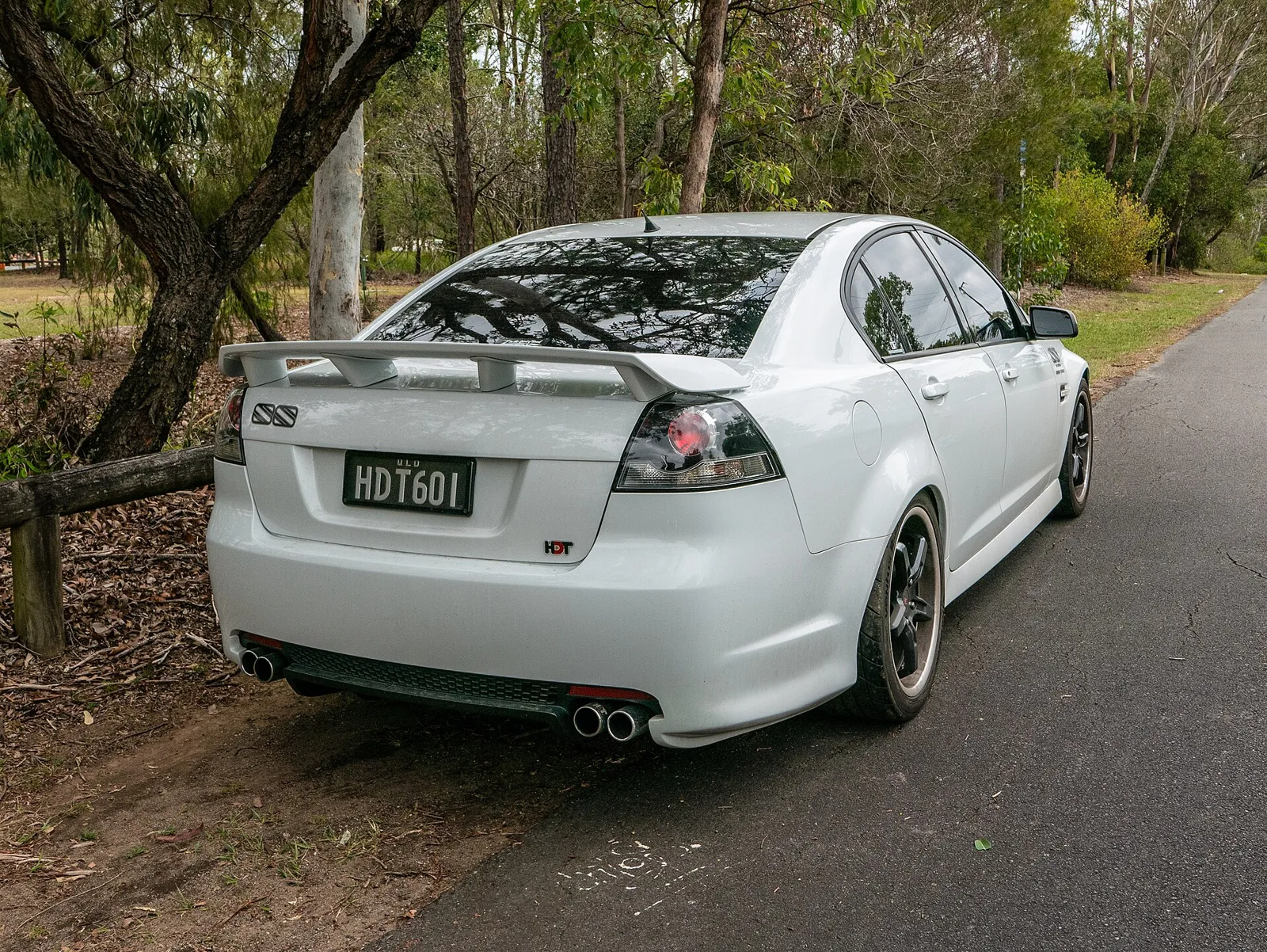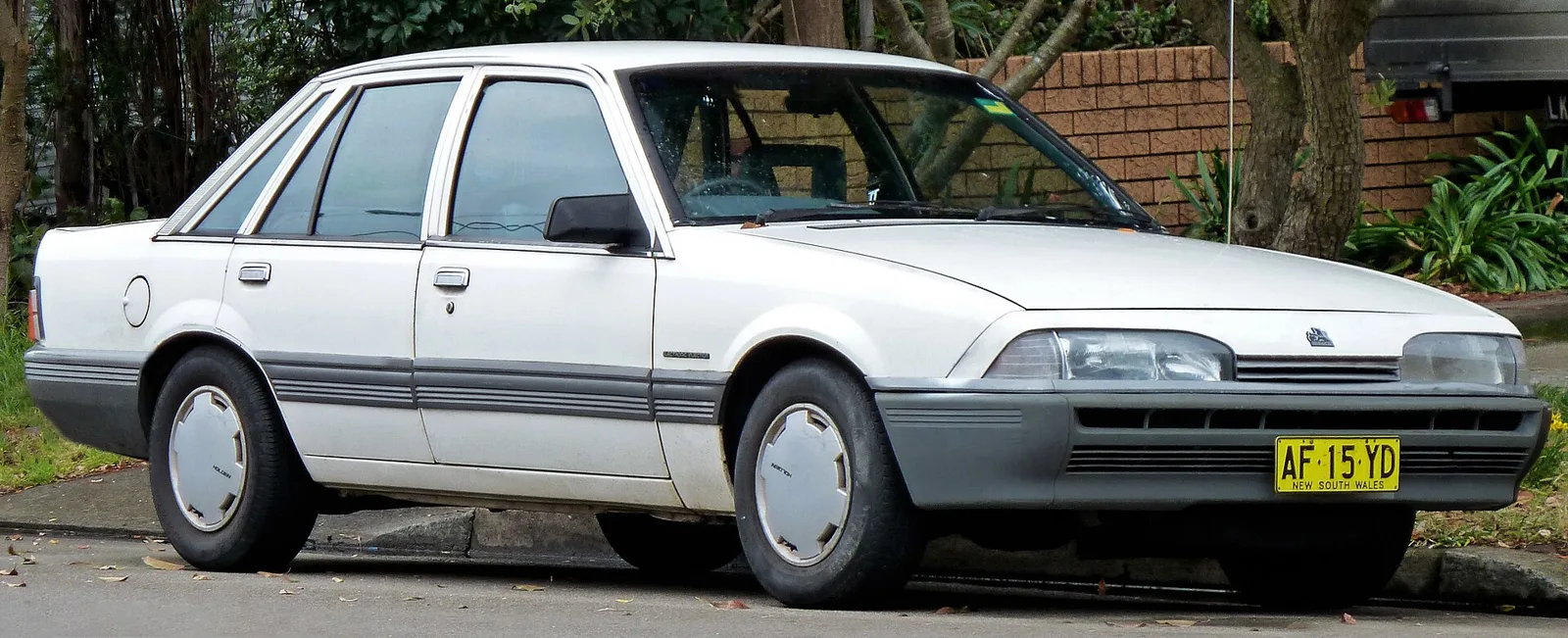
The mid-size VL brought Nissan straight-six power, a turbo road car and the SS Group A that won twice in the 1987 World Touring Car Championship.
Built from 1986 to 1988, the Holden Commodore VL was the final car of the first Commodore generation. It used a Nissan straight-six and an unleaded 5.0-litre V8, and its SS Group A raced in touring cars, including a 1987 world championship win.
The VL began life with a Nissan straight-six under its bonnet, a choice forced by the arrival of unleaded petrol in Australia. Holden built 151,801 VL Commodores between February 1986 and August 1988, and the model is remembered for a turbo road car and the SS Group A touring car.
It was also the last mid-size Commodore until 2018, when the range moved on. That gives the VL a distinct place in the range's history.
Where did the VL Commodore come from?
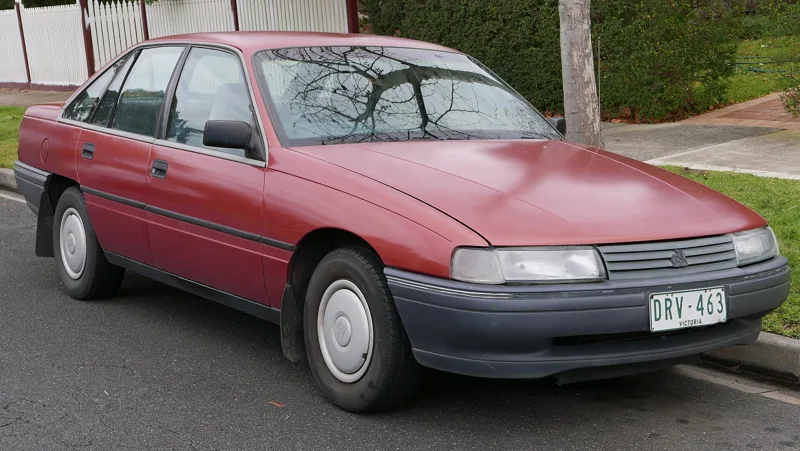
The VL was a substantial makeover of the VK and closed out the first Commodore generation. It ran alongside the luxury Holden Calais, a model name that was sold without the Commodore badge. The car's shape was softer than the VK's.
Designers softened the VL's lines. Panels were rounded, and the boot lid gained a small spoiler built into its edge. The headlamps were lower-profile and rectangular, while only the Calais had semi-retracting covers, which were new for Holden.
The Torana GTR-X concept had carried fully retractable headlights, but it never reached production.
Inside, the dashboard received new instruments and touch switches either side of the steering column. The headlight switch moved from the right of the dash to the indicator stalk, and the centre console gained extra storage.
The VL was built around unleaded fuel, and that single rule shaped its whole engine line-up.
Why did the VL get a Nissan six?
Holden's old six could not run on the unleaded fuel that Australian-built cars needed from January 1, 1986. Nissan's 3.0-litre RB30E straight-six, designed and built in Japan, replaced it. Holden had also found its own six's tooling too worn to justify an unleaded rework.
The RB30E came with an Electronic Combustion Control System and a ram-tuned intake manifold. Its arrival in the VL ended the Holden six that had served the range before it.
Six months after launch the range gained a turbocharged RB30ET, rated at 150 kW (201 hp). A Garrett turbo sat in a water-cooled housing, and new pistols lowered the compression ratio, which lifted the top speed from 200 km/h to 220 km/h (137 mph).
Police forces chose the turbo model as their highway interceptor, and those cars carried BT1 in their model code. Turbo cars also had larger brakes and finned alloy front calipers.
How did the VL transmissions and final drive work?
Holden sourced a Jatco electronic four-speed automatic, and manual cars used five-speed gearboxes made by Nissan. The MX7 and MF5 designations applied to the turbo and naturally aspirated versions, which identified the two drivetrains on the build sheet. Final drive ratios were 3.45 or 3.23.
Power reached the rear wheels through a Borg-Warner differential, with a limited-slip option available. The ratios were taller than the Skyline's, which used the same engine.
In New Zealand the six was the RB20E 2.0-litre, paired with the Jatco four-speed automatic, and its output was 95 kW (129 hp), reached at 5,600 rpm. The 2.0-litre also went to South East Asian export markets, including Singapore and Thailand.
What was the VL V8 like?
The 5.0-litre V8 arrived in October 1986, adapted for unleaded fuel. It produced 122 kW (164 hp) and 323 N m (238 ft lbf), and it kept a Rochester four-barrel carburettor instead of fuel injection. Among the VL's engines it was the largest.
A media campaign called V8s 'til 98 helped keep the engine in production, and it ran until 1999, when Holden switched to the imported GM LS1.
The VL was the last Holden V8 with a carburettor. The SS Group A SV introduced fuel injection on the V8, and every Holden V8 from the VN onward used it.
What special editions did the VL get?
The Commodore Vacationer appeared in 1987 as a special edition, built on the Executive with body-coloured bumpers and unique wheel covers. The Series 200, which marked the 1988 Bicentenary, followed from March 1988 with two-tone champagne paint, and its standard kit included air conditioning and power steering.
Only 198 Calais wagons were built between March and August 1988, a run that used up the stock of wagon bodies as production ended.
What was the SS Group A?
The SS Group A existed to homologate a racing version of the Commodore, so it could take part in Group A touring car racing. The family ran from 1985 to 1992, and the cars were assembled in Dandenong before HDT modified them in Port Melbourne.
The VL's SS Group A arrived in November 1986 in Permanent Red. Larger front and rear spoilers and a small bonnet scoop, which fed cold air to the carburettor, marked it out, and Holden had 500 built.
The HDT and Holden partnership dated from 1969. In February 1987 Holden ended it after Peter Brock began fitting an Energy Polarizer to HDT cars, a device the company regarded as pseudoscience. Holden would no longer honour warranties on cars that HDT modified.
Holden then formed the Holden Motor Sports Group, signing Roadways Racing and Perkins Engineering as factory-backed teams, with Allan Grice and Larry Perkins at the wheel.
What were the Group A rules?
Group A was a set of regulations that governed many touring car series in the 1980s and 1990s. Those series ran in several countries, including Australia, New Zealand and Britain, as well as Japan, Italy and Germany, and the rules also covered the European Touring Car Championship and major endurance races such as the Spa 24 Hours.
Cars had to be homologated, which meant the maker had to build a set number of road-going versions before a racing car could compete. FISA's rules called for at least 5,000 base cars and a further 500 Evolution specials, and the SS Group A was built to meet that requirement.
The Group A regulations were a major reason the SS Group A existed at all. A racing version of the Commodore could only compete if Holden produced enough street cars for the category.
How did the SS Group A SV sell?
Holden planned a limited run of 500 Group A SV cars from March to November 1988, but HSV later decided to build 250 more. The total of 750 was slow to sell, and some dealers changed the cars' appearance to move them.
Some examples were sold years after launch. The VN was released in August 1988 with a new look that drew buyers away from the SV, and the Group A SV has since become one of the most collectable Holden cars of its era.
How did the VL race in touring cars?
The SS Group A won two races in the 1987 World Touring Car Championship. Allan Moffat and John Harvey took the Monza opener after BMW's M3s were excluded for running 80 kg under the minimum weight, and an HDT Commodore won the 1987 James Hardie 1000 at Bathurst. Both results came within months of Holden ending its factory relationship with Brock, which made the wins a notable irony for the company.
The Bathurst result was complicated. Peter Brock had qualified the car 20th, and the two Eggenberger Sierras that finished ahead were later disqualified for illegal bodywork, which handed the win to the HDT car.
In 1988 Perkins ran the VL as Holden's official factory team in the Australian Touring Car Championship. He competed against lighter and more powerful Ford Sierras and the new Nissan Skyline GTS-R, and the VL's 1,325 kg (2,921 lb) weight made tyre wear a problem in the sprint races.
Results were hard to come by in 1989 and 1990. The factory-backed Holden Racing Team was seen mainly at the endurance races at Sandown and Bathurst, while privateers carried much of the effort.
The fastest Holden at the 1989 Tooheys 1000 qualified 11th, roughly three seconds off the pace. For the first time since 1978, no Holden made the pole shootout, and the Holden Racing Team VLs finished 6th and 7th, three laps down on the winning Sierra.
Wins came later. Win Percy and Allan Grice took the 1990 Tooheys 1000 for the Holden Racing Team, Perkins and Tomas Mezera won the 1990 Nissan Sydney 500, and Perkins took the 1992 Sandown 500 in a VL.
How did the SS Group A SV perform?
The SS Group A SV was the homologation car for the 1988 season. TWR's Walkinshaw bodykit was claimed to cut drag by more than 25 percent over the earlier SS Group A, and the car earned nicknames such as the Plastic Pig and Batmobile.
Its 5.0-litre V8 had a cast block, four-bolt main caps and a twin throttle body inlet manifold with a restrictor plate on the larger body. The car made its British debut at Brands Hatch on August 21, 1988, finishing 13th, and it finished 15th at the RAC Tourist Trophy.
Peter Brock's number 10 car was cobbled together from spare parts, and it was run only to meet a Mobil contract that called for two race cars. It still finished third on the road at Bathurst in 1987, after Brock's own car had blown its engine.
What was AUSCAR and the Thunderdome?
AUSCAR was Bob Jane's take on NASCAR-style stock-car racing, with VL Commodores running at the Calder Park Thunderdome. The circuit is a 1.801 km quad-oval with 24-degree banking, and it was the first high-banked oval of that kind built outside North America.
The VL's AUSCAR body kit was a variant of the SS Group A kit, with a regular bonnet in place of the air-scooped one. Tony Kavich won the 1988/89 series in a VL, and Brad Jones took the first of five straight titles from 1989/90.
What happened to the VL in New Zealand?
New Zealand received 3,500 Berlinas from Australia in 1987, and local assembly began in March of that year. The first Calais models arrived fully built up, and later in 1987 the locally assembled Commodore Royale took over that role.
The VL sold strongly there, with 16,050 cars in total. Of those, 6,550 had the smaller engine and 9,500 had the larger one, and several V8 Berlina wagons were assembled locally as well.
What did HSV's SV88 add to the VL?
The SV88 was HSV's first production car, a luxury Calais with an upgraded 4.9-litre V8 at 136 kW (182 hp). It did not use the Group A engine, and it came in Dorward Blue and Jewel Midnight with an optional in-car phone.
Holden Commodore VL specifications
| Specification | Detail |
|---|---|
| Built | 151,801 units, February 1986 to August 1988 |
| Straight-six | 3.0-litre Nissan RB30E; ECCS and ram-tuned intake |
| Turbo six | RB30ET, 150 kW (201 hp), Garrett turbo, 220 km/h top speed |
| V8 | 5.0-litre Holden V8, 122 kW (164 hp), 323 N m (238 ft lbf), carburettor |
| Transmissions | Jatco electronic four-speed automatic; Nissan five-speed manual |
| Final drive | 3.45 or 3.23, with a Borg-Warner limited-slip option |
| SS Group A SV | 5.0-litre V8 at 180 kW (241 hp), Panorama Silver, 750 units |
| Calais wagons | 198 built, March to August 1988 |