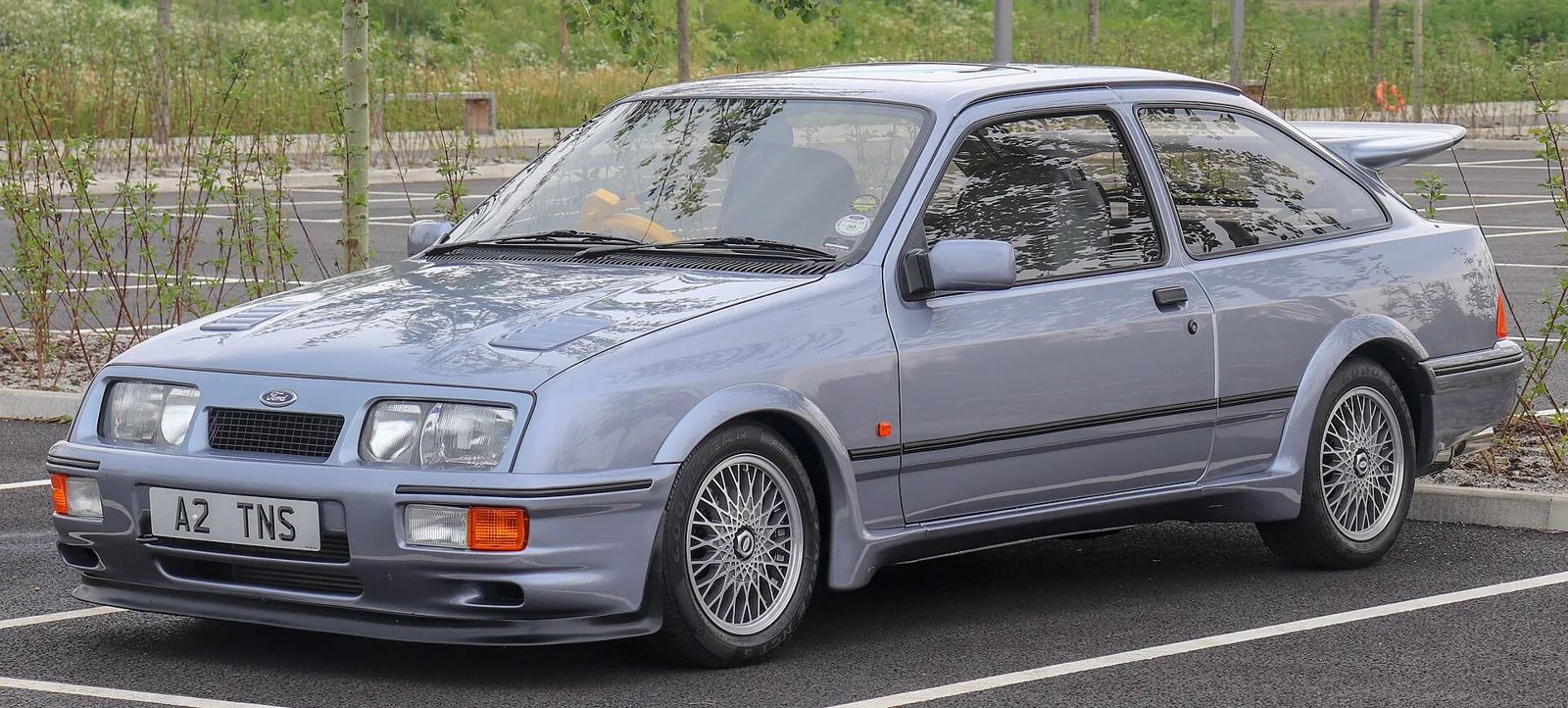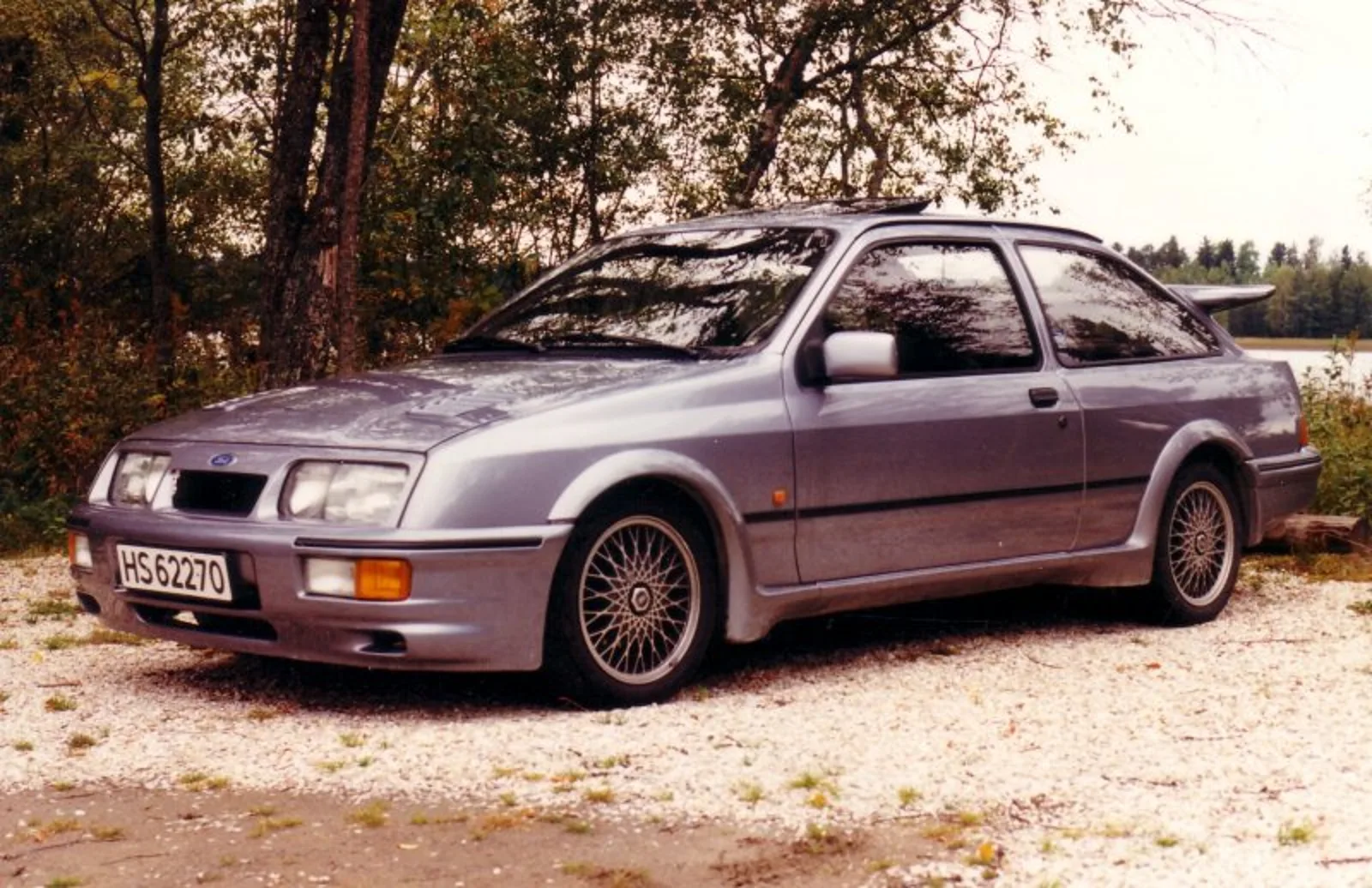
Built at Genk from 1986 to 1992 to win Group A racing, the turbocharged Sierra became the basis for the RS500 and went on to dominate touring car series around the world.
The Ford Sierra RS Cosworth was a turbocharged Sierra built by Ford Europe from 1986 to 1992 for Group A racing. Its RS500 evolution, with 227 PS, won titles in Europe, Australia and Japan.
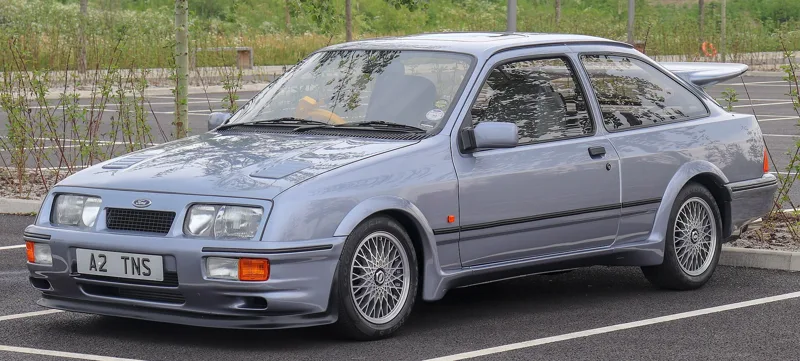
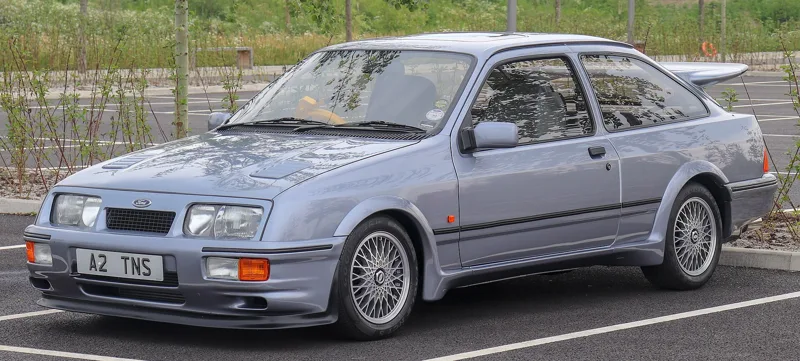
The Ford Sierra RS Cosworth was a high-performance version of the Sierra built by Ford Europe from 1986 to 1992. It was a Ford Motorsport project with one purpose: to produce an outright winner for Group A touring car racing in Europe. The three-door car became the basis for the RS500, and the wider family went on to dominate touring car series in Europe, Australia, Japan and New Zealand.
Why did Ford build the Sierra RS Cosworth?
The project was defined by Stuart Turner in the spring of 1983, shortly after he had been appointed head of Ford Motorsport in Europe. He realised that Ford was no longer competitive in touring car racing, and he needed a car that could beat the opposition under Group A rules.
Turner won support from Walter Hayes, Ford's vice-president of public relations. Hayes had driven the development of the Ford GT40 that won Le Mans in 1966, and of the Cosworth DFV engine that gave Ford 154 Formula One victories and 12 world championships through the 1960s and 1970s. He found the project appealing and promised his full support.
In April 1983 Turner's team settled on the Sierra as the basis. It offered rear-wheel drive and reasonable aerodynamic drag, and a racing version could also help to lift the car's reputation, which had suffered since its introduction in 1982.
Built to win Group A, the Sierra RS Cosworth became the homologation car that ran away with touring car racing.
How did the engine and gearbox come together?
Turner invited Ken Kohrs, Ford's vice-president of development, to visit the engineering partner Cosworth, where they were shown a project developed on Cosworth's own initiative. This was the YAA, a twin-cam, 16-valve engine built on Ford's T88 block, better known as the Pinto. It proved an almost ideal starting point for the engine Turner needed.
Ford formally requested a turbocharged version, designated the Cosworth YBB, capable of 180 HP on the street and 300 HP in race trim. Cosworth agreed but set two conditions: the road engine would make at least 150 kW (204 HP), and Ford would have to accept no fewer than 15,000 engines. Turner's project needed about 5,000, but Ford accepted the terms anyway.
The extra 10,000 engines later became one of the reasons Ford chose to develop the four-door second-generation Sierra RS Cosworth. The gearbox also proved a challenge. The Borg-Warner T5, which was used in the Ford Mustang, was chosen, but the higher revving of the Sierra caused problems, so Borg-Warner had to set up a dedicated production line for the RS gearbox.
Why does the Sierra RS Cosworth look the way it does?
Lothar Pinske, responsible for the bodywork, demanded a free hand on appearance so that the car would be stable at high speed. Experience had shown that the Sierra hatchback generated significant lift even at moderate speeds, and wind tunnel testing confirmed the problem.
A prototype built on an XR4i body with provisional fibreglass and aluminium modifications was tested at the Nardo circuit in Italy. The appearance drew little enthusiasm, and the large rear wing caused particular reluctance. Pinske insisted that the changes were necessary. The wing kept the car in contact with the road at 300 km/h, the gap between the headlights fed air to the intercooler, and the wheel arch extensions housed racing wheels 10 inches wide.
Many of the suspension changes came from racing experience. Jack Roush's turbocharged IMSA Merkur XR4Ti in America and Andy Rouse's 1985 British Saloon Car Championship campaign both fed back into the design. Some parts from the XR4Ti made their way into production, including a speedometer with an integral boost gauge and the Motorsport 909 chassis stiffening plates.
How did Ford sell a homologation car?
Group A required 5,000 cars to be built and sold, and the feedback from dealers was discouraging. Walter Hayes visited many European Ford dealers in 1984 to survey demand for the car, and the dealers estimated they could sell 1,500 cars.
Hayes did not give up. He continued his internal marketing, and dealers were invited to test-drive the prototypes, which lifted enthusiasm. Ford also cut the price by limiting the options. The car came in three exterior colours, black, white and Moonstone Blue, with one grey interior, and buyers could choose only between central locking with electric windows or without them.
European models differed from the UK cars in equipment. A basic radio cassette without an amplifier was fitted to the European cars, rather than the Ford Sound 2000 head unit and amplifier used in Britain.
How many Sierra RS Cosworths were built?
The Sierra RS Cosworth was first shown at the Geneva Motor Show in March 1985, with plans for sales in September and production of the 5,000 cars closing in summer 1986. In practice it launched in July 1986, and 5,545 cars were manufactured in total.
Of those, 500 were sent to Tickford for conversion into the three-door RS500. Cars were built at Ford's Genk factory in Belgium in both left-hand and right-hand drive. Pre-production cars were built in February 1986, main production ran through the summer, and the final cars came off the line in December 1986.
White and Moonstone Blue each accounted for about two-fifths of the right-hand drive cars, and black for about one-fifth. The 1986 RS catalogue gave a top speed of 149 mph (240 km/h), a 0-60 mph time of 6.5 seconds and a drag coefficient of 0.345. The car ran 205/50 VR15 tyres on 15 by 7-inch alloys, with viscous coupled limited-slip differential.
What was the Sierra RS500?
Mike Moreton led the team that planned an evolution model to make the car unbeatable on track. In March 1987 Aston Martin Tickford was signed to convert the 500 cars, and the RS500 was announced in July 1987 and homologated in August of that year.
The engine was Cosworth's uprated competition unit. It had a thicker-walled block, a larger Garrett AiResearch T04 turbocharger, a larger air-to-air intercooler and an uprated fuel pump. A second set of four Weber injectors and a second fuel rail were fitted, though the second rail did nothing in the road version. Output rose to 227 PS (224 hp; 167 kW) at 6,000 rpm, with 277 N m (204 lb ft) of torque at 4,500 rpm.
Visually the RS500 added a lower rear spoiler beneath the upper whale tail, which had a gurney flap for extra downforce. Discreet RS500 badges went on the tailgate and front wings, and the front bumper was reworked with intake grilles in place of the fog lamps to help brake cooling.
All 500 RS500s were right-hand drive for the UK, the biggest market for this type of Ford. The plan was to build all 500 in black, but 56 white and 52 moonstone blue cars were also produced. The declared power was 260 PS, although some owners claim at least 40 PS more.
How did the RS500 perform in touring car racing?
Ford started from pole in each of the last six 1987 World Touring Car Championship rounds, and it crossed the line first in four of them. Eggenberger Motorsport won the entrants' world title, although its cars were disqualified from the 1987 Bathurst 1000 over wheel arch panel irregularities. That result cost Klaus Ludwig and Klaus Niedzwiedz the drivers' title. Eggenberger later won the 1989 Spa 24 Hours.
Gravett's 1990 British title was taken in an RS500. The points system favoured smaller classes, so the Sierra finished first in 9 of 12 rounds in 1987 and won every race from 1988 to 1990, but it took the drivers' title only once. The 1988 DTM drivers' crown went to Ford Team Grab's Klaus Ludwig, and Wolf Racing took the team title. Both teams were Ford works outfits.
Dick Johnson Racing dominated Australia in 1988 and 1989, with its drivers Dick Johnson and John Bowe taking first and second in both seasons. Early in 1988 the team homologated a modified Ford nine-inch axle, which removed the drivetrain weakness and let the cars be driven harder. The RS500 won the Bathurst 1000 in 1988 and 1989, and it took the Sandown 500 in 1988 and 1990.
Ford left the DTM at the end of 1989 after the series imposed heavier weight and boost penalties, which made the cars uncompetitive. Motorsport Magazine later called the RS500 statistically the most successful road-derived racing car of all time, with 84.6% of its entries winning.
Did the Sierra win rallies?
The Cosworth was pressed into rallying too. After Group B ended in the World Rally Championship at the close of 1986, manufacturers had to turn to Group A cars. Ford's four-wheel-drive XR4x4 had an excellent chassis but an old engine making around 230 bhp, which was too weak against Lancia.
The rear-drive Cosworth never won a loose-surface World Rally Championship event, but drivers such as Stig Blomqvist, Carlos Sainz and Ari Vatanen often finished in the top five. On tarmac, Didier Auriol took the 1988 Corsica Rally outright, which was the single occasion that year when Lancia lost a head-to-head contest.
Below world level the car was very popular. Jimmy McRae won the British Rally Championship in 1987 and 1988, while Sainz and Auriol took the Spanish and French titles in those same years. Its flame-spitting exhaust and tail-sliding character made it popular with spectators, and its toughness and modest price made it a favourite with amateurs.
What were the Sapphire and 4x4 versions?
The second-generation four-door Sierra Sapphire Cosworth was assembled at Genk with the UK-built Ford-Cosworth YBB engine. Around 13,140 were produced in 1988 and 1989, making it the most numerous and lightest of the Sierra Cosworths, particularly in left-hand drive form with a lower trim level. Its more discreet rear wing and different shell gave it a drag coefficient of 0.33.
In January 1990 the third-generation Sierra RS Cosworth 4x4 arrived. Ford Motorsport had discussed a four-wheel-drive Sierra with Mike Moreton as early as 1987, and the Ferguson MT75 gearbox was not ready until late 1989. Ford also wanted a three-door special, but the four-door was judged to have better market potential.
Ford Motorsport used the waiting time to test and improve the car. The bonnet louvres returned, and 80% of the engine parts were modified. The engine was designated YBG for catalysed cars and YBJ for those without, and the power was raised to offset the 100 kg added by four-wheel drive and more equipment.
The 4x4 was never a great World Championship success. It made a few works appearances in 1990 and then contested the full programme in 1991 and 1992, taking several second and third places through drivers such as Francois Delecour and Massimo Biasion but never a win. Its gearbox was an early weak point, and it was heavy and less sophisticated than the latest Lancias and Toyotas. Biasion's best result came on the 1992 Rally of Portugal, where he finished second.
What are the Sierra RS Cosworth specifications?
| Specification | Detail |
|---|---|
| Production years | 1986 to 1992 (three-door); 1988 to 1989 (Sapphire); 1990 to 1992 (4x4) |
| Engine | Turbocharged Cosworth YBB, at least 150 kW (204 HP) in street form |
| Total production | 5,545 three-door cars, including 500 RS500 conversions |
| RS500 output | 227 PS (224 hp; 167 kW) at 6,000 rpm |
| RS500 torque | 277 N m (204 lb ft) at 4,500 rpm |
| Declared RS500 power | 260 PS, with some owners claiming 40 PS more |
| Top speed (1986 catalogue) | 149 mph (240 km/h) |
| 0-60 mph (1986 catalogue) | 6.5 seconds |
| Fuel consumption | 38.2 mpg at 56 mph; 30.1 mpg at 75 mph |
| Drag coefficient | 0.345 (three-door); 0.33 (Sapphire) |
| Sapphire performance | 150 mph (240 km/h) top speed; 0-60 mph in 6.1 seconds |
| Gearbox | Borg-Warner T5 five-speed |
| Wheels and tyres | 15 by 7-inch alloys on 205/50 VR15 tyres |
| Brakes | Front discs 28.3 cm; rear discs 27.3 cm |
| Differential | Viscous coupled limited slip |