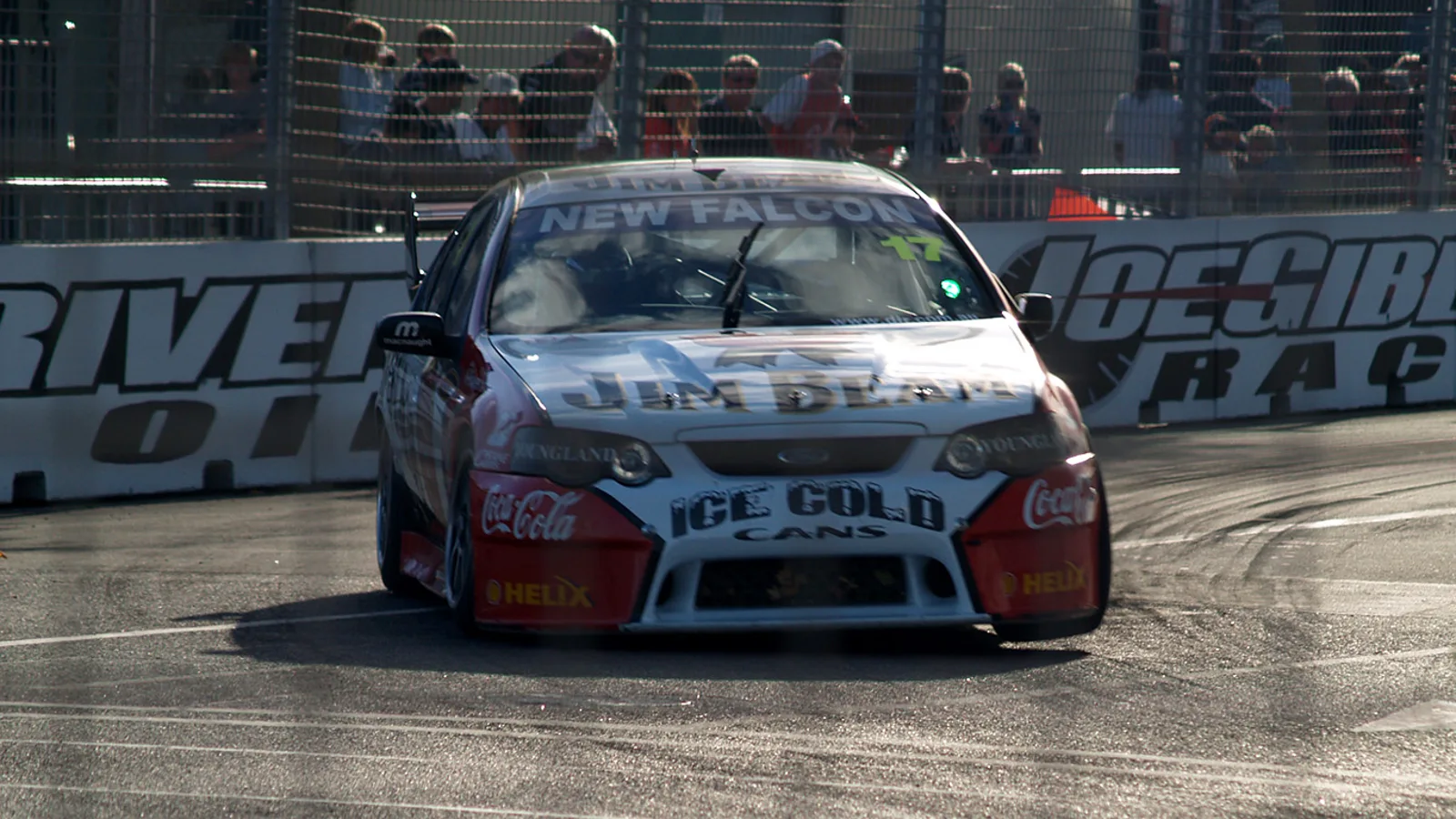
Founded by Dick Johnson in 1980, the team won Australian touring car titles, Bathurst 1000s and a long run of Supercars results before a 2014 Penske partnership.
Dick Johnson Racing is Australia's oldest Supercars team, founded by Dick Johnson in 1980. Its drivers have won ten touring car titles and the team has four Bathurst 1000 wins.
Dick Johnson Racing is Australia's oldest motor racing team competing in the Supercars Championship. The squad was started by Dick Johnson, and its drivers have collected ten Australian Touring Car Championship titles, half of them through Johnson, along with four Bathurst 1000 wins. It is based in Stapylton on the Gold Coast.
What is Dick Johnson Racing today?
The team currently runs two Ford Mustang GTs, with Brodie Kostecki in the No. 17 car and Rylan Gray in the No. 38. Viva Energy Australia became its naming rights partner in 2017, and the team has raced under the Shell V-Power name since then.
The team's home is on the Gold Coast, where it also housed a museum of its history. The business has changed hands several times, but the Johnson name remains part of its identity.
Australia's oldest team, built after a rock on the Bathurst track and carried through Falcons, Sierras and Supercars.
How did Johnson's career begin?
After only sporadic entries in the early 1970s, Johnson rose to prominence after a crash caused by a rock on track at Bathurst in 1980. Public and Ford Australia donations returned him to the car for the following season, and that support became part of the team's story.
The team was founded in 1980 and was first based at Johnson's home in Daisy Hill in Brisbane's southern suburbs. It later moved to facilities inside the factory of sponsor Palmer Tube Mills.
How did the 1980 Bathurst crash shape the team?
In 1980 Johnson qualified on the front row alongside Kevin Bartlett, and he built a large lead before a rock in the road sent his Falcon into the wall at The Cutting. The crash almost destroyed the car, and the rock was a turning point for the team's public profile.
Public donations of about AU$72,000 were matched by Ford Australia's boss Edsel Ford II, and the sale of the crashed car to a fellow Queenslander helped Johnson return with a new XD Falcon for 1981. The donation totalled $144,000.
When did Johnson win his first title?
Inspired by that support, Johnson won the 1981 Australian Touring Car Championship in a duel with Peter Brock that went down to the last race at Lakeside. He won by a second, in a race that many still see as one of the best touring car races in Australia.
The 1981 Bathurst race was also the first win for the team at The Mountain. Johnson and John French took the result after the race was red-flagged on lap 121 of 163 and declared with the leaders in front, the first time the race had been declared short of its full distance.
What were the 1982 and 1984 seasons like?
Johnson won the touring car championship again in 1982, after Brock was disqualified for using engine parts that were not yet homologated. At Bathurst that year the team finished fourth on the road but was disqualified after scrutineering for illegal engine modifications.
In 1984 the team built a new XE Falcon and finished no lower than third at each round, winning in the wet at Surfers Paradise. That season gave Johnson his third title, the last under the locally developed Group C rules.
Why did the team turn to Mustangs?
Ford Australia would not homologate a turbocharged XF Falcon for Group A, so Johnson bought two Zakspeed-built Ford Mustangs for 1985 and 1986. They brought limited success, but reliability and handling helped him finish runner-up in the 1985 Australian Touring Car Championship.
The Mustang's only victory came in the Group A support race at the 1985 Australian Grand Prix in Adelaide. Jim Richards won seven of the ten rounds in the BMW that year, so the Mustang was outclassed in the main series.
How did the Sierra years go?
In 1987 the team switched to the Ford Sierra RS Cosworth and began a 17-year naming rights deal with Shell. It ran two cars for the first time, with Gregg Hansford as Johnson's first full-time teammate. The turbocharged Sierras were plagued by reliability problems, and only one win came that season.
That win, at Adelaide, was the first Group A win anywhere in the world for the RS Cosworth. The Sierra RS500 addressed many of the car's shortcomings, and Johnson took a November Group A support win in Adelaide, his first triumph in the RS500.
John Bowe replaced Hansford in 1988 and began an eleven-year stint with the team. Johnson and Bowe finished first and second in the 1988 and 1989 championships, and the team won the 1989 Bathurst 1000 with Johnson and Bowe.
How did the team handle the Sierra's drivetrain?
After the 1987 Bathurst differential failure, Johnson worked with Harrop Engineering to homologate a modified Ford 9-inch differential for the RS500 in April 1988. The unit included upsized axles, and it became popular in Australia because standing starts put heavy load on the drivetrain.
During 1988 the team also homologated an Australian-built Holinger six-speed gearbox, which proved more reliable than the German Getrag gearboxes used by most Group A cars. Both parts later became common choices for Australian teams.
What was the team's Group A success overseas?
In August 1988 the team air-freighted the ATCC-winning car to England for the RAC Tourist Trophy at Silverstone. Johnson qualified on pole, and the car set the touring car lap record during the race, even though a water pump failure dropped it to 21st.
The speed of the DJR Sierra drew interest, and Robb Gravett bought two DJR Sierras for his British team Trakstar at the end of 1988. Gravett went on to win the 1990 British title with nine race wins.
How did Bathurst and the Nissan years go?
In 1988 Johnson claimed his first Bathurst pole, and he and Bowe finished second behind Tony Longhurst's Sierra. In 1989 they won after leading every lap, despite a late loss of turbo power.
In 1990 Johnson lost the ATCC narrowly to Jim Richards' Nissan Skyline R32 GT-R. The team's second car finished second at Bathurst, and Johnson won two rounds, with the Phillip Island win being his 30th and last ATCC race win.
Johnson also ran a Winston Cup effort in 1989 and 1990, as owner-driver, with Jay Sauter as a driver and Ray Evernham as crew chief.
How did the team reach the V8 Supercar era?
The 1991 ATCC saw DJR outpaced by Nissan, and the Sierras showed unreliability as they chased more power. In 1992 Ross Stone became team manager while Lowe built the first 1993-spec Ford EB Falcon V8.
A 7,500 rev limit imposed on the Sierras improved both their speed and reliability. Johnson claimed the Bathurst pole that year with a Sierra lap of 2:12.898, a time that beat the previous Sierra record by more than a second.
For the new all-V8 era DJR switched to Ford EB Falcons. John Bowe won the opening 1993 round at Amaroo Park, and the team won both the Sandown and Bathurst endurance races in 1994.
What happened in the 1995 to 1999 seasons?
In 1995 Bowe won the championship for the team. A win at Sandown that year suggested a Bathurst win too, but an incident with Glenn Seton forced the number 17 Falcon out while it was leading.
Bowe left after 1998 to join PAE Motorsport, and Paul Radisich replaced him. In 1999 Johnson finished fourth at Bathurst in his final race, with his son Steven as co-driver.
How did the 2000s go for the team?
In 2000 Steven Johnson took over the number 17 Falcon from his father. Radisich and Jason Bright finished second at Bathurst that year. In 2001 Johnson won the Canberra 400, and he and Radisich won the 2001 Queensland 500, the team's last win for seven years.
Shell ended its naming rights deal at the end of 2004. Sponsorship from Westpoint Corporation collapsed in 2006, and Charlie Schwerkolt bought 50 per cent of the team that year. Will Davison won at Eastern Creek in 2008, the team's first win since 2001.
What happened with the Penske partnership?
In September 2014 the team announced that a 51 per cent stake had been sold to United States businessman and racer Roger Penske. The remaining 49 per cent was retained by Johnson, Steve Brabeck and Ryan Story, and the team was renamed DJR Team Penske.
Marcos Ambrose joined the team for 2015 and Scott McLaughlin arrived in 2017. McLaughlin took the Supercars drivers' crown in 2018 in Car No. 17, beating Shane van Gisbergen in a tight season-long fight. In October 2020 Penske announced it was divesting, and the team was renamed Dick Johnson Racing again.
What are the team's key results at a glance?
| Year | Driver | Event | Result |
|---|---|---|---|
| 1981 | Dick Johnson | ATCC and Bathurst 1000 | Series title and first Bathurst win |
| 1984 | Dick Johnson | ATCC | Third title, the last under Group C rules |
| 1985 | Dick Johnson | ATCC | Runner-up in the Mustang |
| 1987 | Team | Adelaide | First Group A win for the Sierra RS Cosworth |
| 1989 | Johnson and Bowe | Bathurst 1000 | Win after leading every lap |
| 1990 | Dick Johnson | ATCC | Two round wins, the 30th and last ATCC win |
| 1995 | John Bowe | Supercars | Series championship |
| 2001 | Johnson and Radisich | Queensland 500 | Win, the last for seven years |
| 2008 | Will Davison | Eastern Creek | First win since 2001 |
| 2010 | James Courtney | Series | Series championship |
| 2018 | Scott McLaughlin | Supercars | Drivers' championship in Car No. 17 |
Why does Dick Johnson Racing matter?
Dick Johnson Racing matters because it has run in Australian touring car racing for more than four decades, and it has shaped the Ford Falcon story at the top level. Its titles, its Bathurst wins and its Sierra engineering all remain part of the sport's history.
The team also shows how a sponsor can define an era. Shell's naming rights ran for 17 years, and the team's identity changed with each ownership and partnership. Its story shows the value of a persistent founder willing to rebuild after setbacks.