Ten Grand Prix wins, a 1979 breakaway from the FIM, a switch to touring cars and a 1993 Bathurst 1000 win that few riders could match.
Gregg Hansford was an Australian racer who won ten motorcycle Grand Prix races between 1978 and 1979 before switching to touring cars. He won the 1993 Bathurst 1000 and died in a Supertouring crash at Phillip Island in 1995.
Gregg Hansford was an Australian racer who competed in motorcycle Grand Prix racing from 1978 to 1981 and then built a second career in touring cars from 1982 to 1994. He won ten Grand Prix races and the 1993 Bathurst 1000, and he died in a Supertouring race at Phillip Island in 1995.
Who was Gregg Hansford?
Gregory John Hansford was an Australian racer on two wheels and four, born on 8 April 1952 in East Brisbane, Queensland. He won ten Grand Prix races, placing him fourth among Australian winners behind Mick Doohan, Casey Stoner and Wayne Gardner. He died at Phillip Island in 1995, at the age of forty-two.
Schooling took him from Milton State to Anglican Church Grammar and then Brisbane State High, and he later worked as a motorcycle mechanic. He began racing in 1971 with financial help from his mother.
Ten Grand Prix wins, a Bathurst victory in a touring car and a career that ended in a race at Phillip Island.
How did Hansford start racing?
Hansford started on dirt tracks and in motocross before turning to road racing in the early seventies. John Taylor at Brisk Sales gave him a Kawasaki H1R to race, which led to a ride for the Brisbane Yamaha distributor. He became known for his mastery of Lakeside International Raceway near Brisbane.
In 1974 he made his international debut at the Daytona 200 on a Yamaha TZ750, but ignition trouble ended his race. Back home at Mount Panorama he finished second, narrowly beaten by Warren Willing in the Unlimited Class race, and then won the Unlimited Class Australian national title at 21. It was the first of six Australian road-racing national titles he won in different classes.
Kawasaki Australia contracted him in 1975 to replace the injured Ron Toombs. In 1977 he finished fourth at Daytona as the highest-placed Kawasaki rider, and Motocourse rated him the world's fifth-best rider that year, even though he had never started a world championship round.
What did Hansford achieve in the 1978 world championship?
Hansford joined the world championship in 1978 with Team Kawasaki Australia, riding 250cc, 350cc and 750cc machines. That season brought seven wins across the 250cc and 350cc Grand Prix classes, but he lost the 250cc title to Kork Ballington by six points and finished third in the 350cc standings.
He stood over 1.83 m (6 ft 0 in), taller and heavier than his main rival Kork Ballington, whose smaller frame gave him an edge on the bike. His first world championship race, the Venezuelan Grand Prix, saw him lead the 350cc race after four laps before a mechanical failure ended his day. The Spanish round began with an obstacle, as organisers refused his entry and cited records they could not find. Once the FIM intervened he took his maiden Grand Prix victory, beating Kenny Roberts.
At the French Grand Prix he took both the 250cc and 350cc races, one of three double wins in those classes that season. On his first visit he also set the fastest 250cc and 350cc qualifying times at the Nurburgring, a 22.9 km (14.2 miles) circuit that had been considered too dangerous for Formula One.
Why did the 1979 riders' revolt matter to Hansford?
Hansford was one of the leading riders who broke with the FIM in 1979. Riders boycotted the Belgian Grand Prix over a track paved days earlier, with diesel fuel seeping to the surface. Hansford joined Kenny Roberts, Barry Sheene and Barry Coleman in a rival World Series, which later collapsed.
Yamaha offered him Roberts' 500cc seat for 1980, but Hansford turned it down to stay loyal to the breakaway. He had already rejected a Suzuki offer to partner Barry Sheene in the 500cc class after 1978, and he remained with Kawasaki. His 1979 season began slowly after injuries and tyre problems, and the team switched from Michelin to Dunlop tyres mid-season.
He still won three Grand Prix races that year, all in the 350cc class. His final Grand Prix victory came at the Finnish round, and a KR750 also won at Nogaro that year, in a round of the 1979 Formula 750 series.
What happened in Hansford's final motorcycle seasons?
In 1980 Hansford raced Kawasaki 250s and 350s in the Australian national championships while Kawasaki developed its KR500 for the 500cc world championship. He made only one world championship appearance that year, at the German round, where he debuted the new KR500 with its monocoque chassis and retired with a mechanical problem.
His best result that year came at the Suzuka 8 Hours, where he teamed with Eddie Lawson on a modified Kawasaki KZ1000 to finish second. Cooley and Crosby, who rode a Yoshimura GS1000, beat them, and the result was a rare endurance highlight in his late motorcycle career.
Why did Hansford leave motorcycle racing?
Hansford retired from motorcycle racing after a crash at the 1981 Belgian Grand Prix, where his front brake calipers had been incorrectly replaced. When the brakes failed, he slowed the bike to about 70 km/h on the rear brake, but it still struck a car that a track marshal had parked there. The impact broke a femur.
Recovery took several years. Back in Australia he had run motorcycle businesses in Brisbane and a watercraft business on the Gold Coast, but his competitive instincts drew him back into racing. He chose to pursue a car racing career, and that decision took him into Australian touring cars.
How did Hansford's touring car career develop?
Hansford moved into touring cars in 1982 with Allan Moffat Racing, having earlier been linked to the team. His touring car career ran from 1982 to 1994 across Ford, Mazda and Holden machinery in the Australian Touring Car Championship and endurance races.
His first ATCC race came in 1983 at Surfers Paradise. Starting third was a surprise, given that he had qualified behind Moffat and Peter Brock. A missed gear at the start dropped him to eleventh, but he recovered to finish third. A few rounds later he finished second to Brock in the wet final round at Lakeside, while Moffat took third to clinch his fourth ATCC title.
His first touring car win came in the 1984 Oran Park 250, a round of the endurance series, where he partnered Moffat in the RX-7. Moffat, recovering from a crash at Surfers Paradise earlier that year, started from pole and handed the car to Hansford while leading. Hansford kept the lead to the flag.
Dick Johnson, Sierras and the late 1980s
In 1985 Hansford teamed with Colin Bond in an Alfa Romeo GTV6 and finished eighth outright at Bathurst, first in Class B. In 1986 he partnered Dick Johnson, a fellow Queenslander, in a Mustang GT and came fourth outright at the James Hardie 1000.
Hansford stayed with Dick Johnson Racing for 1987, when the team ran two new Ford Sierra RS Cosworths. The Johnson and Hansford car retired after just three laps of the 1987 Bathurst race. Johnson then replaced him for 1988 with John Bowe, and Hansford returned to Allan Moffat, winning the Enzed 500 at Sandown in a Ruedi Eggenberger-built Sierra RS500.
What were Hansford's key results in touring cars?
| Year | Event | Result |
|---|---|---|
| 1978 | Grand Prix world championship | Seven 250cc and 350cc wins; 250cc runner-up |
| 1979 | Finnish Grand Prix, 350cc | Final Grand Prix victory |
| 1981 | Belgian Grand Prix | Crash ends his motorcycle career |
| 1983 | ATCC round, Surfers Paradise | Third after starting third |
| 1984 | Oran Park 250 | First touring car win, with Moffat |
| 1984 | Bathurst 1000 | Third outright, qualified eighth |
| 1986 | Bathurst 1000 | Fourth outright with Dick Johnson |
| 1988 | Bathurst 1000 | Leading by almost a lap, then engine failure |
| 1993 | Bathurst 1000 | Won with Larry Perkins |
| 1993 | James Hardie 12 Hour | Second with Charlie O'Brien |
| 1994 | James Hardie 12 Hour | Won with Neil Crompton |
What was Hansford's 1993 Bathurst win?
Hansford took the 1993 Tooheys 1000 at Bathurst alongside Larry Perkins, driving a Holden VP Commodore. Perkins and Hansford shared the driving. The win gave him a unique distinction: a race won on Mount Panorama in both motorcycle and car racing.
It came after several seasons in which on-track results had eluded him. He had driven the RS500 Sierra for Moffat and for Glenn Seton in the ATCC and at Bathurst, and those turbo Sierras had earlier been described as fast but fragile.
His run of endurance results continued the following year, when he won the James Hardie 12 Hour with Neil Crompton in an RX-7. He also took third at the 1994 Tooheys 1000 and at Sandown, both with Perkins in a Holden Commodore.
How did Hansford die?
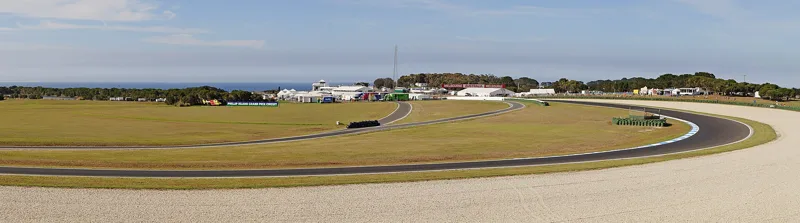
Hansford died on 5 March 1995 after a crash during a Supertouring event at Phillip Island. His Ford Mondeo left the track and struck a tyre barrier at speed, then bounced back onto the circuit, where Mark Adderton's Peugeot 405 struck it at over 200 km/h.
He died moments after the impact. His youngest son, Harrison, was only eight months old at the time. Hansford is buried at Pinnaroo Lawn Cemetery in Brisbane.
His older sons, Ryan and Rhys, from his marriage to Julie-Anne, took their first steps into motor racing in 2007. Ryan competed in the Australian Mini Challenge and the V8 Ute Racing Series before joining Touring Car Masters, where he was still racing in 2025.
How is Hansford remembered?
The Australian Motor Sport Hall of Fame honoured him in 2016, recognising a career spanning two wheels and four. His career is also covered in The Immortals of Australian Motorcycle Racing, a 2023 book by Darryl Flack, which is part of a seven-volume sports collection.
Hansford is remembered for having raced at the highest level on two wheels and then on four. His ten Grand Prix victories and his Bathurst win are the two results most often cited, and the 1979 breakaway remains part of the story of the sport's fight over track safety.