Ford's factory rally operation won the 1979 world title with the Escort, struggled through Group B and the Sierra era, then fought Citroen and Peugeot in the 2000s and 2010s.
The Ford World Rally Team was Ford's factory WRC operation, which won the 1979 world title with the Escort and the 2006 manufacturers' title. It withdrew after 2012 and is announced to return from 2028 as a factory-backed team.
The Ford World Rally Team was Ford Motor Company's factory entry in the World Rally Championship. It competed regularly for decades until it withdrew after the 2012 season, and it is set to return from 2028, when it will race again as a factory-backed team.
What was the Ford World Rally Team?
The Ford World Rally Team, known as the Ford Motor Co. Team before 2005, was the manufacturer's works crew in the World Rally Championship. It won the world title in 1979 with the Escort RS1800, and it kept a presence in the sport through the Group B era, the Sierra period and the later Focus years.
Its story is one of big peaks and long periods of frustration. The team's most successful seasons came when a strong driver line-up met a competitive car, and its sporting identity has moved from Boreham to Cumbria as the operation changed hands.
A works rally team that won the 1979 title with the Escort, fought through the lean years and returns in 2028 as a factory team.
How did Ford win the 1979 title?
Ford won the World Rally Championship in 1979 with the Escort RS1800 and a driver line-up of Hannu Mikkola, Bjorn Waldegard and Ari Vatanen. Mikkola had already won the season-ending RAC Rally in 1978 in an Escort RS1800, with Waldegard and Russell Brookes following him home in similar machinery.
The title marked the high point of the Escort's rally career. Ford then stepped back from official entries for the 1980 to 1985 seasons, as it concentrated on developing the Escort RS 1700T, a programme cancelled in 1983.
Why did the RS200 matter?
Rivals such as the Audi Quattro S1 and the Peugeot 205 T16 were four-wheel-drive Group B machines, and Ford needed a new car to compete. Lessons from the RS 1700T programme shaped the RS200, which made its rally debut in 1986. The car used four-wheel drive and a turbocharged Cosworth BDT engine of 450 bhp.
Swedish drivers Stig Blomqvist and Kalle Grundel each contested only four rallies that year, in a season overshadowed by tragedy. Grundel took a podium on the RS200's debut in Sweden, and that result was never bettered. The following round in Portugal saw an RS200 leave the road and kill three spectators, and Ford withdrew its entry for that rally.
Group B was banned for 1987, and Ford finished fifth in the 1986 manufacturers' championship behind Peugeot, Lancia, Volkswagen and Audi. The RS200 was over as a works rally car, and the team had to start again in the post-Group B era.
How did the Sierra years go?
In 1987 Ford started with the four-wheel-drive Sierra XR4x4, which was less powerful than its rivals, and then moved to the rear-wheel-drive Sierra RS Cosworth. That car was more powerful but lacked grip on the gravel rallies that dominate the championship.
Stig Blomqvist was the main Ford driver that year, and Ari Vatanen paired with him on the 1000 Lakes Rally in Finland, where they finished second and third. Ford finished the season fifth in the manufacturers' championship, with Blomqvist seventh in the drivers' standings.
In 1988 Ford used both the XR4x4 and the Sierra RS Cosworth, and Blomqvist finished second on his home round in Sweden with the best result of the four-wheel-drive Ford. Didier Auriol won in Corsica for his first victory, and Ford's 23rd top-flight win came in that event. Ford finished the season second behind Lancia with 79 points.
What happened in the lean years?
Ford did not have a car that could match Lancia's Delta Integrale in 1989, so it was absent from most rallies and entered only Corsica and the RAC Rally. Ford finished 13th in the manufacturers' standings after scoring six points for the season.
In 1990 the team used the four-door Sierra RS Cosworth 4x4, a car that was still delayed by gearbox problems and did not run until the end of the season. Ford finished eighth with 22 points, and the team's results gave little hint of a comeback.
The 1991 season was a chance to push for victory again, and the team evolved the Sierra RS Cosworth 4x4. Francois Delecour surprised many with a third place on the Monte Carlo Rally, while Malcolm Wilson joined the line-up. Ford was winless that year and finished fourth in the manufacturers' championship with 54 points.
The 1992 team brought Miki Biasion, a double world champion, to lead the squad alongside Delecour. Biasion's experience was meant to add the final ingredient for a title push. Ford finished third with 94 points, and the Sierra RS Cosworth 4x4 was retired for the 1993 car.
How did the Escort return and the late 1990s unfold?
Ford introduced the Escort RS Cosworth in 1993, and development continued through 1994 with a sequential gearbox, antilag and larger 18-inch wheels for tarmac rounds. Biasion's form dropped away that year, and Delecour won the Monte Carlo Rally before breaking both ankles and missing four months.
Tommi Makinen drove the Escort only on his home rally that year, but he secured a second win for the team there. Ford finished third in the manufacturers' standings behind Toyota and Subaru. In 1995 the rally budget was cut sharply by commitments in Formula One and the BTCC, and the work was contracted out to RAS Sport of Belgium.
For 1996 Ford returned as a full manufacturer entry with Repsol backing and Carlos Sainz as its lead driver. Sainz won the Indonesian Rally and was on the podium at every rally he finished, but retirements left him third in the championship. The team finished third among the manufacturers.
In 1997 the Escort WRC was run by M-Sport, the Cumbria-based team, rather than from the long-term Ford Motorsport base at Boreham. Sainz won the Acropolis and Indonesia rallies and finished third in the championship. Ford finished second among the manufacturers, behind Subaru and ahead of Mitsubishi.
The Escort's last factory season came in 1998, ending the model's thirty-year association with works rallying at the Rally of Great Britain. Juha Kankkunen drove for the team, and he finished fourth in the drivers' standings, but he left for Subaru before 1999.
What did the Focus WRC bring?
The Ford Focus WRC, built by Ford and M-Sport, replaced the Escort for 1999. It debuted on the Monte Carlo Rally with Colin McRae and Simon Jean-Joseph, and McRae set several fastest stage times before a disqualification for an illegal water pump.
McRae gave the Focus its first win at the Safari Rally in Kenya, finishing more than fifteen minutes ahead of Didier Auriol's Toyota. Reliability problems and a series of costly shunts ended his title hopes, and he finished sixth in the drivers' standings.
In 2000 McRae and Sainz drove the Focus at every event. They finished third and fourth in the drivers' championship, while Ford took second place in the manufacturers' title behind Peugeot. Piero Liatti was called on to help with asphalt points.
In 2001 Francois Delecour joined as a regular third driver. McRae won three events in a row in Argentina, Cyprus and Greece, but Richard Burns took the title at the final round after McRae crashed out while leading. Sainz finished sixth with 33 points, and Ford lost the manufacturers' title to Peugeot in the same round.
In 2002 McRae and Sainz regrouped for their final seasons with Ford, while Markko Martin replaced Delecour as the third driver. Sainz's third place in the championship beat McRae's fourth, and Sainz took his only win of the year in Argentina. By September 2002 Ford had decided not to renew McRae's contract, and both men joined Citroen.
How did the Martin and Duval years go?
In 2003 Ford promoted its younger drivers, Markko Martin and Francois Duval, to the top two seats. A thorough redesign of the Focus debuted at the 2003 Rally New Zealand, and Martin won the Acropolis Rally, his first of five career victories. He also became only the third non-Scandinavian winner of the Rally Finland.
Duval secured a podium finish on the Tour de Corse, having scored his first podium earlier in the year in Turkey. The two drivers finished fourth and ninth in the drivers' standings that season.
In 2004 Martin won the French, Spanish and Mexican rallies and finished third overall. Both drivers left at the end of the season, with Martin joining Peugeot and Duval joining Citroen.
The 2005 season saw Ford field two less experienced drivers, Toni Gardemeister and Roman Kresta. Gardemeister finished fourth in the drivers' championship and Kresta eighth, and the team introduced its 2006 car at the final rally of the year.
How did the 2006 manufacturers' title come about?
For 2006 the team was an all-Finnish line-up of Marcus Gronholm and Mikko Hirvonen. Gronholm had come from Peugeot, and he won his first two events for the team, in Monte Carlo and Sweden. Sebastien Loeb was the rival who overtook him in the points, but Ford's strength on gravel helped the team take the lead it kept.
The manufacturers' title came that year, the first for Ford since 1979. The result was built on the combined pace of the two senior drivers on gravel rather than on a single star.
What did the 2007 to 2012 seasons bring?
In 2007 the team kept the same primary drivers. Gronholm won in Sweden and led the drivers' standings at the summer break, but he crashed on Rally Ireland and Loeb took the title on the final rally. Ford sealed a successful defence of the manufacturers' title, helped by Hirvonen's strength on loose surfaces.
Hirvonen took his second and third career victories in Norway and Japan that season. A third Ford, run with a joint venture from BP-Ford and the Abu Dhabi Tourism Board, joined for part of the calendar with Khalid Al Qassimi.
In 2008 Hirvonen and Jari-Matti Latvala led the team, after Gronholm retired. Latvala beat Henri Toivonen's long-standing record as the youngest winner of a World Rally Championship event on Rally Sweden. Loeb won the drivers' title, although the team closed to within eleven points of Citroen in the manufacturers' race.
In 2009 Loeb won the first five rallies of the season, and Ford finished second behind Citroen in the manufacturers' championship. Latvala won in Italy and Hirvonen took four consecutive victories, but Loeb won the title at the final round in Britain.
In 2010 Latvala beat Sebastien Ogier to win in New Zealand after Loeb made errors. In 2011 the Focus gave way to the Fiesta RS WRC, which used a 1600cc turbo engine, and Ford finished second in the manufacturers' title, twenty-seven points behind Citroen.
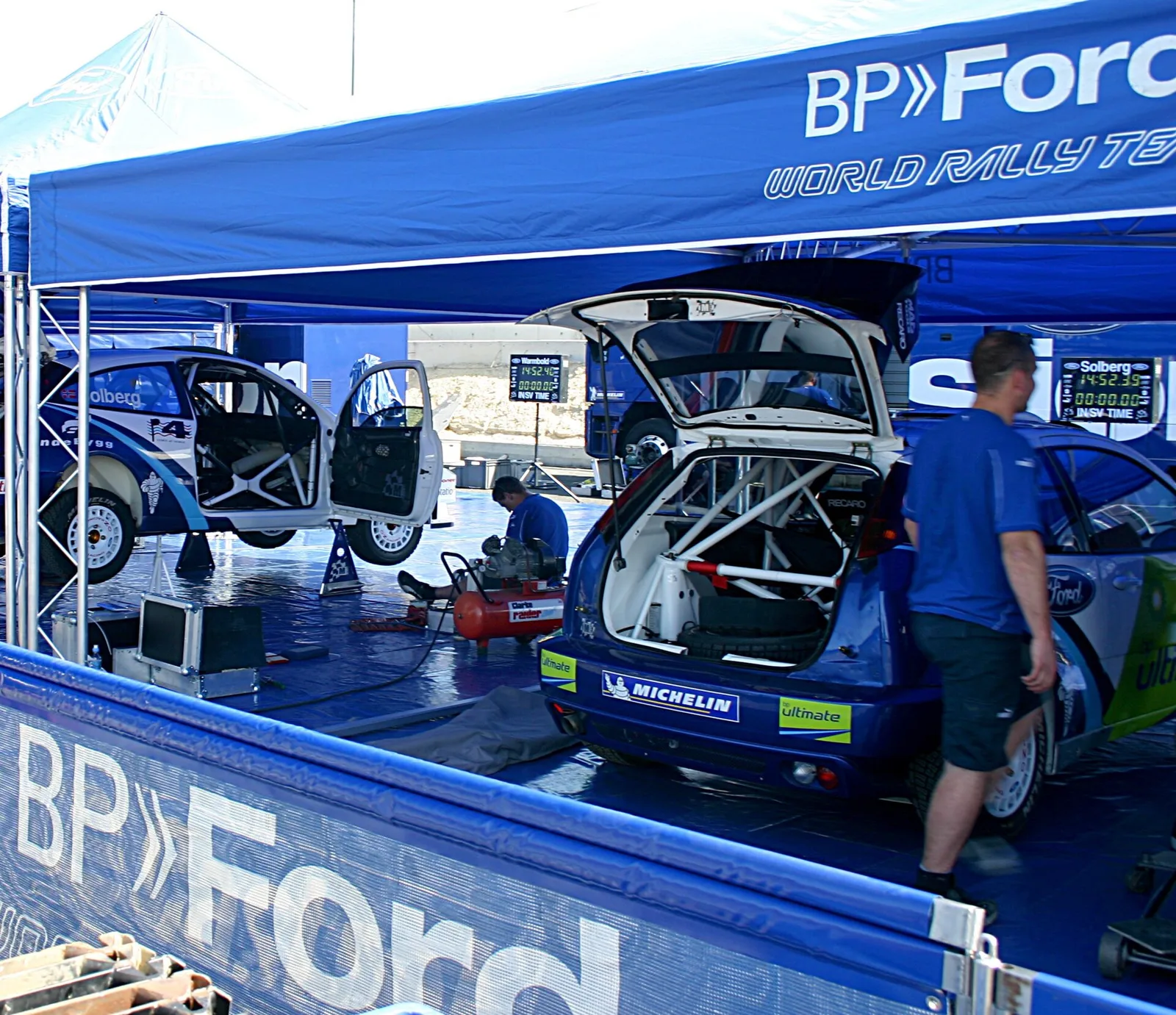
In 2012 Petter Solberg joined Latvala after Hirvonen moved to Citroen. Latvala crashed out while leading the Monte Carlo Rally, and Ford finished second behind Citroen again. The sponsorship then ended, which closed a seventeen-year link with the M-Sport squad.
What happened after the works team left?
In late 2012 M-Sport secured sponsorship from the State of Qatar, and Mads Ostberg and Nasser Al-Attiyah drove for the team in 2013. Although it ran Ford Fiestas and had technical support from the Ford Motor Company, the team was not classed as the Ford World Rally Team.
The works badge returned to the plans in October 2026, when Ford Racing announced that the Ford WRT would come back to the World Rally Championship as a factory-backed team from the 2028 season.
What are the key results?
The main results are the 1979 world title, the 2006 manufacturers' title and Colin McRae's 1999 Safari win. The table below sets out the headline results by season and series.
| Season | Result | Car |
|---|---|---|
| 1979 | World Rally Championship title | Escort RS1800 |
| 1986 | Manufacturers' fifth place, Grundel podium in Sweden | RS200 |
| 1988 | Manufacturers' second place, 79 points | Sierra RS Cosworth |
| 1992 | Manufacturers' third place, 94 points | Sierra RS Cosworth 4x4 |
| 1996 | Manufacturers' third place, Sainz third in drivers' standings | Escort RS Cosworth |
| 1997 | Manufacturers' second place | Escort WRC |
| 1999 | Safari Rally win, Colin McRae | Focus WRC |
| 2000 | Manufacturers' second place, McRae third and Sainz fourth | Focus WRC |
| 2006 | Manufacturers' title, first Ford title since 1979 | Focus RS WRC |
| 2011 | Manufacturers' second place, twenty-seven points behind Citroen | Fiesta RS WRC |
What is the legacy of the Ford World Rally Team?
The team's legacy is a long list of drivers and cars that defined rallying in several decades, from Mikkola and Vatanen in 1979 to Gronholm and Hirvonen in the 2000s. Its 1979 title and 2006 manufacturers' crown are the two results that stand above the rest.
The announced return from 2028 gives the Ford name a new chapter in the World Rally Championship. Its history shows how often the team has moved between factory, sponsor and independent roles, and the next phase will test whether the return can match the best years.