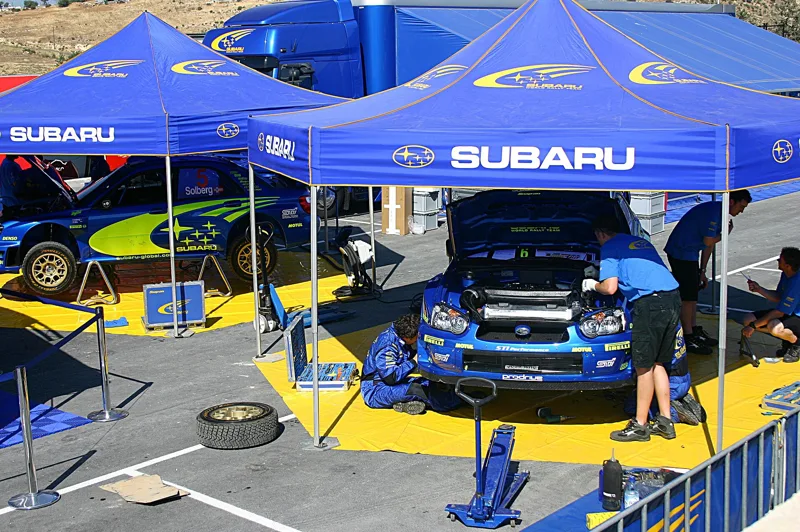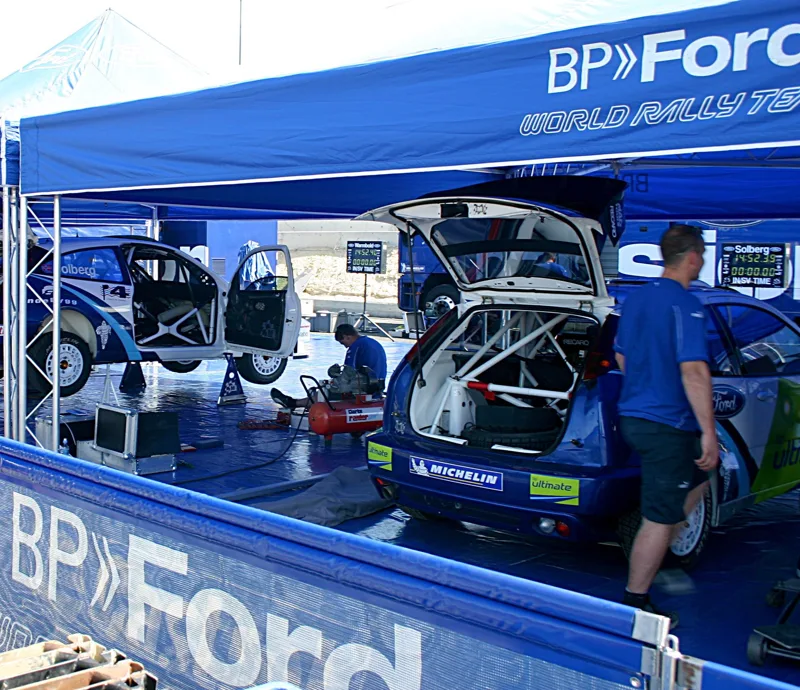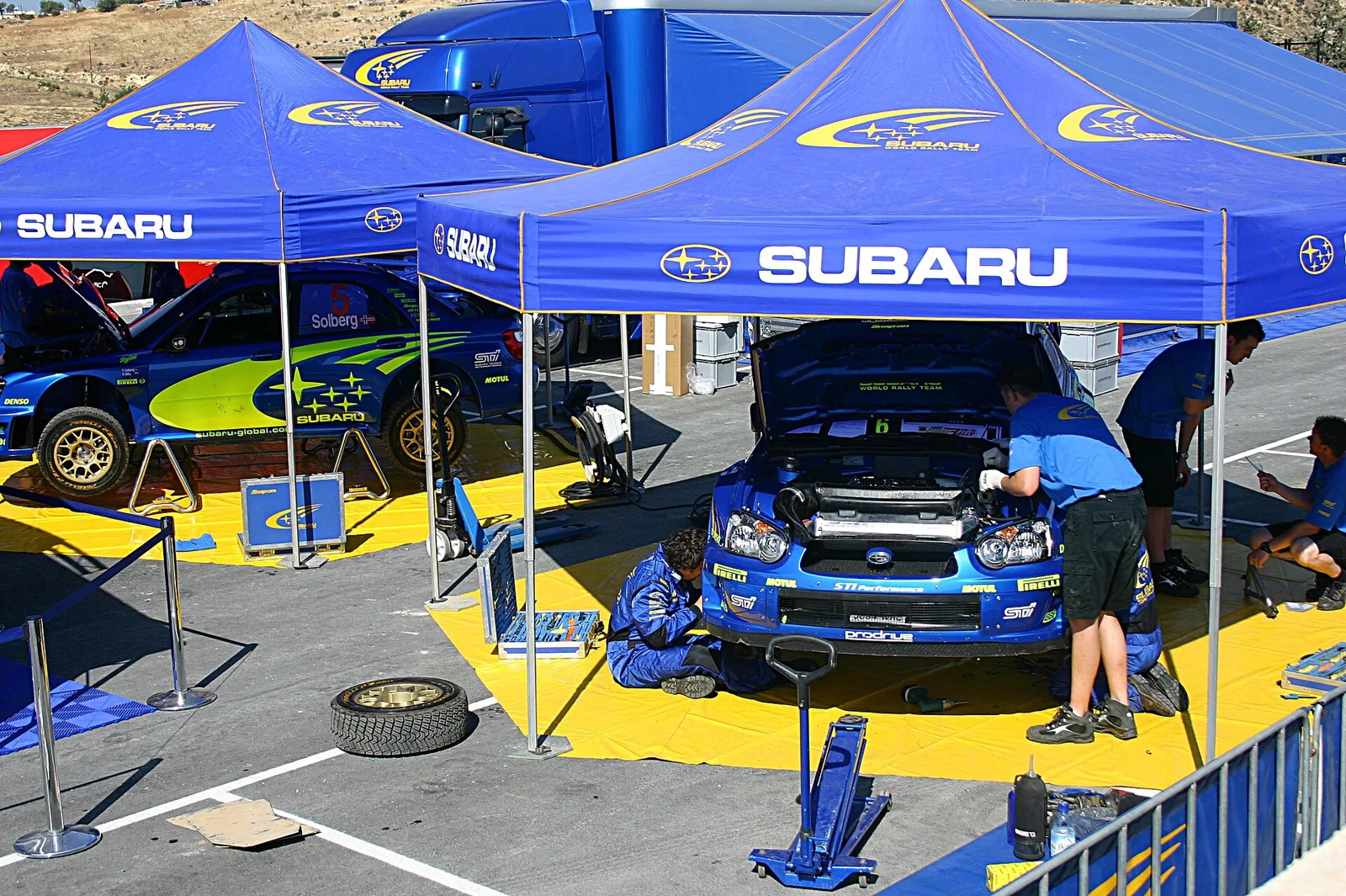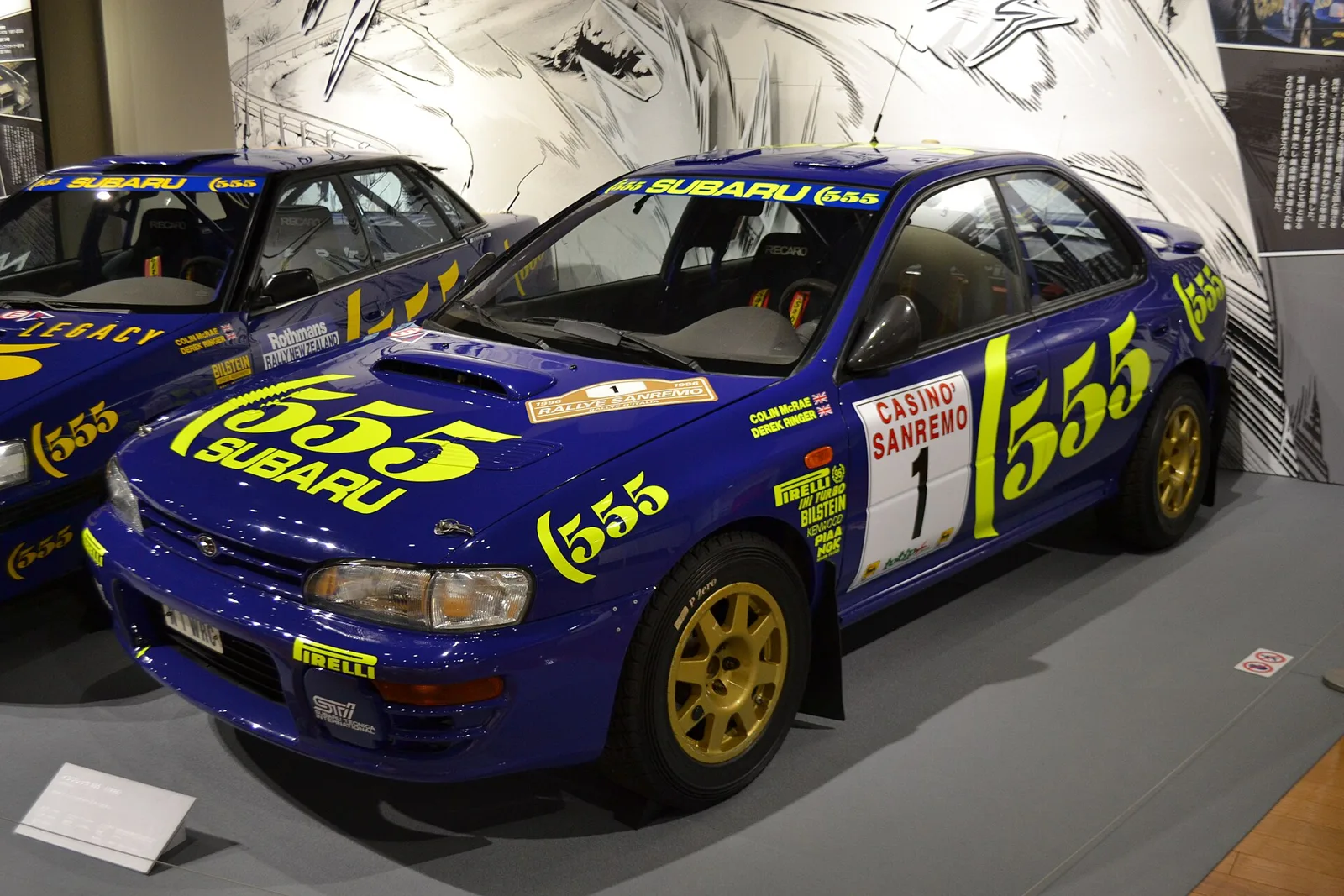
Prodrive-built rally cars from the Impreza 555 to the WRC2007, with Subaru's manufacturers' titles and Petter Solberg's 2003 drivers' crown.
Built by Prodrive from the Impreza 555, the car competed in the series from 1993 to 2008. It brought Subaru manufacturers' titles in 1995 and the season after, and Petter Solberg won the drivers' championship in 2003 in the same car line.
The Subaru Impreza WRC was a rally car that raced in the World Rally Championship from 1993 to 2008. It began as the Impreza 555, and Subaru went on to win the manufacturers' title in 1995 and again the following season, while Carlos Sainz, Colin McRae, Richard Burns and Petter Solberg drove for the team in championship battles.
The car's story is one of steady change: a coupe body in 1997, a four-door bodyshell from 2001, and a Prodrive update almost every year. Its results were uneven, and the team's hopes were often higher than the final standings.
Where did the Impreza WRC come from?
The Impreza WRC grew out of the Legacy RS, which had become uncompetitive against the Ford Escort Cosworth and the Toyota Celica ST185. The Subaru World Rally Team asked Prodrive to prepare a new Impreza to Group A regulations, and the car took the name 555 from its sponsor of the time.
Its debut came at the Rally of Finland in 1993, with Ari Vatanen, Markku Alen and Colin McRae as drivers.
In 1994 the car's competitiveness drew Carlos Sainz to the English team, and Subaru kept McRae as his teammate. Sainz won the Acropolis Rally that year, the first victory for the car, and he lost the title at the final event after a fine duel with Toyota's Didier Auriol.
Solberg won the 2003 drivers' title by a single point, the third Subaru driver to win the crown.
How did the 555 become a title contender?
In 1995 McRae and Sainz fought for the drivers' crown, and McRae beat Sainz in a sprint at the last event to take the title. Subaru won its first manufacturers' championship that season.
The following year Sainz moved to Ford, and Subaru chose the Swede Kenneth Eriksson and Piero Liatti to support McRae. McRae won three events, but three accidents cost him the title, which went to Tommi Makinen in a Mitsubishi. Subaru still won the manufacturers' title for a second year in a row.
What changed with the WRC97 and WRC98?
New regulations in 1997 let Subaru use a coupe version built in a limited run, and the car it chose was the WRC97, code name 22B. It was 1,770 mm (69.9 in) wide, with revised suspension geometry, and it produced 224 kW (300 PS; 300 hp) at 5,500 rpm.
The engine work changed the camshafts, cylinder ports and combustion chambers, and the torque reached 470 Nm (347 lb ft). The 1997 drivers were McRae, Eriksson and Liatti, with the last two alternating on gravel and tarmac events.
The WRC98 evolved from the WRC97. Its active differentials, controlled by computer at the front, rear and centre, worked with an electronic throttle, yet breakdowns were common and pushed the team out of the title race.
Why did Subaru slip in 1998?
Subaru slipped as the Impreza seemed to lose competitiveness against the new Toyota Corolla WRC and Mitsubishi Lancer Evo V, and a few technical problems too many did not help. After three consecutive years at the top, the team dropped from first to third in the manufacturers' standings, overtaken by Mitsubishi and Toyota.
McRae fought on until the penultimate rally, but a fourth place there cut him out of the title battle.
The WRC99, introduced at the first round, had an electronically controlled semi-automatic gearbox with hydraulic actuation. Drivers changed gear with paddles mounted on the steering wheel, similar to those of Formula One cars.
What did the 1999 and 2000 seasons bring?
In 1999 McRae and Liatti left, making way for Richard Burns and Juha Kankkunen. Subaru won five events, three by Burns and two by Kankkunen, and it finished second in the manufacturers' standings, just four points behind Toyota.
Burns was in the title fight until the penultimate rally, the Rally of Australia. There he won, but Makinen finished third and took the title.
The WRC2000/P2000, code name S6, followed in 2000. It had about 80% of its components renewed and was designed with the developments of the 2001 44S already in mind. Its technical manager was the Belgian Christian Loriaux, who later became the mind behind Ford's WRC success.
Anyone wanting to tell a P2000 apart from earlier cars can look for the two large air outlets on the front bonnet, which were absent before. The P2000 had shown such competitiveness that it could be considered the best Impreza WRC ever built. The renewal paid off. Burns won four events and lost the title only at the last event to Marcus Gronholm, while Subaru took third in the manufacturers' standings behind Peugeot and Ford.
Did the 44S win a title in 2001?
Yes, but narrowly. Richard Burns took the 2001 drivers' title with 44 points, the lowest winning total in the championship's history, after a first half of the season hit by technical failures on the WRC2001. The title was won with a single victory, in New Zealand.
The 44S was the new generation of Impreza WRC. The WRC2001 arrived alongside the second-generation road Impreza, code GD, and it received a completely new bodyshell. That marked Subaru's return to a four-door saloon after four years of running the coupe.
Subaru's engineers stressed how deep the technical carry-over from the P2000 had been. The main challenge was the new weight distribution, which called for a study to cut the car's moment of inertia and lower its centre of gravity, so the car would respond on mixed roads and roll less in corners.
The title came with a few too many worries. Burns went into the Rally of Great Britain with the smallest chances of the title contenders. He finished only third, but the other three contenders retired, and Burns took the title. Subaru finished fourth out of six manufacturers, and Burns left for Peugeot at the end of the year.
How did the 2001 team line-up play out?
Subaru fielded four cars in 2001. Richard Burns kept his seat, Petter Solberg ran a full programme, and Markko Martin and the newcomer Toshihiro Arai ran reduced schedules. Technical problems dominated the first part of the season, before the results began to turn.
From the Rally of Argentina the results began to improve. Burns and Reid recorded four more second-place finishes in the rest of the championship, and a single win came at New Zealand, enough to secure the drivers' title.
Subaru as a team did not share that success. Its season ended fourth out of six manufacturers, a result that fell well short of the team's initial expectations.
What did the WRC2002 and WRC2003 change?
The WRC2002 made its first appearance at the Tour de Corse, the third event of 2002. It looks almost identical to the WRC2001, but the blade under the front bumper switched from carbon to fibreglass, and torque was raised between 4,500 and 5,000 rpm through changes to the exhaust ducts, flywheel and turbo.
Some rallies used the old 555 livery, which returned after five years, while others used the classic six-star Subaru logo.
The WRC2003 adopted the restyled Impreza's near-rectangular front lamps. Maximum power stayed at 300 PS, but torque jumped from 48 kgm to 60 kgm, which improved acceleration and pick-up.
How did Solberg win the 2003 title?
Solberg won the drivers' title in 2003 by a single point, after victories in Cyprus, Australia, Corsica and Wales. Wales was the decisive win, the last event of the season. The margin owed a good deal to luck, including Pirelli tyres and the problems Citroen met in its last three or four events.
In Corsica a huge downpour hit the island, and only Subaru had suitable tyres. Solberg had crashed during the shakedown before winning the rally.
At Catalonia, the penultimate event, Loeb was overtaken on the final special stage by Gilles Panizzi after a wrong tyre choice. At the final event, the Wales Rally GB, Sainz retired at the first stage when the on-board camera caught fire.
Solberg became the third driver, in a Subaru, to win the title after McRae and Burns. His teammate Tommi Makinen, on whom the greatest expectations had been placed, finished ninth and then left the world rally scene after seventeen years and four world titles.
Specifications at a glance
| Version | Season | Code name | Notable detail |
|---|---|---|---|
| WRC97 | 1997 | 22B, S5 | 224 kW (300 PS; 300 hp) at 5,500 rpm; 470 Nm (347 lb ft) |
| WRC98 | 1998 | S5 | Computer-controlled active differentials and an electronic throttle |
| WRC99 | 1999 | S5 | Electronically controlled semi-automatic gearbox with paddles |
| WRC2000/P2000 | 2000 | S6 | About 80% of components renewed |
| WRC2001 | 2001 | S7 | New four-door bodyshell |
| WRC2003 | 2003 | S9 | Torque 60 kgm, up from 48 kgm; power unchanged at 300 PS |
| WRC2005 | 2005 | S11 | Bodyshell 30 mm wider than before |
| WRC2007 | 2007 | S13 | Transmission weighs 95 kg filled with oil; gearbox runs at 17 MPa (2,500 psi) |
What did the WRC2004 to WRC2006 seasons bring?
The WRC2004 was presented at the Rally of Mexico, and a revised gearbox arrived in mid-season. Solberg finished second overall with five victories, which were the core of the team's season that year, while Subaru took third place among five manufacturers.
The WRC2005 was developed by Subaru and Prodrive over 12 months and presented on 11 March 2005 at the Rally of Mexico. Its bodyshell was stiffer and 30 mm wider, and it used more composite panels and a revised IHI turbocharger.
In 2006 the car received a second restyling with hawk-eye headlamps, and rule changes that banned active differentials and water injection forced mechanical changes. Subaru finished third behind Ford and Citroen but won no events, and Solberg finished sixth while Atkinson was tenth.
How costly was the WRC2007 transmission?
Each WRC2007 transmission took 85 hours to build and cost more than 75,000 pounds sterling. The front and rear differentials were similar, while the centre differential was unique, and each took about 16 hours to build and cost around 20,000 pounds.
The transmission and differential casings were made of magnesium to save weight. Filled with oil, the transmission weighed 95 kg and a differential 25 kg.
The hydraulic shifting system ran at 17 MPa (2,500 psi), completing gear changes in less than 0.1 seconds, and the differentials usually operated around 100 degrees Celsius.
Why does the Impreza WRC still matter?
Rule changes shaped much of the car's history. The 1997 regulations allowed the coupe version, and the 2006 rules banned active differentials, which forced mechanical changes on the team.
It matters because it gave Subaru manufacturers' titles in 1995 and the season after, and because it gave Petter Solberg the drivers' championship in 2003. That made Solberg the third Subaru driver to win the title. Richard Burns had left Subaru for Peugeot after 2001, the season of his title.
Tommi Makinen, a four-time world champion who joined the team in 2002, finished ninth in 2003 and then left the world rally scene. His 22 points in 2002 were a sharp contrast with the expectations he brought to Subaru.
Christian Loriaux, the P2000's technical chief, later became the mind behind Ford's success in the WRC.