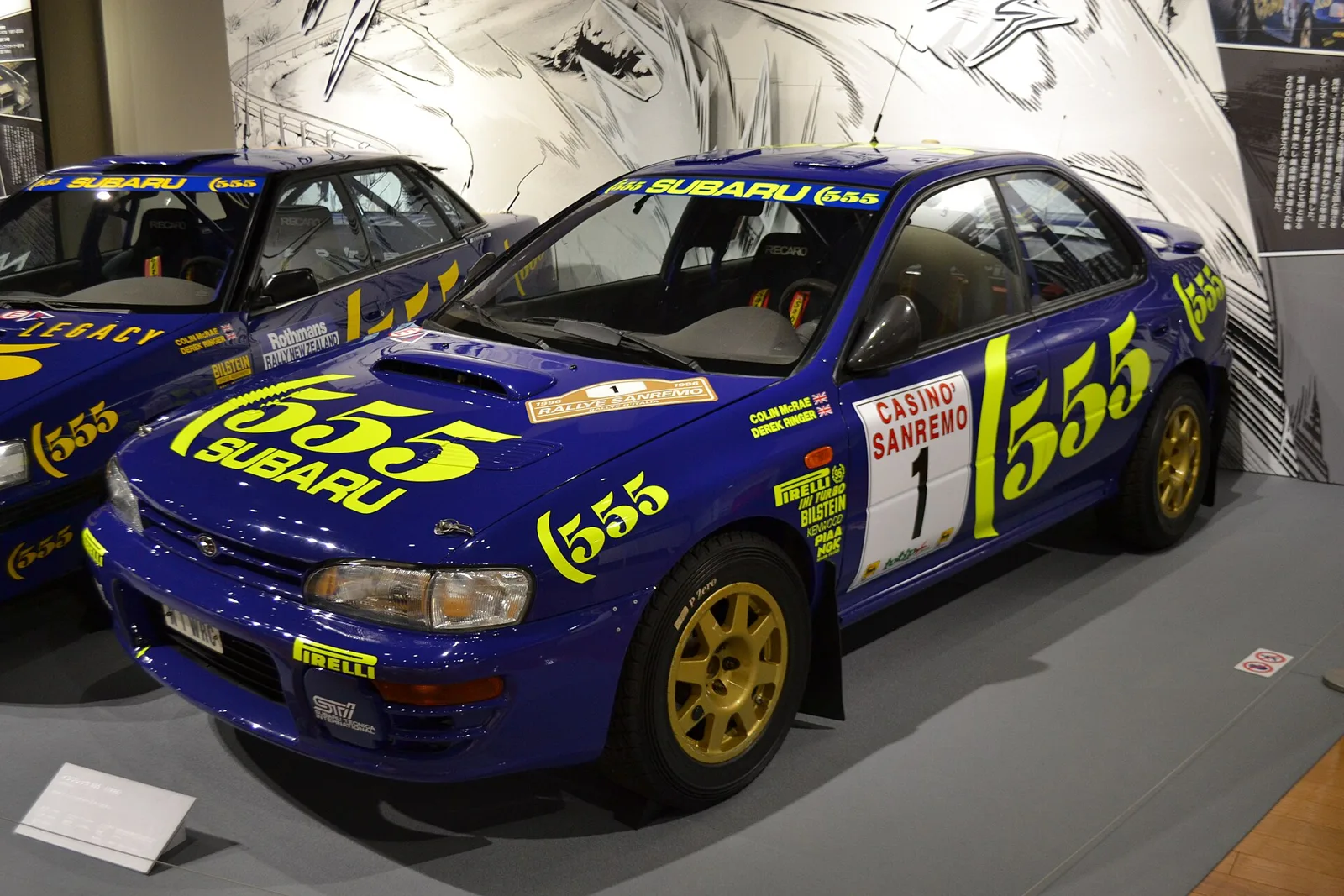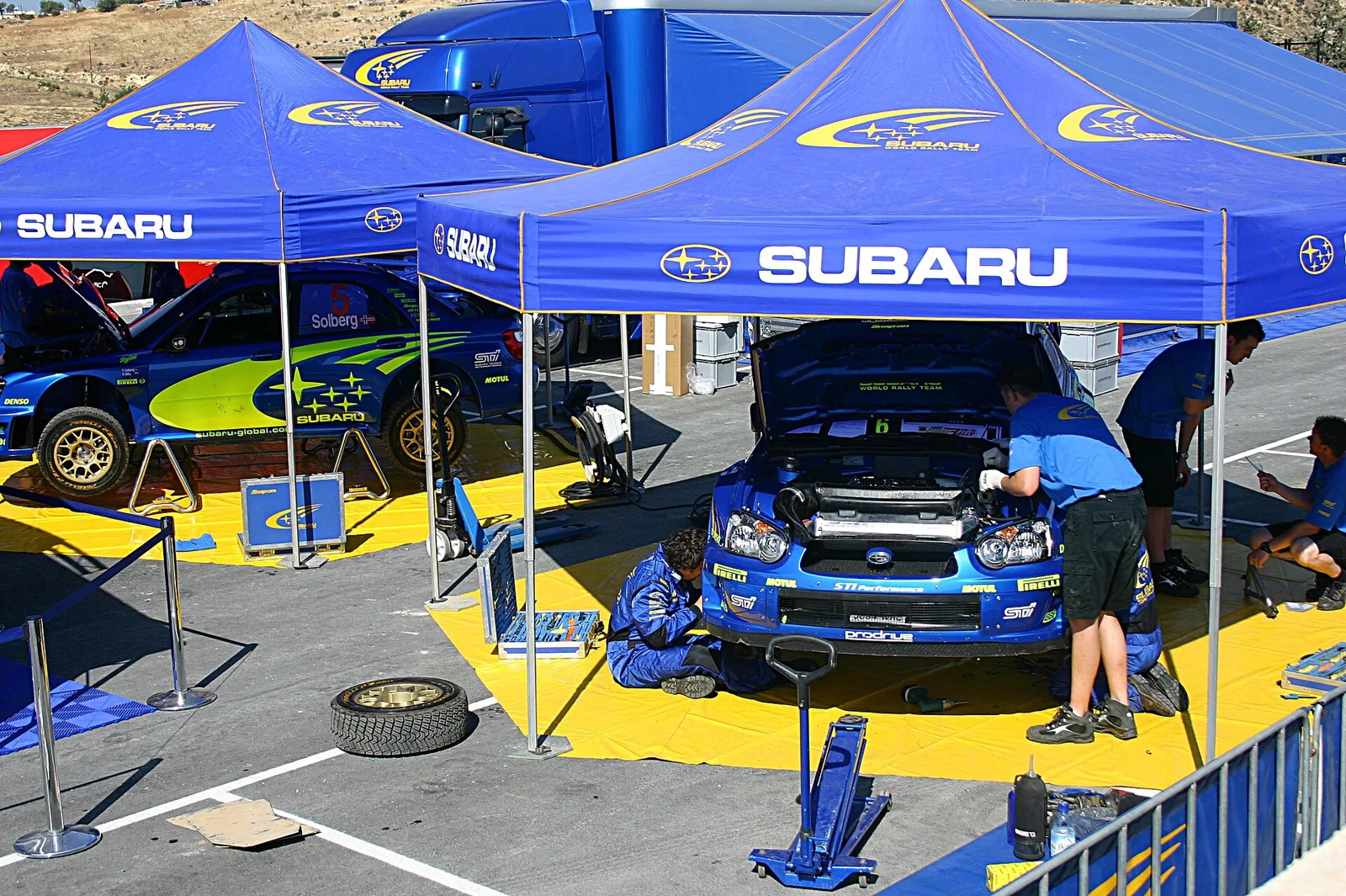
A blue and yellow Prodrive-built team that won manufacturers' titles in 1995, 1996 and 1997 and carried symmetrical all-wheel drive to the top of rallying.
The Subaru World Rally Team was Subaru's World Rally Championship team, run with British firm Prodrive from 1989 to 2008. It won manufacturers' titles in 1995, 1996 and 1997, drivers' titles in 1995, 2001 and 2003, and its Impreza won a record 46 rallies.
The Subaru World Rally Team was Subaru's entry in the World Rally Championship for most of two decades. Run with British firm Prodrive, it built a reputation on the Impreza, won manufacturers' titles in the mid-1990s and carried the brand's symmetrical all-wheel drive into the record books. The team left the championship at the end of 2008.
What was the Subaru World Rally Team?
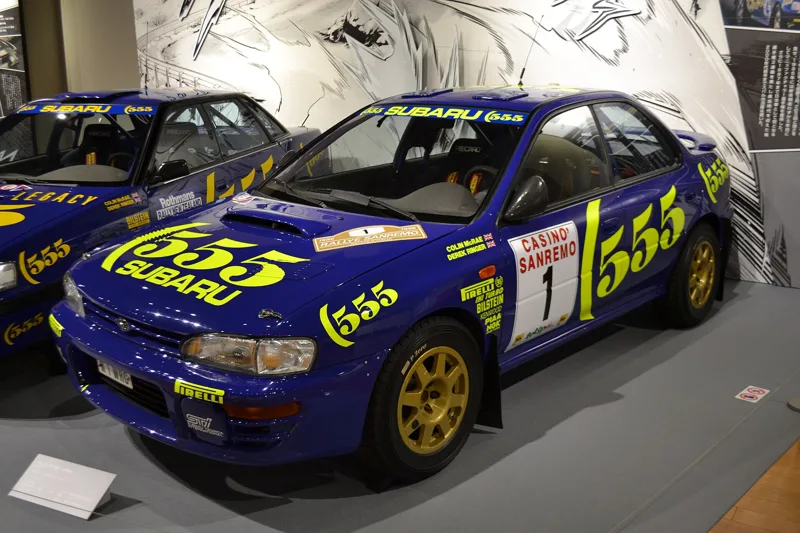
The Subaru World Rally Team, known as SWRT, was Subaru's World Rally Championship team. Its blue and yellow colour scheme recalled the State Express 555 sponsorship, a cigarette brand popular in Asia. In 1989 Prodrive took over operations, and the team relocated from Japan to Banbury in England.
The team was the showcase for Subaru's symmetrical all-wheel-drive technology. The company credited rising sales of its vehicles, especially the Impreza, to the team's success in the championship.
A Prodrive-built all-wheel-drive team that turned a blue and yellow Impreza into three manufacturers' crowns in the mid-1990s.
Where did Subaru's rally effort begin?
Subaru's WRC efforts date back to 1980, when the first Subaru car entered a world rally at the Safari Rally. The team at that time was Subaru Rally Team Japan, run by Noriyuki Koseki, and it entered only a few events a season in the Subaru Leone.
Early drivers were Ari Vatanen, Per Eklund, Shekhar Mehta and Possum Bourne. Bourne's third place at the 1987 Rally New Zealand was the only podium of that period.
How did the Prodrive era start?
The current form of the team was created in September 1989, when Subaru Tecnica International president Ryuichiro Kuze partnered with Prodrive to prepare the Legacy RS for the championship. Prodrive's first car, the Group A Legacy RS, was driven in 1990 by Finnish driver Markku Alen.
Alen finished fourth at the 1990 Rally Finland, and in 1991 he added a third place and two fourth places. For 1992 Subaru entered only seven of the fourteen WRC events and concentrated on gravel rallies. Ari Vatanen and Colin McRae, a Scot, were the main drivers, and both took second-place finishes.
How did the Impreza 555 change the team in 1993?
For 1993 the team debuted its distinctive blue and yellow scheme, together with the new title sponsor State Express 555. McRae took the first Subaru win of the era at Rally New Zealand, the eighth round of the season, which was the last outing for the Group A Legacy.
The Prodrive-developed Impreza 555 made its debut at Rally Finland, where Vatanen showed the car was quick and finished second. Subaru finished third in the manufacturers' standings that year, and McRae was fifth in the drivers' championship.
Who else drove for the team in 1993?
Other drivers joined the team for selected events in 1993. Possum Bourne competed in New Zealand and Australia, Piero Liatti in Sanremo and Great Britain, and Per Eklund and Hannu Mikkola in Sweden. Markku Alen returned part-time after a brief stint at Toyota in 1992 and finished fourth in Portugal.
Vatanen ended the season seventh in the drivers' championship, and McRae was fifth with 50 points. Richard Burns and Alister McRae raced in the British Championship, which Burns won, and then drove Legacies at Rally Great Britain, where Burns finished seventh and McRae tenth.
Did Subaru win the titles in 1995?
Yes. Subaru won the 1995 manufacturers' championship and McRae won the drivers' title, with Carlos Sainz second in the standings. The team's Impreza was the car to beat in the mid-1990s.
Sainz arrived in 1994 alongside co-driver Luis Moya, and the Impreza won its first event at the Acropolis Rally. In 1995 Sainz won the Rallye Monte Carlo opener, and the team locked out the podium at the Rallye Catalunya with a 1-2-3 finish. McRae won the RAC Rally of Great Britain at his home event, which gave him his only drivers' title and the first for the team.
Between McRae and Sainz the team won five of the season's eight rallies. Sainz then left for Ford World Rallye Sport at the end of the season.
How did the team fare in 1996 and 1997?
In 1996 Colin McRae was again the lead driver, alongside Kenneth Eriksson and Piero Liatti. McRae won at the Acropolis Rally and again at Sanremo, and Subaru took a 1-2 finish at the Rallye Catalunya with Liatti second. The team defended its constructors' title, but McRae lost the drivers' title to Tommi Makinen.
For 1997 Derek Ringer was replaced by Nicky Grist as McRae's co-driver. The team won eight rallies from fourteen and defended the constructors' title again. McRae lost the drivers' championship to Makinen by just one point.
Why did McRae leave for Ford?
In 1998 the team had an almost unchanged line-up, but bad weather and mechanical failures hurt its form. McRae took wins in Portugal, Corsica and Greece, but the team and its driver each ended the year in third place.
McRae then moved on to Ford, which offered him its new Focus WRC.
How did the 1999 to 2001 seasons go?
Subaru started 1999 with an all-new line-up of Richard Burns and Juha Kankkunen, plus Bruno Thiry. The new WRC99 had a paddle shifter and drive-by-wire throttle, and the team struggled until the seventh round in Argentina. From there it reached the podium in seven of eight events, with five wins, and finished second in the manufacturers' championship, just four points behind Toyota. Burns won in Greece, Australia and Wales to take second in the drivers' standings, while Juha Kankkunen finished fourth with wins in Argentina and Finland.
Petter Solberg joined mid-season in 2000, and the team finished third in the championship. In 2001 Subaru won the drivers' championship again, this time with Burns and co-driver Robert Reid, before Burns left for Peugeot.
Did Makinen and Solberg bring success in 2002 and 2003?
In 2002 Tommi Makinen replaced Burns, with Kaj Lindstrom as co-driver. Makinen won the season-opening round in Monte Carlo but then finished only five more events. Solberg fared better, finishing nine events and taking his first WRC win at Rally Great Britain, the season's last round.
In 2003 Solberg won four rallies, including a second straight win in Britain, and took the drivers' title with co-driver Phil Mills by one point from Sebastien Loeb. The team finished third in the manufacturers' standings, behind Citroen and Peugeot. Makinen retired from the WRC at the end of the season.
What were the highlights and records?
| Season | Milestone |
|---|---|
| 1995 | Manufacturers' and drivers' titles, with McRae the drivers' champion |
| 1996 | Manufacturers' title defended; McRae second in the drivers' standings |
| 1997 | Manufacturers' title defended with eight wins from fourteen rallies |
| 2001 | Drivers' title with Richard Burns |
| 2003 | Drivers' title with Petter Solberg |
| 2008 | Final season; withdrawal announced 16 December 2008 |
Across its run the Impreza model won a record 46 rallies.
What were the 2004 to 2006 seasons like?
For 2004 Richard Burns was to return, but a brain tumour developed in late 2003 and he never came back to the team. Solberg was partnered by Mikko Hirvonen, and the team kept third place in the manufacturers' championship. Solberg was second in the drivers' championship, winning five rallies including New Zealand, Greece, Japan, Italy and a third consecutive Wales win.
The 2006 season was the hardest. The WRC2006 car had to be introduced at the first round after rule changes banned active differentials and water injection. Solberg scored no points at the first two rallies, and David Lapworth was replaced by Paul Howarth as team boss. The team took third among manufacturers with no wins, a season that a television series about the sport called the Season from Hell.
How did the final seasons go?
In 2007 Solberg finished second at Rally Portugal after the Ford cars were disqualified over thin rear-window glass. He retired from Rally Finland after handling problems, and the team took third among manufacturers. Richard Taylor called the season poor, with only two podium finishes and no overall wins.
In 2008 Chris Atkinson scored his best result, second at Rally Mexico, and was second again at Rally Argentina after Solberg's electrical failure. Solberg had retired from Rally Mexico on the second day after a driveshaft failure, and he finished 12th under SupeRally rules. At the Jordan Rally Atkinson secured a third podium in a row, but the year marked the end of the team's time in the WRC.
Why did Subaru leave the WRC?
On 16 December 2008 Subaru announced that it would no longer compete in the World Rally Championship, ending a partnership that had begun with Prodrive in 1989. The decision came from its parent company, Fuji Heavy Industries, partly because of the economic downturn, but also because Subaru felt it had achieved its sporting and marketing goals.
Ikuo Mori rejected the idea that the 2010 technical changes, or strained dealings with Prodrive, had shaped the decision. He said a return to the top category was not impossible, although it looked unlikely for the foreseeable future.
How were the cars built and prepared?
The Subaru Leone was the team's first rally car, with a second-generation Group A version at the 1980 Safari Rally. In 1984 it was replaced by a third-generation Leone coupe, which received a turbo a year later. The Legacy RS, built from 1989 to 1993, came from Prodrive, and its boxer engine gave the car a low centre of gravity.
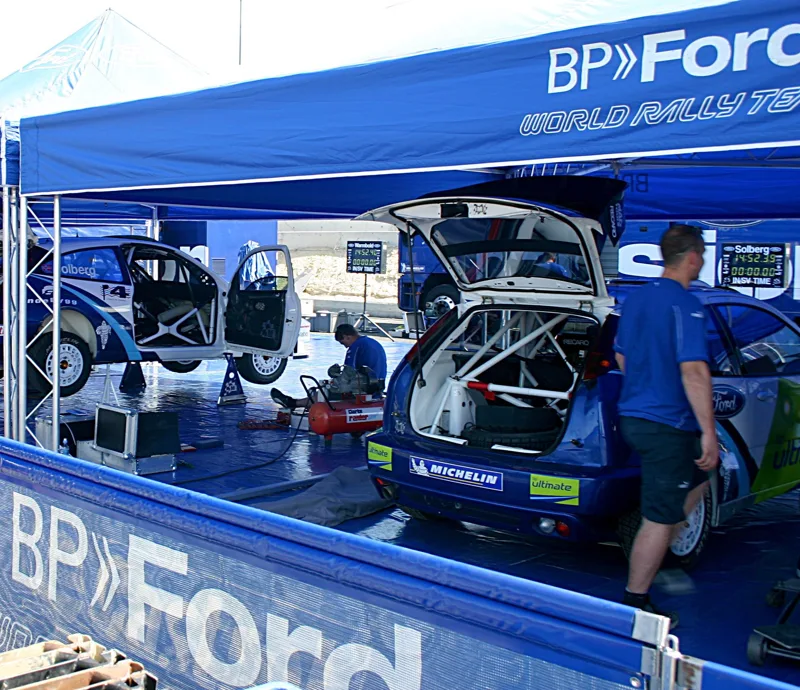
Before each rally every bodyshell was completely rebuilt. A rebuild took 160 hours in 1993, rising to 650 man hours in 2003 and 780 hours in 2006. Graham Moore was the overall chief engineer, and he had been a member of the team from 1991 to 2002 before rejoining in 2006.
Who ran the team behind the scenes?
David Richards served as principal, and he was also a founder and chairman of Prodrive. Paul Howarth became operations director and team manager in 2006, and Richard Taylor was managing director.
Jonathan Carey was chief engineer for Petter Solberg, Richard Thompson was chief engineer for Chris Atkinson and Chris Wattam was chief mechanic.