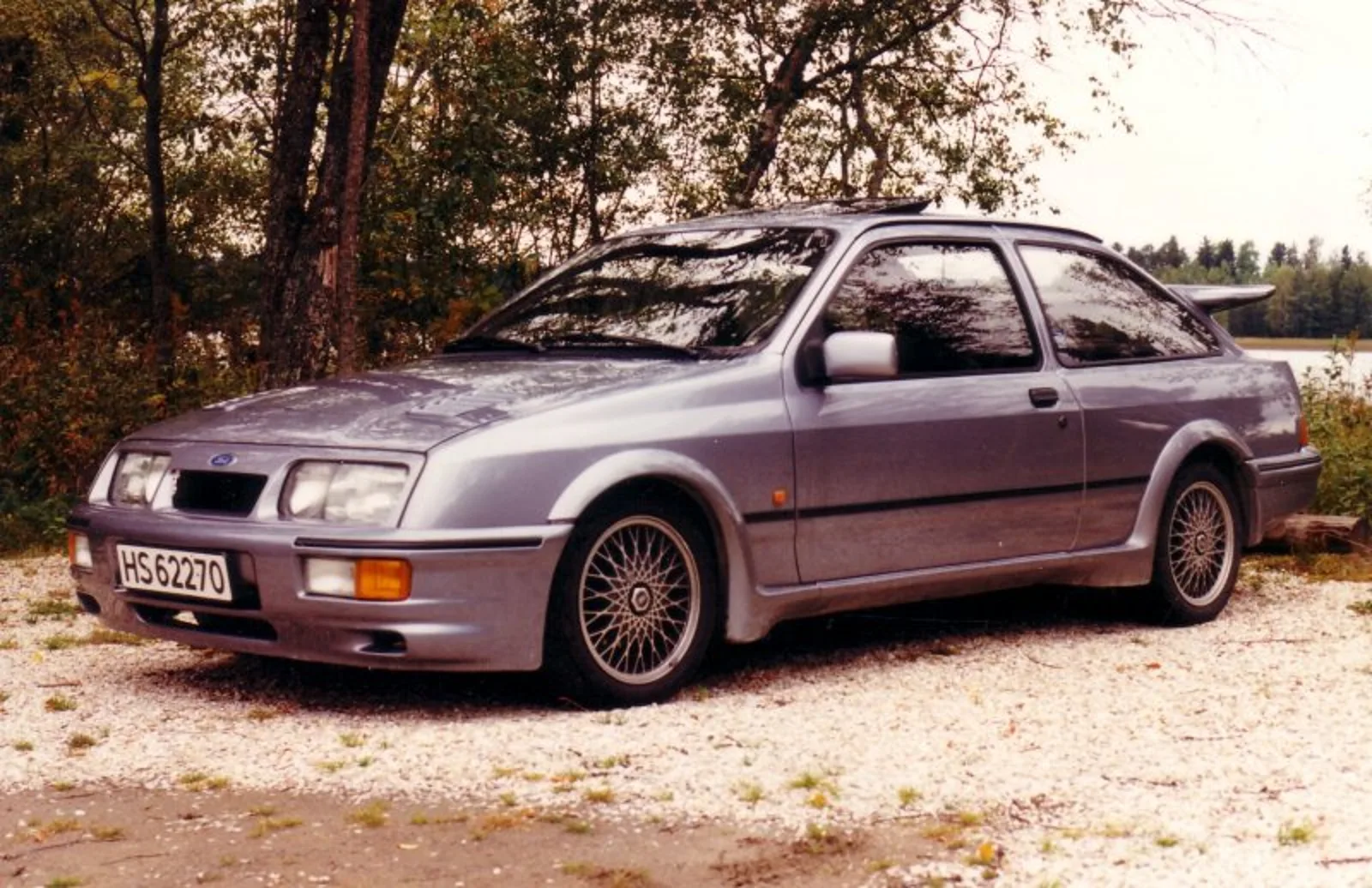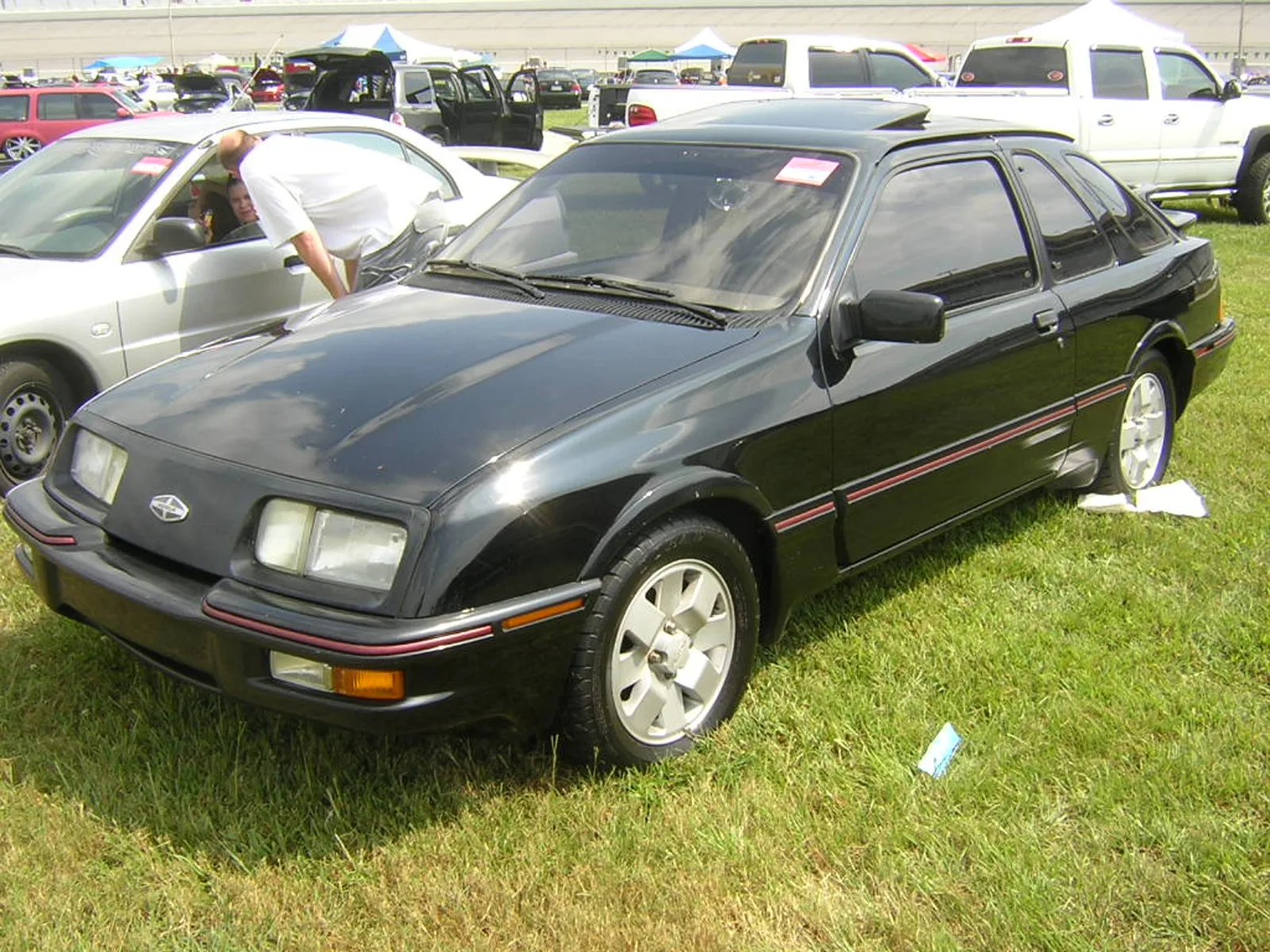
A turbocharged European Sierra sold under the Merkur name from 1985 to 1989, with a racing legacy that outlived its showroom success.
The XR4Ti reached North American showrooms in 1985 and ended in 1989 as a Merkur-badged hatchback built on the European Sierra and adapted for US rules. Contract builders in Germany put the cars together largely by hand, and the engine was a turbocharged four.
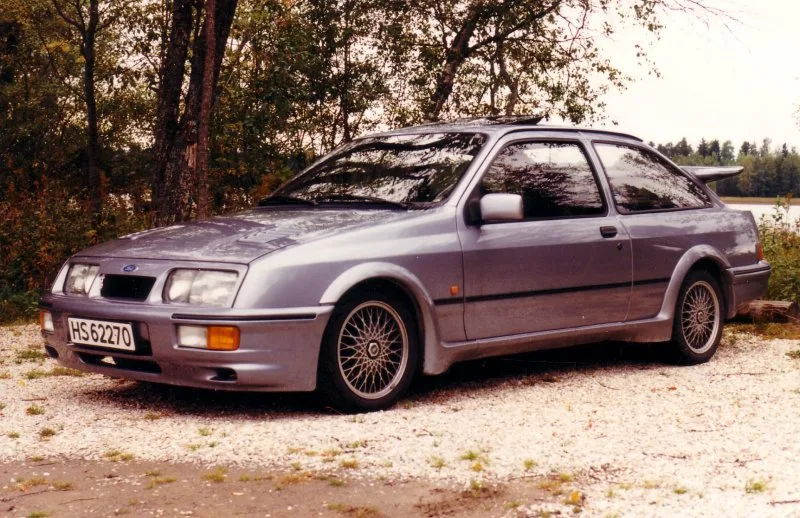
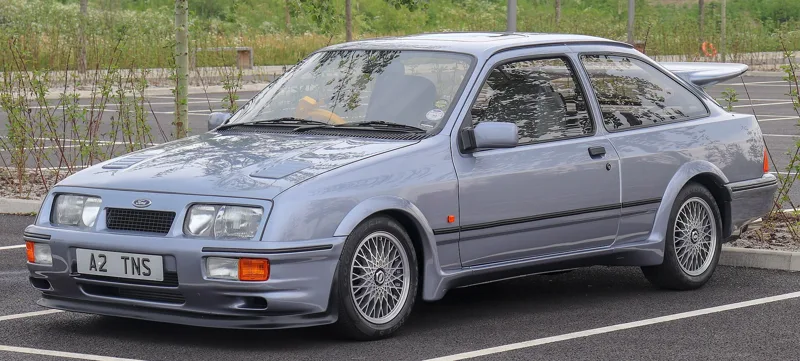
The Merkur XR4Ti was a turbocharged three-door hatchback sold in North America from 1985 to 1989. Ford based it on the European Sierra, adapted it for US rules and sold it under a separate Merkur brand through Lincoln-Mercury dealers. The car was largely built by hand in Germany.
The XR4Ti was meant to be a sporty answer to the luxury imports of its day, and its project was championed by Ford vice president Bob Lutz. Its life was short and its reputation divided. Sales began well and then faded, and enthusiasts still argue over whether the car was a capable performer or an awkward compromise.
Where did the Sierra come from?
The Sierra succeeded the Cortina and Taunus at Ford of Europe, and it was developed while Lutz was chairman of the European operations. Financial limits kept the front-engine, rear-wheel drive layout, so the team pursued better fuel economy through advanced aerodynamics. The Probe III design study at the 1981 Frankfurt Motor Show foreshadowed that direction.
Responsibility for the design rested with vice president for design Uwe Bahnsen and chief stylist Patrick le Quement. The Sierra reached European showrooms in September 1982, and the performance XR4i followed in 1983, sitting above the Fiesta-based XR2 and the Escort-based XR3 in the range.
A European Sierra turned into an American turbo hatch, with a new name and a long debate over whether it was a hero or a compromise.
Why did Lutz want the XR4i in North America?
Lutz wanted a North American version of the XR4i that could take on sporty luxury imports such as BMW. Adapting it would take work, but he insisted the car's character must stay intact. The US model would be turbocharged, gaining a T in its name while keeping the i for fuel injection.
Why was the car sold as a Merkur?
The Sierra name was not used in North America. General Motors already used Sierra for its GMC pickup, and the name sounded too close to the Oldsmobile Cutlass Ciera. Chief executive Pete Petersen chose the Merkur brand instead, a German word meaning Mercury, which tied the car to the Lincoln-Mercury dealer network.
About 800 Lincoln-Mercury dealers enrolled to become Merkur dealers at the start. The name was a deliberate link to an existing dealer base.
How was the XR4Ti built?
Ford's own production lines were fully occupied building Sierras for the European market, so assembly of the XR4Ti was contracted out. Body panels came from Ford's factory in Genk, and Wilhelm Karmann GmbH in Rheine, Germany, built the cars largely by hand, and the launch price was US$16,503, equivalent to $51,100 in 2025.
The changes needed for the American market were extensive. The unibody floorpan gained reliefs to accommodate catalytic converters, side intrusion beams were added to both doors, and the bumpers were stretched to meet US impact requirements. A taller hood was needed to clear the American engine. In total 850 unique parts were developed for the US and Canadian cars, adding about 280 lb (127.0 kg).
The body itself kept the three-door semi-notchback shape of the XR4i. It retained the triple side-window profile and a bi-plane rear spoiler from Europe, and the lower body was clad in polycarbonate anti-abrasion panels that were matte grey on the early cars. The drag coefficient was 0.328.
What suspension and brakes did the XR4Ti have?
The XR4Ti used independent suspension at both ends. The front had MacPherson struts with concentric coil springs, lower lateral links and an anti-roll bar to brace them, while the rear used semi-trailing arms with coil springs placed ahead of the axle half-shafts. An anti-roll bar was fitted at the rear as well.
Spring rates were softened compared with the XR4i after feedback from Jackie Stewart, who joined the programme as both a development tester and a spokesman. Steering was by power-assisted rack and pinion with 3.6 turns lock to lock. The brakes were 10.2 in (259 mm) discs at the front and 10.0 in (254 mm) drums at the rear.
The car had a two-piece driveshaft that used a giubo as a torsional damper.
What engine did the XR4Ti use?
The XR4Ti used a turbocharged 2,301 cc inline-four, the American market version of the Pinto engine used in the standard European Sierra. US emissions rules ruled out the 2.8 L Cologne V6 used in the European XR4i, so the turbocharged four was the only engine offered in North America.
The engine had a cast-iron block and a cast-iron cylinder head with two valves per cylinder, plus a single overhead cam driven by a timing belt. The turbocharger was a Garrett AiResearch unit, and the car used fuel injection managed by Ford's EEC-IV engine control. The engine was built at Ford's plant in Taubate, Brazil, with a bore of 96.04 mm (3.8 in) and a stroke of 79.4 mm (3.1 in).
Output depended on the gearbox. Automatic cars ran 8 to 10 psi of boost and produced 145 hp (108 kW), while manual cars were raised to 12 to 14 psi and produced 175 hp (130 kW). That was more than the 148 hp of the pushrod Cologne V6 used in Europe, and most cars were built with manuals.
The same engine family had appeared in the 1983 Mustang Turbo GT and the Thunderbird Turbo coupe. The XR4Ti did not have the intercooler fitted to the 1984 SVO Mustang or the 1987-88 Thunderbird Turbo coupe.
How did Ford deal with the engine's vibration?
The second-order vibration of the large four was noticeable in the turbocharged Thunderbird and Cougar, so Ford worked to reduce noise, vibration and harshness rather than add balance shafts. Stiffer, lighter external components were fitted to the engine, and soft rubber mounts reduced how much vibration reached the body.
Engine roll was controlled by wide-based mounting brackets, and movement over bumps was limited by hydraulic mounts that connected the brackets to the body. The base transmission was a 5-speed Ford Type 9 manual, while a Ford C3 3-speed automatic was optional.
What options did the XR4Ti offer?
The XR4Ti arrived with an extensive list of standard equipment, including flush headlamps, variable ratio power steering, power mirrors, power disc brakes and nitrogen-pressurised shock absorbers. Air conditioning, a 60/40 folding rear seat and an AM/FM stereo with an integrated cassette were also standard.
The manual gearbox was standard and the automatic optional, and most cars were built with manuals. Power windows, power locks, cruise control, leather seats, heated front seats, a manual moonroof and metallic paint were extra-cost options. The first cars rode on Pirelli P6 195/60HR14 tyres fitted to 14-inch phone-dial alloy wheels.
Changes came in small steps. In 1986 a central high-mounted stop light was added to the lower rear wing, the windows lowered below the sill edge, the driver's side wiper airfoil was dropped and the turbocharger outlet tube became smooth. A heater core upgrade arrived late in the year.
What changed for 1987 and 1988?
The 1987 model borrowed upgrades from the Sierra Mk.II in Europe, with a wider transmission tunnel and altered pedal spacing. A monochrome paint scheme that matched the lower cladding to the body became a mid-year option in black, red or white, and the standard wheels grew to 15-inch eight-slot pie-spoke designs on Pirelli P6 195/60HR15 tyres.
The dashboard was redesigned to address premature cracking seen in earlier cars, and the diamond Merkur badge on the rear was replaced by simple Merkur text on the deck lid. The antenna became a trace bonded to the rear hatch glass, and the engine received a new cam cover. Steering was redesigned to reduce the lock-to-lock figure to 2.42, and the turning circle to 35.4 feet.
The 1988 model replaced the bi-plane rear spoiler with a simpler single-level wing. The rear hatch gained a larger glass panel, which raised the drag coefficient, and the standard alloys changed to a BBS-style cast wire-spoke design. Beige or brown cladding became available depending on body colour, and the speedometer scale ran to 150 mph.
The 1989 model was the last. Cruise control became standard, the dashboard ends were shortened slightly to let the A-pillar trim extend past them, and the coolant overflow bottle was relocated.
Why did the XR4Ti sell so poorly?
Ford projected sales of 16,000 to 20,000 units a year, and those targets were never met. The first two years came close, with over 25,000 units sold, but the car struggled to establish its identity with the public and with dealers. An unfavourable dollar and Deutschmark exchange rate pushed the price up, and sales dropped sharply after 1986.
By the late 1980s the XR4Ti faced a redesign to comply with incoming US safety regulations. Ford dropped the Merkur name in 1988 and began to sell its two European imports under their model names. Fewer than 3,000 XR4Tis were sold in the last year, and 1989 was the final year for the car.
The XR4Ti was also the last vehicle that Ford imported into North America from Germany until the Focus RS arrived in 2016.
How did reviewers rate the XR4Ti?
Car and Driver's September 1984 test recorded 0-60 mph in 7.0 seconds, a quarter mile in 15.5 seconds and a top speed of 129 mph (207.6 km/h). Later tests by the same magazine took 7.8 seconds to reach 60 mph, which led the testers to suspect the first press car had been specially prepared.
Road and Track's March 1985 test put the car at 7.9 seconds to 60 mph and 16.0 seconds for the quarter mile. Lateral acceleration was measured at 0.767 Gs, the car ran the R&T slalom at 59.7 mph, and its fuel economy was 23 mpg-US (10.2 L/100 km).
Most reviewers praised the handling, while recognising areas where the car fell short. Some felt it showed more body roll than desirable, and the disc and drum brakes were seen as adequate rather than outstanding. Others were disappointed that no anti-lock system was offered, and the engine's narrow power band made it hard to use the car effectively.
How was the XR4Ti received overall?
Opinion was sharply divided. Car and Driver named the XR4Ti to its Ten Best list for 1985, but in 2009 the magazine listed that honour as one of the most embarrassing awards in automotive history. Some commentators have ranked the car among the ten worst cars ever made, calling it not one of Ford's finest hours.
Other writers have described it as one of the ten best forgotten cars, and an example that had received an unfair reputation. Its polarising appearance and the unusual pronunciation of the brand name drew comment throughout its short life.
Did the XR4Ti race successfully?
Yes. Andy Rouse campaigned one in the British Saloon Car Championship, despite the car never being sold outside the United States and Canada. Rouse won the overall crown in 1985 and the class title in 1986, collecting 14 wins along the way. Eggenberger Motorsport also used the car in the European Touring Car Championship and the German Touring Car Championship in 1986, with positive results.
The racing experience fed back into Ford's own programme. Engineers used feedback from the XR4Ti teams to develop the 1986 Sierra RS Cosworth, which first appeared on track in 1987 and was superseded in mid-1987 by the Sierra RS500. Some body panels used to stiffen the Sierra chassis and create the Merkur shell were later branded 909 Motorsport parts.
In North America, Pete Halsmer and Scott Pruett campaigned a Roush-prepared XR4Ti between 1986 and 1987 to take the Trans-Am Series title. That car used a tubeframe construction, like a silhouette racer, rather than the standard shell. Paul Miller joined the pair in running an XR4Ti in the IMSA series in 1988.
What special editions were built?
Several automotive customisers produced versions with more performance and better handling, including Roush, Rapido and RC Consultants. These conversions were sold as owner-installed kits or as pre-built cars. Ford itself offered only one special edition, the XR4Ti K2 of 1987, which was a tie-in with the ski manufacturer K2 Sports.
The K2 was all white, with coloured K2 logos on the front fenders and a roof-mounted ski rack, and it had no mechanical changes. The most extreme conversion was the Scorch XS, built by Ralph Todd, which replaced the Ford engine with a twin-turbocharged Nissan VG30DETT V6.
Only one Scorch was completed. Scorch Prototype #001 was priced at US$50,000 and later listed at US$55,000 in the last magazine article about it, and it was upgraded with larger brakes and wheels. Other Scorch conversions were started but never finished.
What are the Merkur XR4Ti specifications?
| Specification | Detail |
|---|---|
| Body | 3-door semi-notchback hatchback |
| Drag coefficient | 0.328 |
| Engine | Turbocharged 2,301 cc (140.4 cu in) inline-four |
| Bore and stroke | 96.04 mm (3.8 in) by 79.4 mm (3.1 in) |
| Boost | 8 to 10 psi (0.55 to 0.69 bar) automatic; 12 to 14 psi (0.83 to 0.97 bar) manual |
| Power | 145 hp (108 kW) automatic; 175 hp (130 kW) manual |
| Transmission | 5-speed Ford Type 9 manual; Ford C3 3-speed automatic optional |
| Brakes | 10.2 in (259 mm) discs front; 10.0 in (254 mm) drums rear |
| Steering | Power rack and pinion, 3.6 turns lock to lock (2.42 from 1987) |
| Starting price | US$16,503 (equivalent to $51,100 in 2025) |
| Production | North America, 1985 to 1989; built by Karmann in Rheine, Germany |
| Car and Driver 0-60 mph | 7.0 seconds in the September 1984 test |