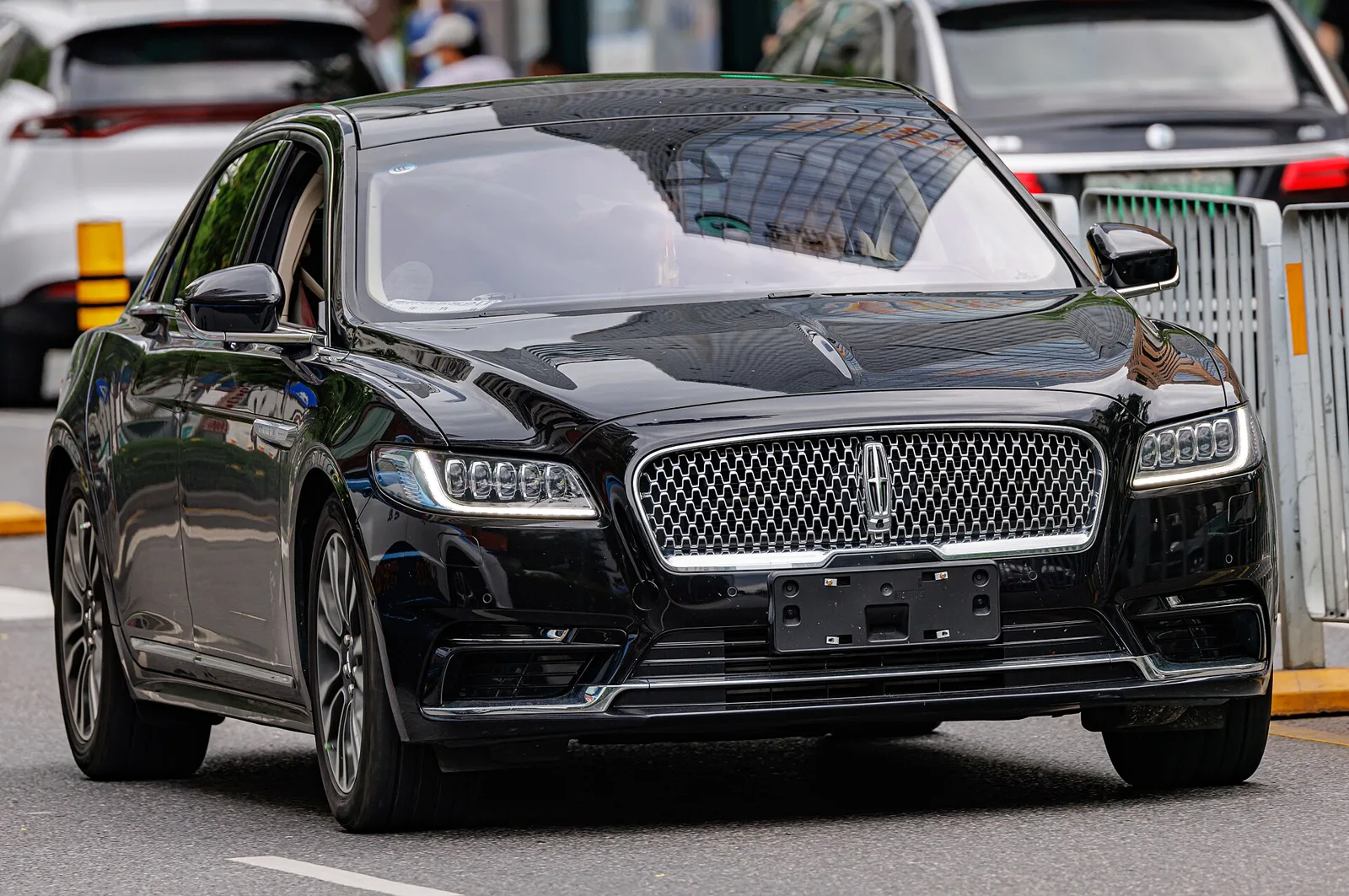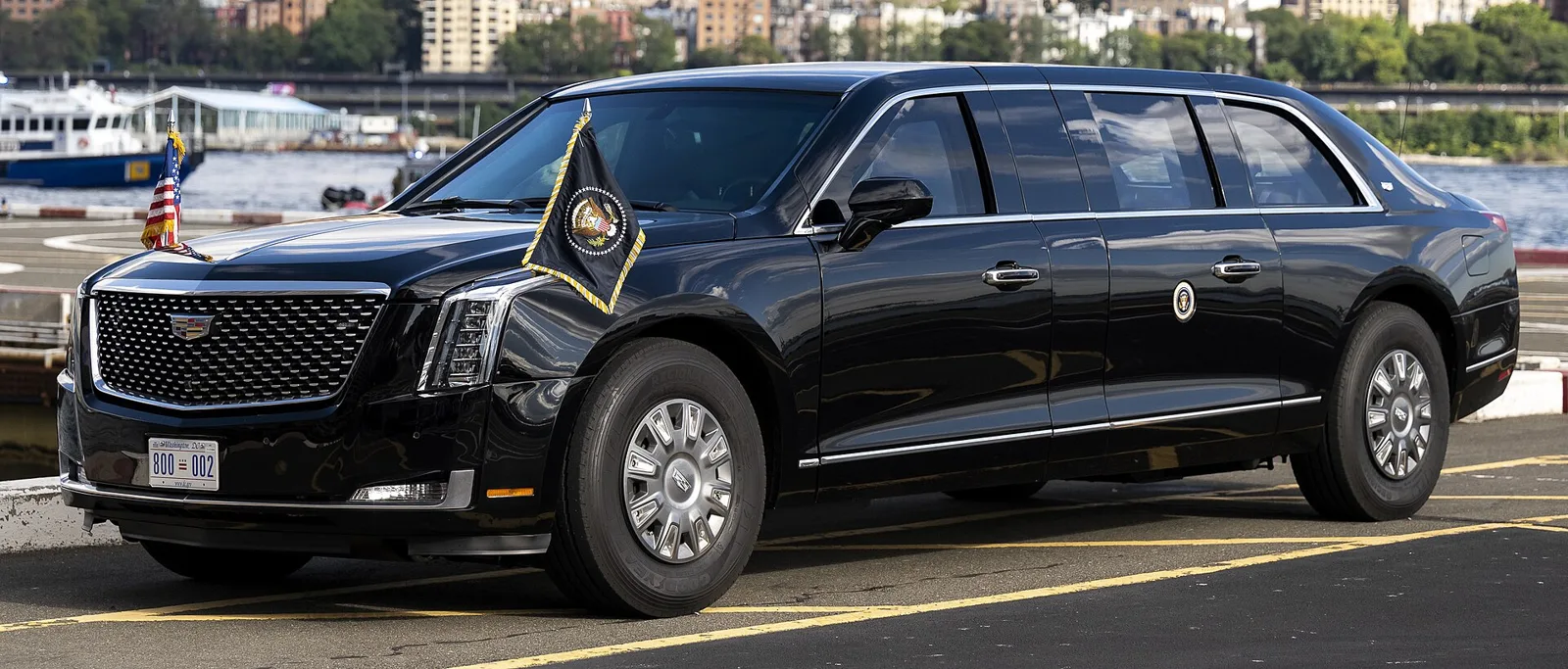
From a 1901 steam ride to today's armoured Cadillac, how the presidential limousine became a rolling fortress.
The United States presidential state car is an armoured limousine used by the sitting president, nicknamed the Beast. It has been a custom-built Cadillac since 2018, following Lincolns, Cadillacs and a 1939 convertible called the Sunshine Special, all shaped by security needs.
The United States presidential state car is the armoured limousine that carries the sitting president, and since 2018 it has been a custom-built Cadillac nicknamed the Beast. Its story starts with a steam car that William McKinley rode in 1901 and runs through Lincolns, a Cadillac delivered in 1984 and the sealed vehicles of the 21st century.
How did presidents first take to the car?
Presidents took to motor cars early in the 20th century, when William McKinley rode a steam car in 1901. William Howard Taft then converted the White House stables into a garage, and the 1939 Sunshine Special later became the first car built to Secret Service specifications.
McKinley's ride was made in a Stanley Motor Carriage Company steam car. Secret Service agents had followed presidential carriages on foot by custom, and in 1907 the agency bought a White Motor Company Model G 30 hp steam car. Theodore Roosevelt avoided using the steam car, because he wanted to protect his rough-riding image.
Taft's fleet was a 4-car affair on a budget of $12,000 (about $430,000 in 2025). It included 2 Pierce-Arrow cars, a Baker electric and a 1911 White steam car that cost $4,000 (about $143,000 in 2025). Taft used a timed burst of steam to hide from press photographers.
The Wilson administration bought 3 Pierce-Arrow cars, and Wilson bought one of them for $3,000 (about $54,151 in 2025) in 1921. Woodrow Wilson had also used 1918 Milburn Light Electrics for part of his term, and Warren G. Harding became the first president to drive to his own inauguration.
Franklin D. Roosevelt bought a Ford V8 Phaeton coupe in 1936 and had it fitted with hand controls. In December 1939 he received a car that would become his best-known automobile.
Each new generation of the state car traded speed for protection, and every layer of armour added weight.
What was the Sunshine Special?
The Sunshine Special was a 1939 Lincoln Motor Company V12 convertible that Franklin D. Roosevelt received in December 1939. It was the first presidential car built to Secret Service specifications and the first leased rather than bought, and it took its name from a top that was frequently open.
The car was built on the chassis of the Lincoln K series and had a 160-inch (4,100 mm) wheelbase, room for 10 passengers, rear suicide doors and 2 side-mounted spare tyres. Standing platforms on the exterior gave Secret Service agents a place to ride.
The car was modified in 1941 and again in 1942. In 1941 its top was lowered 3 inches (76 mm) for appearance. After the attack on Pearl Harbor in 1942 it gained armour, 1-inch (25 mm) bulletproof glass, puncture-proof inner tubes, a radio set, a siren, warning lamps and a storage space for submachine guns.
Once it was armoured, the car weighed 9,300 pounds (4,200 kg) and was 6 feet (1.8 m) longer than before the changes.
The Lincoln Cosmopolitans and the bubble top
Legend says Harry S. Truman snubbed General Motors after it refused him cars for his 1948 campaign. In 1950 the White House leased 10 Lincoln Cosmopolitans, which Henney Motor Company and Hess and Eisenhardt adapted with extra security and headroom for tall silk hats before the cars were painted black.
9 of the cars had enclosed bodies, and the armoured convertible was built for Truman himself. The armoured convertible was 20 feet (6.1 m) long and 6.5 feet (2.0 m) across, and tipped the scales at 6,500 pounds (2,900 kg), 1,700 pounds (770 kg) above a stock Cosmopolitan. Each car ran a 152-horsepower (113 kW) V8 with a heavy-duty automatic transmission.
In 1954 Dwight D. Eisenhower had the convertible fitted with a Plexiglas roof, known as the Bubble-top, which stayed in service until 1965. By May 2008 it had about 105,942 miles (170,497 km) on the odometer.
Why did the Kennedy car change so much?
The 1961 Lincoln Continental built for John F. Kennedy was designed to make the president more visible to the public, through removable roofs and a raised rear cushion. Those features also increased his vulnerability, and after he was assassinated in Dallas on 22 November 1963, the car was rebuilt as an armoured limousine with a glass enclosure.
The stock car was built in Wixom, Michigan, with a retail price of $7,347 (about $79,156 in 2025). Ford leased it to the federal government for $500 a year, and Hess and Eisenhardt modified it at a cost of $200,000 (about $2,154,788 in 2025). It was painted Presidential Blue Metallic with silver flakes and given the Secret Service codenames SS-100-X and X-100.
Work began on 3 March 1961 after four years of planning. The car reached the White House on 14 June 1961 with 2,024 miles already on the odometer.
The stock car was stretched 3.5 feet (1.1 m) to fit a centre row of jump seats. It also had retractable standing platforms, red lights recessed in the bumper and 3 removable roofs made of fabric, lightweight metal and transparent plastic. A hydraulic lift raised the rear cushion 10 1/2 inches (270 mm). These additions were meant to make the president more visible.
After the shooting the car went through a rebuild called The Quick Fix. Hess and Eisenhardt, the Secret Service, a US Army materials centre, PPG Industries and Ford engineers all took part, and removed parts were destroyed to keep collectors from getting them. The rebuild was estimated at $500,000.
The car was painted black, and its fuel tank was protected by a porous foam matrix against explosion. The passenger compartment gained 1,600 pounds (730 kg) of armour, and the removable roofs gave way to a glass enclosure of 13 pieces, each 25 to 46 mm (1 to 1 13/16 inches) thick, which cost more than $125,000. Weight rose 25 percent to 9,800 pounds (4,400 kg), and a hand-built 350-horsepower (260 kW) V8 supplied 17 percent more power.
President Lyndon B. Johnson first rode in the refurbished car on 5 October 1964, alongside Philippine president Diosdado Macapagal. Before that he had borrowed bulletproof Cadillacs from FBI director J. Edgar Hoover.
How did the 1967 and 1972 Lincolns differ?
The 1967 Lincoln was a black hardtop with 4,000 pounds (1,800 kg) of armour, an 11,000-pound (5,000 kg) weight and a 340-horsepower (250 kW) V8. The 1972 limousine was heavier at 13,000 pounds (5,900 kg), with a 460-cubic-inch (7.5 L), 214-horsepower (160 kW) engine and a lease price of US$5,000 a year.
President Johnson preferred white convertibles, but protocol and safety concerns led to a black 1967 hardtop instead. Building the car cost Ford about $500,000 (about $4,830,000 in 2025), and Ford leased it to the government for $1 a year. It could still reach 160 km/h (100 mph), and with 4 flat tyres it managed 80 km/h (50 mph).
The 1967 car went on to serve Presidents Johnson, Nixon, Ford and Carter, and it visited 32 nations before its retirement in the mid-to-late 1970s. Ford restored it in 1996, and the Nixon library received it as a gift, recognising its role on several of Nixon's most significant trips.
The 1972 car reached the White House in 1974 with external microphones, full armour plate, bulletproof glass and racks for submachine guns. It served 5 presidents: Nixon, Ford, Carter, Reagan and George H. W. Bush. A Lockheed C-141 Starlifter cargo plane usually carried it, burning 1,800 US gallons (6,800 L; 1,500 imp gal) of jet fuel an hour.
In 1975 Sara Jane Moore shot at President Ford while he was in the car. In March 1981 the car was hit by the last 2 of 6 gunshots fired at Ronald Reagan, and afterwards it took him to George Washington University Hospital. Ford later rebuilt the car to look like a 1979 model, and it left service in 1992 with 40,617 miles (65,367 km) on the odometer.
The Cadillacs of 1983 to 2009
The next state car was a 1983 Cadillac Fleetwood, delivered on 30 January 1984. It was 17 inches (430 mm) longer and 3 inches (76 mm) taller than the stock car, with armour and bulletproof glass 2 3/8 inches (60 mm) thick. Oversized wheels and tyres, heavy-duty brakes and an automatic leveling system offset the extra weight.
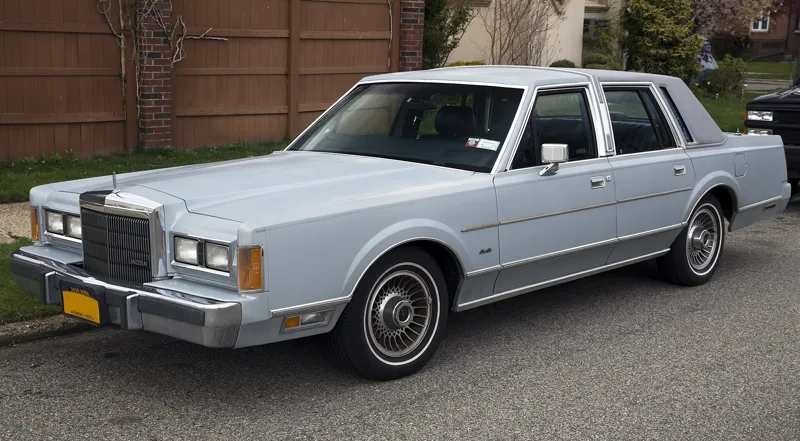
At 22 feet (6.7 m) in length and more than 5 feet (1.5 m) in height, the 1989 Lincoln Town Car arrived at the White House for the George H. W. Bush administration. It had an extra section behind the B-pillar with rear-facing seats, and a raised roof.
Bill Clinton used a 1993 Cadillac Fleetwood, which now sits at the Clinton Presidential Center in Little Rock, Arkansas, with its doors kept closed. Curator Christine Mouw said staff can dust the outside of the car, but opening it would need the regional Secret Service office. CNN interviewed Joe Funk, a former agent who drove the car, and he described armour cutting the president off from the outside world while phones, satellite and internet remained at hand.
The George W. Bush car was built for his first inauguration in 2001, because Cadillac no longer produced a suitable base car. General Motors' R and D arm designed it from the ground up, and it had 5-inch (130 mm) armoured doors and an estimated weight of approximately 14,000 pounds (6,400 kg). Rumoured features included a sealed cabin with its own air supply, run-flat tyres and a 454-cubic-inch (7.44 L) engine, while confirmed extras included a 10-disc CD changer.
The Beast nickname stuck through the first presidency of Donald Trump. In 2007 one of Bush's cars stalled for 5 minutes on a street in Rome. He travelled with 2 armoured limousines, one for use and one as a backup, flown by C-5 or C-17 aircraft, so the spare took over once he reached his destination.
The 2009 car entered service on 20 January 2009, when it drove President Barack Obama 2 miles (3.2 km) down Pennsylvania Avenue to the inaugural parade. Its weight is estimated at 15,000 to 20,000 pounds (6,800 to 9,100 kg), and it could only reach about 60 mph (97 km/h). Economy ranged from 64 to 29 L/100 km (3.7 to 8 miles per US gallon), and cost estimates ranged from $300,000 to $1,500,000 (about $500,000 to $2,100,000 in 2025).
Its glass was 5 inches (130 mm) thick and its doors 8 inches (200 mm) thick. In 2013 the car wore standard DC plates that protested taxation without representation. The Henry Ford's curator described the car as a tank with a Cadillac badge.
What makes the current Beast so different?
The current state car has been in service since 24 September 2018, when President Donald Trump travelled to New York City in it. It is a custom Cadillac built under contracts from General Motors, and it is reported to weigh 15,000 to 20,000 pounds (6,800 to 9,100 kg), with armour, a sealed cabin and blood supplies on board.
The Secret Service commissioned the car in 2014 and awarded General Motors 3 contracts for the new limousine. Each vehicle was projected at US$1-1.5 million, and GM had received $15,800,765 (about $21,196,950 in 2025) by January 2016.
Prototypes were spotted on public roads in monochrome multi-scale camouflage, and Cadillac said the vehicle had been handed over to the customer. The Secret Service said the programme was on track for service by late summer 2018.
Road and Track called it a simple evolution of the old model with more current Cadillac design cues, and described it as massive and tall. Car and Driver said it was built on the GMC TopKick platform, carried Escalade headlamps and weighed up to 15,000 pounds. NBC reported 20,000 pounds and seating for 7, and suggested the look evoked the Cadillac XT6. The car stands about 6 feet (1.8 m) tall.
Its defences are extensive. The exterior walls are 8 inches (200 mm) thick and the windows are multi-layered at 5 inches (130 mm). The armour combines aluminium, ceramic and steel, and the car is hermetically sealed against chemical attacks. Run-flat tyres, night-vision devices, smoke screens and oil slicks are among its measures, and stores of blood in the president's type are carried for emergencies.
The doors are believed to be about 1 foot (0.30 m) thick, reportedly as heavy as those on a Boeing 757, and they can electrify their handles to deter entry.
The car was used alongside the previous model as of May 2019. In January 2026 Donald Trump used a new armoured Cadillac Escalade at the World Economic Forum in Davos, Switzerland. The service life of custom Secret Service vehicles is typically 8 years, a limit the current Beasts reach in 2026.
How do motorcades work around the state car?
Modern presidential motorcades are detailed operations involving 24 to 45 vehicles besides the state car, covering security, healthcare, the press and route clearing. Because motorcades are hard to organise, Marine One helicopters are generally preferred. The state car sits at the centre of this arrangement.
Motorcades have varied greatly in size. The Kennedy motorcade had four motorcycle escorts, three buses and over 17 cars besides the state car. Bush-era convoys involved up to 24 cars, and Obama-era motorcades added 30 other vehicles, including police cars.
Obama-era convoys also carried Secret Service SUVs, electronic countermeasures, a Counter Assault Team, hazardous-materials personnel, press vans and an ambulance.
The state car itself is maintained by the Secret Service, while the other support vehicles are maintained by the White House Military Office. When Bush travelled overseas he sometimes used embassy motor pool cars instead, and he never used non-American government vehicles abroad.
What happens when the state car is retired?
Retired state cars are generally destroyed by the Secret Service, although some older models are kept at its Training Center for training. Most end up in target practice, where firearms and explosive devices test the security, and the remains go to an incinerator or a shredder.
Some cars have ended up in museums. The Kennedy car was donated to the Henry Ford museum after its retirement in March 1977, and the museum would not display it until Kennedy's children were 21 or older. The exhibit opened on 24 October 1981, and the car was still on display as of March 2021.
Plates GG-300 were removed from the Kennedy car when it was upgraded after the shooting. They were sold for $100,000 (about $135,828 in 2025) at a 2015 auction.
What are the presidential state car specifications?
The current car is a custom Cadillac reported at 15,000 to 20,000 pounds (6,800 to 9,100 kg), with 8-inch (200 mm) walls and 5-inch (130 mm) windows. Earlier cars ranged from the Kennedy car's 350-horsepower (260 kW) V8 after its upgrade to the 1972 Lincoln's 460-cubic-inch (7.5 L) engine.
| Specification | Detail |
|---|---|
| Current model | Custom Cadillac in service since 24 September 2018 |
| Reported weight | 15,000-20,000 pounds (6,800-9,100 kg) |
| Height | About 6 feet (1.8 m) |
| Exterior walls | 8 inches (200 mm) thick |
| Windows | 5 inches (130 mm) thick, multi-layered |
| Doors | About 1 foot (0.30 m) thick, reportedly |
| Sunshine Special wheelbase | 160-inch (4,100 mm), Lincoln K series chassis |
| Kennedy car after upgrade | 9,800 pounds (4,400 kg), 350-horsepower (260 kW) V8 |
| 1967 Lincoln | 11,000-pound (5,000 kg), 340-horsepower (250 kW) V8 |
| 1972 Lincoln | 13,000-pound (5,900 kg), 460-cubic-inch (7.5 L), 214-horsepower (160 kW) V8 |