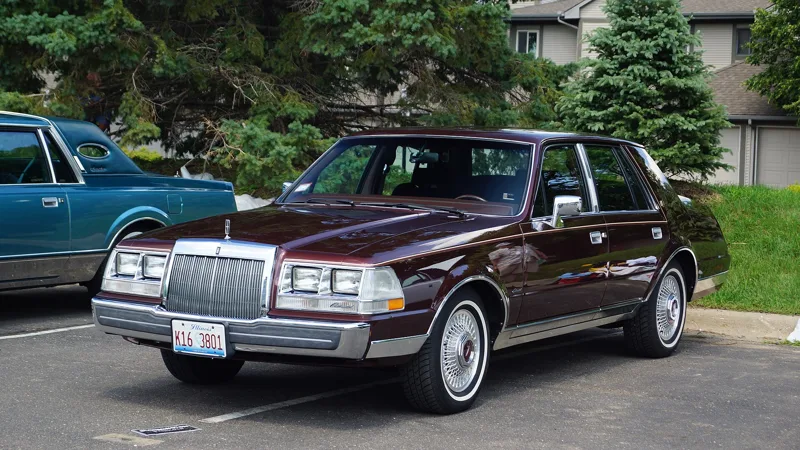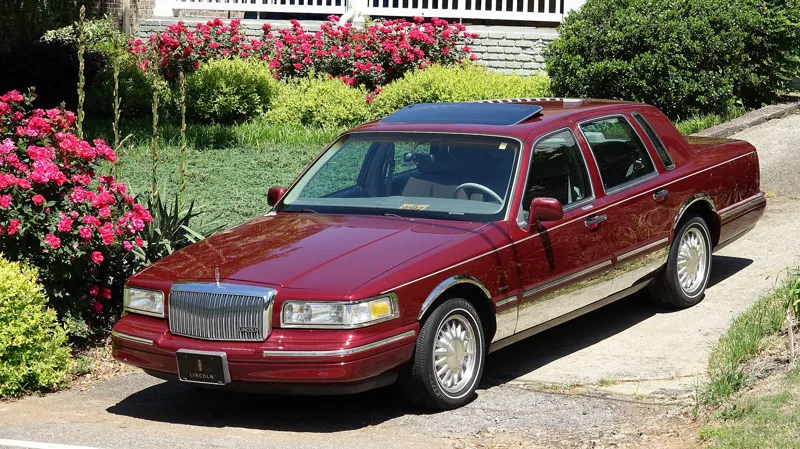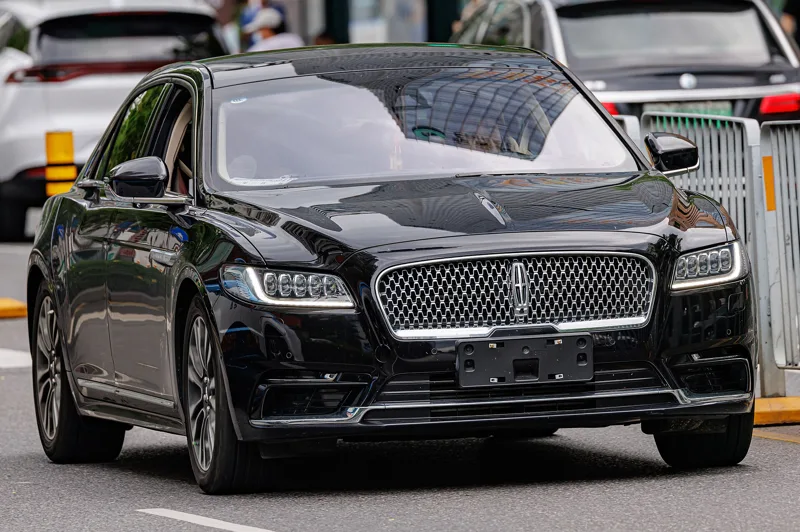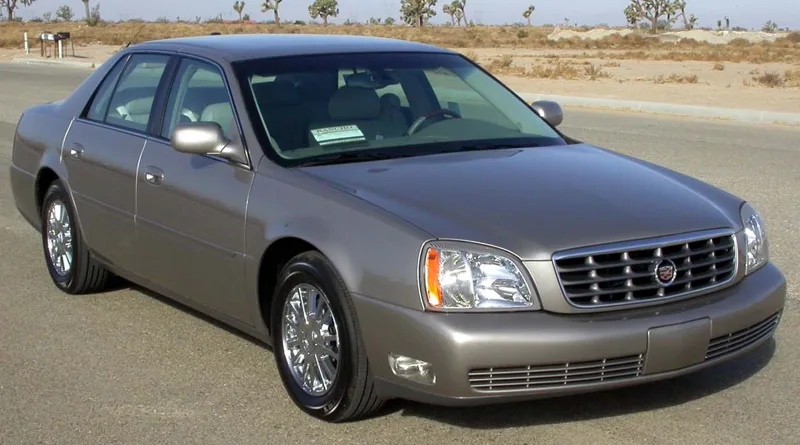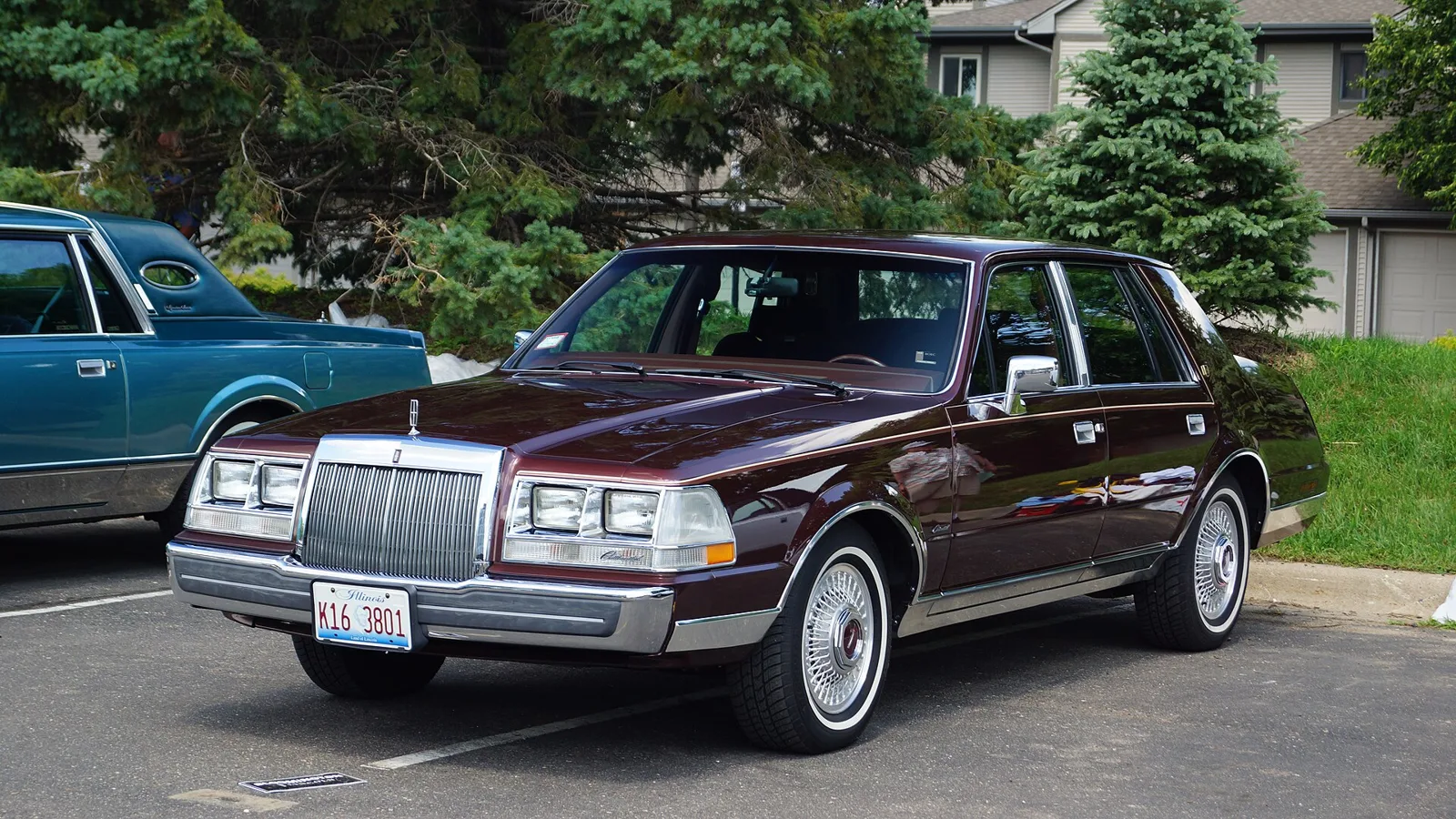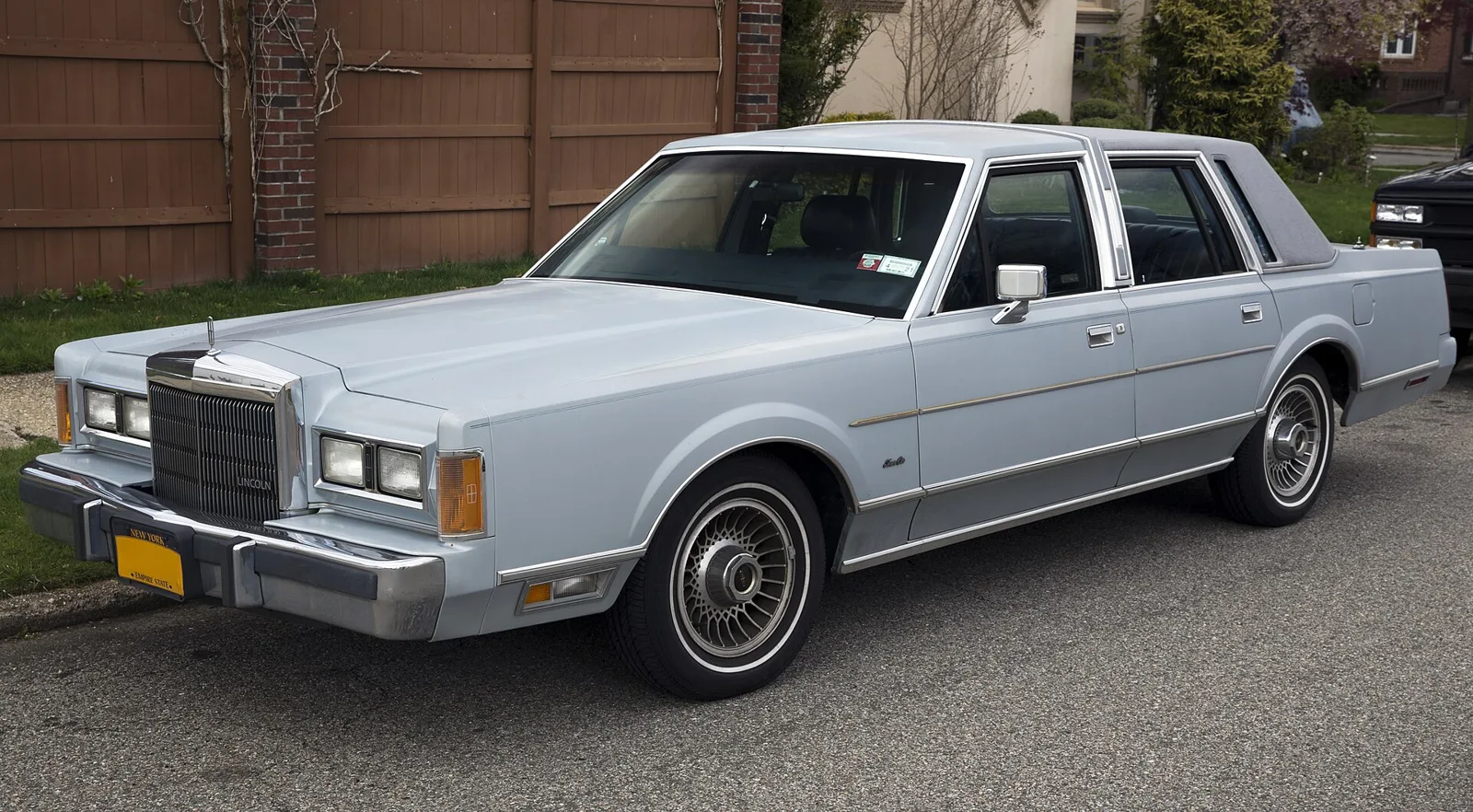
The full-size Lincoln that was renamed from the Continental in 1981 and stayed in the range until 1989, with a V8 and over 850,000 cars built.
Lincoln's Town Car was the Continental renamed for 1981. Its 4,942 cc V8 grew from 130 to 160 SAE PS during the run, and the cars were built at Ford's Wixom plant in Michigan. The range ran until 1989, when the Gucci edition marked the final model year.
The Lincoln Town Car was a full-size, four-door luxury saloon that Lincoln sold from 1981 to 1989. It was the big Continental of 1980 under a new name, carried a 4,942 cc V8 for its whole run, and belonged to Ford's Panther family of large cars.
Where did the Town Car come from?
The Town Car grew out of the sixth Continental generation, which arrived for 1980 on Ford's Panther platform. Lincoln had sold only full-size cars until the 1970s. Fuel rules and the oil price crisis then pushed the brand towards smaller cars, starting with the 1977 Versailles, derived from the Ford Granada.
The 1980 Continental was much smaller than its predecessors, and it was technically close to the fourth-generation Ford LTD, which had appeared a year earlier. That shared engineering would later tie the Town Car to the Ford LTD Crown Victoria and the Mercury Grand Marquis, although each carried its own body.
Renamed from the Continental in 1981, the Town Car stayed in Lincoln's range until 1989 and built up 853,825 cars.
Why did Lincoln rename the Continental?
For the 1981 model year Lincoln changed the name of its big car to Town Car, without changing the engineering or the styling. The name had previously been used only for the top equipment grade of the Continental. The Continental name then moved onto a new mid-size model from 1982, which replaced the unsuccessful Versailles.
The rename was a change of badge only. The 1981 car was the same big Lincoln under a new name, while the Continental name went to a smaller car.
Where did the Continental Mark VI and Mark VII fit?
The Continental Mark VI was a richer, better-equipped version of the Town Car and was sold alongside it until 1983. Lincoln also offered a two-door version with shorter wheelbase, which existed only on the Mark VI. The Continental Mark VII later appeared as a two-door coupe that complemented the four-door small Continental.
Because the Mark VI was the more expensive sister, Lincoln gave it a richer equipment level. The two cars differed mainly in details of the body, which the design section below sets out.
What did the Town Car look like?
The design was led by Gale Halderman and built around angular, edgy body panels. The car used a vertical stainless steel grille that recalls a Rolls-Royce radiator, with rectangular twin headlamps on either side. None of its outer panels were shared with the cheaper Ford or Mercury sister cars, even though the chassis was.
Set against the Town Car, the Mark VI differed in the following ways.
- Its headlamps sat behind flaps painted in the body colour, where the Town Car's were exposed.
- It had an oval opera window in the C-pillar, while the Town Car had a narrow upright side window.
- It lacked the light strip that runs across the full width of the Town Car's rear end.
- It carried a stylised spare-wheel cover in its boot lid.
- It had imitation ventilation openings in its front wings.
What changed with the 1985 facelift?
Ed Golden and Victor Nacif of Ford designed the facelift in 1983, and it arrived in 1985. The aim was to make the car look smaller while its dimensions stayed the same. New bumpers, a slightly angled rear end mask, flush tail lamps and boot lid, and rounder edges in the front mask did the job, while the glass and radiator grille stayed as they were.
What engine and drivetrain did it use?
Every Town Car used a V8 from Ford's Windsor family, in a single 4,942 cc (302 cu in) form with petrol injection. Its output climbed from 130 to 160 SAE PS over the nine model years, and a four-speed automatic was the usual gearbox.
The 5.8-litre Windsor that had been optional on the 1980 Continental was not offered in the Town Car. The biggest mechanical change came for 1986, when Lincoln moved from central-point to multi-point injection. The chassis itself was a box frame with cross members, shared with the Ford and Mercury sisters. The front used upper and lower trapezoidal wishbones with coil springs, and the rear used a rigid axle located by lower longitudinal links and upper diagonal links.
Specifications at a glance
| Item | Lincoln Town Car, 1981-1989 |
|---|---|
| Model years | 1981 to 1989 |
| Body | Four-door notchback saloon; two-door coupe in 1981 only |
| Engine | V8, 4,942 cc (302 cu in), petrol injection |
| Power | 130 SAE PS in 1981, 160 SAE PS by 1989 |
| Transmission | Four-speed automatic |
| Front suspension | Upper and lower trapezoidal wishbones, coil springs |
| Rear suspension | Rigid axle, lower longitudinal links, upper diagonal links, coil springs |
| Total production | 853,825 in nine years |
| Two-door cars built | 4,935 |
What trim lines did the Town Car have?
The Town Car came as a base model and a Signature Series, with the Cartier as the most expensive of the three regular trim levels. The base car had a fully vinyl-covered roof. The Signature Series kept vinyl only on the rear part of its roof, and an imitation stainless steel roll bar separated that from the body-coloured front.
The Cartier version was built around designer prestige. Lincoln had been putting designer names on its Mark coupes since the 1976 model year, with versions by Bill Blass, Cartier, Hubert de Givenchy and Emilio Pucci. The Cartier moved from the Mark VI to the Town Car for 1982 and stayed there until 1989. Its exclusive paint came in white, grey or silver shades that no other line offered. Its roof was fully vinyl-covered until 1983 and then changed to a Landau roof, the same type offered on the Signature Series.
The idea of designer trims was not Lincoln's own. American Motors had introduced a Hornet 'Gucci' in 1971, and the idea later reached the Lincoln Mark range.
What special series did Lincoln build?
Lincoln launched a run of special series from 1987, on top of the three regular trim lines. The most expensive arrived in the final model year, 1989, with the Gucci Edition.
The Sail America Commemorative Edition came for 1987 only. It marked the 26th America's Cup, a sailing contest that Ford sponsored and that Dennis Conner won with Stars & Stripes 87, a yacht owned by Ford. The cars were finished in white with a dark blue vinyl covering over the whole roof area, in the style of a convertible. The seats were white with blue topstitched seams. Lincoln built 1,800 vehicles with this equipment package.
In 1988 a very similar line was sold as the Signature Series Special Edition. It cost US$2,461 more than the regular Signature Series. The final model year brought the Signature Series Gucci Edition, the most expensive and most complete Town Car, which added Gucci emblems at various points on the body.
How many Town Cars were built, and where?
Lincoln built 853,825 Town Cars across nine years, and only 4,935 of them were two-doors. All the cars came from Ford's Wixom Assembly Plant in Wixom, Michigan, where the Town Car was the lone Panther-family model made. Four-door saloons made up almost all of that total.
Early output ran in the mid five-figure range, about the level of the big Continentals of the 1970s. That was less than half what Cadillac produced with its DeVille and Fleetwood cars of 1977 to 1984. When Cadillac moved its big cars to smaller front-wheel-drive models in 1985, Town Car production doubled, and more than 200,000 were built in 1988.
Did the Town Car become a stretch limousine?
The Town Car was often the starting point for stretched limousines, but Lincoln never offered a factory-lengthened version. Its catalogues did show long examples, though they stressed that the work was done on individual orders by independent coachbuilders with no link to Ford. Cadillac's Fleetwood Limousine sat in its own factory range into the late 1980s, so a buyer could order a long car straight from the brand. Lincoln's buyers had to go to outside firms.
Firms that stretched Town Cars included Krystal Koach and Ultra Coachbuilders in California, along with Moloney in Michigan and Andy Hutton in Canada. How much each job involved depended on the buyer's wishes. Some firms went beyond simple stretching. Krystal Koach, for instance, built at least one car on the traditional Town Car body form, a Coupe de Ville style with an open driver's compartment.
What was the presidential Town Car?
Ford produced a state car for the US president, based on a 1989 Town Car. The order was placed while Ronald Reagan was in office, but George Bush used the car for most of his four-year term. Its design departed from the production car in several ways, described in the next paragraph.
The Town Car was lengthened both ahead of and behind the rear doors, and it had a redesigned roof with thinner pillars and large window areas. The state car is more than 6,700 mm (264 in) long and over 1,520 mm high. Its passenger compartment held two rows of seats, one facing forwards and one facing backwards, so passengers could hold meetings on the move. Its engine did not come from the standard Town Car range. It was borrowed from the F-Series truck line, whose petrol units went up to 7.5 litres. There is no information on the armour or the car's weight.
Bill Clinton replaced the car in 1994 with a newly designed presidential vehicle based on a Cadillac. The Town Car is no longer in service, and in the 21st century it belongs to a museum collection. It was the last presidential vehicle based on a Lincoln.
Why did the Town Car matter in the American market?
The Town Car was Lincoln's full-size flagship while large American cars were shrinking. Through the early 1980s it competed head to head with Cadillac's DeVille, and from 1985 it faced the Cadillac Brougham. The 1985 facelift changed its look but not its dimensions.
The shrinking began with the oil price crisis and the fuel rules that followed it. Lincoln's answer in 1981 was not a new car but a renamed one, which kept the large body and the V8 that the Continental had already used. Its engineering was shared with Ford and Mercury, so the car was built on a familiar base rather than a new one.
When Cadillac moved its big range to smaller front-wheel-drive models in 1985, the unchanged Town Car kept its full size. The Cadillac Brougham, which had not taken part in that downsizing, became the Lincoln's closest match from then on. Chrysler had already dropped its rear-drive New Yorker in 1981, so the Town Car had no full-size rival from that maker.
How did rivals respond to the Town Car?
Until 1984 the Town Car's closest North American rival was Cadillac's DeVille, which was almost the same size. After Cadillac introduced a much smaller front-drive DeVille for 1985, the Lincoln faced the Cadillac Brougham instead, a model that had skipped the downsizing. Chrysler had no full-size contender once its rear-drive New Yorker was discontinued in 1981.