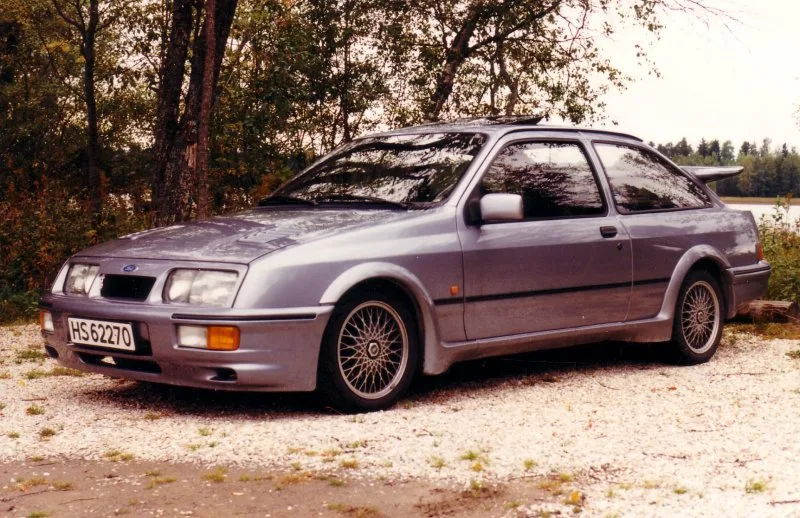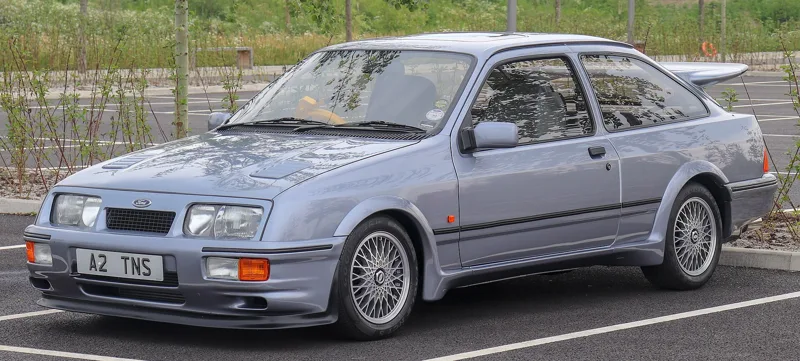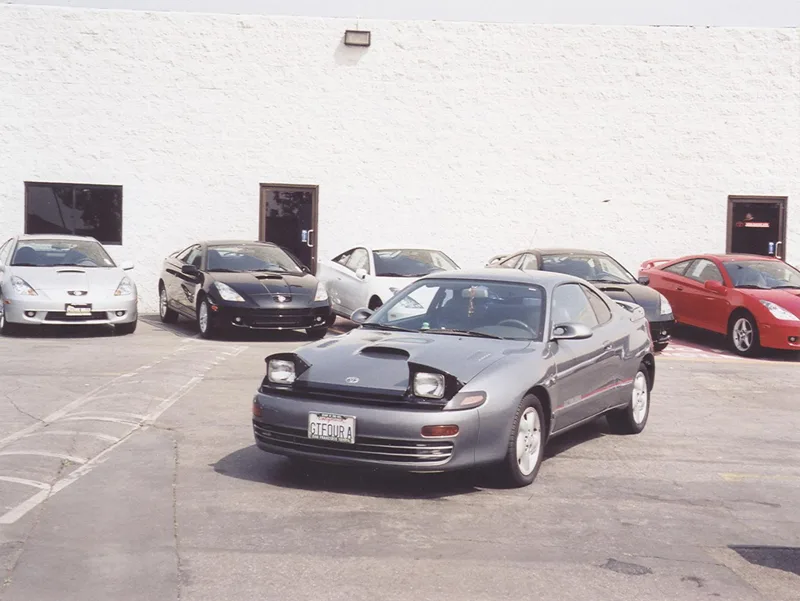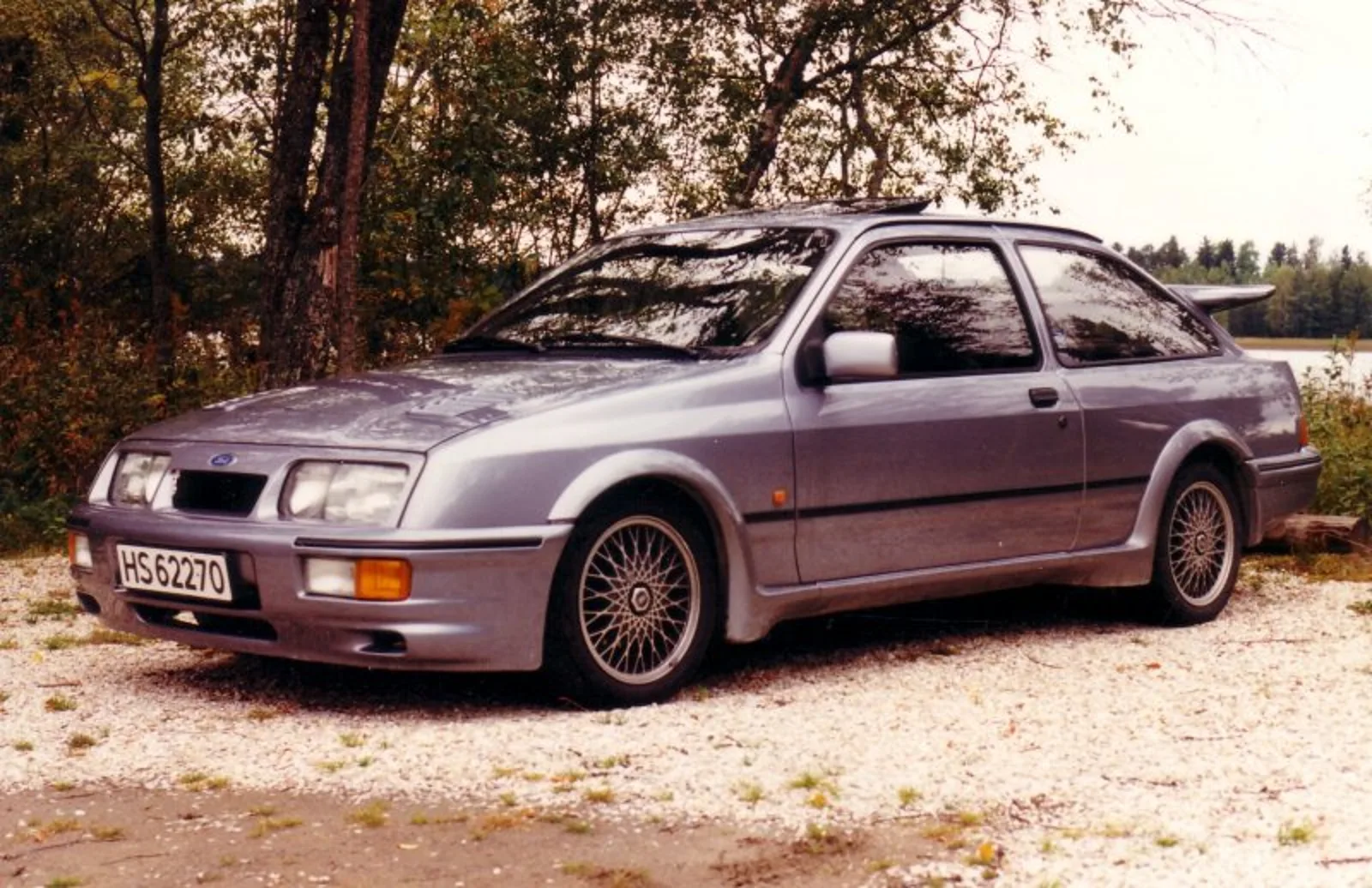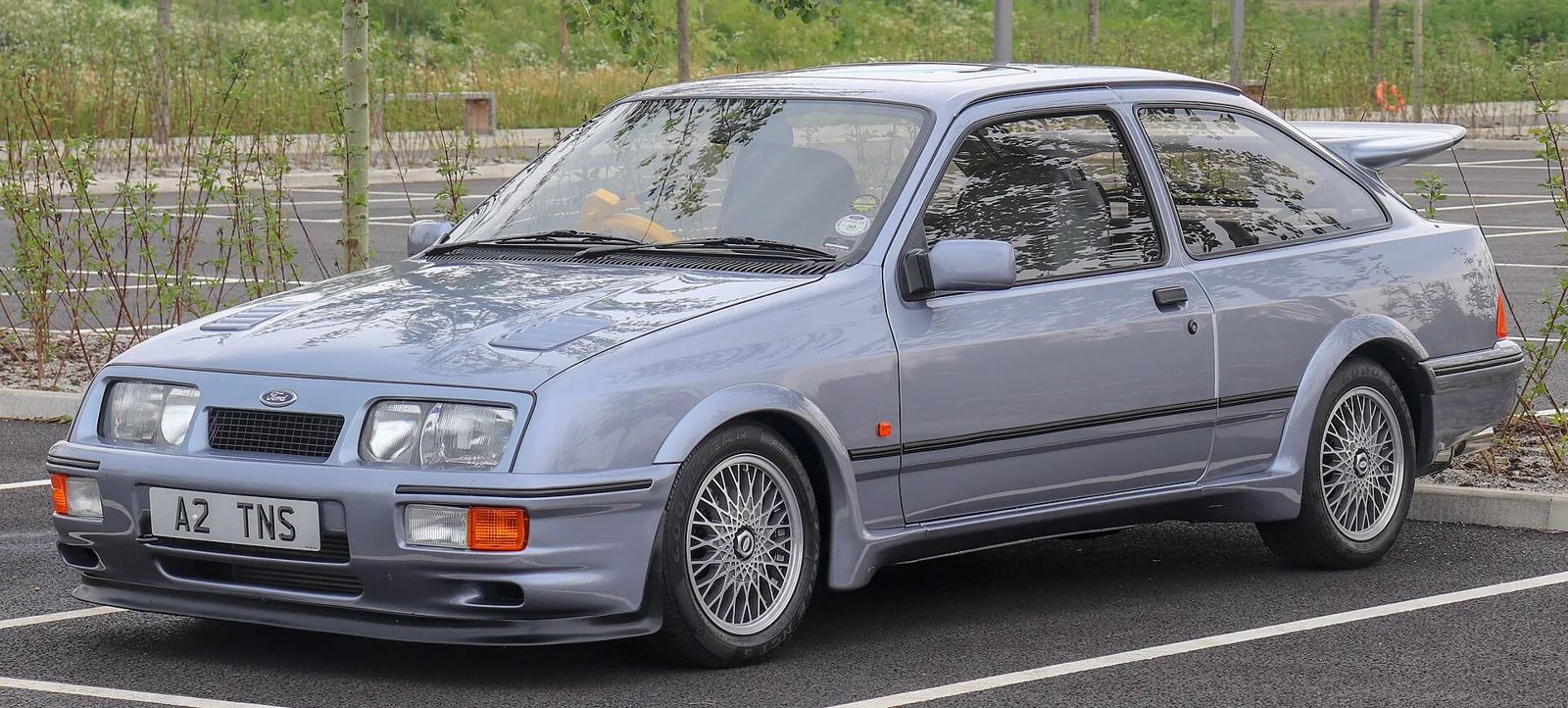
A rear-drive Ford turbo that dominated touring car racing and a full-time all-wheel-drive Toyota that took WRC titles.
The Ford Sierra RS Cosworth was built by Ford Europe from 1986 to 1992 to win Group A racing. The Toyota Celica GT-Four was built from 1986 to 1999 to compete in the World Rally Championship. Their greatest results came in different series.
The Ford Sierra RS Cosworth and the Toyota Celica GT-Four were both built to win in rallying and touring car racing, and both were homologation specials sold to the public to qualify for those events. The Sierra was a rear-wheel-drive hatchback with a Cosworth turbo engine. The Celica was a liftback with a turbocharged 3S-GTE and full-time all-wheel drive.
Where did the Sierra and Celica come from?
The Sierra RS Cosworth was a Ford Motorsport project, built by Ford Europe from 1986 to 1992 with a single purpose: to produce an outright winner for Group A racing in Europe. Stuart Turner defined the project in the spring of 1983, after realising Ford was no longer competitive in that field.
The Celica GT-Four was created to compete in the World Rally Championship, whose rules required manufacturers to build road-going versions in sufficient numbers. It was produced from 1986 to 1999, first as the ST165 and later as the ST185 and ST205 generations.
The Sierra's engine took shape through a partnership with Cosworth, Ford's longtime engineering partner. Cosworth's own YAA prototype was a twin-cam, 16-valve unit on Ford's T88 block, better known as the Pinto, and it became the basis for the turbocharged YBB that Ford requested.
Two homologation specials built to win, one a rear-drive Ford turbo that dominated touring car racing and the other a full-time all-wheel-drive Toyota that took WRC titles.
Why did Ford choose the Sierra as the basis?
In April 1983 Turner's team settled on the Sierra. It offered rear-wheel drive and reasonable aerodynamic drag, and a racing version could help improve a reputation that the car had struggled with since its 1982 introduction.
Cosworth attached two conditions to its engine work: a minimum output of 150 kW (204 HP) for the street car and a commitment to at least 15,000 engines. Ford accepted, even though the project needed only about 5,000, and the extra engines later helped justify a four-door second-generation Sierra RS Cosworth.
Ford's experience in America and Britain also fed the car. Suspension lessons came from the turbocharged Jack Roush IMSA Merkur XR4Ti and from Andy Rouse's 1985 British Saloon Car Championship campaign, and some XR4Ti parts, such as a speedometer with an integral boost gauge, reached production.
How did the Sierra's looks come about?
Lothar Pinske, responsible for the bodywork, insisted on a free hand over appearance, because the Sierra hatchback generated significant lift even at moderate speed. Wind tunnel work and test runs at the Nardo circuit in Italy followed.
The prototype, based on an XR4i body with fibreglass and aluminium changes, raised little enthusiasm. The large rear wing caused particular reluctance, but Pinske argued that each modification was necessary. The wing kept the car on the ground at 300 km/h, the headlight opening fed air to the intercooler, and the wheel arch extensions housed 10-inch wheels for racing.
The ST165 was identified by its front bumper, which had larger openings and round fog lights, and by GT-Four decals on the doors.
Could Ford sell enough Sierra RS Cosworths?
The dealers did not think so. When Walter Hayes visited European Ford dealers in 1984, they estimated they could sell 1,500 cars, while Group A demanded that 5,000 be built and sold. Hayes kept pushing internally, and dealer test drives on the prototypes lifted enthusiasm.
Ford also cut costs to bring the price down. The car came in only three exterior colours, black, white and moonstone blue, with one grey interior and just two equipment options, with or without central locking and electric windows.
The Sierra was first shown at Geneva in March 1985, with plans for September sales. In practice the car launched in July 1986, after pre-production prove-out cars in February 1986 and main production from the summer. The final cars left the line in December 1986.
Production was split by colour. White and moonstone blue each accounted for about two-fifths of the right-hand drive cars, and black for about one-fifth.
What was the Celica GT-Four's engine and drive system?
The 3S-GTE turbo was the centre of the Celica's appeal. The ST165 version made between 182 and 190 hp, depending on market and year, and 249 N-m (184 lb-ft) of torque. It was the only car sold with the first version of the 3S-GTE.
The GT-Four began as a convertible prototype shown at the 1985 Tokyo Motor Show under the theme Open Air 4WD Sport. The convertible never reached production, and the liftback took its place in October 1986.
The GT-Four's full-time four-wheel drive was unusual for a transverse-engined car. Hollow splined shafts gave a true 50:50 split from the centre differential, and a viscous coupling kept the front and rear axles locked together in normal driving. Early ST165 models could lock the centre differential by vacuum, though that was recommended only for off-road use.
The ST185 added an air-to-air intercooler and a CT26 twin-entry turbo. The Japanese model produced 225 PS (165 kW; 222 hp). The ST205 went further, with 242 PS (178 kW; 239 hp) for export cars and 255 PS (188 kW; 252 hp) in Japan.
The ST165 had a differential lock switch by the handbrake until the October 1987 update, which swapped the manually lockable centre unit for a viscous limited-slip type. In North America the car was sold as the All-Trac Turbo, and in Canada as the Turbo 4WD.
The Celica GT-Four launched in the United Kingdom in March 1988 and was the first car sold there designed to run only on unleaded petrol. The GT-Four RC arrived in September 1991 to meet FIA rules for the 1992 WRC season, with a water-to-air intercooler and a lighter bumper.
The RC also had triple-cone synchromesh on second and third gears, a shorter shift lever throw and a numbered plaque on the centre console. Of its 5000 units, 1800 went to Japan and 3000 to Europe.
How did the Sierra RS500 differ from the RS Cosworth?
Mike Moreton led the team that planned an evolution model, and Aston Martin Tickford was signed in March 1987 to convert 500 cars. The RS500 was announced in July 1987 and homologated that August, with uprated competition parts throughout.
Its engine had a thicker-walled block, a larger Garrett AiResearch T04 turbocharger, a larger intercooler and an uprated fuel pump and cooling system. Output rose to 227 PS (224 hp; 167 kW) at 6000 rpm, with 277 N-m (204 lb-ft) of torque at 4500 rpm.
Visually, the RS500 had a lower tailgate spoiler under the upper whale tail, discreet RS500 badges, and a redesigned front bumper that swapped the fog lamps for intake grilles. Exactly 500 were built, all right-hand drive for the UK, although 56 white and 52 moonstone blue cars were also produced.
How did the Sierra and Celica do in touring car racing?
The Sierra RS500 was homologated in August 1987, and Ford took pole in all six remaining 1987 World Touring Car Championship events. Eggenberger Motorsport won the entrants' title, although its cars were disqualified from the 1987 Bathurst 1000 for wheel arch irregularities.
Robb Gravett won the 1990 British Touring Car Championship in an RS500. In the DTM, Klaus Ludwig took the 1988 drivers' title for Ford Team Grab, while Wolf Racing won the team championship. The cars were then reined in with extra weight and boost penalties, and Ford left the DTM after the 1989 season.
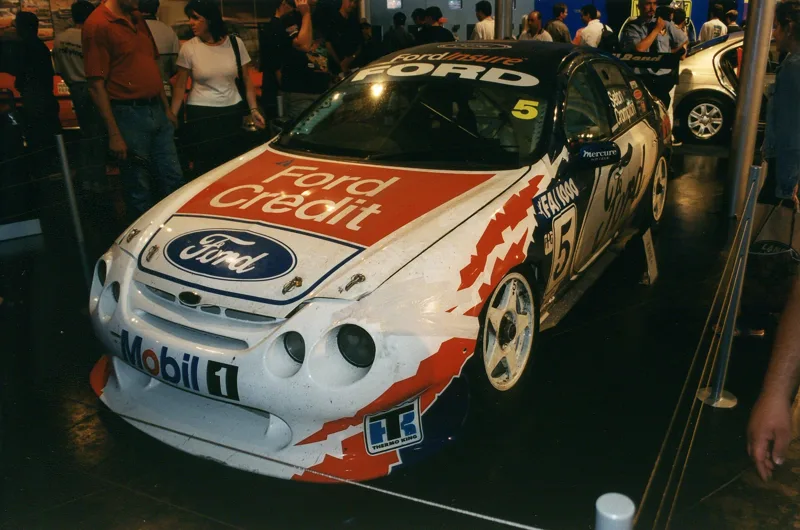
Australia was the RS500's strongest region. Dick Johnson Racing dominated the 1988 and 1989 Australian Touring Car Championships, and the RS500 won the Bathurst 1000 in both years. Ford's nine-inch axle homologation gave the Johnson team a stronger drivetrain for standing starts.
The RS500 also won the 1988 and 1990 Sandown 500s and the Japanese Touring Car Championship from 1987 to 1989. Glenn Seton won the 1990 Australian Endurance Championship in a Sierra RS500.
How did the Celica GT-Four do in rallying?
The ST165 made its World Rally Championship debut at the 1988 Tour de Corse and won its first WRC rally at the 1989 Rally Australia. The ST185 debuted at the 1992 Rally Monte Carlo, and its first win came at the 1992 Safari Rally, one of four victories that year.
The ST185 won the 1992 WRC Drivers' Championship, then the Manufacturers' and Drivers' titles in 1993 and 1994. The ST205 became the official rally car in 1995, with one WRC win before a disqualification, and it won the 1996 European Rally Championship.
Toyota was the first Japanese manufacturer to win WRC titles with an all-wheel-drive turbocharged car, and it preceded Mitsubishi and Subaru in that role. Toyota Team Europe also introduced anti-lag on the Group A ST205, a technical step other teams later copied.
Sierra RS Cosworth and Celica GT-Four side by side
| Feature | Ford Sierra RS Cosworth | Toyota Celica GT-Four |
|---|---|---|
| Production | 1986 to 1992; 5,545 cars | 1986 to 1999 across three generations |
| Launch | Geneva showing March 1985; sales from July 1986 | ST165 production from October 1986 |
| Drive | Rear-wheel drive | Full-time four-wheel drive with viscous coupling |
| Engine | Turbocharged Cosworth four on a Pinto block | Turbocharged 3S-GTE |
| Power | Minimum 150 kW (204 HP) for the street car; RS500 227 PS (224 hp; 167 kW) | ST165 182 to 190 hp; ST185 Japan 225 PS (165 kW; 222 hp); ST205 up to 255 PS (188 kW; 252 hp) |
| Performance | 149 mph maximum; 0-60 mph in 6.5 seconds | None given |
| Special versions | RS500, 500 built by Aston Martin Tickford | GT-Four RC, 5000 units, sold as the Carlos Sainz edition in Europe |
| Build sites | Ford's Genk factory, Belgium | Toyota's Tahara plant, Japan |
| Motorsport peak | 1987 World Touring Car entrants' title; Bathurst 1000 wins in 1988 and 1989 | 1992 WRC Drivers' title; manufacturers' titles in 1993 and 1994 |
| Legacy | DTM and Australian titles for the RS500 | Toyota returned to WRC in 2017 with the Yaris |
Which car suits which buyer?
The Sierra suits a buyer who wanted a rear-drive turbo saloon with motorsport heritage and a rare special edition. The Celica suits a buyer who valued all-wheel traction, a sharper rally pedigree and a liftback body.
Neither record settles which car was better. The Sierra's racing record is strongest in touring cars, while the Celica's is strongest in rallying.
A buyer hunting for an RS500 should check originality closely, since only 500 exist and all were right-hand drive cars for the UK market. A Celica buyer should check which generation the car is, because the ST165, ST185 and ST205 differ in power and equipment.
What became of the Sierra and Celica?
The Sierra RS Cosworth went out of production in 1992, after a six-year run. The spare engine capacity that Ford had been obliged to buy was one reason it also chose to develop a four-door second-generation RS Cosworth.
The Celica was discontinued in 1999. Toyota returned to the WRC in 2017 with the Yaris, eleven years after the Celica was discontinued.
Both cars remain cited examples of the homologation era, when a road car existed mainly to qualify a racing car.