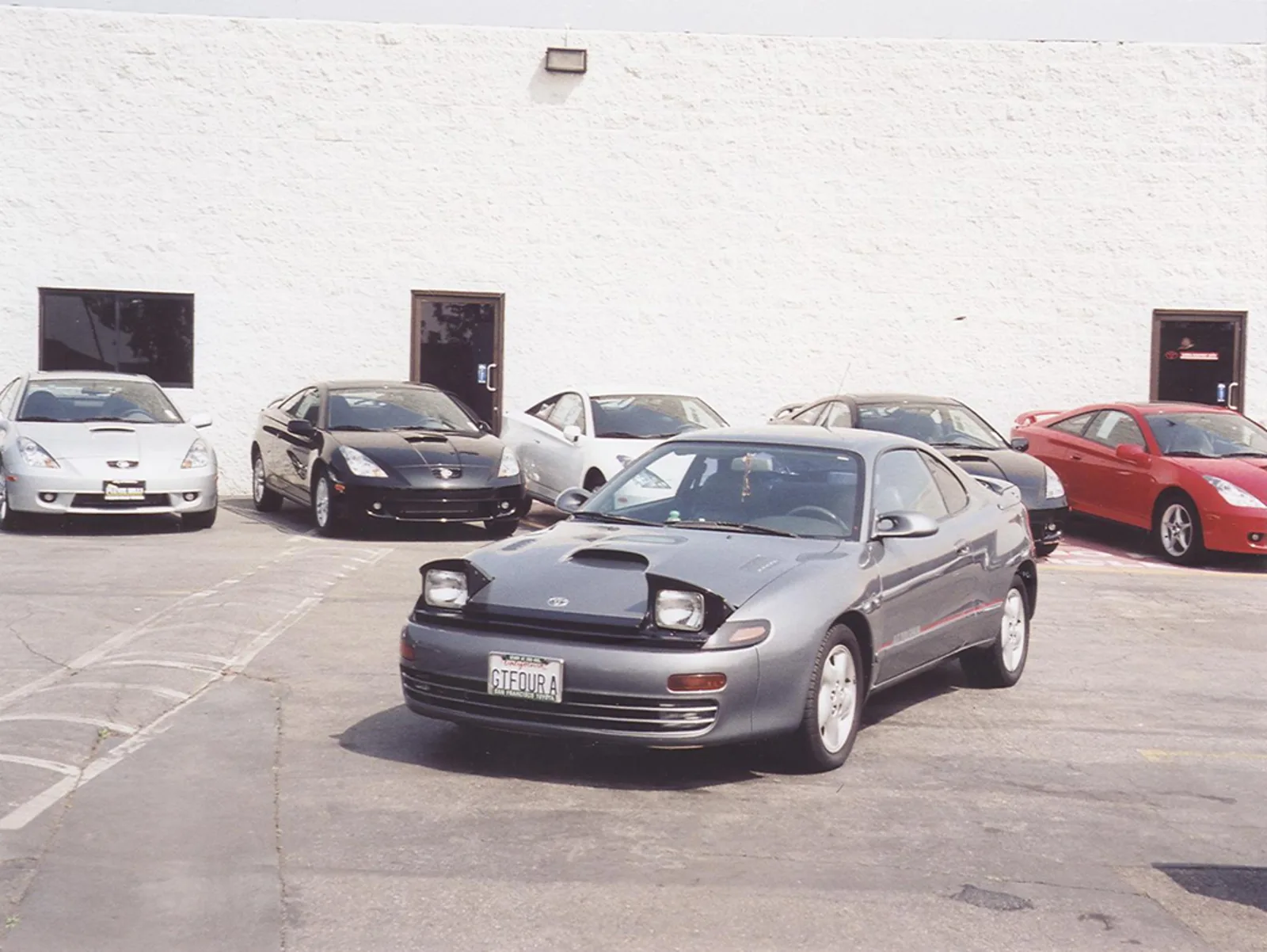
Three generations of turbocharged, full-time all-wheel-drive Celica built to win the World Rally Championship between 1986 and 1999.
Turbocharged and all-wheel drive, the Toyota Celica GT-Four was homologated for rallying and came in three generations: ST165, ST185 and ST205. The ST185 won the 1992 drivers' title, and Toyota took the manufacturers' crowns in 1993 and 1994.
The Toyota Celica GT-Four was a high performance version of the Celica Liftback, built from 1986 to 1999 with a turbocharged 3S-GTE engine and full-time all-wheel drive. Toyota developed it to compete in the World Rally Championship, whose rules required manufacturers to build road-going versions of their rally cars in sufficient numbers.
Why did Toyota build the Celica GT-Four?
The Celica GT-Four existed because the World Rally Championship demanded road-going homologation special vehicles. A manufacturer had to sell enough road cars that its rally car could be approved for competition, and the Celica became Toyota's answer. Its turbocharged engine and full-time all-wheel drive gave it the grip and power that rallying demanded.
The project began with a convertible prototype shown at the 1985 Tokyo Motor Show. It was the first car called the Celica GT-Four, under the theme Open Air 4WD Sport. The convertible never reached production, but the concept carried over into the liftback that went on sale in October 1986.
A turbocharged Celica that gave a Japanese maker its first rally titles with all-wheel drive, from one clean design.
How many generations of the Celica GT-Four were there?
The Celica GT-Four came in three generations. The ST165 was based on the fourth generation Celica and was built from October 1986 to August 1989. The rounder ST185 followed from September 1989 to September 1993, and the ST205 was built from February 1994 to June 1999.
Production cars were built at Toyota's Tahara plant in Aichi Prefecture, Japan. The rally cars were prepared by Toyota Team Europe in Cologne, Germany, the factory team that ran Toyota's World Rally Championship effort.
How did the Celica GT-Four's all-wheel drive work?
The GT-Four introduced Toyota's first performance drivetrain that powered all four wheels. Transverse engine layouts usually make all-wheel drive systems front biased, because the front axles must power the rear axles. Toyota avoided that problem by routing power through hollow splined shafts, creating a true 50:50 starting split.
Power leaves the transmission and reaches the centre differential. One hollow shaft carries the left side gear's output forwards to the front axle, while a second carries the right side gear's output back to the rear. A driveshaft inside both hollow shafts sends power to the right front wheel, so it is isolated from the rear drive.
Because the front and rear deliveries are separated, the torque split can run from 100:0 to 0:100 in either direction. A viscous limited-slip coupling then holds the centre differential close to 50:50. Under certain conditions, such as no grip at the rear, the rear wheels spin first before the coupling feeds torque forwards again.
Was the GT-Four a true all-wheel drive car?
The GT-Four is closer to a four-wheel drive system than a conventional all-wheel drive car. It powers all four wheels equally at the same time, and a coupling always keeps the front and rear axles locked together. That is most true of the early ST165, whose solid-locking centre differential could not be used on paved roads when turning.
Early ST165s from the 1986 and 1987 models used a vacuum-operated actuator to lock the centre differential. With the lock off, the full range of torque split was available, but with it engaged the car was stuck at 50:50, so it was only recommended off-road. The October 1987 update replaced that unit with a viscous-coupling limited-slip type.
All three generations shared the same basic system. The ST185 RC and ST205 also had a rear Torsen limited-slip differential as standard, while on the regular ST185 it was standard or optional depending on the year and market.
What were the ST165 specifications?
The ST165 was the first generation, and it was the only Celica GT-Four to use the first version of Toyota's 3S-GTE engine. That engine developed between 182 and 190 hp depending on the market and model year, with 249 Nm (184 lb ft) of torque. Its front bumper had larger openings and round fog lights, and GT-Four decals sat on the doors.
The October 1987 update gave the ST165 a new grille, new tail lights and new alloy wheels. Export cars also gained ground effects, most noticeably side spoilers. In the United States the car was sold as the All-Trac Turbo, and in Canada as the Turbo 4WD.
North America saw the ST165 only in a special edition. Seventy-seven cars were sold to celebrate Toyota's IMSA GTO championship win, all white with white wheels and blue interiors. One car went to each of the 77 Toyota dealerships in California, and they were sold as 1988 models.
The ST165 also had a UK milestone. When it launched in the United Kingdom in March 1988, it became the first car sold there that was designed to run only on unleaded petrol.
What changed with the ST185?
The first 21 ST185 units were built in December 1988 as prototypes for testing. The production model launched in Japan in September 1989, and deliveries began a month later. Its 3S-GTE used an air-to-air intercooler and a CT26 twin entry turbocharger, which eliminated exhaust gas interference between cylinders.
The Japanese GT-Four produced 225 PS (165 kW; 222 hp) and 304 Nm (224 lb ft) of torque, thanks to more aggressive ignition advance and a ceramic turbine. Export cars were wide-body liftbacks with flared fenders, while the Japanese market had a narrow body on the pre-facelift model.
In August 1990 Toyota added the wide-body GT-Four A to the Japanese line-up. It shared the export body and came with a 10-speaker Super Live Sound System as standard, while ABS, automatic air conditioning, leather seats and a sunroof were optional.
Which ST185 gearboxes were fitted?
The ST185 came with three gearboxes. The E150F, with a 4.285 final drive ratio, went into regular Japanese models and the All-Trac. European and Australian cars used the E151F with a 3.933 ratio. The Japanese-only GT-Four Rally used the E152F, with close ratios through first to fourth and a 4.285 final ratio, while the RC, Carlos Sainz and Group A Rallye cars used the E151F.
In the United States the ST185 All-Trac Turbo was the most expensive Celica yet, with a power-operated driver's seat, auto tilt-away steering wheel, airbag and cruise control. Its 2.0 L turbocharged 3S-GTE made 200 hp (203 PS; 149 kW) and 271 Nm (200 lb ft), making it the most powerful Celica sold in the United States.
How did the Australian and European ST185 differ?
European versions had standard ABS and a small bonnet spoiler near the windscreen. Headlight washers and heated door mirrors were also offered. The sunroof came standard in UK models, while the premium sound system and leather interior were options only in selected European countries and were not offered in the UK.
The Australian specification was less luxurious. Cruise control, leather, sunroof and the premium sound system were not offered, and early examples lacked ABS and fog lights until those became standard a few months after launch.
What was the GT-Four RC?
To meet the FIA homologation requirements for the 1992 World Rally Championship season, Toyota launched the GT-Four RC in September 1991 for the Japanese market. The export version was sold as the Carlos Sainz Limited Edition in Singapore and Europe, and as the Group A Rallye in Australia.
The RC changed several parts for competition use. It had a water-to-air intercooler instead of the standard air-to-air unit, a different bonnet to extract air from the engine bay, and a lighter bumper with more openings. Its shift lever throw and clutch pedal travel were shortened, and gears two and three gained triple cone synchromesh instead of double cone. Each car had a numbered plaque on the centre console.
Toyota built 5000 RC units. Of those, 1800 went to Japan, 3000 to Europe, 150 to Australia and 25 to Singapore, with very few reaching other markets.
What did the ST205 bring?
The ST205 launched in Japan in February 1994 and reached Australia, Europe and the UK in the middle of that year. It was the most powerful Celica yet, producing 242 PS (178 kW; 239 hp) for export cars and 255 PS (188 kW; 252 hp) in Japan from an updated 3S-GTE matched to the E154F gearbox.
Toyota Team Europe influenced the final version strongly. It gained an all-aluminium bonnet to save weight, four-channel ABS (optional in Japan), an improved CT20B twin entry turbocharger and Super Strut Suspension.
Toyota also built 2500 homologation cars so that the GT-Four could compete as a Group A car. Those cars added anti-lag system plumbing, a spray bar and pump that wet the front intercooler, a simple water injection system and a higher rear spoiler. Of the 2500, 2100 stayed in Japan, 300 went to Europe, 77 to Australia and 5 to New Zealand.
How did the ST205 change during its life?
The Japanese ST205 had automatic climate control as standard, while export models received manual air conditioning. ABS was optional in Japan at first and became standard from August 1996, and all export cars came with standard ABS.
The August 1995 facelift brought new six-spoke alloys, contoured side spoilers and a redesigned rear spoiler. Sport ABS and dual airbags became standard from August 1996. The high WRC-style rear spoiler was not on the 1995 facelift, but it returned in December 1997, and the final facelift added a three-spoke leather steering wheel with airbag and projector headlights.
What was Toyota's rally record?
The ST165 made its World Rally Championship debut at the 1988 Tour de Corse and scored its first WRC victory at the 1989 Rally Australia. Carlos Sainz won the 1990 WRC Drivers Title in an ST165. The ST165 also took the 1989 and 1990 British Rally Championship and the 1990 Asia Pacific Rally Championship.
The ST185's WRC debut came at the 1992 Rally Monte Carlo, and its first win was at the 1992 Safari Rally, one of four victories that year. Sainz took the 1992 drivers' title, Juha Kankkunen won in 1993 and Didier Auriol in 1994. Toyota won the manufacturers' championship in 1993 and 1994, and the ST185 went on to win the 1995 European Rally Championship and the 1997 Rally of Malaysia.
For over twenty years the ST185 stood as Toyota's most decorated rally machine, until the Toyota Yaris WRC and later the GR Yaris Rally1 took that position. Its record shows how a single turbocharged, all-wheel drive design could carry a manufacturer to multiple titles.
Did the ST205 win in the World Rally Championship?
The ST205 appeared in late 1994 and became Toyota's official rally car in 1995, where its single WRC win was later lost to disqualification. In 1995 Toyota was caught using illegal turbo restrictor bypasses at the Rally Catalunya, and the FIA imposed a one-year ban. Toyota and drivers Juha Kankkunen, Didier Auriol and Armin Schwarz also lost their points.
FIA president Max Mosley said the illegal restrictor was the most sophisticated device he had ever encountered in thirty years of motor sport. He also stated that there was no suggestion the drivers knew what was happening. Toyota's factory team was banned from the 1996 season, but the ST205 still raced in 1996 and 1997 with private teams such as HF Grifone in Italy.
The ST205 won the 1996 European Rally Championship and the 1996 Manx International Rally with Armin Schwarz. Together with the Corolla WRC it also won the 1998 FIA Teams Cup for HF Grifone. Despite its short factory stay, it recorded the highest share of podiums of any Group A car relative to its starters, at 25.6 percent.
Why did Toyota matter in WRC history?
The Celica GT-Four was the first time a Japanese manufacturer entered the World Rally Championship with an all-wheel drive turbocharged car, then took trophies and won titles. European manufacturers had dominated the series before. Other Japanese manufacturers followed, including Mitsubishi with the Lancer Evolution and Galant VR-4 and Subaru with the Legacy and Impreza.
Toyota later left the WRC to concentrate on Formula One, but it returned in 2017 with the Toyota Yaris, 11 years after the Celica was discontinued. Toyota Team Europe also introduced the anti-lag system on its Group A ST205 cars, a breakthrough that other teams later adopted.