A 2,500-car qualifying run, a non-working water injection kit and a rally record that fell short of the title it was built to win.
The Ford Escort RS Cosworth was a homologation special of the fifth-generation Escort, built on the Sierra Cosworth's chassis and mechanicals. Ford made 2,500 cars to qualify it for Group A rallying and 7,145 in total between 1992 and 1996, with a 167 kW (227 PS) turbo engine.
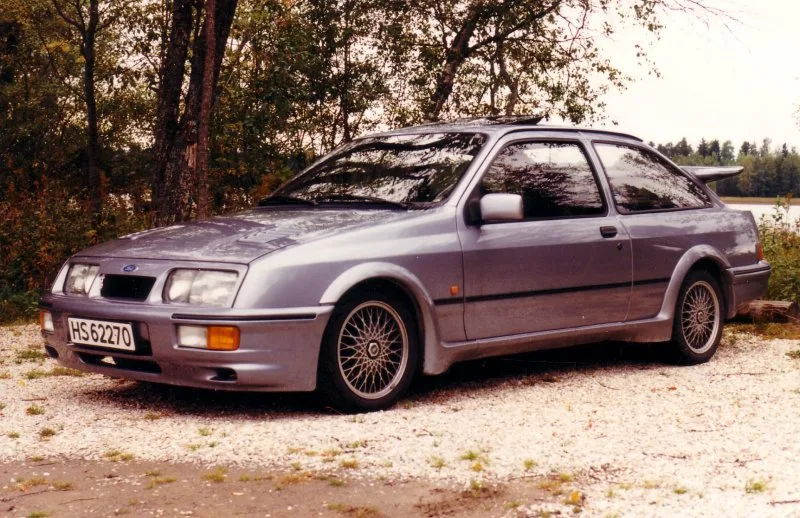
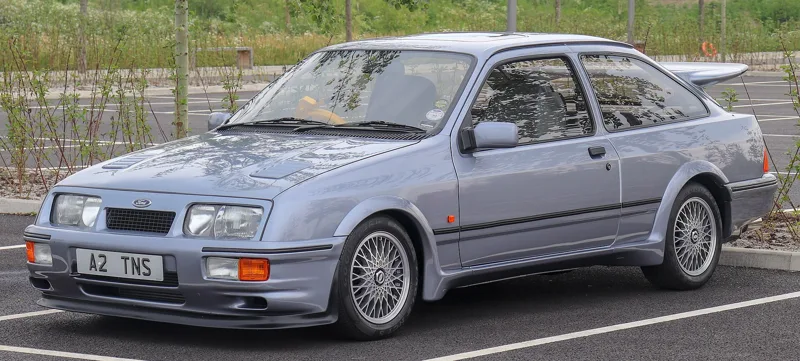
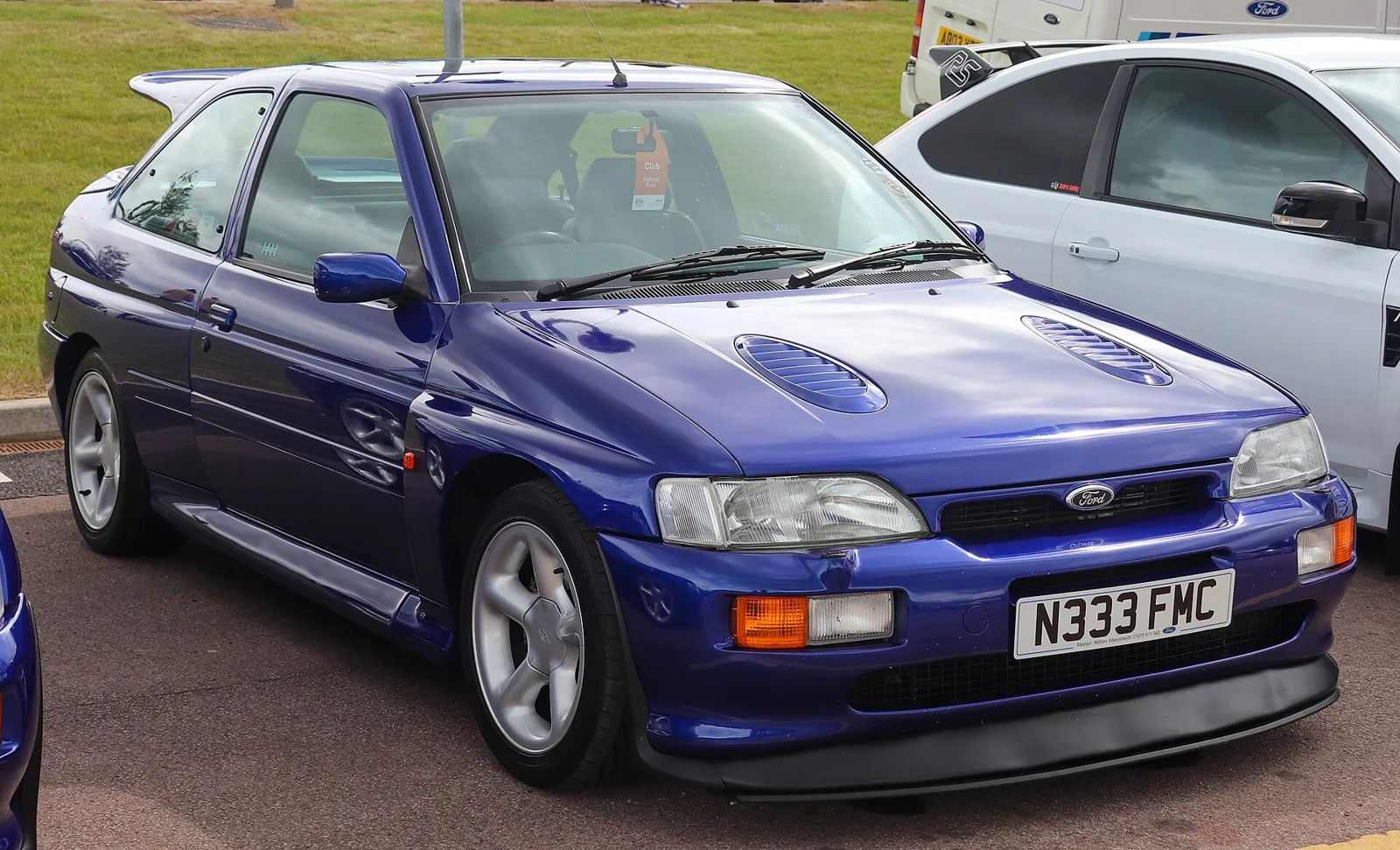
Only the front doors and the roof of a Ford Escort RS Cosworth are shared with the ordinary Mk 5 Escort it was dressed to resemble. Underneath sits the Sierra Cosworth's chassis and running gear, and the whole package was built for one purpose: to win the World Rally Championship.
What is the Ford Escort RS Cosworth?
It was Ford's homologation car for the fifth-generation European Escort, engineered so the model could be entered in Group A of the World Rally Championship, where it competed from 1993 to 1998. Customers could buy it on the road from 1992 until 1996. Its heart was a Cosworth YBT mounted lengthways, a turbocharged 2.0-litre (1,993 cc) inline-four that was easy to tune and produced 167 kW (227 PS) in standard trim, and no other Escort used it.
Enthusiasts call it a Cossie, as they did its Sierra predecessor. Ford built 7,145, from the first car on 19 February 1992 to the last on 12 January 1996. A third party brought a small number into the United States officially.
It was built to win the World Rally Championship, and while it never did, it won eight events as a Group A car.
What is a homologation special?
Think of it as a qualifying ticket. To enter a car in Group A, a maker had to gain FIA accreditation by building a fixed number of road cars. For the Escort RS Cosworth that number was 2,500. Ford completed these cars by 1 January 1993, and they were the large-turbo cars fitted with a Garrett T3/T04B hybrid turbocharger and an air-to-water intercooler.
Every one of those 2,500 also carried a water injection kit beneath the rear passenger seat. It did not work. It was there to show that the car had water injection capability under the Group A rules. Demand was high enough that the large-turbo car stayed on sale until June 1994, well past the point where the quota had been met.
Built on Sierra Cosworth bones
Ford's engineers designed the car around the chassis and running gear of the Sierra Cosworth so that it could hold the larger Cosworth engine and transmission, then covered it in Escort body panels. That route was needed because the standard Mk 5 Escort's floor pan began life front-wheel-drive only, although the four-wheel-drive RS2000 4x4 soon followed.
The project was steered by Ford SVO's Rod Mansfield and John Wheeler. Stephen Harper at MGA Developments in Coventry drew the styling in 1989, a year before the standard Escort went on sale, and MGA also designed the front and rear spoilers under Wheeler's oversight. John Bull and Mick Kelly looked after ride and handling. The coachbuilder Karmann made the body tooling and built the cars at its facility in Rheine, Germany.
Ford changed the engine management and fitted a new turbocharger. Permanent four-wheel drive, with 34 percent of the drive going to the front and 66 percent to the rear, came through an uprated five-speed gearbox like that of the Sierra Cosworth.
Ford Escort RS Cosworth performance
The YBT engine has a bore and stroke of 90.8 by 77 mm (3.57 by 3.03 in). Ford quoted 167 kW (224 bhp) at 6,250 rpm and 304 Nm (224 lbf ft) on 95 RON fuel at 3,500 rpm. Standard boost from the Garrett AiResearch turbocharger was 0.8 bar (12 psi), rising to 1.0 to 1.1 bar on overboost. The car reached 100 km/h in 5.7 seconds. Quoted top speed varies: 232 km/h (144 mph) by GPS, or 237 km/h (147 mph) if the large rear wing is left off, against a figure of 150 mph (240 km/h) elsewhere that placed it among rivals such as the Audi Coupe S2, BMW M3 and Nissan 300ZX, with the Toyota Supra and Porsche 968 also named, and comfortably clear of hot hatchbacks like the Golf GTI. Tuning companies have taken the engine beyond 746 kW (1,000 bhp).
The Lux weighed 1,310 kg (2,890 lb) and other versions 1,275 kg (2,811 lb). The aerokit earned a first: no mass-production car before it generated downforce at both front and rear. At 180 km/h (110 mph) the front produced 4.6 kg (45 Newtons) with the adjustable splitter in its middle position, and the rear 19.4 kg with the large wing.
Big turbo against small turbo
| Feature | Large turbo | Small turbo (YPT) |
|---|---|---|
| Production | Start to June 1994 | From June 1994 |
| Turbocharger | Garrett T3/T04B hybrid | Garrett T25 |
| Engine management | Weber-Marelli IAW P8 | Ford EEC IV |
| Ignition | Static, no distributor | One coil per cylinder |
| Cam and coil cover | Blue | Black and silver |
| Peak power | 167 kW (227 PS) | 5 PS (3 kW) lower |
Motorsport Base, Standard and Lux
Customers could choose from three road variants. The Motorsport Base was aimed at buyers who wanted a basic road car to prepare for rallying, and these were the first cars off the line. All were Diamond White with grey hexagon-pattern cloth seats. Air conditioning, fog lamps, central locking, the sunroof, the radio and electric windows, mirrors and boot release were all left out, along with rear headrests, underseal and some sound deadening, and the body was strengthened at the suspension mounts. The fuel pump access panel was riveted rather than welded, the VIN plate was stamped Motorsport, and kerb weight was 40 kg lower. All 2,500 homologation cars were Motorsport Base spec. Ford Motorsport also supplied 937 ready-prepared Shell 909 bodyshells with strengthening plates, seam welding and a roll cage.
The Standard was more civilised, with electric windows, a sunshine roof, central locking and a remote boot release. From 1994 the whale-tail spoiler could be deleted and airbags became available. The Lux added a CD player, air conditioning, an electric sunroof, heated mirrors, leather seats and a rear armrest. Switch blanks for heated seats were fitted, but the option was never offered with the Recaro seats. All the small-turbo cars are Standard or Lux.
Escort RS Cosworth special editions and build numbers
A UK Monte Carlo edition celebrated the 1994 Monte Carlo Rally win, in Ash Black, Mallard Green or Jewel Violet, with an estimated 200 built. Italy got 120 Miki Biasion cars in 1992, each with a numbered dashboard plaque, and a 1994 Motorsport Edition in ash black. The Martini Racing Edition was limited to 200. Only one of a planned 200 Acropolis Editions was built, a yellow car that marked Biasion's 1993 Acropolis Rally win. Japan received the Arrows F1 Escort with a remapped 195 kW (265 PS), though only an estimated ten of a planned 25 were made. Wolf Tuning in Germany offered a 300 PS version.
Build numbers fell year on year: 3,448 in 1992, 1,143 in 1993, 1,180 in 1994, 1,306 in 1995 and 68 in 1996. Production ended in early 1996 because the car could not meet new EU drive-by noise rules.
Escort RS Cosworth in the World Rally Championship
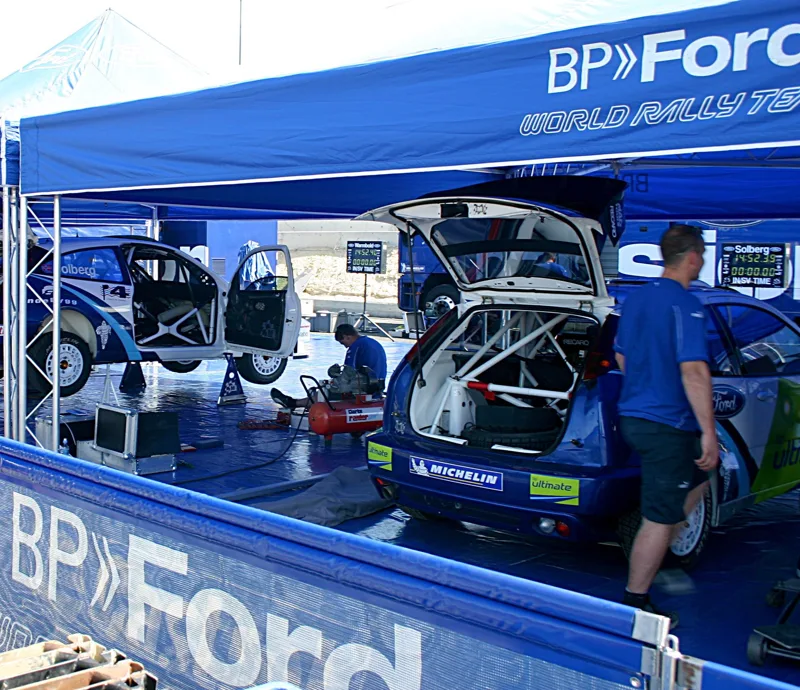
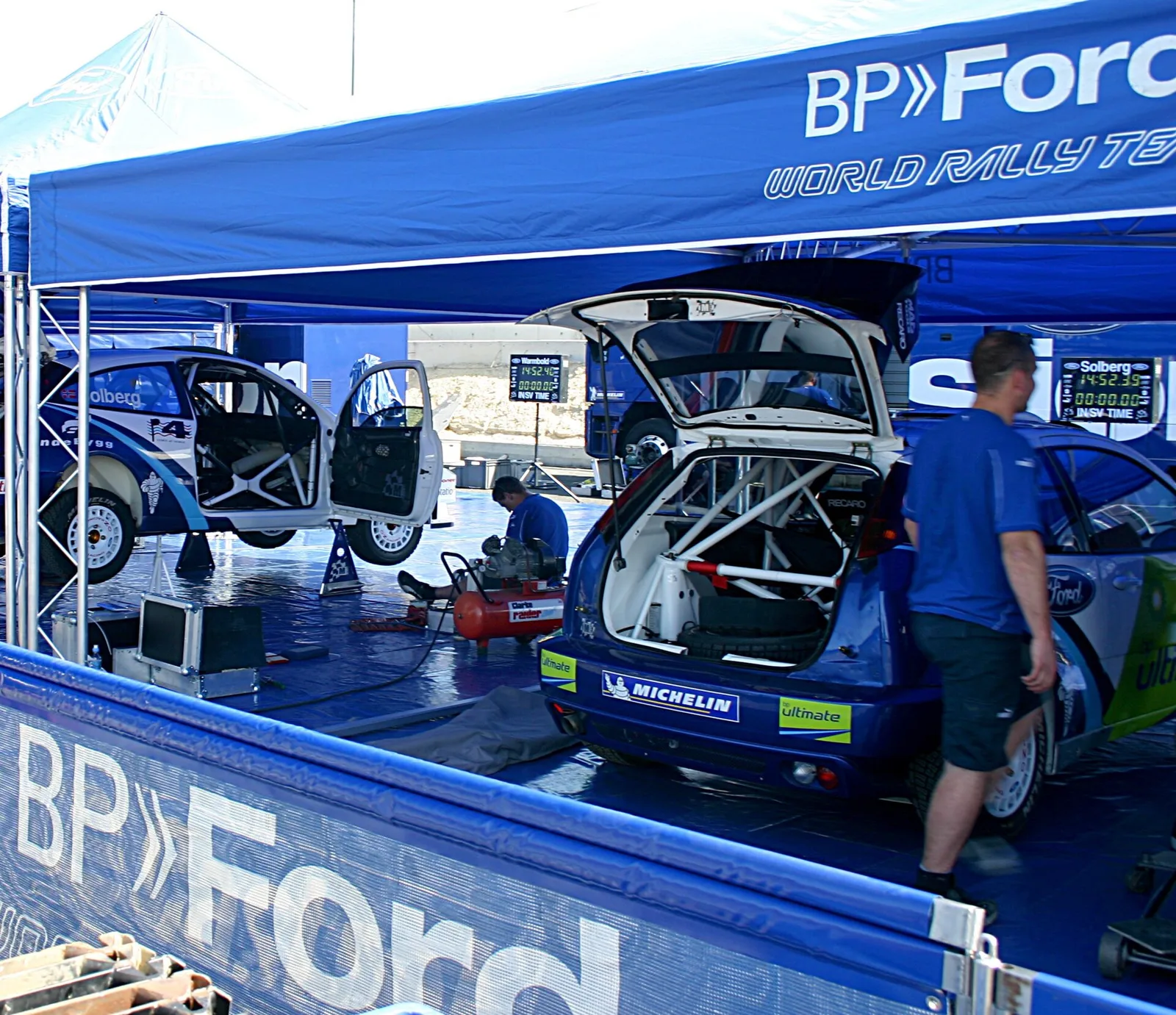
The car existed to win the championship. It fell short, though it took eight wins between 1993 and 1996 in Group A trim, plus two in 1997 as a World Rally Car, before the Focus RS WRC replaced it. The Ford Works Rally Team developed it from late 1990 to 1992. Jose Maria Bardolet gave it its first competitive win in the Spanish championship at the Rally Talavera in 1990. At the 1992 Scottish Rally, Malcolm Wilson, the lead development driver, ran faster stage times than the winner Colin McRae while not formally competing.
At its first World Championship outing, the 1993 Monte Carlo Rally, Francois Delecour led with Miki Biasion second until a late charge by Didier Auriol in a Toyota Celica won the event with the Fords second and third. Delecour then won in Portugal and Corsica, Biasion won in Greece, and the pair were first and second in the standings. Toyota's Juha Kankkunen took victories in Argentina, Finland and Australia, and Toyota took the manufacturers' title. At San Remo the privately entered Escort of Franco Cunico beat the works Lancia Delta Integrale of reigning champion Carlos Sainz, the first privateer win at that level in several years. Delecour won the penultimate round in Catalunya but lost the drivers' title to Kankkunen.
In 1994 Delecour won the Monte Carlo Rally, retired in Portugal and was injured in a road accident that cost him four rounds. Biasion left at the end of the season and never drove at championship level again. Guest drivers including Ari Vatanen, Bruno Thiry and Cunico filled in, and Tommi Makinen won the 1994 1000 Lakes Rally on a one-off drive.
The Ford Sierra under the Escort
The Sierra was launched in 1982 and built until 1993 by Ford of Europe, as a three- or five-door hatchback and an estate, with a van in 1984 and the Sapphire saloon from 1987. Uwe Bahnsen, Robert Lutz and Patrick Le Quement designed it. Its drag coefficient of 0.34 was a big step from the boxy outgoing Taunus and Cortina's 0.45, and the shape earned it the nickname jellymould. It went on sale on 15 October 1982, replacing the Taunus TC3 and Cortina Mark V.
Sales started slowly. Dealers were heavily discounting surplus Cortina stock, crosswind stability problems drew press attention until aerodynamic nolders were added in 1985, and the styling put off conservative buyers, including company car drivers. Still, in 1983 the Sierra sold nearly 160,000 in Britain, behind only the Escort. It was Britain's second best seller in 1983, 1988 and 1989, with its best year in 1989 at over 175,000, and still fifth in 1992. In West Germany it reportedly sold at treble the Taunus rate within months.
Underneath, the drivetrain was conservative, with rear-wheel drive and the Cortina's engines and transmissions, partly to reassure fleet buyers. The chassis was more advanced, with fully independent suspension. Magazine Auto Motor und Sport ranked it above the Volkswagen Passat and Opel Ascona in December 1982, and more than three decades later said no Ford had beaten a Volkswagen in its road tests since. The Sierra finished second behind the Audi 100 for 1983 European Car of the Year. The Sierra XR4x4 followed at Geneva in 1985, with two viscous differentials and two thirds of the drive going to the rear wheels, and the Mondeo replaced the Sierra in Europe in April 1993, with stock lasting about two years more.
What this means if you are buying an Escort RS Cosworth
The cam and coil cover colour is the quick tell: blue for the large-turbo cars, black and silver for the small-turbo YPT. The first 2,500 cars were all Motorsport Base, with a Motorsport VIN plate, no sunroof and no electrics, so a Standard or Lux car cannot be one of the homologation batch. Airbags and the option to delete the whale tail date from 1994, so they point to later cars. Tuned examples have exceeded 746 kW (1,000 bhp), so engine history matters. Special editions are scarce: 120 Biasion cars and one Acropolis.
Where this goes next
Ford replaced the Escort RS Cosworth in the World Rally Championship with the Focus RS WRC after 1997. Road-car production stopped in January 1996, and a total of 7,145 cars were built. The Sierra gave way to the Mondeo in Europe in April 1993.